Why Do Towels Feel Stiff After Air Drying? 10 Causes and Easy Fixes
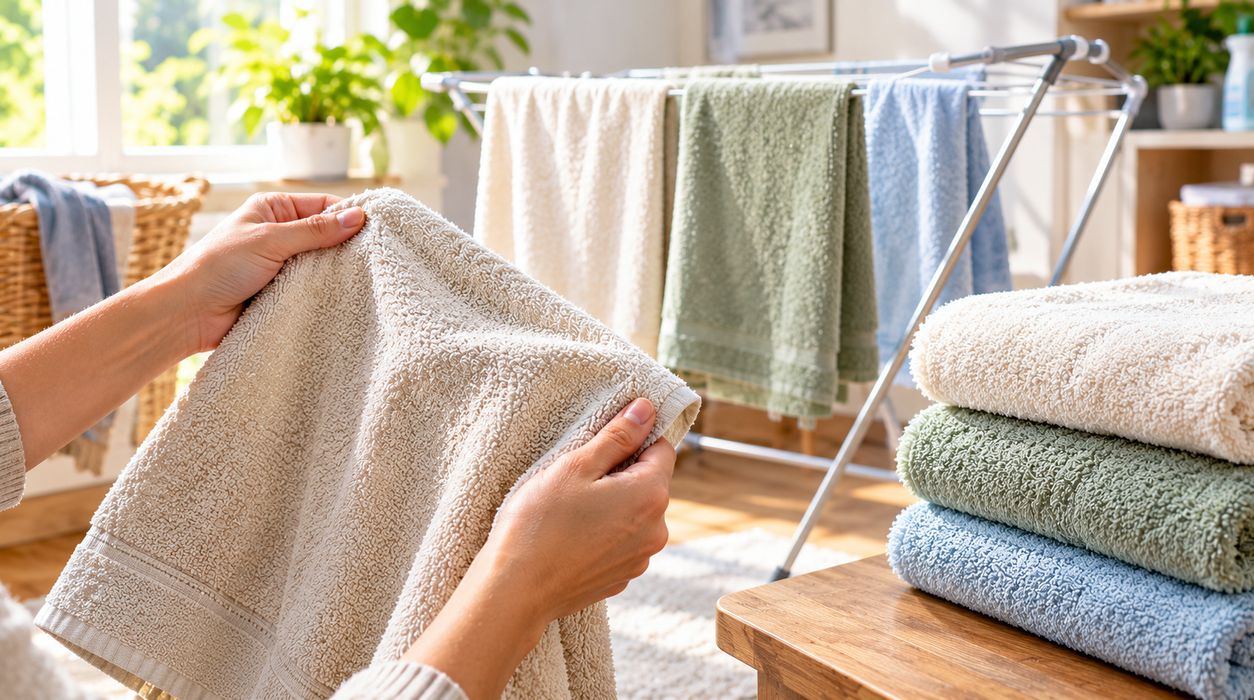
You wash your towels, hang them outside or on a drying rack, and wait for them to dry. They look clean and smell fresh, but when you take them down, they feel rough, crunchy, or almost like cardboard.
Meanwhile, the same towels often come out of a tumble dryer feeling fluffy and soft.
If you’ve wondered why towels feel stiff after air drying, the answer involves more than laundry detergent or water hardness. The way cotton fibers behave as moisture evaporates plays an important role.
In fact, scientific research has shown that naturally dried cotton can become stiff even when it is clean and free from detergent residue.
Fortunately, there are practical ways to make air-dried towels feel softer without relying on large amounts of fabric softener.
This guide explains ten reasons towels may feel stiff, how to identify the underlying problem, and the best ways to maintain softness while protecting absorbency.
Quick Answer: Why Do Towels Get Hard After Air Drying?
Cotton towels often become stiff during air drying because the fibers move closer together as water evaporates. A small amount of water remains associated with the cellulose fibers, contributing to hydrogen bonding that makes the fabric feel rigid.
Other factors can make stiffness worse, including:
- Detergent residue
- Hard-water minerals
- Excessive fabric softener buildup
- Overloaded washing machines
- Inadequate rinsing
- Limited movement during drying
- Excessive heat exposure
- Worn or flattened towel loops
- Improper washing routines
- Low-quality or damaged fabric
The easiest fix: Shake your towels firmly before hanging them, allow plenty of airflow, use the correct detergent amount, and shake them again once dry.
If your care labels permit it, a short tumble on an air-only or low-heat setting may also help loosen stiff fibers.
1. Cotton Fibers Naturally Become Stiff During Air Drying
The most important reason towels become crunchy after line drying is the natural behavior of cotton fibers.
Cotton is primarily made of cellulose, a material that interacts strongly with water.
When towels are washed, water enters and surrounds the fibers.
As the towel dries, the fibers move closer together, and interactions involving water and cellulose help hold them in a relatively rigid arrangement.
What Does Science Say?
Researchers from Hokkaido University and Kao Corporation studied why naturally dried cotton becomes stiff.
Their findings identified a special form of moisture called bound water on cotton fiber surfaces.
This bound water contributes to interactions between fibers that make dried cotton feel harder.
You can read the explanation in Hokkaido University’s research on why cotton towels become stiff after natural drying.
Does This Mean Your Towels Are Dirty?
Not necessarily.
Even thoroughly cleaned cotton towels can become stiff when they dry without much movement.
This explains why a towel can feel rough despite being freshly washed.
How to Fix It
Try gently flexing and shaking the towel before and after drying.
This movement can help loosen the stiff fiber structure.
2. Your Towels Are Drying Without Enough Movement
A tumble dryer continuously lifts, drops, and moves towels.
This mechanical action helps separate fibers and prevents them from remaining tightly packed.
When a towel hangs motionless on a clothesline, the fibers can settle into a firmer structure.
Why Movement Matters
As cotton dries, fiber-to-fiber interactions can make the towel feel rigid.
Mechanical movement can disrupt some of those interactions.
This is one reason a line-dried towel often becomes noticeably softer after being shaken or flexed.
How to Make Air-Dried Towels Softer
- Remove the towel from the washing machine.
- Hold it securely by two corners.
- Give it several firm but controlled shakes.
- Hang it with enough space for airflow.
- Turn or reposition it if drying is uneven.
- Shake it again after it has dried.
Avoid pulling aggressively on delicate or damaged towels.
Does Wind Help?
A breezy drying location may help towels move while drying.
However, the amount of softening varies depending on the towel, weather, and fabric construction.
3. Too Much Laundry Detergent Can Leave Residue
Using more detergent does not automatically produce cleaner towels.
When detergent is overdosed or rinsing is inadequate, residues may remain in the fabric.
These residues can affect the towel’s texture and performance.
Signs of Detergent Buildup
You may notice:
- Towels feeling unusually coated
- Visible detergent marks
- Excessive suds during washing
- Towels becoming stiff after every wash
- A strong fragrance despite poor cleaning
- Reduced comfort against the skin
How Much Detergent Should You Use?
Follow the detergent manufacturer’s instructions.
The correct dose depends on load size, water hardness, soil level, and detergent concentration.
High-efficiency washing machines generally require compatible HE detergent.
How to Remove Detergent Residue
If buildup is suspected:
- Wash the towels using the correct detergent dose.
- Avoid overloading the washer.
- Select a suitable rinse cycle.
- Use an extra rinse if needed.
- Dry the towels with adequate airflow.
Do not repeatedly reduce detergent below the recommended amount if doing so leaves towels inadequately cleaned.
4. Hard Water Can Make Towels Feel Rough
Hard water contains relatively high concentrations of dissolved minerals, especially calcium and magnesium.
These minerals can interfere with some cleaning processes and contribute to deposits or residue on fabrics.
How Does Hard Water Affect Towels?
Hard water may contribute to:
- A rough fabric texture
- Reduced cleaning effectiveness
- Mineral-related deposits
- Detergent performance problems
- Stiffness that persists across different drying methods
How Can You Tell If You Have Hard Water?
Possible clues include:
- White mineral deposits around faucets
- Scale buildup in kettles or fixtures
- Soap not lathering as expected
- Repeated laundry stiffness
However, these signs do not establish the exact hardness level.
A water-quality report or appropriate water test can provide more reliable information.
What Can You Do?
Choose detergent and dosing appropriate for your water conditions.
If hardness is substantial, a compatible laundry water-softening product may help.
The American Cleaning Institute’s laundry basics guide explains how hard-water minerals can affect washing and fabric texture.
5. Fabric Softener Buildup Can Affect Towel Performance
Fabric softener is designed to modify how fabric feels.
Some products can reduce friction between fibers or interfere with the bonding that contributes to cotton stiffness.
However, excessive use may leave a coating on towels.
Can Fabric Softener Reduce Absorbency?
Some softening treatments can affect how readily towel fibers absorb water, depending on the formulation, concentration, and fabric.
This is why towel manufacturers sometimes recommend limiting or avoiding fabric softener.
What Happens When You Use Too Much?
Possible issues include:
- Residue buildup
- A coated or slippery texture
- Reduced absorbency
- Inconsistent washing results
How to Soften Towels Without Fabric Softener
Try:
- Correct detergent dosing
- Effective rinsing
- Shaking towels before hanging
- Allowing airflow around the fabric
- A brief air-only tumble if permitted
These approaches focus on cleaning and fiber movement rather than applying additional softening products.
For related laundry troubleshooting, read Why Do Clothes Smell Musty After Washing?.
Internal link note: Confirm that this article is published at the indicated URL before using the link.
6. Overloading Your Washing Machine Prevents Effective Rinsing
Towels are thick and absorb substantial amounts of water.
A tightly packed washing machine may struggle to move, clean, and rinse them effectively.
Why Overloading Matters
When towels cannot circulate properly, some areas may retain detergent or soil.
The machine may also struggle to extract water evenly.
Signs Your Washer Is Too Full
- Towels remain tightly compressed.
- Laundry feels unevenly washed.
- Residue remains after rinsing.
- Towels are unusually wet after spinning.
- Some towels feel rougher than others.
How to Fix It
Follow your washer manufacturer’s load capacity instructions.
Do not judge capacity solely by how many towels fit into the drum.
Leave enough space for the machine to operate as designed.
For particularly heavy bath towels, smaller loads may improve washing consistency.
7. Inadequate Rinsing Leaves Laundry Products Behind
Even with the correct detergent amount, some washing conditions can result in poor rinsing.
Possible contributors include:
- An overloaded drum
- An unsuitable wash cycle
- Excessive detergent
- Improper product dispensing
- Washer maintenance issues
Should You Use an Extra Rinse?
An extra rinse may help when detergent or softener residue is suspected.
However, it is not necessary for every load.
Using additional water without a clear need can increase water consumption.
How to Check Whether Rinsing Is the Problem
Wash a small load using the recommended detergent amount.
If the towels feel noticeably better after an additional rinse, residue may have contributed to the problem.
Remember that normal cotton stiffness can still occur after air drying, even when rinsing is effective.
8. Excessive Sunlight and Heat May Affect Towel Texture
Outdoor drying is convenient and can reduce electricity use.
However, long exposure to intense sunlight and high temperatures can affect certain fabrics and dyes over time.
Does Sunlight Make Towels Stiff?
Sunlight is not the fundamental cause of normal cotton air-drying stiffness.
The fiber interactions that produce stiffness can occur indoors or outdoors.
However, harsh drying conditions may affect the fabric’s feel or contribute to wear over repeated cycles.
How to Dry Towels Outside
- Follow the care label.
- Choose a location with good airflow.
- Avoid unnecessary prolonged exposure after drying.
- Shake towels before hanging.
- Remove them once fully dry.
A lightly shaded, breezy location may be useful when strong sunlight could affect the fabric.
Is Indoor Air Drying Better?
It depends on indoor humidity and ventilation.
If towels dry very slowly indoors, they may develop unpleasant odors.
The ideal location allows complete drying without excessive delay.
9. Old Towels Can Lose Their Original Softness
Towels experience friction, washing, drying, and repeated use.
Over time, their loops may flatten, break, or become worn.
This can change their texture.
Signs a Towel Is Wearing Out
Look for:
- Thin patches
- Frayed edges
- Flattened loops
- Reduced absorbency
- Rough areas that do not improve after washing
- Visible fabric damage
Can You Restore an Old Towel?
You may improve its feel by removing residue and changing drying methods.
However, you cannot fully restore fibers that have physically worn away.
When Should You Replace Towels?
There is no universal replacement schedule.
Consider replacing a towel when it is damaged, no longer cleans or dries effectively, or remains uncomfortable despite appropriate care.
10. Your Towel’s Fabric Construction Affects Softness
Not all towels are manufactured in the same way.
Differences in fiber quality, yarn structure, loop height, density, and finishing can influence softness.
Why Some Towels Feel Fluffier
Thick towels with lofty loops may initially feel more plush.
However, heavier towels can also take longer to dry.
Are Expensive Towels Always Softer?
No.
Price alone does not guarantee softness, absorbency, or durability.
A well-made midpriced towel may perform better than an expensive towel that is poorly suited to your needs.
Does Cotton Type Matter?
Different cotton fibers and yarn constructions can influence the final texture.
However, everyday washing and drying practices still play a major role.
For more clothing and textile-care topics, explore Grandloopy’s Fashion section.
How to Make Air-Dried Towels Soft Again: Step-by-Step
If your towels have become stiff, try this simple recovery routine.
Step 1: Check the Care Label
Confirm the recommended washing temperature, drying method, and product restrictions.
Step 2: Inspect the Towels
Look for detergent residue, fabric softener buildup, worn loops, or other signs of damage.
Step 3: Wash a Manageable Load
Avoid packing too many towels into the washer.
Step 4: Measure Detergent Correctly
Use the amount appropriate for your water hardness, load size, and soil level.
Step 5: Rinse Effectively
If residue is suspected, consider an extra rinse.
Step 6: Shake Each Towel
Give the towel several controlled shakes to help separate its fibers.
Step 7: Hang With Space Between Towels
Avoid overlapping thick sections.
Step 8: Choose Good Airflow
A breezy or well-ventilated location can improve drying.
Step 9: Shake Again After Drying
Flex the towel gently to reduce its rigid feel.
Step 10: Use Brief Mechanical Tumbling if Appropriate
If you have access to a dryer and the care label permits it, a short air-only or low-heat cycle may improve softness.
You do not necessarily need to complete the entire drying process in a tumble dryer.
Can You Make Towels Soft Without a Dryer?
Yes, although line-dried towels may not achieve exactly the same fluffy texture as tumble-dried towels.
The goal is to improve softness while retaining the advantages of air drying.
Best Dryer-Free Methods
Shake before hanging. This helps loosen and separate the fabric.
Use adequate spacing. Allow air to circulate around each towel.
Avoid excessive detergent. Prevent unnecessary residue.
Rinse properly. Remove laundry products effectively.
Choose suitable drying conditions. Avoid prolonged dampness and unnecessary heat exposure.
Flex the towel after drying. Gentle movement can make rigid fibers feel more flexible.
Why Do Towels Feel Crunchy but Still Smell Clean?
A crunchy texture does not necessarily mean that the towel is dirty.
Clean cotton can naturally become stiff during drying.
Researchers have examined how bound water and hydrogen bonding contribute to this effect.
A peer-reviewed study, Elucidation of Softening Mechanism in Rinse Cycle Fabric Softeners, discusses the relationship between cotton fiber bonding and fabric stiffness.
How to Tell Normal Stiffness From Residue
Normal air-drying stiffness is more likely when:
- The towel feels softer after shaking.
- The same towel feels fluffy after tumble drying.
- There is no unusual coating or residue.
- The towel remains absorbent.
Residue may be more likely when:
- The towel feels slippery or coated.
- Visible detergent remains.
- The towel rinses poorly.
- The stiffness persists regardless of drying method.
These are practical clues rather than definitive tests.
Does Vinegar Make Towels Softer?
White vinegar is often suggested as a home remedy for stiff towels.
However, it is not a guaranteed solution and may not be suitable for every washing machine or fabric.
What Should You Know Before Using Vinegar?
Vinegar is acidic and may interact with certain residues.
But it does not eliminate the natural fiber interactions responsible for all air-drying stiffness.
Some manufacturers discourage its use in their appliances.
Always check the washer manual and towel care instructions.
Never mix vinegar with chlorine bleach.
Is Baking Soda Better?
Baking soda is also commonly suggested for laundry care.
However, it is not a universal towel softener.
Its effectiveness depends on the actual problem.
Correct washing, rinsing, and drying methods should come first.
Does Fabric Softener Actually Make Towels Softer?
Fabric softeners can change the way cotton fibers interact, potentially making towels feel smoother.
Scientific studies have investigated these mechanisms, including the effects of bound water and fiber bonding.
However, fabric softener is not necessary for every towel or every wash.
Should You Stop Using Fabric Softener?
If your towels are losing absorbency or developing residue, reducing or temporarily eliminating softener may help.
Follow the towel manufacturer’s recommendations.
What About Dryer Sheets?
Dryer sheets can deposit softening ingredients on fabrics.
Their suitability depends on the product and towel type.
Avoid assuming that adding more softening product will solve every texture problem.
How to Keep Towels Soft and Absorbent
Softness and absorbency are both important.
A towel that feels luxurious but does not absorb water effectively may be frustrating to use.
Wash Towels Properly
Choose a suitable cycle and temperature.
Use enough detergent to clean the load without overdosing.
Avoid Unnecessary Coatings
Follow care instructions for fabric softeners and specialty laundry products.
Dry Completely
Do not store towels while damp.
Maintain Towel Loops
Avoid snagging towels on rough objects.
Do not use excessively aggressive cleaning methods.
Address Odors Promptly
If towels smell sour or musty, investigate moisture, washing effectiveness, and machine cleanliness.
For related home maintenance advice, see Grandloopy’s Blog section.
Why Do Some Towels Stay Soft While Others Get Hard?
Two towels washed in the same machine may dry differently.
Possible explanations include:
- Different fiber compositions
- Different yarn constructions
- Different fabric finishes
- Previous softener treatments
- Different levels of wear
- Differences in detergent residue
- Different drying positions
Does Thickness Affect Drying?
Thicker towels often retain more water and may take longer to dry.
However, thickness alone does not determine final softness.
Does Towel Age Matter?
Yes.
Repeated use and laundering can change fiber structure and texture.
But even new cotton towels may become stiff after air drying.
Common Mistakes That Make Towels Stiffer
Mistake 1: Using More Detergent Than Necessary
Excess detergent may leave residue.
Mistake 2: Overloading the Washer
Crowded loads can reduce washing and rinsing effectiveness.
Mistake 3: Assuming Every Stiff Towel Is Dirty
Normal cotton fiber interactions can produce stiffness.
Mistake 4: Using Too Much Fabric Softener
Buildup may affect texture and absorbency.
Mistake 5: Hanging Towels Without Shaking Them
A little movement before drying may improve the final feel.
Mistake 6: Leaving Towels Outside Longer Than Necessary
Unnecessary exposure may contribute to wear or fading.
Mistake 7: Ignoring Hard Water
Mineral-related laundry problems may require adjustments to detergent and washing methods.
Mistake 8: Using Unapproved Home Remedies
Vinegar, strong chemicals, or excessive heat may damage certain materials or appliances.
Frequently Asked Questions
Why do towels feel stiff after air drying?
Cotton fibers can form a rigid structure during natural drying through interactions involving bound water and hydrogen bonding. Residue and water hardness may also contribute.
How do you soften towels without a dryer?
Shake them before hanging, allow good airflow, rinse properly, and flex them after drying.
Why are towels soft from the dryer but hard from the clothesline?
Tumble dryers move and separate fibers while drying, whereas line-dried towels remain relatively motionless.
Does too much detergent make towels hard?
It can. Excess detergent may leave residue that affects texture and rinsing.
Can hard water make towels stiff?
Yes. Hard-water minerals can interfere with washing and contribute to fabric residue.
Should I use fabric softener on towels?
Follow the towel manufacturer’s recommendations. Some softening products may affect absorbency or leave buildup.
Does shaking towels make them softer?
It can help by loosening the rigid fiber structure that forms during drying.
Is sunlight responsible for crunchy towels?
Not by itself. Cotton can become stiff during natural drying indoors or outdoors.
Can old towels become soft again?
Sometimes their feel can improve through proper washing and drying, but physically worn fibers cannot be fully restored.
Are stiff air-dried towels still clean?
They can be. Stiffness alone does not establish whether a towel is clean or dirty.
Final Thoughts
If you’re wondering why towels feel stiff after air drying, the main explanation is the natural behavior of cotton fibers as water evaporates.
Scientific research shows that bound water and interactions between cellulose fibers contribute to the rigid texture many people notice after line drying.
Detergent residue, hard water, fabric softener buildup, and poor rinsing can make the problem worse.
The best approach is to wash towels correctly, avoid unnecessary buildup, shake them before and after hanging, and provide adequate airflow.
You do not need to rely on excessive fabric softener or harsh cleaning chemicals.
With a few simple adjustments, you can enjoy cleaner, more comfortable towels while continuing to save energy through air drying.

Ryan Mitchell is a passionate writer and digital content creator dedicated to sharing insightful, engaging, and informative articles across multiple niches. With a strong interest in technology, lifestyle, trending topics, and online media, Ryan Mitchell focuses on delivering well-researched and reader-friendly content that inspires and informs audiences worldwide.