

Many people get confused between discard and disgard because the words look similar.
In reality, only discard is the correct English spelling, while disgard is a common misspelling.
In this guide, you’ll learn the correct spelling, meaning, pronunciation, and proper usage of discard.
We’ll also share easy examples to help you avoid this spelling mistake in everyday writing.
Discard vs Disgard: The Quick Answer
Discard is the correct spelling. “Disgard” is not a real English word, no matter how natural it looks on the page. Discard means to get rid of something you no longer need or want, like an old receipt, a bad habit, or a losing card in a game. If you remember one thing from this article, remember this: always spell it with a C, never a G.
What Does “Discard” Mean?
At its core, discard means to throw away, dispose of, or reject something. It works as both a verb and a noun.
As a verb, it describes the act of getting rid of something:
- She decided to discard the broken umbrella.
- Please discard any expired coupons.
As a noun, it refers to the thing being thrown away:
- The discard pile grew taller by the minute.
Simple, direct, and useful in daily conversation, business writing, and even card games. That last part actually matters more than you might think, and we will get to it shortly.
Click Here To Read another Topic
Why Do People Write “Disgard” Instead?
Here is the honest reason: English pronunciation tricks us constantly. The letter C in “discard” makes a hard K sound, similar to how G sounds in words like “guard” or “regard.” Since “regard” and “discard” rhyme and share a similar structure, your brain quietly swaps the C for a G without asking permission.
Add in fast typing, autocorrect fatigue, and the fact that nobody actually says the word out loud while spelling it, and you get a very common typo that spreads across emails, essays, and social media posts.
Is “Disgard” a Word at All?
No. Disgard has no listing in any standard English dictionary, including Merriam Webster, Oxford, or Cambridge. It is not a regional variant, an old spelling, or a British versus American difference. It is simply a misspelling, plain and consistent across every major English dialect.
If you search for “disgard” online, most results either correct you or lead you straight back to “discard.” That alone should settle the debate, but let’s dig a little deeper for the readers who like proof.
Discard vs Disgard: Quick Comparison Table
| Feature | Discard | Disgard |
| Correct spelling | Yes | No |
| Found in dictionaries | Yes | No |
| Part of speech | Verb, Noun | Not applicable |
| Common usage | Everyday English, gaming, writing | Only as a typing error |
| Origin | Old French “descarter” | No origin, invented misspelling |
This table alone answers most search queries in under ten seconds, which is exactly the point.
Where Did the Word “Discard” Come From?
Discard has an interesting backstory rooted in card games, not scripture or ancient texts. It comes from the old French word descarter, which combined des (meaning away) with carte (meaning card). Literally, it meant to throw a card away.
The word entered English in the late 1500s and quickly expanded beyond card tables into everyday use, covering anything a person wanted to remove, reject, or dispose of. So while there is no biblical reference tied to “discard,” its history is still colorful, dating back centuries to gamblers clearing their hands during a match.
How to Use “Discard” in a Sentence
Seeing the word in real context helps the correct spelling stick permanently. Here are practical examples across different situations:
- At home: “We need to discard these old paint cans before the inspection.”
- At work: “The manager asked us to discard outdated client files.”
- In gaming: “You must discard one card before drawing another.”
- In writing: “The author chose to discard the first three chapters and start fresh.”
Notice how the word fits naturally into casual speech, professional settings, and hobbies alike. That flexibility is part of why it shows up so often in daily English.
Common Mistakes People Make With “Discard”
Beyond the classic “disgard” typo, a few other slip ups tend to appear:
- Writing “descard,” influenced by the French root
- Confusing it with “discharge,” which means something different entirely
- Using “disgarded” as a past tense form instead of the correct discarded
Keeping an eye on these variations helps you avoid embarrassing mistakes in resumes, emails, or published content, where spelling errors can quietly damage credibility.
Discard vs Discharge vs Disregard: Don’t Mix These Up
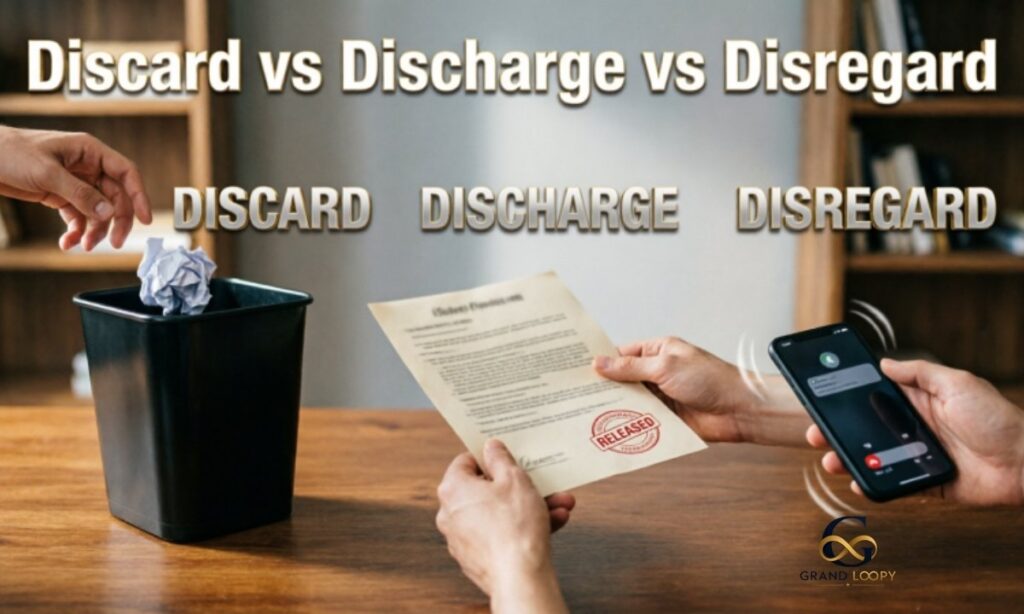
Since these three words share similar beginnings, people often blur their meanings together.
- Discard means to throw away or get rid of something.
- Discharge means to release, dismiss, or let something out, like discharging a patient from a hospital.
- Disregard means to ignore or pay no attention to something.
Here is a quick example to show the difference clearly:
“He decided to discard the old paperwork, disregard the outdated instructions, and discharge his duties for the day.”
Three different meanings, three different jobs, and now hopefully three words you will never confuse again.
Which One Should You Use?
There is no real debate here. Always use “discard.” “Disgard” is not an alternate spelling, not a British variation, and not acceptable in formal or informal writing. If you are ever unsure while typing quickly, slow down for a second and picture a playing card being tossed aside. That mental image alone can help the correct spelling click into place.
Simple Tricks to Remember the Correct Spelling
A few memory tricks that readers have found genuinely useful:
- Think of the word “card” hiding inside “discard.” You discard a card, not a “gard.”
- Remember that “regard” and “discard” rhyme and both use a C sound spelled with C, not G.
- If your keyboard suggests “disgard,” trust the dictionary over your instincts.
Small mental shortcuts like these tend to stick far longer than simply memorizing a rule.
FAQ Section
Is disgard ever correct in British English?
No. British English and American English both agree on this one. The correct spelling everywhere is discard, with no regional exception.
What is the past tense of discard?
The past tense is discarded. For example, “She discarded the invitation after the event was cancelled.”
Can discard be used as a noun?
Yes. A discard can refer to the item being thrown away, such as in card games where a discard pile collects unwanted cards during play.
Final Thoughts
Spelling confusion happens to everyone, especially with words where pronunciation plays tricks on logic. The takeaway here is refreshingly simple: discard is correct, disgard is not, and now you have the history, examples, and memory tricks to make sure this mistake never sneaks into your writing again.
Next time you need to toss something aside, whether it is an old card, a bad habit, or a wrong spelling, you will know exactly which word to reach for.