

Ever typed “totaling” into an email, stared at it, and thought it looked wrong? Then you tried “totalling” and that looked wrong too. This tiny word causes real confusion because two spellings exist, both are correct, and neither one is a typo. The truth is simple: totaling is the American English spelling, and totalling is the British English spelling. Once you know which country’s rules you’re writing for, the confusion disappears completely.
Totaling or Totalling: The Quick Answer
If you’re writing for a US audience, use totaling with one “L.”
If you’re writing for a UK, Australian, or Canadian audience, use totalling with two “L’s.”
Both words mean the same thing: adding numbers together or reaching a final amount. The spelling difference is purely regional, not grammatical. Google’s own results confirm this, but most explanations stop there without telling you why the split happened in the first place. We’re going deeper.
What Does “Totaling” Actually Mean?

“Totaling” (or “totalling”) is the present participle of the verb “total.” It describes the act of adding numbers to reach a sum, or the state of amounting to a specific figure.
For example:
- The invoice is totaling $4,200 this month.
- Damages from the storm are totalling over two million dollars.
In both sentences, the word points to a final number being calculated or reached. Simple enough. The spelling is where things get interesting.
Click Here To Read More Grammar
American English vs British English: Why Two Spellings Exist
This isn’t a random inconsistency. It traces back to one man: Noah Webster.
In the early 1800s, Webster wrote his own American dictionary and intentionally simplified British spellings to make American English more efficient and distinct. He dropped extra letters wherever he felt they didn’t change pronunciation. Words like “colour” became “color,” “travelling” became “traveling,” and “totalling” became “totaling.”
British English kept the older, more traditional double consonant pattern. So when you see “totalling” with two L’s, you’re actually looking at the original, older spelling. American English is the one that changed.
The Simple Grammar Rule Behind the Single vs Double “L”
Here’s the rule that explains almost every version of this confusion, not just this one word.
British English rule: When a verb ends in a single vowel plus a single consonant (like the “l” in “total”), the final consonant is doubled before adding “-ing” or “-ed,” even if the syllable isn’t stressed.
American English rule: The final consonant is only doubled if the last syllable is stressed. Since “TO-tal” stresses the first syllable, American English does not double the “L.”
That’s it. That’s the entire logic. Once this clicks, you’ll never second-guess “totaling” or “totalling” again, and you’ll also understand similar pairs like “cancelling/canceling” and “modelling/modeling.”
Totaling or Totalling: Quick Comparison Table
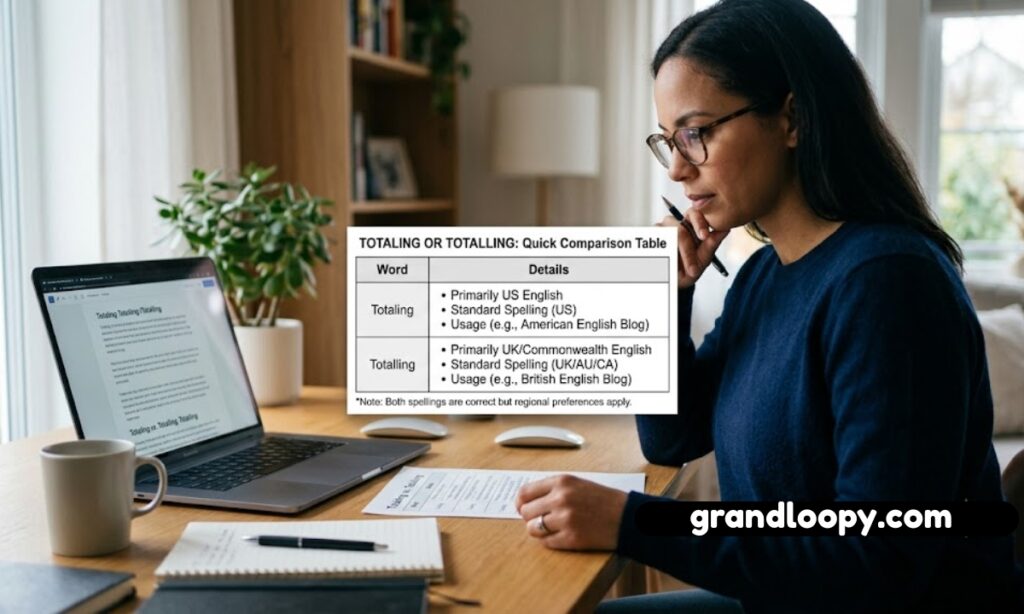
| Feature | Totaling | Totalling |
| Region | American English | British English |
| Consonant Rule | Single “L” | Double “L” |
| Common In | US, and often Canada | UK, Australia, India |
| Root Word | Total | Total |
| Meaning | Same | Same |
| Example | Totaling $500 | Totalling £500 |
Both spellings appear in reputable dictionaries. Neither is “more correct.” They’re just built for different audiences.
Real-Life Examples of “Totaling” in a Sentence
Since this is the American spelling, you’ll see it constantly in US business writing, news reports, and everyday conversation.
- Her monthly expenses are totaling close to $1,800.
- The company reported sales totaling $3.4 million last quarter.
- After the accident, repair costs came totaling $6,000.
- Votes are still totaling in three counties.
Notice how the word almost always sits right before a number or amount. That’s your biggest clue about how to use it naturally.
Real-Life Examples of “Totalling” in a Sentence
If you’re writing for a British, Australian, or Indian audience, this is the spelling readers expect.
- The charity raised funds totalling £12,000 in a single weekend.
- Losses from the flooding are totalling millions across the region.
- His debts were totalling more than he could manage.
- The survey collected responses totalling nearly 10,000 entries.
Swap “totaling” for “totalling” here and nothing about the meaning changes, only the region the reader expects it from.
Historical Origin of the Word “Total”

The word “total” itself comes from the Latin word “totus,” meaning “whole” or “entire.” It moved into Old French as “total” before entering English in the 1400s with the same meaning it has today, a complete amount.
Interestingly, older biblical and historical English texts often used phrases like “the sum total” or “in total” long before the verb form “totaling” or “totalling” became common. The verb form (using “total” as an action, like totaling numbers) only became widely used in accounting and record keeping during the 1700s and 1800s, right around the time American and British spelling started drifting apart. That timing is exactly why this word became one of the clearest examples of the US versus UK spelling split.
Common Mistakes People Make With This Word
Most mistakes with this word aren’t really about grammar. They’re about mixing regional rules without realizing it.
- Writing “totalling” in a US business report when the style guide expects American spelling.
- Using “totaling” in British academic papers submitted to UK universities, which often get flagged by editors.
- Assuming one spelling is “wrong” instead of understanding it’s regional.
- Mixing both spellings in the same document, which looks inconsistent even if each version is technically correct.
- Confusing “total” (the base verb) with “totally,” which is a completely different word meaning “completely” or “entirely.”
The real fix isn’t memorizing a trick. It’s knowing your audience before you write a single sentence.
Which One Should You Use?
Ask yourself one question: who is reading this?
- Writing for US readers, American clients, or US-based platforms? Use totaling.
- Writing for UK, Australian, or international English audiences? Use totalling.
- Writing for a global audience with no clear region? Pick one spelling and stay consistent throughout the entire piece. Consistency matters more than which version you choose.
If you’re using spell check or grammar tools, set your language preference to either “English (US)” or “English (UK)” first. That single setting will catch almost every mismatch automatically.
Related Words That Follow the Same Rule
Once you understand “totaling” versus “totalling,” you can predict dozens of similar word pairs without looking them up.
- Cancelling (UK) vs Canceling (US)
- Modelling (UK) vs Modeling (US)
- Travelling (UK) vs Traveling (US)
- Labelling (UK) vs Labeling (US)
- Fuelling (UK) vs Fueling (US)
Notice the pattern? Every single one follows the exact same doubled consonant logic explained earlier. Learn the rule once, and you’ve basically learned twenty words at the same time.
FAQs About Totaling or Totalling
Is “totalling” a real word?
Yes. “Totalling” is a fully recognized, dictionary correct spelling used in British English and other Commonwealth English variations. It is not a misspelling.
Is “totaling” grammatically incorrect in British English?
It’s not grammatically incorrect, but it would look out of place. British style guides, publishers, and editors generally expect “totalling” with two L’s for formal and academic writing.
Which spelling does Microsoft Word or Google Docs prefer?
That depends entirely on your language setting. If your document is set to English (US), “totaling” will be marked correct and “totalling” may show a red underline, and vice versa for English (UK).
Final Takeaway
“Totaling” and “totalling“ aren’t competing for the title of correct. They’re simply speaking two different dialects of the same language.
Pick American or British spelling based on your audience, stay consistent within your document, and this tiny grammar debate stops being confusing for good.