


You typed “13rd” into a document, paused, and thought, “wait, does that look right?” It doesn’t. Your eyes caught something your brain almost missed. Autocorrect didn’t flag it, your coworker didn’t notice it, but you did, and now you need the real answer, fast.
The correct form is always “13th,” never “13rd.” English ordinal numbers don’t follow a simple pattern based on the last digit alone, and 13 is one of the numbers people trip over most. Below, you’ll get the rule, the reason, and enough examples that you’ll never second guess it again.
What Is the Correct Ordinal Form: 13th or 13rd?
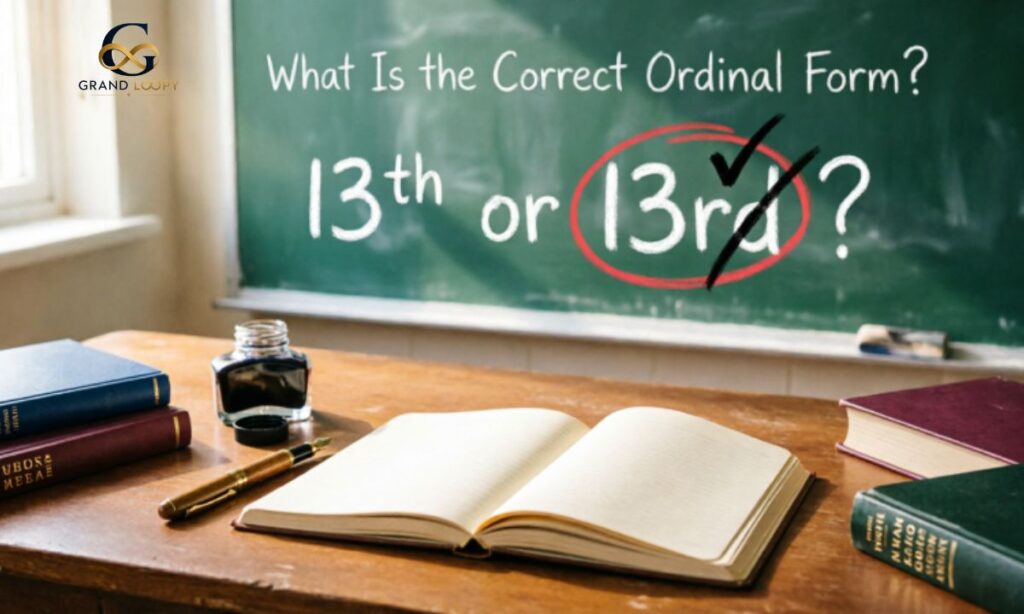
“13th” is correct. “13rd” is a spelling mistake, plain and simple.
Ordinal numbers show position or order (first, second, third, and so on). For the number 13, English always uses “th,” giving you “13th,” pronounced “thirteenth.”
There’s no version of this rule where “13rd” becomes acceptable, not in casual writing, not in formal writing, not in texting your boss.
Click Here To Read More Like this
Why Do People Think “13rd” Is Correct?
Most people who write “13rd” aren’t careless. They’re pattern matching, and English just betrayed them.
Numbers ending in 3 usually take “rd”: third, 23rd, 33rd, 43rd. So the brain sees “13” ending in 3 and assumes the same rule applies. It’s a reasonable guess. It’s also wrong.
This mix up happens constantly with birthdays, anniversaries, and dates on invitations, which is exactly where a typo gets noticed the most.
Why Doesn’t 13 Follow the “Third” Pattern?
Here’s the part almost no other article explains clearly: the teens (11, 12, 13) are exceptions to the last-digit rule, and they’ve been exceptions for centuries.
The rule most people learn is:
- Numbers ending in 1 use “st” (1st, 21st, 31st)
- Numbers ending in 2 use “nd” (2nd, 22nd, 32nd)
- Numbers ending in 3 use “rd” (3rd, 23rd, 33rd)
- Everything else uses “th”
But 11, 12, and 13 break that pattern on purpose. They always take “th,” no matter what. So you get 11th, 12th, and 13th, even though 11 ends in 1, 12 ends in 2, and 13 ends in 3.
Once you see the teens as their own separate group, the confusion disappears for good.
Where Did This Rule Come From?
This isn’t a modern grammar committee decision. It traces back to Old English number formation, where the teens (called “teen” numbers because they come from the Old English “tien,” meaning ten) were treated as a distinct set from the tens that follow.
Old English speakers built numbers like thirteen from “three and ten,” and the ordinal forms grew out of that same compound structure rather than the simple last-digit pattern used later for 21, 22, 23, and beyond.
That’s why the teens still feel like their own island in modern English. They were built differently from the start, long before anyone worried about spelling “23rd” correctly.
Historical and Religious Uses of “13th”

The number 13 shows up often in religious, historical, and cultural texts, and it’s always written as “13th” or spelled out as “thirteenth.”
In Christian tradition, the Last Supper is frequently referenced alongside the number thirteen, since thirteen people were present, Jesus and his twelve disciples. Historical accounts describing this event use “thirteenth” when referring to related dates or rankings, never “thirteenth” spelled with “rd.”
You’ll also see “13th” used constantly in:
- The 13th Amendment to the U.S. Constitution, which abolished slavery
- References to the “13th century” in history books
- The “13th” chapter or verse in religious and literary texts
Every single one of these uses “th.” That consistency across centuries of writing is a strong signal that “13rd” was never correct, in any era.
13rd vs 13th: Quick Comparison Table
| Form | Correct? | Why |
| 13th | Yes | Teens (11, 12, 13) always use “th” |
| 13rd | No | Confuses the “3 ends in rd” rule with the teen exception |
| Thirteenth | Yes | Correct spelled-out version |
| Thirteenrd | No | Not a real word in any context |
Keep this table in your back pocket. It’s the fastest gut check when you’re typing fast and your brain starts second guessing itself.
Real-Life Examples of “13th” Used Correctly
Seeing the word in context makes it stick better than any rule ever will.
- “Her birthday falls on the 13th of March.”
- “We’re meeting on the 13th floor, not the 14th.”
- “He finished 13th out of 40 runners in the race.”
- “The event starts on June 13th at 6 p.m.”
- “This is the 13th time I’ve explained this rule this month” (said every teacher, ever).
Notice the pattern? “Th” fits naturally into a sentence without making the reader pause. “13rd” would stop a reader cold, like hitting a speed bump they didn’t see coming.
Common Mistakes People Make With “13th”
Beyond writing “13rd,” a few other slip ups show up regularly.
- Writing “13nd” or “13st”: This happens less often, but it’s the same root problem, applying the wrong suffix pattern to a teen number.
- Mixing formats in one document: Writing “13th” in one paragraph and “13rd” in another. Consistency matters, especially in formal writing or business documents.
- Autocorrect blind spots: Many spellcheck tools won’t catch “13rd” because it’s technically a real-looking word pattern, not a nonsense string. Never fully trust autocorrect with ordinal numbers.
- Confusing it with “thirty third”: “33rd” is correct because 33 ends in a 3 that isn’t part of the teen group. People sometimes mentally blend the two.
Which One Should You Use: 13th or 13rd?
Always use “13th.” There is no context, formal or informal, academic or casual, where “13rd” is the accepted form.
If you’re writing a date, a ranking, an anniversary, a legal document, or a text message, the rule doesn’t change. “13th” is the only correct choice, every single time.
Think of it this way: “13rd” isn’t a stylistic variation, like choosing between “gray” and “grey.” It’s simply incorrect, the same way “recieve” is incorrect no matter how many people misspell it.
Does This Rule Apply to 113th, 213th, and Other Larger Numbers?

Yes, and this is where the pattern becomes genuinely useful long-term.
Any number ending in 13 as part of a larger number still uses “th,” because the teen exception carries through no matter how large the number gets.
- 113th (not 113rd)
- 213th (not 213rd)
- 1,013th (not 1,013rd)
The same logic applies to numbers ending in 11 and 12 within larger numbers: 111th, 112th, 211th, 212th, and so on. Once you memorize the teen exception, it scales perfectly to any number size.
How to Remember 13th vs 13rd Permanently
Here’s a trick that sticks better than memorizing rules: picture the number 13 wearing a “teen” name tag at a party. Everyone at the “teen” table (11, 12, 13) gets the same “th” badge, no exceptions, no special requests.
If a number is part of that teen group, it’s “th.” If it’s outside that group and ends in 3, like 23 or 33, then “rd” applies. Two groups, two rules, zero confusion once it clicks.
Another quick test: say the number out loud. “Thirteenth” naturally rolls off the tongue. “Thirteenrd” sounds like a typo even when spoken, which is usually a solid sign your fingers made a mistake, not your ear.
Frequently Asked Questions
Is “13rd” ever grammatically acceptable in any context?
No. “13rd” is not accepted in any style guide, dictionary, or formal writing standard. It is always considered a spelling error, regardless of tone or context.
Why do 11th, 12th, and 13th all use “th” instead of following the usual pattern?
Because the teens (11, 12, 13) formed differently in Old English number building, growing from compound words rather than the simple last-digit suffix system used for numbers like 21, 22, and 23. That historical structure carried forward into modern English.
What is the correct way to write out “13th” in full words?
The correct spelled-out form is “thirteenth.” There is no version spelled “thirteenrd,” even though people occasionally type it by mistake when rushing.
Final Takeaway
“13th” wins, every time, no exceptions. The teens (11, 12, 13) simply don’t follow the same last-digit rule as the rest of the numbers, and once that clicks, the confusion around “13rd” disappears for good.
Next time your fingers try to type “13rd,” picture that teen name tag at the party. It’ll save you a typo, and maybe a little embarrassment on that wedding invitation.