
You typed “compair” into a search bar because something felt off, right? Maybe spellcheck underlined it in red, or maybe a sentence just looked strange on the page. Here is the short version before you read another word: “compare” is correct, and “compair” is not a real word in English. Once you know why people mix these up, you will never second guess it again.
Compair vs Compare: The Quick Answer
Compare is the only correct spelling. It means to look at two or more things side by side to find out how they are similar or different.
Compair is simply a misspelling. It has no meaning, no dictionary entry, and no grammatical use. People write it because it sounds exactly like “compare” when spoken quickly, but sound and spelling do not always match in English.
What Does “Compare” Actually Mean?
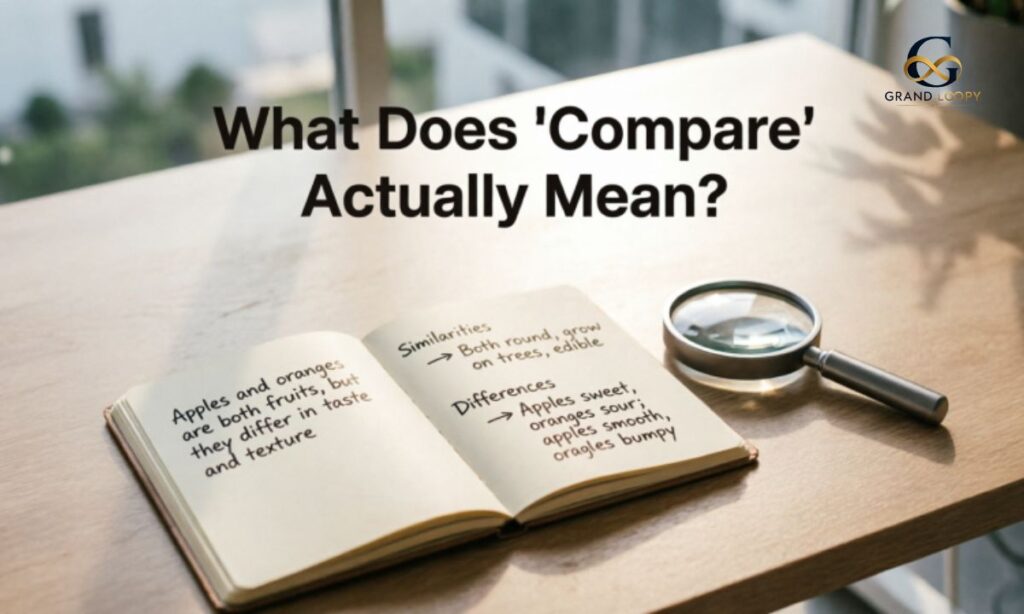
At its core, compare means to examine two or more items, ideas, or people to understand their similarities and differences.
You use it when:
- Judging which product is better
- Studying differences between two ideas
- Measuring one thing against a standard
Example: “Let’s compare these two laptops before buying one.”
Simple, clear, and useful in almost any conversation.
Click Here To Read another Topic
Why Do So Many People Write “Compair” Instead?
This mistake happens for one honest reason: pronunciation confusion. The “are” ending in English does not always sound like it looks, and many words ending in “air” (like “fair,” “chair,” and “repair”) trick the brain into thinking “compare” should follow the same pattern.
Add autocorrect gaps, fast typing, and non native English speakers translating sounds instead of spelling, and “compair” becomes an easy slip.
The good news? Once your eyes register the correct pattern a few times, the mistake naturally disappears.
Where Did the Word “Compare” Come From?
“Compare” comes from the Latin word comparare, meaning to pair equally or match together. It entered English through Old French in the 14th century and has held its spelling steady ever since.
Interestingly, this word even appears in classic literature and religious texts. The King James Bible uses it in the Song of Solomon: “I have compared thee, O my love.” Centuries later, the spelling has not changed at all, which shows how stable this word has remained in English.
That kind of consistency is rare for English, a language famous for breaking its own rules.
Compair vs Compare: Quick Comparison Table
| Word | Correct? | Meaning | Example |
| Compare | Yes | To examine similarities or differences | “Compare the two offers before deciding.” |
| Compair | No | Not a real word | Should always be replaced with “compare” |
This table alone answers most of what people are searching for, but let’s go deeper so you fully understand how to use the word with confidence.
How to Use “Compare” Correctly in a Sentence
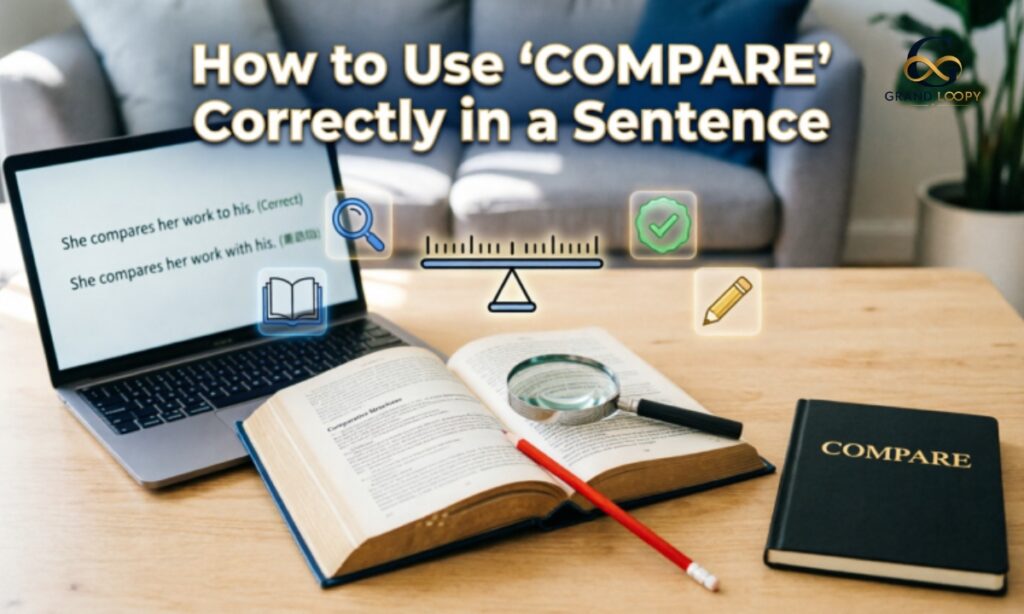
“Compare” works as a verb, and it usually pairs with the word “to” or “with” depending on what you are highlighting.
- Use compare to when pointing out similarities. Example: “She compared her sister to a shining star.”
- Use compare with when examining both similarities and differences. Example: “Compare this year’s sales with last year’s numbers.”
Both are grammatically correct, so choose based on what you want to emphasize.
Common Mistakes People Make With “Compare”
Even confident writers slip up sometimes. Here are the most frequent errors:
- Writing “compair” instead of “compare”
- Mixing up “compare to” and “compare with” without understanding the difference
- Forgetting the correct past tense form, “compared,” not “compaired”
- Using “comparison” and “comparing” interchangeably, even though they serve different grammatical roles
Spotting these patterns early saves you from repeating them in emails, essays, or professional writing.
Compare vs Compared vs Comparison: What’s the Difference?
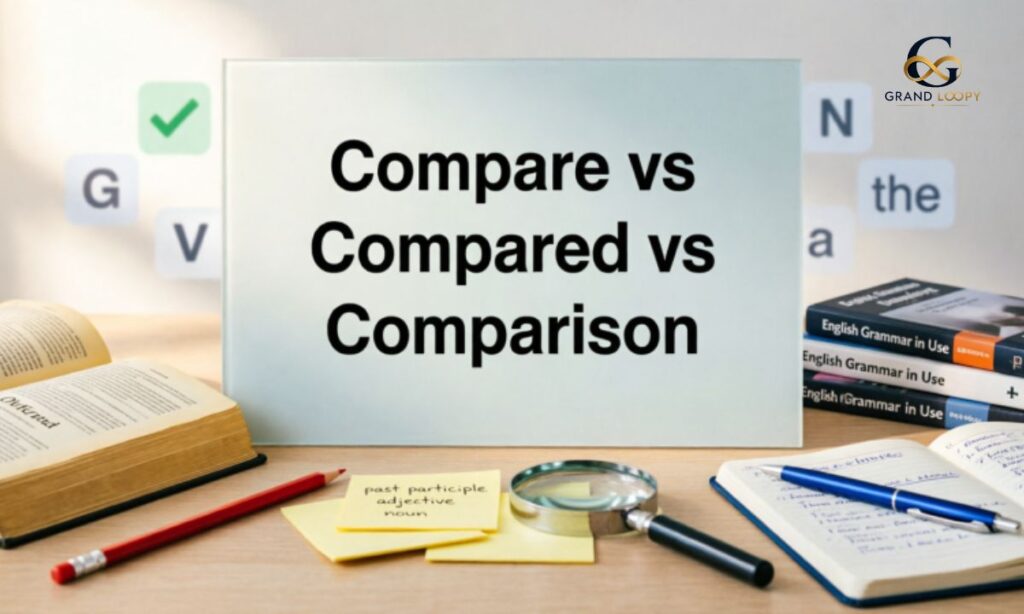
These three words come from the same root but serve different jobs in a sentence.
- Compare is the base verb: “I compare two options.”
- Compared is the past tense: “I compared two options yesterday.”
- Comparison is the noun form: “The comparison showed a clear winner.”
Knowing this small difference instantly improves how polished your writing sounds.
Which One Should You Use, “Compair” or “Compare”?
Always use compare. There is no situation, formal or casual, where “compair” is acceptable. Not in essays, not in business emails, not even in texting.
If you remember nothing else from this article, remember this one rule. It solves the entire confusion in one sentence.
Simple Tricks to Never Misspell “Compare” Again
Here are a few memory tricks that actually work:
- Think of the phrase “compare and prepare,” since both end the same way.
- Remember that “compare” contains the word “pare,” like paring down two things to see their differences.
- Read the word slowly instead of relying on how it sounds when spoken.
Small tricks like these train your brain faster than simply memorizing spelling rules.
Real-Life Examples of “Compare” in Everyday Writing
Seeing the word in context makes it stick even better.
- Shopping: “I always compare prices before buying electronics.”
- Academic writing: “This essay will compare two historical leadership styles.”
- Workplace communication: “Please compare both proposals and share your feedback.”
- Everyday conversation: “You can’t compare apples to oranges.”
Notice how naturally the word fits into different tones, from casual chat to formal writing.
Frequently Asked Questions
Is “compair” ever correct in British English?
No. Both American and British English use the same spelling, “compare.” There is no regional version where “compair” becomes correct.
Why does spellcheck sometimes not catch “compair”?
Spellcheck occasionally misses errors when a similar sounding word exists nearby in its dictionary, or when autocorrect settings are limited. Always proofread manually for spelling confidence.
What is the correct past tense of “compare”?
The correct past tense is “compared,” not “compaired.” The same spelling rule applies across all tenses of the word.
Final Thoughts
Spelling confusion happens to everyone, and “compair vs compare” is one of the easiest mix ups to fix once you understand why it happens. Just remember that compare is the only correct spelling, rooted in Latin, stable through centuries of English writing, and simple to use once you see the pattern clearly.
Next time you type it, you will not even need to think twice.