

You typed a sentence, paused, and stared at the word “puting.” Something feels off, but you can’t put your finger on it (pun intended). Here’s the short answer before you spiral into a Google rabbit hole: “putting” is correct, and “puting” is always a misspelling. Stick around, because knowing why will stop you from making this mistake again.
Putting is the only correct spelling; “puting” is always a typo or grammatical error. Because the verb “put” follows the consonant-doubling rule a single syllable ending in a vowel-consonant you must double the “t” before adding the “-ing
What Is the Correct Spelling: Puting or Putting?
“Putting” is the only correct spelling. It has two T’s, not one.
“Puting” doesn’t exist in any English dictionary, formal or informal. It’s simply a typo that happens because our fingers move faster than our brains, especially when typing on a phone.
Every major dictionary, including Merriam-Webster and Cambridge, lists “putting” as the present participle of the verb “put.” “Puting” appears nowhere as an alternate spelling, a regional variation, or an old-fashioned form.
Why Is “Puting” Incorrect?
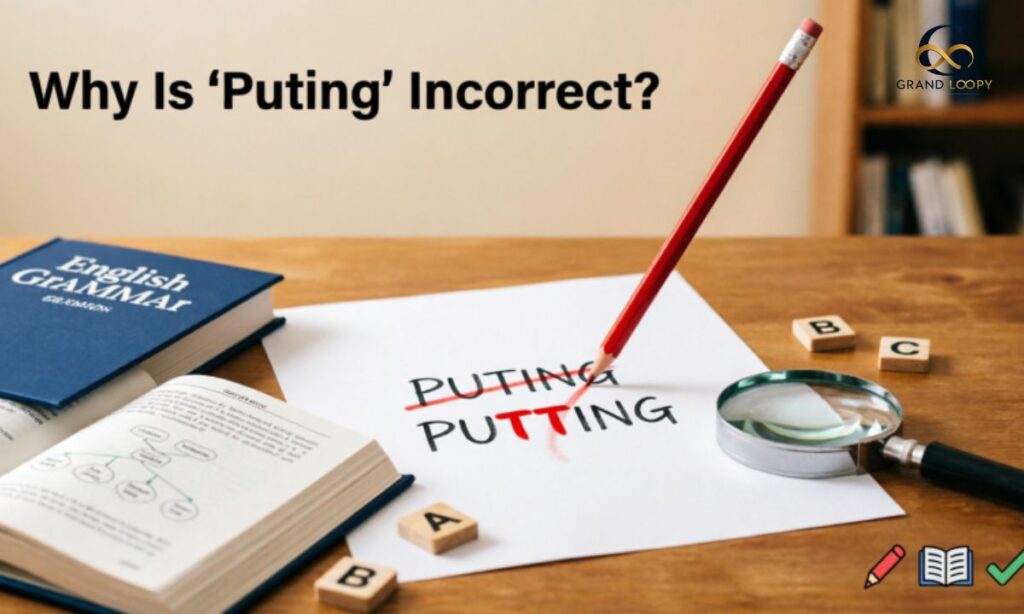
English spelling follows a pattern for short verbs ending in a single consonant after a single vowel. When you add “-ing,” you double that final consonant.
“Put” ends in a single “t” right after a single vowel “u.” So the rule kicks in, and you double the “t” before adding “-ing.” That gives you putting, not “puting.”
Compare it to similar words like “sit” becoming “sitting” or “run” becoming “running.” Nobody writes “runing,” and “puting” deserves the same side eye.
Click Here To Read More Grammar Topic
What Does “Putting” Mean?
“Putting” is the -ing form of the verb “put,” meaning to place, move, or set something somewhere.
It’s one of the most common words in English because “put” itself is everywhere in daily conversation. You use it to describe placing objects, expressing ideas, or even applying effort to a task.
A few quick meanings:
- Placing something physically: “She is putting the keys on the table.”
- Expressing thoughts: “He’s putting his ideas into words.”
- Applying effort: “They’re putting a lot of work into this project.”
Where Does “Putting” Come From? A Quick Look at Its History
The verb “put” traces back to Old English and Middle English, where similar forms meant to push, thrust, or place something firmly.
Language historians link it to Old Norse influence during the medieval period, when Norse settlers in Britain brought words that blended with existing English vocabulary. Over centuries, “put” settled into the simple, sturdy word we use today.
You won’t find “put” or “putting” in famous biblical translations as a standout term, but the King James Bible does use “put” frequently, as in phrases like “put off” and “put on,” showing the word has carried the same core meaning of placing or setting for hundreds of years.
That long history is exactly why the spelling rules around it are so fixed. “Putting” isn’t a modern invention. It’s centuries of consistent usage, and “puting” simply never earned a seat at that table.
Puting vs Putting: Quick Comparison Table
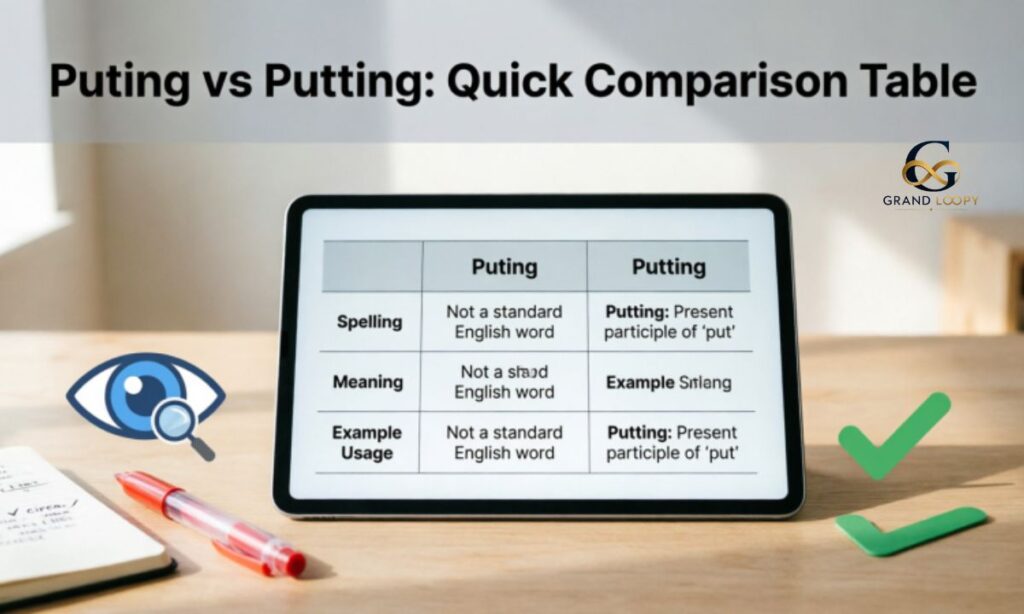
| Feature | Puting | Putting |
| Correct spelling | No | Yes |
| Found in dictionaries | No | Yes |
| Follows English spelling rules | No | Yes |
| Used in formal writing | Never | Always appropriate |
| Common cause | Typo or rushed typing | Standard verb form |
This table makes it obvious at a glance. If you ever see “puting” written anywhere, including in an email from a coworker, you now know exactly why it looks wrong.
How to Use “Putting” in a Sentence
Seeing the word in action helps it stick better than any rule ever could. Here are real, everyday examples.
- “I’m putting the groceries away right now.”
- “She’s putting a lot of thought into her career change.”
- “We were putting up decorations for the party all afternoon.”
- “He kept putting off the meeting until it was too late.”
- “They’re putting the final touches on the new website.”
Notice how natural “putting” sounds in casual speech and formal writing alike. That’s because it’s the grammatically correct form doing exactly what it should.
Common Mistakes People Make With “Putting”
Even native English speakers slip up sometimes, so don’t feel bad if you’ve made one of these.
Mistake 1: Dropping the second “t.” This creates “puting,” which is the exact error we’ve been fixing this whole article.
Mistake 2: Confusing it with “putin.” Autocorrect on phones sometimes suggests “Putin” (the political figure’s name) when someone types “puting” quickly. Awkward, and definitely not what you meant.
Mistake 3: Overcorrecting to “putting’ing.” Some writers panic and add extra letters trying to fix the word, making it worse instead of better.
Mistake 4: Mixing up “putting” with “put.” Using the wrong tense, like saying “I am put the box down” instead of “I am putting the box down,” is a separate grammar issue worth knowing too.
“Putting” in Golf: A Special Meaning Worth Knowing

Here’s a fun twist competitors rarely mention. In golf, “putting” has its own specific meaning beyond the general definition.
A “putt” is the light, controlled stroke used to roll the ball into the hole on the green, and “putting” describes the act of making that stroke. A “putting green” is the smooth area around the hole where this happens.
So golfers aren’t just placing something when they say “I’m putting.” They’re performing a very specific, skill based action with a club. The same spelling rule applies though: always two T’s.
Which One Should You Use?
Always use “putting.” There is no situation, casual or formal, where “puting” is the right choice.
If you’re texting a friend, writing a work email, drafting a novel, or filling out a job application, “putting” is your answer every single time. Think of “puting” as a typo, not a variant, similar to typing “teh” instead of “the.”
Related Words That Often Get Misspelled Too
Since we’re already cleaning up spelling confusion, here are a few close cousins worth knowing.
- Put (base verb): “Please put the box down.”
- Puts (third person singular): “She puts her phone away during dinner.”
- Putter (a golf club, or someone who putters around): “He grabbed his putter before heading to the green.”
Understanding these related forms makes the whole “put” family of words much easier to use correctly without a second thought.
Tips to Remember the Correct Spelling for Good
Want a trick that sticks? Picture two chairs sitting side by side, just like the two T’s sitting side by side in “putting.”
Another trick: say the word slowly out loud. “Puh-tt-ing.” You can almost hear that double T doing the heavy lifting. One T just sounds thinner and incomplete.
Finally, remember the doubling rule pattern. Short verb, single vowel, single ending consonant, means you double that consonant before adding “-ing.” Once this clicks, you’ll never second guess “sitting,” “running,” “hitting,” or “putting” again.
FAQ
Is “puting” ever correct in any dialect of English?
No. “Puting” isn’t recognized in American English, British English, or any other established dialect. It’s a spelling error, not a regional variation.
Why does autocorrect sometimes not catch “puting”?
Autocorrect tools sometimes miss short typos, especially if the surrounding sentence still seems to make grammatical sense. It’s always smart to proofread rather than rely fully on spellcheck.
Does the same doubling rule apply to other words like “put”?
Yes. Any short verb ending in a single consonant right after a single vowel usually doubles that consonant before “-ing,” including words like “run,” “sit,” “hit,” and “put.”
Final Thoughts
“Putting” wins, hands down, every time. “Puting” is nothing more than a rushed typo hiding behind a word that looks almost right.
Now that you know the spelling rule, the history behind “put,” and even its special meaning in golf, you’re fully equipped to use “putting” with confidence in any sentence you write. Two T’s, no exceptions, no debate.