Why Do Jeans Stretch Out After Wearing Them?
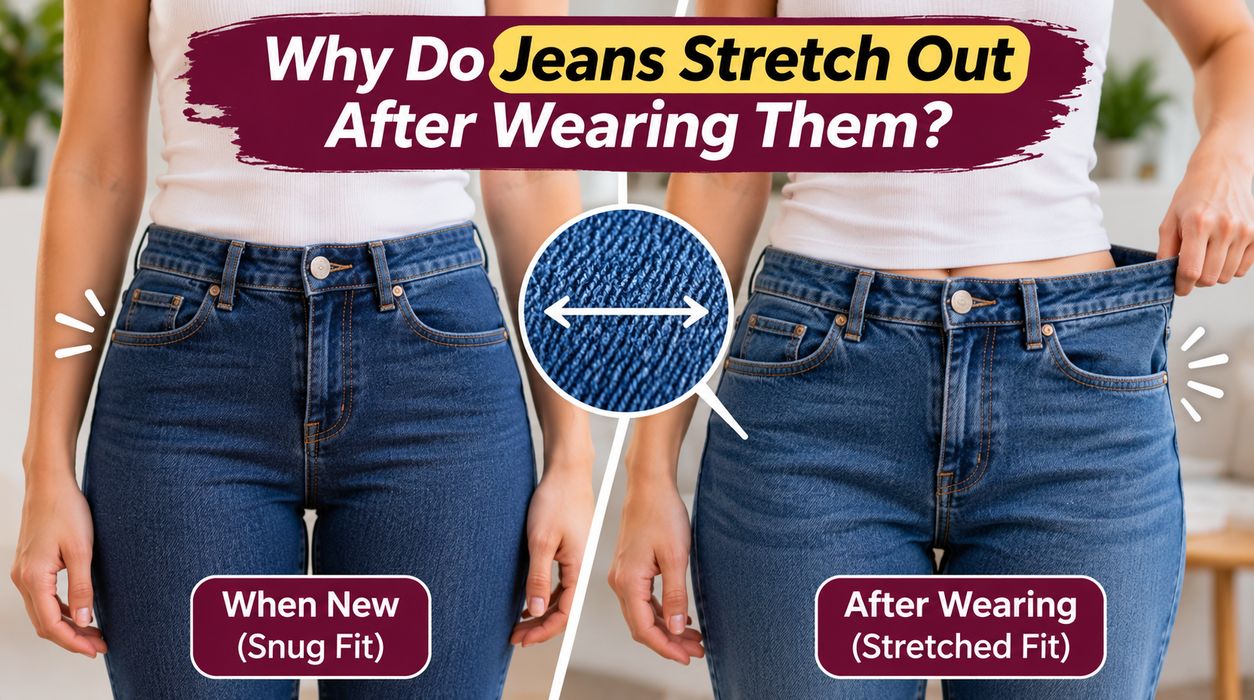
Have you ever purchased a pair of jeans that fit perfectly in the fitting room, only to discover that they feel loose around your waist, hips, or knees after a few hours?
It is a common experience. Your jeans may feel comfortably snug in the morning but start slipping down by the afternoon. Sometimes the waistband becomes noticeably larger, while other times the knees develop a baggy appearance.
So, why do jeans stretch out after wearing them?
The answer involves denim construction, cotton fibers, elastic materials, body movement, moisture, and the way fabric responds to repeated tension.
Some stretching is normal and even desirable because it allows jeans to become more comfortable. However, excessive stretching can make denim lose its original fit.
Understanding how jeans change during wear can help you choose better-fitting denim, prevent unwanted bagginess, and extend the life of your favorite pair.
Why Do Jeans Stretch Out During the Day?
Jeans stretch because denim fabric responds to physical forces created by everyday movement.
When you sit, walk, bend, or squat, the fabric experiences tension in different directions.
These movements can temporarily change the arrangement of yarns within the denim.
In cotton denim, the yarns and fabric structure may relax after repeated movement. In stretch denim, elastic fibers extend and then recover to varying degrees.
The amount of stretching depends on several factors:
- Cotton and synthetic fiber content
- Denim weave and fabric weight
- Amount of elastane or spandex
- Original garment fit
- Frequency of movement
- Washing and drying practices
- Age and condition of the fabric
Not every pair of jeans behaves the same way.
Some jeans gradually become more comfortable while maintaining their shape. Others develop noticeable looseness after only a few hours.
1. Cotton Fibers Relax With Wear
Traditional denim is commonly made from cotton.
Cotton fibers themselves are not highly elastic, but woven cotton fabrics can change shape as yarns shift and tension is redistributed.
When jeans are new or freshly washed, they may feel relatively firm.
As you move throughout the day, the denim gradually becomes more flexible.
Why 100% Cotton Jeans Stretch
Even without added stretch fibers, cotton denim can loosen during wear.
This happens partly because the woven structure adjusts under repeated movement.
The waistband, knees, and seat are especially likely to experience changes because they are subjected to frequent tension.
However, 100% cotton jeans do not necessarily recover their original dimensions immediately after being stretched.
Does Cotton Denim Stretch Permanently?
Some changes are temporary, while others can remain until washing or further treatment.
Over time, repeated wear can also contribute to lasting changes in garment shape.
The amount of change depends on the fabric construction and how the jeans are used.
2. Stretch Denim Contains Elastic Fibers
Many modern jeans contain a small percentage of elastane, also known as spandex.
These fibers help denim stretch and move with the body.
Stretch jeans can feel more comfortable during activities such as walking, sitting, and bending.
However, stretchability and shape recovery are not the same thing.
Stretch vs. Recovery
Stretch refers to how far a fabric can extend under tension.
Recovery refers to how effectively it returns toward its original dimensions after the tension is removed.
A pair of jeans may stretch easily but recover poorly.
This can create bagginess around the knees or seat.
Why Some Stretch Jeans Get Loose
Repeated wear, heat exposure, fabric construction, and aging can affect how elastic components perform.
If the fabric does not recover effectively, the jeans may gradually lose their intended fit.
The percentage of elastane alone does not determine performance. Yarn design and fabric construction also matter.
3. Sitting and Walking Stretch the Fabric
Everyday movement is one of the main reasons jeans change shape.
When you sit, the fabric around your hips, thighs, and knees must accommodate a different body position.
When you stand, some of that tension disappears.
Repeated cycles can gradually change the fabric’s appearance.
Why Jeans Get Baggy at the Knees
Knees bend frequently throughout the day.
This repeatedly stretches the fabric across the front of the knee.
If the denim has limited recovery, the area may develop a loose or rounded appearance.
Why Jeans Stretch Around the Waist
The waistband experiences tension when you sit, bend, or move.
A snug waistband may relax slightly during wear.
If the jeans were already somewhat loose, this change can become especially noticeable.
Why the Seat of Jeans Gets Loose
Sitting places tension on the fabric around the hips and seat.
Over time, some denim fabrics may develop a relaxed appearance in this area.
This is a normal consequence of repeated movement, although the degree varies.
4. Jeans May Be Too Large From the Beginning
Sometimes jeans appear to stretch excessively because the original fit was not ideal.
A pair may feel comfortable in the fitting room but have more room than necessary around the waist or hips.
After the fabric relaxes, the additional space becomes more noticeable.
Check the Fit Before Buying
When trying on jeans, pay attention to:
- Waistband comfort
- Hip and seat fit
- Thigh room
- Knee movement
- Length and rise
- Fabric composition
Move naturally while wearing them.
Sit down, walk, and bend your knees to see how the garment responds.
Avoid Buying Painfully Tight Jeans
Some shoppers deliberately purchase jeans that are too small because they expect the fabric to stretch.
This approach can lead to discomfort and unpredictable results.
Jeans should fit comfortably without excessive pressure or restricted movement.
5. Fabric Weight and Weave Influence Stretching
Not all denim has the same construction.
Some fabrics are lightweight and flexible, while others are heavier and more structured.
Denim typically uses a twill weave, but yarn size, density, and finishing processes vary.
Lightweight Denim
Lightweight denim can feel soft and comfortable.
Depending on its construction, it may also show shape changes more readily during wear.
Heavyweight Denim
Heavier denim often feels more structured initially.
However, heavyweight does not automatically mean better recovery or less stretching.
Fabric quality and construction are more important than weight alone.
Why Construction Matters
Closely woven fabric may respond differently to movement than a loosely constructed material.
Two pairs of jeans with identical fiber labels can still behave differently because of how their yarns and fabrics were manufactured.
6. Washing Can Temporarily Change the Fit
Have you noticed that jeans sometimes feel tighter immediately after washing?
This can happen because laundering changes the arrangement of fibers and yarns within the fabric.
Certain denim garments may also shrink depending on their construction and previous treatments.
After you wear them again, normal movement can cause the fabric to relax.
Why Jeans Feel Tight After Washing
Water, mechanical movement, and drying conditions can affect garment dimensions.
Some cotton denim may contract during laundering.
When you begin wearing the jeans again, the fabric adjusts to your movements.
Does Washing Restore Stretched Jeans?
Washing may help some jeans regain a firmer feel or temporarily reduce looseness.
However, it cannot reliably repair permanently damaged elastic fibers.
Results vary by fabric composition and care method.
The American Cleaning Institute offers general clothing-care guidance that can help consumers follow appropriate washing practices.
Always check the garment’s care label before laundering.
7. High Heat Can Affect Stretch Denim
Heat is an important consideration when caring for jeans containing elastane.
Repeated exposure to unsuitable temperatures may affect elastic components and garment performance.
This can contribute to changes in shape recovery over time.
Should You Put Stretch Jeans in the Dryer?
Follow the manufacturer’s care instructions.
Some jeans are suitable for tumble drying on specified settings, while others benefit from gentler drying methods.
Avoid assuming that high heat will permanently fix loose jeans.
Can Hot Water Shrink Jeans?
Hot water may cause dimensional changes in certain denim fabrics.
However, shrinkage can be uneven and may affect the length, width, color, or overall fit.
Using excessive heat to shrink jeans can also damage materials.
A controlled alteration is generally more predictable than trying to force significant shrinkage through aggressive washing.
8. Jeans Naturally Change as They Age
Like other clothing, denim experiences wear over time.
Repeated friction, washing, stretching, and environmental exposure can affect its appearance and performance.
Older jeans may feel softer than when they were new.
Some people prefer this broken-in feel.
However, fabric that becomes excessively loose may no longer provide the desired fit.
Signs Your Jeans Are Losing Their Shape
Common signs include:
- A waistband that repeatedly slips
- Persistent bagginess around the knees
- Excess fabric around the seat
- A fit that changes dramatically during the day
- Reduced recovery after washing
These changes do not always mean the jeans must be replaced.
Alterations or adjustments may help in some cases.
How to Stop Jeans From Stretching Out Too Much
You cannot eliminate all denim stretching, but you can reduce unwanted shape changes through appropriate selection and care.
Choose Jeans With Good Recovery
When shopping for stretch denim, pay attention to how the fabric returns after being gently stretched.
A fabric that quickly recovers may be less likely to develop persistent bagginess.
However, a brief store test cannot guarantee long-term performance.
Select the Correct Size
Choose jeans that feel secure and comfortable.
Avoid purchasing excessively tight clothing based on the assumption that it will eventually become comfortable.
Follow Care Labels
Wash and dry jeans according to manufacturer instructions.
Different denim blends require different treatment.
Avoid Excessive Heat
High temperatures can affect certain fibers and finishes.
Use suitable washing and drying settings.
Rotate Your Jeans
Wearing different pairs throughout the week may reduce repeated stress on one garment.
This can be useful when you have multiple pairs already in your wardrobe.
How to Fix Jeans That Have Stretched Out
The best solution depends on where the jeans are loose and why the stretching occurred.
Fixing a Loose Waistband
If the waistband is consistently too large, tailoring may be an effective solution.
A professional alteration can sometimes reduce the waist while preserving the overall appearance.
Fixing Baggy Knees
Washing according to the care label may temporarily improve the appearance of some denim.
However, permanent fabric distortion may not be fully reversible.
Fixing Loose Thighs
If jeans are excessively loose through the thighs, a tailor may be able to adjust the fit.
The feasibility depends on the garment’s construction.
Using a Belt
A belt can help secure jeans that are slightly loose at the waist.
However, it will not correct bagginess around the knees or seat.
Consider Professional Alterations
Tailoring can be particularly useful when the jeans fit well in most areas but need adjustment in one location.
Grandloopy’s guide to customize versus customise explains the American English spelling of “customize,” a term often used when discussing clothing adjustments and personalized styling.
Do 100% Cotton Jeans Stretch More Than Stretch Jeans?
There is no universal answer.
Traditional cotton denim and stretch denim behave differently.
| Feature | 100% Cotton Denim | Stretch Denim |
|---|---|---|
| Elasticity | Generally limited | Usually greater |
| Initial feel | Often more structured | Often more flexible |
| Movement | Fabric relaxes through wear | Elastic fibers allow extension |
| Shape recovery | Depends on fabric structure | Depends on elastic fibers and construction |
| Long-term fit | May gradually loosen | May lose recovery with wear or damage |
The best choice depends on comfort preferences, fit, and intended use.
Some shoppers prefer the structured appearance of traditional denim.
Others value the flexibility of stretch jeans.
Neither option is automatically superior.
Should You Buy Jeans One Size Smaller?
Buying jeans one size smaller is not a reliable solution to stretching.
Different brands and denim fabrics have different sizing systems.
A smaller size may become uncomfortable around the waist, hips, or thighs.
Instead, choose jeans based on how they fit your body and how the material behaves.
If the fabric is known to relax slightly, a comfortable but secure initial fit may be appropriate.
Avoid clothing that causes pain, numbness, or restricted movement.
How Often Should You Wash Jeans?
Jeans do not necessarily require washing after every brief wear.
However, washing frequency depends on hygiene needs, activity level, visible dirt, and manufacturer guidance.
Jeans that are sweaty, stained, or contaminated should be cleaned appropriately.
For lightly worn jeans, airing them out may sometimes be sufficient between washes.
Why Overwashing Can Be a Problem
Repeated laundering exposes denim to water, detergent, friction, and drying.
These processes can gradually affect color, texture, and fabric condition.
Why Underwashing Is Not Always Better
Delaying washing indefinitely can allow dirt, oils, and odors to accumulate.
A practical care routine balances cleanliness with fabric preservation.
The U.S. Environmental Protection Agency provides resources on waste reduction and extending the useful life of consumer products.
Maintaining clothing appropriately can help reduce unnecessary replacement.
Why Jeans Sometimes Look Better in Stores
Retail lighting, mirrors, styling, and the condition of new garments can influence how jeans appear.
A freshly displayed pair may have a smooth, structured appearance.
After several hours of wear, the fabric may relax and develop natural folds.
This does not necessarily mean the garment is defective.
Test Jeans Before Purchasing
Spend a little time walking and sitting while trying them on.
Consider how the jeans work with your usual shoes and tops.
A full-length mirror can help you evaluate the overall silhouette.
Think About Your Existing Wardrobe
Jeans are versatile because they can be combined with many different clothing styles.
For example, jeans and a casual hoodie create an easy everyday outfit.
Grandloopy’s hoodie versus hoody guide explains the preferred spelling of this common fashion garment.
The most useful jeans are those that fit comfortably and work with clothing you already enjoy wearing.
How to Maintain the Color and Shape of Denim
Denim care involves more than preventing stretching.
Color retention and fabric condition also affect how jeans look over time.
Wash Similar Colors Together
Separate dark denim from light-colored clothing when appropriate.
This helps reduce the risk of dye transfer.
Turn Jeans Inside Out
Turning jeans inside out may reduce abrasion on the visible outer surface during washing.
Use Suitable Detergent
Follow detergent instructions and avoid excessive quantities.
Residue can affect the appearance and feel of fabric.
Dry According to the Care Label
Avoid unnecessarily high temperatures.
The correct method depends on fiber composition and garment construction.
Grandloopy’s article about shiny versus shiney explains terminology used to describe reflective surfaces. Denim texture and surface wear can also influence how light reflects from the fabric.
Are Expensive Jeans Less Likely to Stretch?
Higher prices do not automatically guarantee better shape retention.
Expensive denim may use specialized materials or manufacturing techniques, but performance varies among products.
Important factors include:
- Fiber composition
- Yarn quality
- Fabric construction
- Elastic recovery
- Garment design
- Manufacturing consistency
A reasonably priced pair with good construction may maintain its shape better than a more expensive pair with poor recovery.
Focus on fabric performance and fit rather than price alone.
Can Tailoring Make Jeans Last Longer?
Tailoring can help extend the usefulness of jeans that no longer fit as intended.
A small waist adjustment may make an otherwise comfortable pair wearable again.
Minor repairs can also prevent damage from becoming more serious.
However, alterations cannot fully restore fabric that has lost its structural integrity.
Repair Before Replacing
If jeans are still in good condition, consider whether a simple adjustment could solve the problem.
The Ellen MacArthur Foundation discusses circular fashion approaches that aim to keep clothing and materials in use longer.
Repairing and maintaining useful garments can be part of a more thoughtful wardrobe strategy.
Common Mistakes That Make Jeans Lose Their Shape
Several habits can contribute to unwanted fit changes.
Buying the wrong size: Jeans that are already loose may become noticeably baggier as the fabric relaxes.
Ignoring fabric composition: Stretch denim and traditional cotton denim behave differently.
Using excessive heat: Unsuitable drying temperatures may affect elastic fibers.
Overstretching the waistband: Repeatedly pulling jeans forcefully can place unnecessary stress on the fabric.
Ignoring care instructions: Incorrect washing methods may affect garment dimensions.
Expecting all jeans to behave identically: Fabric construction varies widely between brands and styles.
Relying on aggressive shrinking methods: Hot water and high heat can produce unpredictable results.
Avoiding these mistakes can help preserve a more consistent fit.
Grandloopy’s guide to constant versus consistent explains the difference between something happening continuously and maintaining a reliable standard.
In denim care, a consistent routine is more useful than repeatedly applying aggressive treatments.
How to Know When It Is Time to Replace Jeans
Jeans do not need replacement simply because they have softened or relaxed slightly.
Many people prefer denim that develops a comfortable, worn-in feel.
However, replacement may become necessary when the garment no longer functions properly.
Consider the following:
- Does the waistband stay securely in place?
- Are the seams and fabric still strong?
- Does the fit remain comfortable throughout the day?
- Can alterations solve the problem?
- Is the garment appropriate for its intended activities?
If the jeans are structurally sound, repairs or alterations may be worthwhile.
If the fabric is severely damaged or the fit cannot be corrected, replacement may be more practical.
Keep Purchase Information
If new jeans stretch excessively after minimal use, review the retailer’s return or warranty policy.
Keeping purchase documentation may be helpful.
Grandloopy’s receipt versus reciept article explains the correct spelling of “receipt,” a document commonly needed for returns and exchanges.
Frequently Asked Questions
Why do my jeans get loose after a few hours?
Jeans can loosen as cotton yarns relax or elastic fibers extend during movement. The amount of stretching depends on fabric composition, construction, and fit.
Do jeans stretch more when you sit?
Sitting places tension on the waistband, hips, seat, and knees. Repeated movement can contribute to fabric relaxation and temporary or persistent shape changes.
Will washing jeans make them tight again?
Washing may temporarily restore a firmer feel or cause some dimensional change, depending on the fabric. It cannot reliably repair permanently damaged elastic fibers.
Do 100% cotton jeans stretch out?
Yes. Traditional cotton denim can loosen as yarns and the woven structure adjust during wear, even without added elastane.
How can I stop jeans from getting baggy at the knees?
Choose denim with suitable recovery, avoid unnecessary stress and excessive heat, and follow care instructions. Persistent bagginess may not be fully reversible.
Should jeans feel tight when you first buy them?
Jeans should feel secure and comfortable. They should not cause pain or significantly restrict movement. Some fabrics relax with wear, but the amount is difficult to predict.
Can a tailor fix stretched-out jeans?
A tailor may be able to adjust a loose waistband or certain fit areas. However, tailoring cannot restore damaged elastic fibers or completely reverse fabric distortion.
Final Thoughts
So, why do jeans stretch out after wearing them?
The main reasons include cotton fabric relaxation, elastic fiber behavior, repeated movement, garment construction, and changes caused by washing and everyday wear.
Some stretching is normal and helps denim become more comfortable.
The problem occurs when jeans lose more shape than expected or no longer fit properly.
Choosing the right size, understanding fabric composition, following care instructions, and avoiding excessive heat can help reduce unwanted stretching.
If your favorite jeans have already become loose, alterations or careful maintenance may improve their usefulness.
Ultimately, the best jeans are not necessarily the tightest, most expensive, or most fashionable pair.
They are the ones that provide a comfortable, dependable fit throughout your everyday activities.

Ryan Mitchell is a passionate writer and digital content creator dedicated to sharing insightful, engaging, and informative articles across multiple niches. With a strong interest in technology, lifestyle, trending topics, and online media, Ryan Mitchell focuses on delivering well-researched and reader-friendly content that inspires and informs audiences worldwide.