Is Hollister Fast Fashion? The Parent Problem, the Ratings, and the 25 Percent Goals

Is Hollister fast fashion is the question every back to school shopper eventually asks about the mall’s most familiar teen store. Yes. Hollister is fast fashion, of the classic mall generation, and the rating evidence says so plainly.
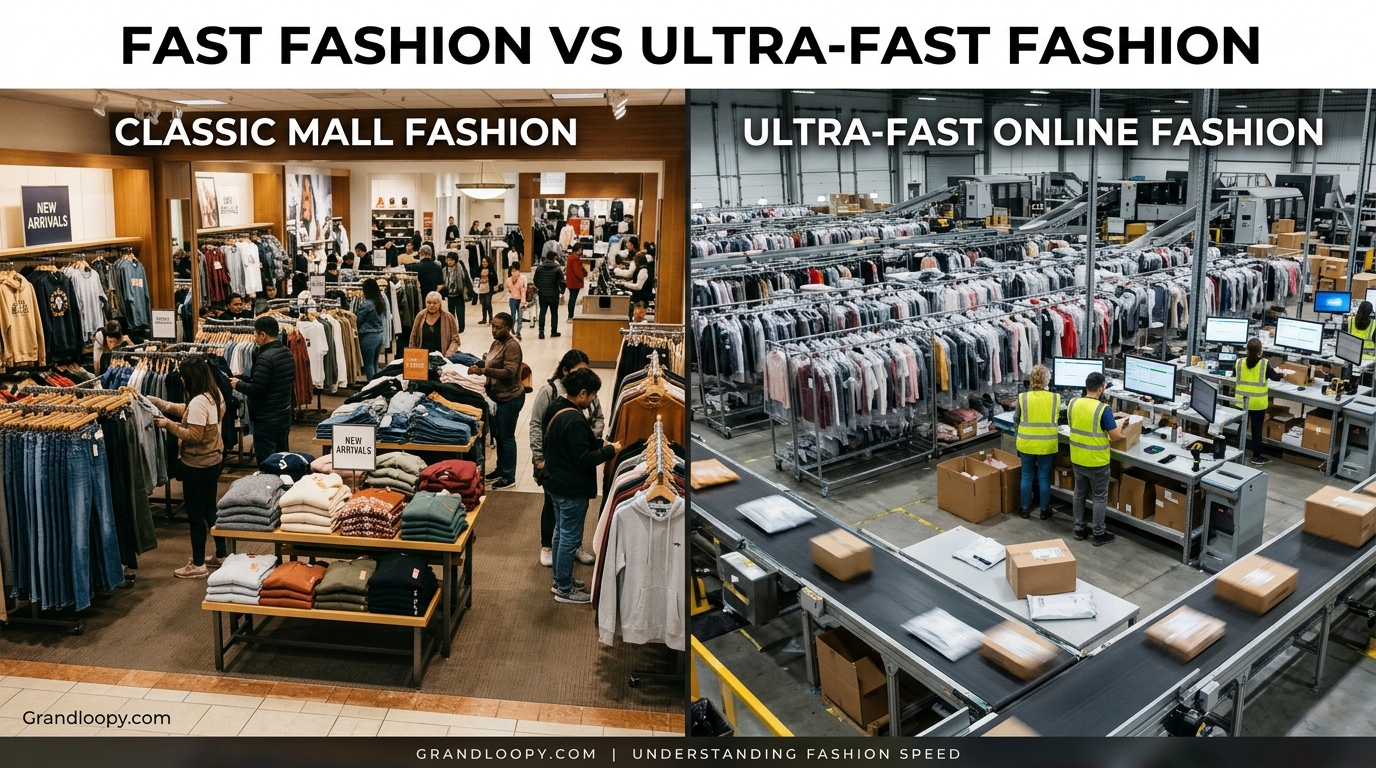
Classic is the operative word. Hollister is not ultra fast fashion like the online only brands flooding social feeds. It rotates trend collections every few weeks in physical stores, at teen prices, with permanent discounting. Same family, older generation, slower gear.
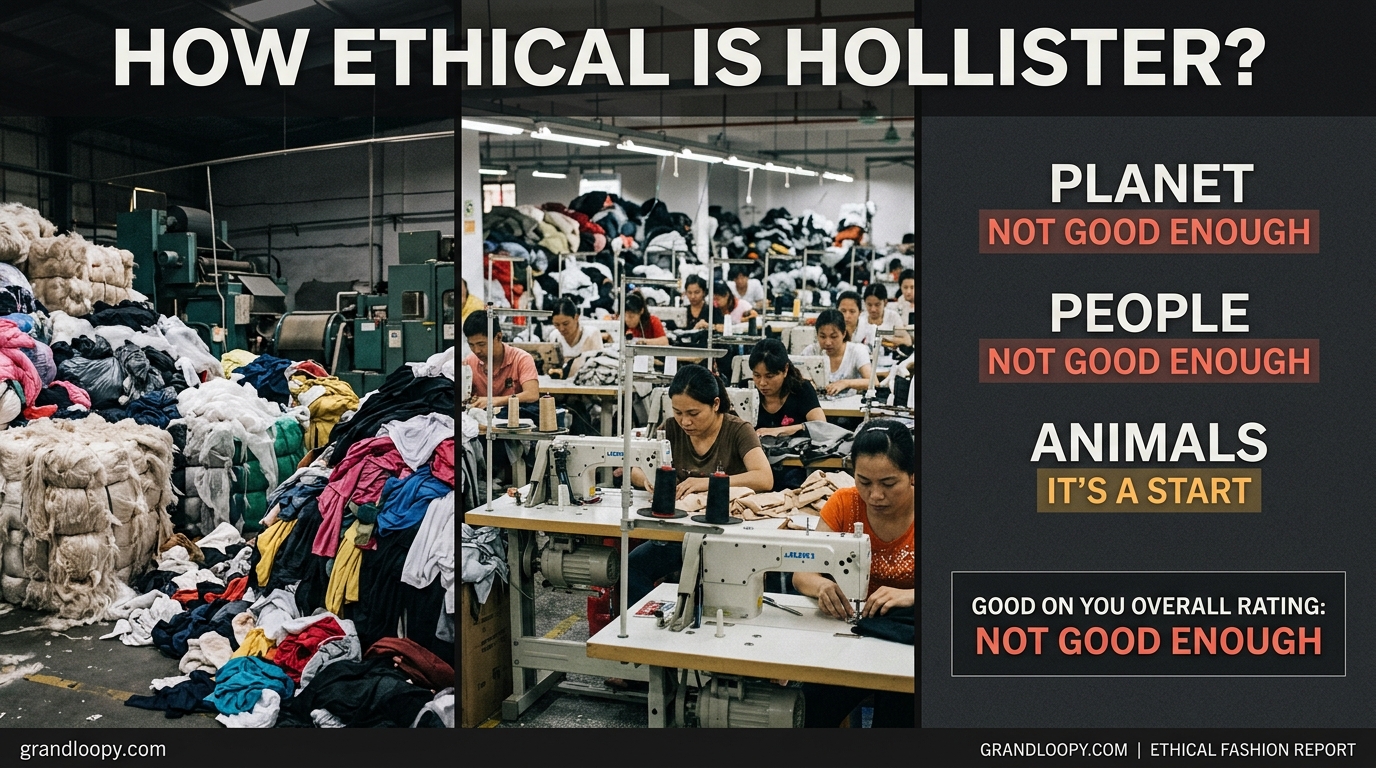
The independent rating matches. Good On You gives Hollister Not Good Enough overall, the second lowest of its five grades, with Not Good Enough for planet and people alike. One grade above the bottom, with the same core failures as the brands sitting there.
The twist in this verdict is whose paperwork decides it. Hollister publishes almost nothing about itself, so raters judge it largely through its parent, Abercrombie and Fitch. That inheritance helps in one place and caps the grade everywhere else.
The brand story is also partly invented, which feels on theme. Hollister was launched in Ohio in 2000, not in California in 1922, whatever the store walls imply. The myth is marketing; the supply chain is real, and it is the supply chain being rated.
What would change the verdict gets its own section, because Hollister’s parent has the money, the scale, and the reporting machinery to publish its way upward. The missing pieces are specific, and they are listed here one by one.
The Short Answer, With the Rating Attached
Yes, Hollister is fast fashion, and the precise label is classic fast fashion. Trend driven collections, rapid rotation, low to mid teen prices, and a discount engine that never switches off.
The independent rating agrees. Good On You’s Hollister directory rating records the axis scores behind the overall grade: Not Good Enough for planet, Not Good Enough for people, and It’s a Start for animals, combining into Not Good Enough overall.
The comparison that calibrates it: the ultra fast brands sit one grade lower, at We Avoid. Hollister’s extra grade is real, and it comes from parent level paperwork, not from a slower conscience. Read the parent section before crediting the brand.
The verdict in one table
|
Question |
Answer |
Evidence layer |
|---|---|---|
|
Is Hollister fast fashion? |
Yes |
Model, cadence, prices, discounting |
|
Is it ultra fast fashion? |
No |
Store led, weekly plus cycles, no daily SKU flood |
|
Is it ethical? |
Rated Not Good Enough |
Good On You, People axis |
|
Is it sustainable? |
Rated Not Good Enough |
Good On You, Planet axis |
|
Who decides the rating? |
Largely the parent’s disclosures |
Abercrombie and Fitch reporting |
|
Does it make any efforts? |
Yes, dated goals at parent level |
2025 goals, status unpublished |
That last row is the article in miniature. The efforts exist, they live at parent level, they carry deadlines that have now passed, and their outcomes are not published. Effort without evidence is the recurring pattern.
Fast, Faster, Ultra Fast: Placing Hollister on the Speed Scale
Fast fashion has generations, and confusing them produces bad verdicts in both directions. The first generation compressed fashion seasons into weeks, sold through stores, and chased trends at accessible prices. Zara built the template; the mall brands copied it.
The second generation removed the store and the season alike. Ultra fast brands test tiny batches online, reorder by the day, and price at the floor.
GrandLoopy’s verdict on whether Cider is fast fashion works through that model’s evidence in full. Conflating the two generations is the most common error in this topic.
Hollister belongs to generation one. Its cadence is measured in weeks, its distribution is store led with online alongside, its prices sit above the ultra fast floor, and its hero product, denim, is built well enough to earn a durability reputation.
The placement table
|
Dimension |
Hollister |
Ultra fast brands |
|---|---|---|
|
Cadence |
New collections every few weeks |
Daily to weekly drops |
|
Channel |
500 plus stores at peak, plus online |
Online only or online first |
|
Price band |
Teen mid low; jeans a step above the floor |
Rock bottom |
|
Production logic |
Seasonal buys with rapid refresh |
Small test batches, data reorders |
|
Hero product |
Denim with a durability reputation |
Trend pieces built for few wears |
|
Rating zone |
Not Good Enough |
We Avoid |
Placement matters for fairness. Hollister should not be acquitted for being slower than the worst model in fashion history, and it should not be convicted of that model’s specific crimes either. It is graded here on its own generation’s record.
The Brand in Brief: A 2000 Ohio Launch Wearing a 1922 Myth
Hollister Co. opened its first store on July 27, 2000, at Easton Town Center in Columbus, Ohio. Abercrombie and Fitch created it to capture younger teens who found the parent brand too old or too expensive, selling a Southern California surf fantasy to the Midwest first.
The founding story on the walls is invented. The brand’s mythology credits John M. Hollister, a 1922 California founder who never existed as described. The company has never hidden that the backstory is a fiction; it is atmosphere, printed on the tags.
The concept worked immediately. Hollister became the parent’s fastest growing segment within two years, passed 500 stores worldwide by 2013, and ranked among the most preferred teen brands in the United States for much of that decade.
The audience is explicit: shoppers roughly 14 to 24, buying jeans, fleece, tees, swim, and fragrance. Its sister brand Gilly Hicks covers intimates and loungewear inside many of the same stores, under the same parent and the same supply chain paperwork.
The turnaround chapter
The parent’s recent revival is a business story worth respecting on its own terms: a struggling mall empire rebuilt its product, marketing, and relevance. The mechanics are the turnaround kind catalogued in GrandLoopy’s step by step guide to starting a small business, executed at public company scale.
Notice the separate ledgers. Commercial revival and ethics ratings moved independently: the comeback is real, and the grade stayed Not Good Enough through it. A brand can be excellent at selling and unremarkable at disclosing, in the same quarter, indefinitely.
The Five Criteria Test, Scored Honestly
Apply the standard five criteria and Hollister passes the classification with a different profile from the ultra fast brands. Two criteria it meets fully, two it meets in milder form, and one, opacity, it meets in full.
|
Criterion |
Hollister evidence |
Verdict |
|---|---|---|
|
Cycle speed |
Collections rotate every few weeks, constant refresh |
Meets it, generation one pace |
|
Trend replication |
Surf and social trend chasing is the stated concept |
Meets it |
|
Price architecture |
Teen prices above the ultra fast floor, permanent sales |
Meets it, milder form |
|
Data driven volume |
Seasonal buys plus rapid refresh, not daily test batches |
Partial by ultra fast standards |
|
Opacity |
Brand level disclosure minimal; outcomes unpublished |
Meets it in full |
Three full passes and two partials is still a clear classification. Fast fashion was defined by the first generation’s behavior, and Hollister’s model matches the definition its own generation wrote.
The honest credits belong in the record. Physical stores mean fit, returns, and garments handled before purchase, which cuts the waste of speculative online baskets. Denim that survives school years lowers cost per wear against rivals whose jeans are seasonal.
The Parent Problem: Rated Through Abercrombie’s Paperwork
Hollister publishes almost nothing about its own supply chain. Its sustainability communication routes through Abercrombie and Fitch Co., the NYSE listed parent, whose group reports are where the evidence, such as it is, actually lives.
What the parent does publish deserves the credit most verdict pages skip. Per rater coverage, the parent publishes a list of its suppliers and factories at group level. Many ultra fast brands publish nothing comparable at any level.
What exists at neither level decides the grade. Audit outcomes from those factories, wage evidence against any living wage benchmark, and an aggregate materials breakdown for the brand are unpublished by parent and brand alike.
Why raters work this way
Good On You rates subsidiaries substantially on parent disclosures, because the supply chain is shared. The same factories, policies, and purchasing practices serve Hollister, Gilly Hicks, and the Abercrombie brand itself.
The inheritance caps both ways. The parent’s factory list lifts Hollister above the ultra fast floor of total silence. The parent’s missing outcomes data then caps every brand in the group at the same ceiling, whatever their individual marketing claims.
For shoppers, the translation is simple. When you check Hollister, you are reading Abercrombie and Fitch’s homework. Gaps in that homework are Hollister’s gaps, and no in store signage outruns them.
The Ratings: Good On You, Axis by Axis, With Dates
Good On You’s directory entry is the current assessment this page relies on. Read the axes separately, because the overall grade compresses three different stories.
|
Axis |
Grade |
Stated basis |
|---|---|---|
|
Planet |
Not Good Enough |
Few lower impact materials; no aggregate materials breakdown; some hazardous chemicals eliminated, no full commitment; some textile offcuts recycled |
|
People |
Not Good Enough |
No supply chain certification by key labour standards; code of conduct covers ILO principles; wage program claimed, no living wage evidence; Xinjiang cotton remediation insufficient |
|
Animals |
It’s a Start |
Leather and wool used; does not appear to use fur, angora, exotic skin, or down; welfare policy not aligned with the Five Domains |
|
Overall |
Not Good Enough |
Second lowest of five grades |
The planet grade’s core fact is a missing document. Without a published materials breakdown, nobody outside the company knows what share of the range is conventional cotton, virgin polyester, or anything better. The goals in the next section float on that absence.
The people grade’s core fact is a missing number. A wage improvement program is claimed; evidence that workers across most of the supply chain earn a living wage is absent. Programs are intentions; wage records are evidence, and ratings score evidence.
The transparency index agrees. Hollister scored 31 to 40 percent in the 2023 Fashion Transparency Index, the disclosure ranking run by Fashion Revolution. Respectable beside total silence, low beside the leaders, and consistent with the directory grade.
The rater conflict, printed honestly
Good On You disagrees with itself across time, and this page prints both versions with dates. Its explainer article, based on the November 2023 rating, scored the animals axis Not Good Enough at that time. The current directory scores it It’s a Start.
That is a rating that moved, probably as policies formalized, not a scandal. The lesson travels: quote any brand grade with its date attached, because last year’s verdict and this year’s can differ on the same website.
The Goals Audit: 25 Percent Promises After Their Deadline
The parent set goals, and goals with deadlines can be audited, which is more than most brands offer. Coverage of the sustainability program reports the following commitments, all framed at group level.
|
Goal |
Deadline |
Published status |
|---|---|---|
|
25 percent of cotton as Better Cotton |
2025 |
No confirmation found in the sources checked |
|
25 percent of polyester from recycled sources |
2025 |
No confirmation found in the sources checked |
|
50 percent of manmade cellulosic fibers tracked (Canopy partnership) |
2025 |
No confirmation found in the sources checked |
|
Denim water use down 30 percent vs 2019 (brand claim) |
2022 |
Claimed achieved in coverage; brand figure, about 190 million gallons |
Read the pattern, not just the rows. The goals were modest by design: even fully met, 75 percent of the two main fibers would remain conventional. Modest goals are not hypocrisy, but they do cap what meeting them would prove.
The deadline problem is the finding. The 2025 dates have passed, and the sources checked for this page publish no confirmation of the outcomes either way. A goal whose result is never reported functions as marketing during its life and silence after it.
One estimate circulates in coverage: a rating site estimates that under 20 percent of Hollister’s materials meet recognized sustainability criteria. It is an estimate by a reviewer, printed here as one, not as a measured figure from the company, which publishes no breakdown to check it against.
Materials, Wages, and the Two Conflicts in the Record

The range runs on conventional cotton, polyester, viscose, and denim blends, per reviewer sampling, with recycled and Better Cotton shares governed by the goals above. Cotton and polyester are the two fibers that matter at this volume.
The animal materials conflict is the second strand this page refuses to merge. The directory says Hollister does not appear to use down.
A separate ethics rater reports the brand using down certified to the Responsible Down Standard in its coats. Both accounts are printed; the company’s own product pages would settle it, garment by garment.
Wages remain the people axis in one line. Sourcing regions carry documented risks of very long hours and below living wage pay across the garment industry generally.
This brand publishes no wage evidence to show its own factories are exceptions. General risk plus absent evidence is exactly what a Not Good Enough people grade means.
One historical strand, labeled. A reviewer account reports that the parent declined to sign the original Bangladesh Accord on factory safety created after the Rana Plaza disaster. It is a single source strand in the coverage checked, printed as history worth verifying, not as this page’s own finding.
The footprint context is bigger than one retailer. The always on, data heavy retail machine behind modern fashion carries the same scale questions examined in GrandLoopy’s investigation of whether AI is bad for the environment.
Speed and volume, in factories and in data centers alike, are where the impact concentrates.
Hollister Versus SHEIN, Versus American Eagle
Against the ultra fast leaders, Hollister is slower, pricier, store based, and one rating grade higher. Against its actual mall rival, the comparison tightens, because American Eagle runs a recognizably similar model at a similar tier.
|
Dimension |
Hollister |
SHEIN |
American Eagle |
|---|---|---|---|
|
Generation |
Classic fast fashion |
Ultra fast |
Classic fast fashion |
|
Cadence |
Collections every few weeks |
Thousands of new styles daily (reported) |
Seasonal plus rapid refresh |
|
Channel |
Stores plus online |
Online |
Stores plus online |
|
Price band |
Teen mid low |
Lowest |
Teen mid low |
|
Ethics zone |
Not Good Enough (Good On You) |
Bottom rated (Good On You) |
Same broad zone; check its current directory entry |
The honest sentence is the middle column’s absence: Hollister is not the worst actor in its industry, and “not the worst” is a description of the industry as much as of the brand. Its direct rival comparison is a near tie of models, decided by details, not categories.
Versus its own parent brand, the strangest comparison: Abercrombie sells a similar product at higher prices to an older customer, from the same supply chain and the same paperwork. The grades travel together because the evidence is literally shared.
What Would Change the Verdict
A verdict page owes readers its falsification conditions. Hollister’s grade, and this page’s classification, would genuinely move under the following, each verifiable from outside the company.
1. Brand level factory and wage disclosure
The parent’s factory list, published with audit outcomes and wage evidence against a living wage benchmark. A list of addresses is a map; outcomes are the weather, and the people grade turns on the weather.
2. A published materials breakdown
The aggregate fiber mix, by share, updated yearly, with the 2025 goals’ outcomes reported against it. One document would convert the entire goals debate from estimation to arithmetic.
3. Emissions targets that include the supply chain
A science based target covering purchased goods, where fashion’s emissions actually sit. The current framing, per the rating record, targets direct operations and leaves the supply chain, the largest share, outside the commitment.
4. A take back, resale, or repair program
Any end of life system at all. The rating record shows none. Denim repair alone, on the hero product, would be a credible start and a natural fit for the brand’s durability story.
5. Slower, longer lived collections
Fewer drops, longer selling lives, and staples carried across seasons. Disclosure can raise the ethics grade; only the operating rhythm can change the fast fashion classification itself.
If You Shop There Anyway: Harm Reduction for Teen Budgets
Teen budgets are real, mall access is real, and ethical alternatives still cost more and fit fewer bodies. These habits cut harm inside the budget that actually exists.
1. Buy the jeans, skip the trend churn
Hollister’s value concentrates in denim. A pair worn for years at this price is a defensible cost per wear purchase. The rotating trend tops beside them are where the model’s waste lives.
2. Buy secondhand first
The same garments circulate constantly on resale platforms and in thrift stores, often unworn with tags. Secondhand Hollister skips the production order entirely while keeping the fit and the look the shopper actually wanted.
3. Treat the sale as a test, not a trigger
Permanent discounting is engineered urgency. If a piece only makes sense at 40 percent off in a panic, it fails the thirty wears test at any price. Walk out; the sale calendar guarantees another chance.
4. Wash cold, repair, keep
Denim rewards basic care: cold washes, air drying, and a patched knee instead of a replacement pair. Extending a hero product’s life is the highest value habit available to its owner.
5. Check the rating before the haul
Two minutes in a directory before a shopping trip beats an hour of regret after it. GrandLoopy’s technology and consumer library exists to keep that check beside the verdicts themselves, brand by brand.
Alternatives, Priced for Reality
Rated alternatives exist, and Good On You’s sustainable alternatives to Hollister collects better scoring brands in a similar surf casual spirit. The honest catch stands: their prices run higher, because Hollister’s prices are part of what is being rated.
The realistic ladder for teens runs secondhand first, then durable staples from better rated high street brands, then the certified specialists for the pieces that matter most. Perfection is not on the menu at this budget; direction is.
The access gap deserves its sentence. Shoppers dependent on mall prices and extended size ranges face the thinnest ethical choices in the market. The fix is better supply at fair prices, and it is owed by the industry, not performed by shaming its youngest customers.
Mistakes Readers Make With This Question
Mistake one is grading Hollister against SHEIN and calling the result a pass. Generation one fast fashion wrote the template the second generation industrialized. Slower than the fastest is a placement, not an acquittal.
Mistake two is crediting the brand for the parent’s factory list without noticing the missing outcomes. Disclosure has layers, and the layer that matters most for workers, wage and audit evidence, is the layer still missing.
Mistake three is treating the 2025 goals as current progress. Their deadlines have passed and their outcomes are unpublished in the sources checked. A goal is a claim about the future; after its date, only the report counts.
Mistake four is checking the store’s story instead of the directory. The 1922 myth is charming and harmless; the same marketing machinery writes the sustainability language, which is why independent ratings carry the verdict here.
General information only: this page classifies a business model from brand claims, parent company disclosures, and independent ratings, each labeled and dated. Ratings move as disclosure changes; check the directory date before quoting any grade.
How to Check Any Mall Brand in Two Minutes
The Hollister method generalizes. Every mall brand raises the same questions, and the same two minute routine answers most of them before a purchase, not after a regret.
1. Find the directory entry
Search the brand in a rating directory and note the overall grade and its date. If the entry is mostly absence, that absence is the finding, whatever the brand’s own page says.
2. Ask who the parent is
Subsidiaries inherit supply chains. A famous parent with published group reporting gives you documents to read. A brand with no parent disclosures and no brand disclosures gives you nothing, which is also an answer.
3. Look for outcomes, not goals
Goals are dated claims about the future. After the deadline, only reported outcomes count. Before it, ask what share the goal even covers: 25 percent of one fiber is a start, not a transformation.
4. Read one fiber label
Pick up the garment and read its fiber content. A rack dominated by virgin polyester and conventional cotton tells you more about the materials grade than any campaign poster in the window.
5. Price the wear, not the tag
Divide the sale price by the wears you will honestly get. Durable staples from a mid rated brand routinely beat disposable trend pieces from a bottom rated one on the only math that reaches your wallet.
Frequently Asked Questions
1. Is Hollister fast fashion?
Yes. Hollister is fast fashion of the classic mall generation: trend collections rotating every few weeks, teen prices, and permanent discounting.
Good On You rates it Not Good Enough overall, with planet and people both Not Good Enough.
2. Is Hollister ultra fast fashion?
No. Ultra fast brands drop daily or weekly online at rock bottom prices using tiny test batches.
Hollister is store led, rotates in weeks, and prices above that floor.
Same family, older and slower generation.
3. What is the difference between Hollister’s model and SHEIN’s?
Generation and channel. SHEIN sells online only, tests thousands of styles with data driven reorders, and prices at the floor.
Hollister sells through hundreds of stores, refreshes seasonally at speed, and charges more for somewhat sturdier product.
4. Why is Hollister considered fast fashion?
Its model checks the boxes. Rapid trend replication, frequent collection drops aimed at teens, accessible prices, heavy discounting, and minimal brand level supply chain disclosure.
Together those traits are the textbook fast fashion pattern.
5. Is Hollister ethical?
Rated Not Good Enough. Good On You’s people axis reflects no supply chain labour certification, no living wage evidence, and insufficient action on forced labor cotton risks.
A claimed wage program exists, without published outcomes.
6. Is Hollister sustainable?
Rated Not Good Enough. The planet axis cites few lower impact materials, no published materials breakdown, partial hazardous chemical action, and no biodiversity measures.
Parent level goals exist; verified brand level progress does not.
7. What is Hollister’s Good On You rating?
Not Good Enough overall. The axes are Not Good Enough for planet, Not Good Enough for people, and It’s a Start for animals, per the current Good On You directory entry.
That is the second lowest of five grades.
8. What does a Not Good Enough rating mean?
It means limited action, publicly evidenced. The five grades run from Great to We Avoid.
Not Good Enough sits one above the bottom: some policies exist, but implementation and evidence fall well short across most issues.
9. Is Hollister worse than Cider or SHEIN?
No, one grade above them. Cider and SHEIN sit at We Avoid, the bottom grade.
Hollister’s Not Good Enough reflects its parent company’s greater disclosure, including a published factory list, not a fundamentally different model.
10. Who owns Hollister?
Abercrombie and Fitch Co. The NYSE listed parent created Hollister in 2000, owns Gilly Hicks too, and runs the shared supply chain and reporting that Hollister’s ethics rating is largely based on.
11. Is Abercrombie and Fitch fast fashion too?
In model, yes, with shared evidence. The Abercrombie brand sells similar product at higher prices from the same supply chain and paperwork.
Raters assess the group substantially together because the factories and policies are shared.
12. When was Hollister founded?
In 2000. The first Hollister store opened on July 27, 2000, at Easton Town Center in Columbus, Ohio.
Abercrombie and Fitch built it to capture younger teens than its main brand served.
13. Is the Hollister 1922 founding story real?
No, it is a marketing fiction. The brand mythology credits John M.
Hollister, a 1922 California founder who did not exist as described.
The company treats the backstory as atmosphere; the real founding is Ohio, 2000.
14. Where are Hollister clothes made?
Primarily across Asia. Like most large apparel brands, production sits in Asian garment hubs, with Bangladesh and China among the countries named in coverage of its sourcing regions.
Brand specific factory detail comes only through the parent’s group list.
15. Does Hollister publish its factory list?
At parent level, yes. Rater coverage notes Abercrombie and Fitch publishes its suppliers and factories as a group list.
What neither level publishes is audit outcomes or wage data for those factories.
16. Are Hollister workers paid a living wage?
No evidence says so. Good On You notes a claimed wage improvement program but no evidence that workers across most of the supply chain earn a living wage.
That absence is central to the people grade.
17. Does Hollister use sweatshops or child labor?
No brand specific proof either way exists publicly. The honest answer is that disclosure is too thin to verify conditions factory by factory.
That opacity, at this scale, is itself the rated failure.
18. What is Hollister’s Fashion Transparency Index score?
31 to 40 percent in 2023. The Fashion Transparency Index, run by Fashion Revolution, scores disclosure of policies and impacts.
Hollister’s band sits well above silent brands and well below the index leaders.
19. What materials does Hollister use most?
Conventional fibers, mostly. Reviewer sampling describes conventional cotton, polyester, viscose, and denim blends dominating, with recycled and Better Cotton shares governed by parent goals.
The company publishes no aggregate breakdown to confirm exact shares.
20. Did Hollister meet its 2025 cotton and polyester goals?
No confirmation is published. The 2025 deadlines for 25 percent Better Cotton and 25 percent recycled polyester have passed, and the sources checked report no outcomes.
Treat the goals as unproven until the company reports against them.
21. Does Hollister use down, leather, or wool?
Leather and wool, yes; down is disputed. Good On You records leather and wool use.
On down, the directory says the brand does not appear to use it, while another rater reports Responsible Down Standard down in coats.
22. Why did Good On You’s animal rating for Hollister differ between pages?
The rating moved over time. Good On You’s explainer, based on its November 2023 rating, scored animals Not Good Enough then.
The current directory entry scores It’s a Start.
Quote any grade with its date attached.
23. Is Hollister cruelty free?
No. It uses leather and wool, holds no cruelty free certification, and its animal welfare policy is not aligned with the Five Domains framework, per Good On You.
It avoids fur, angora, and exotic skins.
24. Is Hollister greenwashing?
The risk pattern is familiar. Sustainability language lives in marketing and parent reports while outcomes data stays unpublished, and goals pass their deadlines without reported results.
Judge the documents, not the adjectives, either way.
25. How often does Hollister release new collections?
Every few weeks, in most accounts. Coverage describes frequent collection drops and constant refresh rather than a fixed calendar.
Any exact cadence is a strand; the direction, many drops a year, is consistent everywhere.
26. Why is Hollister always on sale?
Discounting is the model’s engine. Promotions drive teen traffic and clear rotating stock before the next drop.
End of season discounting is also where the overproduction shows: unsold volume has to move somewhere.
27. Is Hollister quality good?
Mixed, with a denim bright spot. Reviewers rate the jeans and fleece as reasonable for the price and better than ultra fast equivalents, while trend pieces vary.
Quality tracks the hero categories, not the whole rack.
28. How long do Hollister jeans last?
Often several school years. Hollister jeans carry a durability reputation above ultra fast denim, which is why cost per wear math can favor them.
Care matters: cold washing and air drying extend that life further.
29. Is Hollister better than American Eagle?
A near tie of models. Both are classic mall fast fashion at similar prices with similar disclosure gaps.
Differences are details of range and fit, not category.
Check each brand’s current directory entry before treating either as the ethical pick.
30. Is Gilly Hicks fast fashion?
Yes, by the same logic. Gilly Hicks is Hollister’s sister brand under Abercrombie and Fitch, sharing the supply chain and the parent’s disclosure record.
Its rating inherits the same evidence and the same gaps.
31. Does Hollister have a take back or repair program?
None in the rating record. Good On You notes no take back, recycling, or repair program for Hollister.
Resale happens through third party platforms, not through the brand itself.
32. Is buying Hollister secondhand more ethical?
Yes, clearly. A secondhand Hollister garment creates no new production order, and the brand’s denim durability makes used pieces genuinely wearable.
It is the single easiest harm reduction available to its fans.
33. What are the best ethical alternatives to Hollister?
Use the rated alternatives and the ladder. Good On You lists better scoring surf casual brands, usually at higher prices.
For teen budgets, secondhand first, then durable staples, beats any single premium swap.
34. How can I tell if a mall brand is fast fashion?
Run the five criteria. Collections rotating in weeks, trend copying, prices too low for slow production, constant discounting, and no published supplier or wage evidence.
Three or more, and the brand is fast fashion regardless of its story.
35. What would Hollister have to do to stop being fast fashion?
Publish outcomes and slow down. Brand level audit and wage evidence, a published materials mix, emissions targets covering the supply chain, an end of life program, and collections that live longer than a season.
36. Should I stop buying from Hollister?
That is a budget and values call. The evidence rates the model poorly and the brand one grade above the bottom.
Fewer, longer worn, secondhand first purchases cut most of the harm without a premium budget.
37. Is Hollister’s denim water saving claim real?
It is a brand claim. Coverage repeats a 30 percent denim water reduction by 2022 against 2019, roughly 190 million gallons, sourced from the company.
This page prints it as a claimed figure, not an independently verified one.
38. What is the Better Cotton Initiative and does it help?
A cotton sourcing initiative. Better Cotton trains farmers on water, soil, and labor practices and licenses cotton through a mass balance system.
It improves sourcing practices; it is not an organic or fair trade guarantee.
39. Did Abercrombie refuse to sign the Bangladesh Accord?
One reviewer says so. A single analysis in the coverage checked reports the parent declined to sign the original Bangladesh Accord created after Rana Plaza.
This page carries it as a labeled strand, not a settled finding.
40. Is Hollister linked to forced labor cotton?
The links are not fully remediated. Good On You states Hollister has not taken sufficient steps to remediate its links to cotton sourced from Xinjiang, a region at risk of Uyghur forced labor.
That gap weighs on the people grade.
41. How do I shop Hollister more responsibly if I keep buying?
Buy the durable core, skip the churn. Choose denim and staples over trend pieces, apply the thirty wears test, buy secondhand when you can, and care for what you own.
Direction beats perfection at a teen budget.
42. Why do ratings use the parent company’s evidence for Hollister?
Because the supply chain is shared. Hollister, Gilly Hicks, and the Abercrombie brand use the same factories and policies, so raters assess the group’s published evidence.
Hollister’s near total brand level silence makes the parent’s record its record.
Conclusion
Is Hollister fast fashion resolves into a placement, not just a verdict. Yes, it is fast fashion, of the classic mall generation: slower than the ultra fast leaders, one rating grade above them, and held back by the same missing evidence.
Hold the parent problem at the center of any judgment. Hollister is graded on Abercrombie and Fitch’s paperwork, which supplies a factory list and withholds the audit outcomes, wages, and materials data that would actually test it.
Until those documents exist, Not Good Enough is the honest grade.
Use the five criteria on the next brand, check the directory before the marketing, and prefer the secondhand pair of jeans when the budget is tight. If the parent publishes outcomes against its own goals, this verdict should be revisited. Until then, classic fast fashion stands.