How Does AI Use Water? The Real Numbers, Per Prompt to 2030

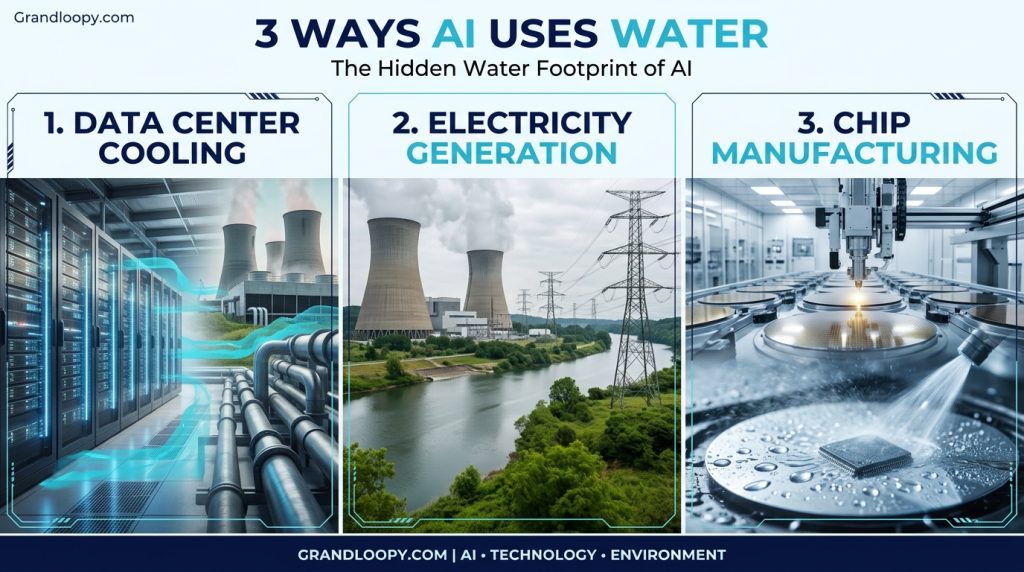
How does AI use water? It uses it in three places: to cool the data centers that run it, to generate the electricity those data centers consume, and to manufacture the chips inside them.
A single prompt uses a tiny amount, somewhere between a few drops and a few tablespoons. The exact number depends on who is counting and what they count, and that scope is the whole story.
The aggregate is large, and the strain is local.
A data center can use as much water in a day as a small town, and a data center built in a dry region can compete with farms and homes for the same water.
This guide gives the real numbers, reconciled.
It shows the per prompt figures with their scope labels, debunks the viral 500 mL figure, and explains cooling towers, power plants, and chip fabs.
It ends with five ways to cut your own AI water footprint.
The Short Answer: 3 Places AI Uses Water
AI uses water in three places, and the first two do almost all of the work.
Direct cooling evaporates water at the data center, power plants evaporate water to make the electricity, and chip factories use ultrapure water to make the chips.
| Where | How | Share of a Prompt |
|---|---|---|
| Direct, on site | Cooling towers evaporate water to carry heat away from GPUs and TPUs | About 25% of the total, per UC Riverside |
| Indirect, off site | Thermoelectric power plants evaporate water to cool themselves while making electricity | About 75% of the total, per UC Riverside |
| Chip manufacturing | Fabs use ultrapure water to wash and cool silicon wafers | Small per prompt, large per chip, about 2,200 gallons per chip |
Most public debate counts only the first place and misses the second.
The power plant share is often the bigger one, and it is the reason AI energy use and AI water use are tied together.
The third place is the hardest to measure and the easiest to leave out. Chip water is real, but most per prompt estimates exclude it, so the numbers below say so when they do.
How Much Water Does One AI Prompt Use? The Reconciliation Table
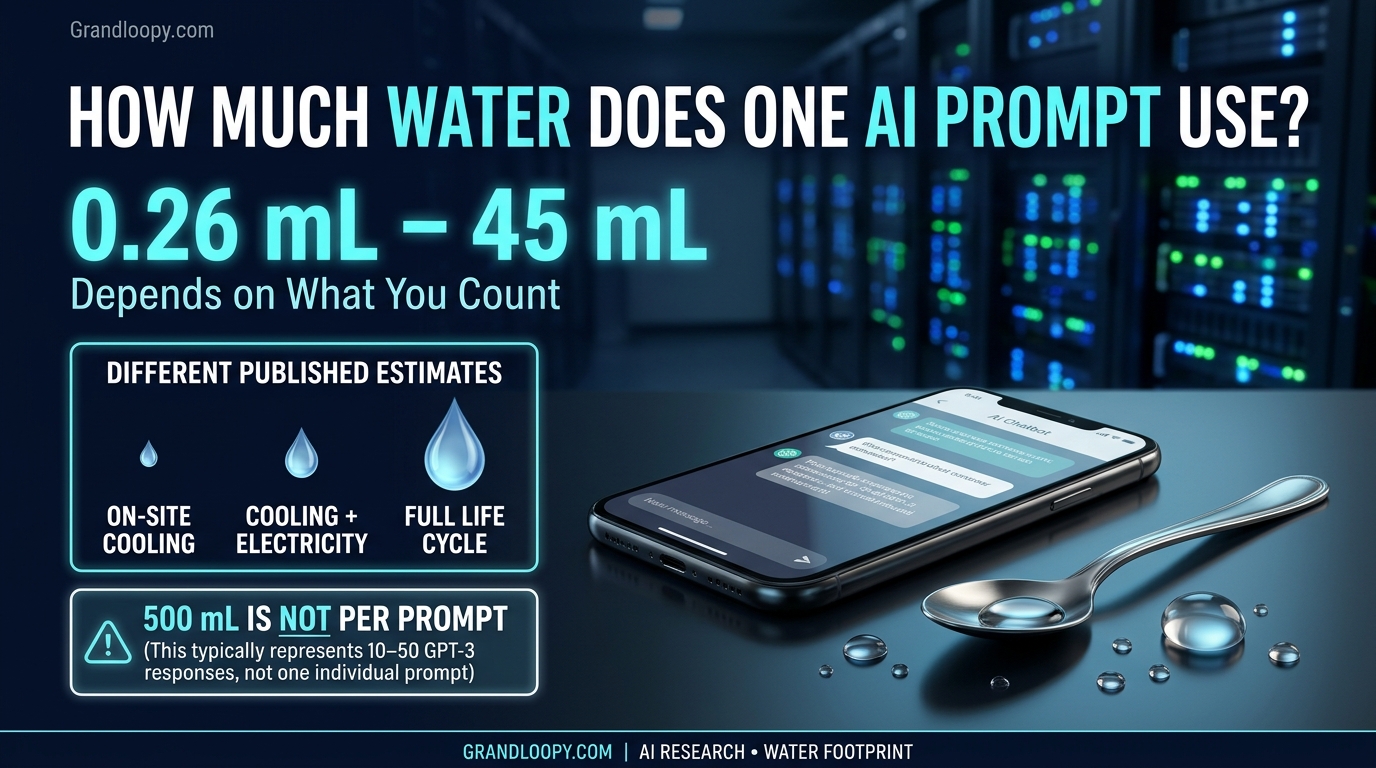
Published estimates for a single text prompt range from about 0.26 milliliters to roughly 45 milliliters.
That is close to a 2,000-fold gap between the smallest and largest numbers in circulation, and the gap is about scope, not disagreement.
| Estimate | Water per Prompt | What It Counts | Who Reported It | Year |
|---|---|---|---|---|
| Google, Gemini median | 0.26 mL, about five drops | On-site cooling only | Google, self-reported | 2025 |
| OpenAI, ChatGPT average | 0.32 mL, about 1/15 of a teaspoon | On-site cooling only | Sam Altman, self-reported | 2025 |
| UC Riverside, revised | About 15 mL total, about 5 mL on-site only | Cooling plus power plant water | Shaolei Ren, independent | 2026 revision |
| UC Riverside, original | About 17 mL, US average | Cooling plus power plant water | Li et al., independent | 2023 |
| Mistral, Le Chat | 45 mL per 400-token answer | Full life cycle, including hardware and training share | Mistral, self-reported | 2025 |
| UC Riverside, 500 mL | About 500 mL per 10 to 50 responses, NOT per prompt | Cooling plus power plant water, GPT-3 era | Li et al., independent | 2023 |
Google and OpenAI figures are self-reported medians across their real production fleets. They are not independently audited, but they are grounded in actual hardware and grid data.
The UC Riverside numbers are third-party estimates built on public assumptions about model size, GPU count, and cooling system. The vendors neither confirm nor deny those assumptions.
Mistral is the only provider that has published a full life-cycle figure.
Its 45 mL includes the water used to make the hardware and to train the model, and 91% of that water comes from training, not from everyday use.
Independent estimates for current generation models generally land in the 1 to 10 mL per query range. That reflects faster, more water efficient hardware and data centers since the 2023 paper.
Google reported 0.24 watt-hours of electricity and 0.26 mL of water for a median Gemini prompt. The energy fell 33-fold through model distillation and custom TPU efficiency, and the water figure fell with it.
OpenAI reported about 0.34 watt-hours and about 0.32 mL for an average ChatGPT query. Sam Altman disclosed the figure in June 2025, with no methodology published.
The 500 mL Myth, Debunked
The most repeated number in this topic is wrong, and it is worth its own section.
The claim that one ChatGPT prompt uses 500 mL of water, a full bottle, is a misapplication, not a finding.
The original 2023 UC Riverside paper estimated about 500 mL for a short conversation of 10 to 50 GPT-3 responses.
That is per conversation, not per prompt, and it used GPT-3 era hardware and energy assumptions.
A 2024 report plugged a far larger, unverified energy estimate for GPT-4 into the same formula. That pushed the water figure up toward a full bottle per prompt, and the number went viral.
The study author, Shaolei Ren, has since said the real per-prompt figure is closer to 15 mL total. About 5 mL of that is on-site cooling, and the rest is power plant water.
The 500 mL figure still appears in headlines, social posts, and even other guides. Treat any source that presents it as per prompt with skepticism, and check what scope it actually counts.
The lesson is not that AI uses no water. The lesson is that the number depends on scope, and a number without a scope is not a fact.
Direct Water Use: Cooling Towers, Explained
AI does not drink water. The computers that run it get hot, and water is the cheapest way to carry that heat away.
A rack of NVIDIA H100 GPUs draws 10 to 30 kilowatts, versus 3 to 5 kW for a standard server rack.
That heat has to go somewhere, and the cheapest place to send it, in energy terms, is into water.
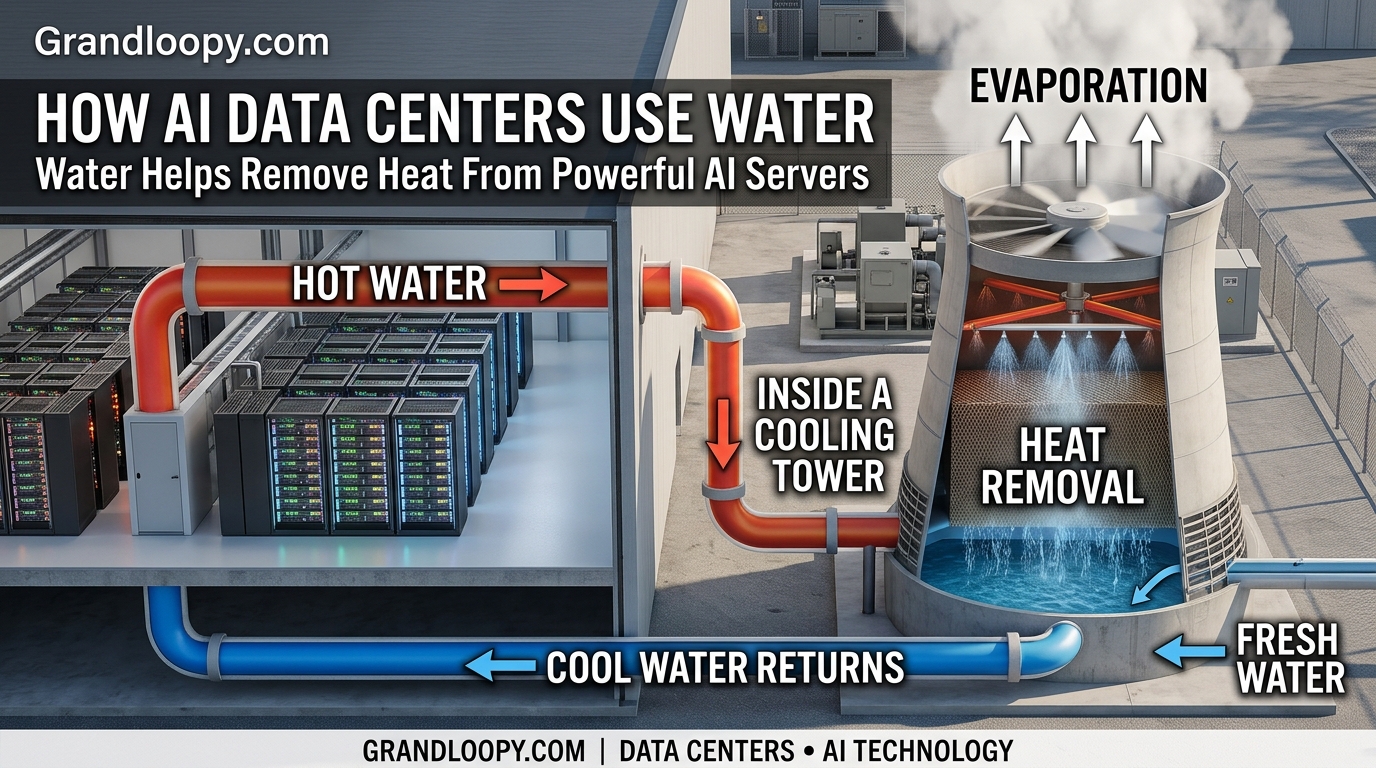
Most large data centers use evaporative cooling. Warm water from the server halls runs through cooling towers, part of it evaporates, and that evaporation pulls heat out of the water.
The evaporated water is gone from the local supply. It goes into the air as vapor, and it does not come back to the river or the aquifer.
About 70% to 80% of the water withdrawn by a cooling tower is evaporated. The rest is discharged as blowdown, to prevent mineral and salt buildup in the tower.
Tower water is typically recycled only 3 to 10 times before it has to be discharged. Fresh make-up water is added constantly, to replace what evaporated and what was flushed.
That make-up water has to be clean, and in many cases it is drinking water. Dirty water clogs pipes and grows bacteria, and a clogged tower is a dead data center.
Newer designs cool the chips directly with liquid in a closed loop, and they use much less water. Direct liquid cooling and immersion cooling keep the water inside the loop, so evaporation drops sharply.
Microsoft newest hyperscale data centers have eliminated evaporative cooling entirely. They use a closed-loop, waterless chilled water system, and Microsoft has a target of zero water consumption by 2030.
How a Cooling Tower Works, Step by Step
1. Hot water leaves the server hall. Chilled water absorbs heat from the GPU racks, warms up, and is pumped to the tower.
2. The tower sprays the warm water through moving air. Some of the water evaporates, and the evaporation carries a great deal of heat away with it.
3. The remaining water comes back cooler. It goes round again, back to the server hall, to absorb more heat.
4. Fresh make-up water replaces what evaporated. The tower needs a constant supply, and that supply is usually municipal drinking water.
5. Blowdown water is discharged. After 3 to 10 cycles, the water is too full of minerals and salts, so it is flushed and replaced.
Cooling Methods Compared
| Method | How It Works | Water Use | Energy Use |
|---|---|---|---|
| Evaporative cooling | Water evaporates in a cooling tower to carry heat away | High, most water is lost as vapor | Low, evaporation is efficient |
| Air cooling | Fans blow air across the equipment | Very low, almost no water | High, fans use a lot of electricity |
| Direct liquid cooling | Liquid runs through cold plates on the chips in a closed loop | Low, water stays in the loop | Low, liquid carries heat well |
| Immersion cooling | Servers sit in a non-conductive liquid bath | Very low, liquid is reused | Low, no fans needed |
| Free cooling | Cold outside air cools the facility when the weather allows | Very low | Very low, weather dependent |
Evaporative cooling is cheap and effective, and it is also a direct, physical loss of fresh water. That trade off is the heart of the AI water debate.
Indirect Water Use: The Power Plant Behind the Prompt
The second, larger use hides behind the plug. The power plant generating the electricity also evaporates water to cool itself, and every kilowatt-hour an AI model draws carries that water cost.
Most of the US grid still runs on thermoelectric power from natural gas, coal, and nuclear plants. Those plants use water for steam generation and cooling, so the water cost is built into the electricity.
Researchers call this the off-site footprint. The 2023 UC Riverside paper, Making AI Less Thirsty, was the first widely cited study to add on-site and off-site water together into one number per query.
In the US, about 2.2 mL per request is evaporated in data center cooling, while about 14.7 mL is consumed by the power plants supplying the electricity.
That split comes from the UC Riverside paper, and it is why the off-site share is about 75% of the total.
Lawrence Berkeley National Laboratory put the scale in stark terms.
In 2023, US data centers consumed 66 billion liters directly, but the indirect water footprint from electricity generation reached 800 billion liters, more than ten times larger.
Power generation is the largest single user of freshwater in the United States.
That is why AI water use and AI energy use cannot be separated, and why a cleaner grid cuts the water footprint too.
Renewable energy changes the math. Solar and wind use almost no water for cooling, so a data center powered by renewables has a far smaller indirect footprint than one powered by coal or gas.
Chip Manufacturing: The Hidden Third Use
Chip factories use large amounts of ultrapure water. That share is the hardest to measure, and most per-prompt estimates leave it out.
Producing one AI chip requires roughly 2,200 gallons of water, according to OECD figures. The water must be ultrapure, far cleaner than drinking water, because even a tiny impurity can ruin a silicon wafer.
Ultrapure water is made by filtering and deionizing ordinary water many times. The process itself uses water, and the fab needs a constant supply, day and night.
Mistral is the only provider that has counted chip water in a per-prompt figure.
Its full life-cycle assessment puts 91% of its model water use in training, which includes the hardware, and most of the rest in everyday use.
Chip water is a one-time cost per chip, spread over billions of prompts. That is why it looks small per prompt and large per chip, and why the scope label matters.
Withdrawal vs Consumption: Why the Numbers Differ 11x
Water withdrawal is all the water taken from rivers or groundwater, even if most of it goes back. Water consumption is the part that does not come back, mostly because it evaporated.
The UC Riverside study uses these definitions, and its 2027 projection shows the gap clearly. In its projection, AI global water withdrawal is about 11 times its consumption.
A cooling tower withdraws the make-up water it adds, and it consumes the part that evaporates. The blowdown water goes back, usually to a treatment plant, and the evaporated water does not.
A power plant works the same way. It withdraws far more water than it consumes, and the consumed share is the part that matters for scarcity.
| Term | Meaning | Example |
|---|---|---|
| Withdrawal | Water removed from the ground or diverted from a surface source | Make-up water added to a cooling tower |
| Consumption | Water evaporated, transpired, or otherwise not available for immediate reuse | Water evaporated from a cooling tower |
| Discharge | Water returned after use, usually treated | Blowdown water flushed from a tower |
Always check which one a figure counts. A withdrawal number will be far larger than a consumption number for the same facility, and mixing them up is how bad comparisons happen.
Training vs Inference: Where the Water Really Goes
Training a model uses far more water than running it, but running it happens far more often. The balance between the two decides where the footprint sits.
Training GPT-4 at Microsoft Iowa facilities consumed 11.5 million gallons in July 2022 and 13.4 million gallons in August 2022. Those two months alone used about 25 million gallons, for one model, at one site.
Mistral life-cycle assessment attributes 85.5% of its model lifetime emissions and 91% of its water use to training. Everyday use, the prompts you send, accounts for the smaller share.
| Phase | What Happens | Water Share (Mistral LCA) |
|---|---|---|
| Training | Thousands of GPUs run for weeks or months to teach the model | About 91% of lifetime water use |
| Inference | One prompt runs through the trained model in seconds | About 9% of lifetime water use |
| Hardware | Chips are made in fabs that use ultrapure water | Counted inside the training share |
The training share shrinks as a model gets used more. A model that answers billions of prompts spreads its training water over billions of answers, so the per-prompt training share falls.
Heavy reasoning and image generation change the balance.
A deep thinking model can burn 18 to 40 watt-hours on a single complex problem, versus 0.24 watt-hours for a median text prompt, and the water follows the energy.
How Much Water Do AI Data Centers Use Per Day?
A typical AI data center uses approximately 300,000 gallons of water per day. That figure comes from the Brookings Institution, and it is the middle of a wide range.
Hyperscale facilities can consume up to 5 million gallons per day. That is equivalent to the daily use of a town of 10,000 to 50,000 people, according to the Environmental and Energy Study Institute.
Google data centers and offices consumed 10.9 billion gallons of water in 2025. That is about 30 million gallons a day, up 34% in a single year, per Google 2026 Environmental Report.
Google largest facility, in Council Bluffs, Iowa, drew 1.35 billion gallons in a single year. That is one site, and it is the scale that makes local communities pay attention.
Across the US, data centers used about 17 billion gallons of water for cooling in 2023. That is the direct figure only, before counting the power plants that feed them.
Company Totals: Google, Microsoft, Amazon, Meta
Company totals must be labelled by scope and year, because the same company reports different numbers for different scopes. Google data-center-only water and Google company-wide water differ by billions of gallons.
| Company | Water | Scope | Period |
|---|---|---|---|
| 6.4 billion gallons | Global data centers | 2023 | |
| 6.1 billion gallons | Global data centers | 2024 | |
| 9.9 billion gallons | Data centers and other operations | 2024 | |
| 10.9 billion gallons | Company-wide | 2025 | |
| Microsoft | 1.7 billion gallons, up 34% | Global operations | 2023 |
| Microsoft | About 2.75 billion gallons | Global operations | 2024 |
| Amazon, AWS | 2.5 billion gallons | Global data centers | 2025 |
| Meta | About 1.4 billion gallons | Global operations | 2024 |
Microsoft reported its global water use jumped about 34% in the year generative AI took off. Google rose about 20% in the same period, into the billions of gallons each.
Amazon published its first absolute water figure in June 2026. AWS AI data centers consumed roughly 2.5 billion gallons globally in 2025.
Microsoft said in June 2026 that it replenished more water than it withdrew globally in fiscal 2025. That is five years ahead of its 2030 water positive goal.
Google has launched 165 water stewardship projects targeting 19 billion gallons of replenishment per year by 2030. Replenishment means returning water to the watershed, through aquifer recharge, restoration, and efficiency projects.
Microsoft and Google report different twelve-month windows. Microsoft reports July to June, while Google and Amazon report calendar years, so a 2025 Microsoft figure and a 2025 Google figure cover different periods.
WUE: The Efficiency Number That Matters
Water Usage Effectiveness, or WUE, measures how much water a data center uses per unit of IT energy. It is reported in liters per kilowatt-hour, and lower is better.
| Company | WUE (L/kWh) | Basis |
|---|---|---|
| About 1.1 | Global average, 2022 reporting | |
| Meta | About 1.26 | Global average, 2022 reporting |
| Microsoft | About 1.8 | Global average, 2022 reporting |
WUE and PUE measure different things. PUE, Power Usage Effectiveness, measures energy efficiency, and WUE measures water efficiency, and a data center can be good at one and bad at the other.
Air cooling has a low WUE but a high PUE. It uses almost no water, but the fans use a lot of electricity, so the energy cost rises.
Evaporative cooling has a higher WUE but a lower PUE. It uses a lot of water, but the evaporation is energy efficient, so the electricity cost falls.
The best data centers balance the two. They use free cooling when the weather allows, liquid cooling for dense racks, and evaporative cooling only when it is needed.
Where AI Water Strain Hits Hardest
The aggregate is large, but the strain is local. A data center in a wet region is a small problem, and the same data center in a dry region is a big one.
| Place | What Happened | Scale |
|---|---|---|
| Memphis, Tennessee | xAI Colossus draws up to 1 million gallons per day of potable water from the local aquifer | Labelled, re-verify at publication |
| Iowa | Residents protested Microsoft groundwater use near its five data center campuses | Labelled, re-verify at publication |
| Texas | Data centers consumed about 25 billion gallons in 2025, counting direct and indirect use | HARC, January 2026 |
| Arizona | Data centers compete for water in a desert state with long droughts | Context, not a single figure |
| Virginia | The largest data center market in the world, with growing water demand | Context, not a single figure |
Texas data centers are projected to use 29 to 161 billion gallons a year by 2030. That is up to 2.7% of Texas water use, per the Houston Advanced Research Center, January 2026.
Location determines impact far more than workload. The same prompt uses the same energy everywhere, but the water it costs depends on the local grid, the local climate, and the local water supply.
A data center in a cool climate can use free cooling for much of the year.
A data center in a hot, dry climate needs evaporative cooling almost all year, so it uses far more water for the same work.
AI Water Use by 2030: The Projections
Projections differ because they count different things, and they must be presented by source and year, never merged. WRI, IEA, and UNU-INWEH use different boundaries, and their numbers are not the same thing.
| Source | Projection | Year | What It Counts |
|---|---|---|---|
| World Resources Institute | 1.1 to 1.7 trillion gallons per year | 2030 | AI infrastructure freshwater consumption |
| IEA | About 1,200 billion liters per year, up from 560 billion in 2023 | 2030 | All global data centers, not AI only |
| UNU-INWEH, high-AI scenario | 9.3 trillion liters per year | 2030 | AI-related water consumption, high scenario |
| de Vries-Gao | 312 to 765 billion liters | 2025 | AI systems water footprint alone |
The United Nations University June 2026 report put 2025 data center water consumption at the equivalent of 1.8 million Olympic-sized pools. Its high-AI scenario reaches 9.3 trillion liters of AI-related water consumption by 2030.
The same UNU report projects AI data centers will consume water equivalent to the basic living needs of 1.3 billion people annually by 2030.
That figure is a comparison, not a measurement, and it shows the scale in human terms.
Global daily AI prompt processing has surged to 2.5 billion prompts per day.
At even 1 mL per prompt, that is 2.5 million liters a day, and at 15 mL it is 37.5 million liters a day, before training and chips.
Global data center water consumption could surge from roughly 560 billion liters annually to nearly 1,200 billion liters by 2030. That is the IEA projection, and AI is the main driver of the growth.
How to Reduce Your Own AI Water Footprint
Your own footprint is small, but the habits are real, and they add up across billions of users. Five actions cut it sharply, and none of them require you to stop using AI.
1. Use Shorter Prompts and Smaller Models
A short prompt on a small model uses far less water than a long prompt on a large reasoning model. Use the fast model for simple questions, and save the heavy model for hard problems.
A median text prompt uses about 0.24 watt-hours. A deep reasoning problem can use 18 to 40 watt-hours, which is 75 to 165 times more, and the water follows the energy.
2. Batch Your Questions
Ask five questions in one prompt instead of five separate prompts. Batching cuts the overhead, because each prompt has a fixed cost on top of the answer itself.
3. Skip Image and Video Generation When You Do Not Need It
Image and video generation use far more energy and water than text. Use text when text will do, and save generation for the images you actually need.
4. Choose Providers That Disclose Water Use
Google, OpenAI, and Mistral have published per-prompt figures. Microsoft, Anthropic, and Meta have not, and disclosure is the first step toward accountability.
5. Ask at Off-Peak Times
Grids are cleaner at some times than others. When renewable energy is abundant, the indirect water cost of your prompt falls, because solar and wind use almost no cooling water.
A daily habit of 25 text and coding prompts works out to roughly 35 milliliters per day.
That is about seven teaspoons, or roughly 10 to 12 liters over an entire working year, at the combined cooling plus grid estimate.
7 Mistakes to Avoid
Most mistakes around AI water use are easy to avoid, and the list below covers the seven most common ones.
1. Quoting 500 mL Per Prompt
The 500 mL figure is per 10 to 50 GPT-3 responses, not per prompt. The per-prompt version is a 2024 misapplication, and the author has corrected it to about 15 mL.
2. Mixing Withdrawal and Consumption
Withdrawal is all the water taken, and consumption is the part that does not come back. A withdrawal number will be far larger than a consumption number for the same facility.
3. Merging Company Totals Across Scopes and Years
Google 6.4 billion gallons in 2023 is data centers only, and Google 10.9 billion gallons in 2025 is company-wide. They are not the same number, and they cannot be compared directly.
4. Treating Vendor Figures as Audited
Google and OpenAI figures are self-reported, not independently audited. They are grounded in real data, but no outside party has verified them.
5. Counting Only On-Site Cooling
On-site cooling is about 25% of a prompt footprint, and power plant water is about 75%. Counting only the data center misses most of the water.
6. Ignoring Location
The same prompt costs different amounts of water in different places. The local grid, the local climate, and the local water supply decide the impact, not the prompt alone.
7. Presenting Projections as Measurements
WRI, IEA, and UNU-INWEH figures are projections and estimates, not measurements. They use different boundaries, so present them by source and year, never merged.
Keep Reading on GrandLoopy
GrandLoopy does not have an AI environment or sustainability cluster yet, so there are no water, energy, or data center guides on this site to link to.
The closest live pages are the AI guides, and they fit the AI side of this topic.
Our guide to why ChatGPT gives different answers explains the seven reasons a chatbot answer changes.
It covers the model, the prompt, and the randomness behind the answer, and it pairs with the per-prompt water figures in this guide.
Our guide to how to stop AI chatbots from making up sources shows how to check a chatbot answer against real sources.
It covers the verification habit that matters for AI water claims too, because the 500 mL figure spread by being repeated without a check.
Our guide to how AI customer support is changing small online stores covers AI in small business.
It shows where AI actually runs in the real world, and every one of those chatbots runs in a data center that uses water.
Our guide to how to tell if an image is AI-generated lists ten clues for spotting AI images.
It covers image generation, which uses far more energy and water than text, so it pairs with the reduction section above.
Our guide to laptop fan running with nothing open explains why a computer gets hot and how to cool it.
It covers the same heat problem at a small scale, and a data center cooling tower is the same problem at a very large scale.
The site has no AI water, AI energy, or data center pages yet, so this article carries no topical internal links.
The follow up cluster should add how much energy AI uses, AI carbon footprint, and how much water ChatGPT uses.
It should also add data center cooling methods, WUE explained, and water positive explained, so future AI environment guides can link to each other.
FAQs About AI Water Use
How does AI use water?
AI uses water in three places: to cool data centers, to generate the electricity those data centers use, and to manufacture the chips.
Cooling towers evaporate water, power plants evaporate water, and fabs use ultrapure water.
How much water does AI use per prompt?
Between about 0.26 mL and about 45 mL, depending on what you count.
Google reports 0.26 mL for on-site cooling only, OpenAI reports 0.32 mL, UC Riverside estimates about 15 mL including power plant water, and Mistral reports 45 mL for a full life cycle.
How much water does ChatGPT use per query?
About 0.32 mL for on-site cooling, per Sam Altman in June 2025. That is about 1/15 of a teaspoon, and it counts only the water evaporated at the data center, not the power plant water.
How much water does Gemini use per prompt?
About 0.26 mL for a median text prompt, per Google in August 2025. That is about five drops, and it counts on-site cooling only, with 0.24 watt-hours of electricity.
How much water does Copilot use?
Microsoft has not published a per-prompt water figure for Copilot.
Copilot runs largely on OpenAI models in Microsoft data centers, so OpenAI 0.32 mL is the closest disclosed reference, but Microsoft has not confirmed it for Copilot itself.
How much water does Claude use?
Anthropic has not published a per-prompt water figure for Claude. No independent estimate specific to Claude has been published either, so any figure you see is a guess based on other models.
How much water does Mistral use?
About 45 mL per 400-token Le Chat answer, per Mistral full life-cycle assessment in July 2025. That includes hardware and training, and 91% of the water comes from training, not from everyday use.
Does AI use drinking water?
Yes, often. Cooling towers need clean make-up water, and in many cases it is drinking water, because dirty water clogs pipes and grows bacteria.
Why does AI need so much water?
Because AI hardware generates enormous heat, and water is the cheapest way to carry heat away.
A rack of H100 GPUs draws 10 to 30 kilowatts, and evaporative cooling removes that heat efficiently, at the cost of evaporated water.
Does AI use a lot of water?
Per prompt, no. In aggregate, yes. One prompt uses a few drops to a few tablespoons, but 2.5 billion prompts a day, plus training and chips, add up to billions of gallons a year.
How much water does a data center use per day?
A typical AI data center uses about 300,000 gallons per day, and a hyperscale facility can use up to 5 million gallons per day.
That is equivalent to the daily use of a town of 10,000 to 50,000 people.
How much water does Google use for AI?
Google data centers used 6.4 billion gallons in 2023 and 6.1 billion gallons in 2024. Company-wide, Google used 10.9 billion gallons in 2025, up 34% in a year, per the 2026 Environmental Report.
How much water does Microsoft use for AI?
Microsoft used 1.7 billion gallons in 2023, up 34%, and about 2.75 billion gallons in 2024.
In June 2026, Microsoft said it replenished more water than it withdrew globally in fiscal 2025, five years ahead of its 2030 goal.
How much water does Amazon use for AI?
Amazon AWS data centers consumed roughly 2.5 billion gallons globally in 2025. That was Amazon first absolute water figure, published in June 2026.
How much water does Meta use for AI?
Meta used about 1.4 billion gallons in 2024. Meta has not published a per-prompt figure, and its total is smaller than Google, Microsoft, or Amazon.
How much water does training AI use?
Training uses far more water than running a model, but it happens once.
Mistral attributes 91% of its model lifetime water use to training, and GPT-4 training at Microsoft Iowa used about 25 million gallons in two months in 2022.
How much water does GPT-4 training use?
At Microsoft Iowa, GPT-4 training consumed 11.5 million gallons in July 2022 and 13.4 million gallons in August 2022. That is about 25 million gallons in two months, for one model, at one site.
How much water will AI use by 2030?
The World Resources Institute projects AI infrastructure will consume 1.1 to 1.7 trillion gallons of freshwater annually by 2030.
The IEA projects all global data centers will use about 1,200 billion liters by 2030, up from 560 billion in 2023.
Is AI water use a problem?
Per prompt, no. In dry regions, yes.
The strain is local, and a data center in a drought-prone area can compete with farms and homes for the same water, while the same data center in a wet region is a small problem.
Where does AI water come from?
Mostly municipal drinking water, groundwater, and surface water. Cooling towers use municipal water, power plants use river and lake water, and chip fabs use ultrapure water made from municipal water.
What is AI water footprint?
The total water used to run AI, including direct cooling, power plant water, and chip manufacturing. The footprint depends on scope, so a figure without a scope label is not a fact.
How is AI water measured?
Companies measure withdrawal and consumption at the data center, and researchers estimate the power plant share from grid data. No company publishes per-query water data with an independent audit, so direct comparisons require estimates.
What is the difference between water withdrawal and water consumption?
Withdrawal is all the water taken, even if most of it goes back, and consumption is the part that does not come back, mostly because it evaporated.
In the UC Riverside 2027 projection, AI global water withdrawal is about 11 times its consumption.
What is WUE?
Water Usage Effectiveness measures how much water a data center uses per unit of IT energy, in liters per kilowatt-hour. Lower is better, and Google reports about 1.1, Meta about 1.26, and Microsoft about 1.8.
What is PUE?
Power Usage Effectiveness measures how much total energy a data center uses per unit of IT energy.
A data center can be good at PUE and bad at WUE, because air cooling saves water but uses more electricity.
Conclusion
How does AI use water? It uses it in three places: to cool data centers, to generate electricity, and to manufacture chips, and the power plant share is often the largest.
One prompt uses between about 0.26 mL and about 45 mL, depending on scope.
Google and OpenAI count on-site cooling only, UC Riverside adds the power plant, and Mistral counts the full life cycle including training.
The 500 mL figure is not per prompt. It is per 10 to 50 GPT-3 responses, and the author has corrected the per-prompt figure to about 15 mL.
The aggregate is large, and the strain is local. A data center can use as much water as a small town, and a data center in a dry region competes with farms and homes.
Use shorter prompts, smaller models, and batch your questions. Skip image generation when text will do, choose providers that disclose water use, and ask at off-peak times when the grid is cleaner.
Check the scope before you quote a number. A figure without a scope label is not a fact, and a projection is not a measurement.
For the original research, see Making AI Less Thirsty: Uncovering and Addressing the Secret Water Footprint of AI Models on arXiv. For the global energy picture, see the IEA data centres page.
For the United Nations view, see UNU-INWEH. For Google own reporting, see Google Sustainability. For the World Resources Institute, see WRI.
The World Resources Institute projection of 1.1 to 1.7 trillion gallons by 2030 is named here with its source and year.
The WRI insights page guessed at writing time returned a 404, so it is not linked.
The Lawrence Berkeley National Laboratory 2024 report and the USGS thermoelectric water page are named in plain text only.
Berkeley Lab returned a bot wall and USGS returned a 403 to our check at writing time.