Who Owns Claude AI? Anthropic, Not Amazon or Google
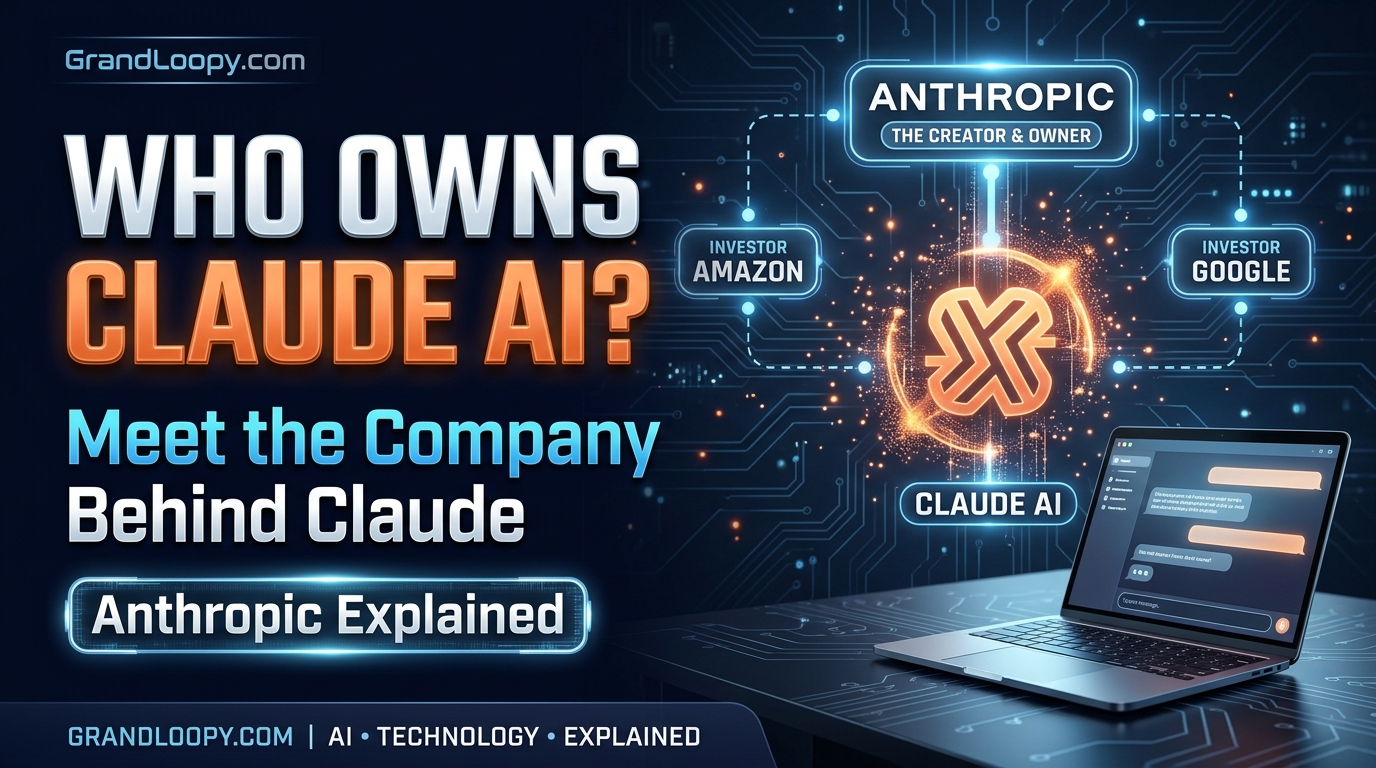
Who owns Claude AI? Anthropic does, the company that built it, and no other company owns it.
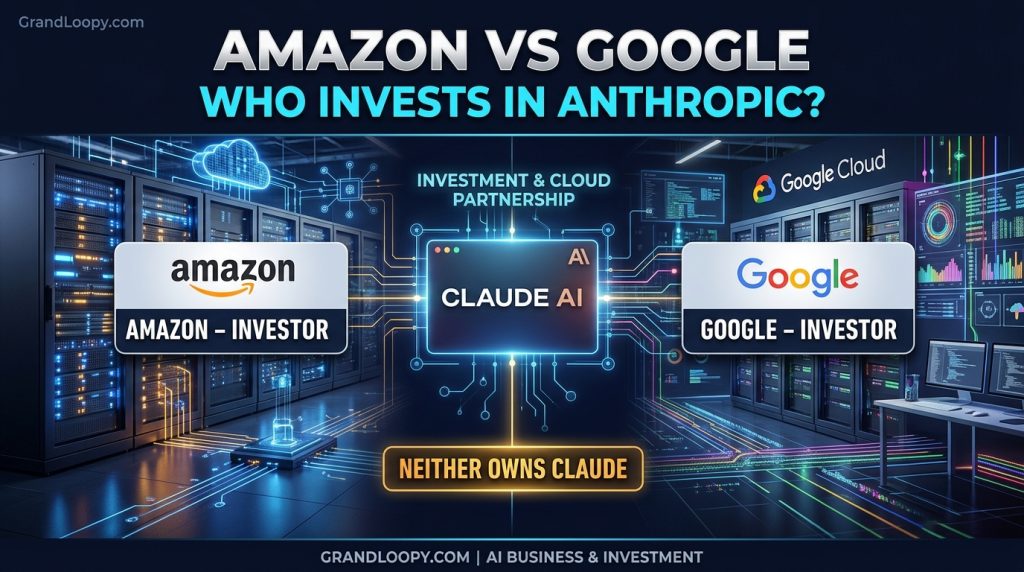
Claude is not owned by Amazon, Google, OpenAI, or Microsoft. Amazon and Google are major investors, but they hold nonvoting shares, and they do not control Anthropic.
Anthropic is a privately held public benefit corporation, founded in 2021 by former OpenAI employees. Its seven co-founders, its board, and an independent Long-Term Benefit Trust govern it.
This guide gives the one-line answer first, then the full breakdown.
It shows the stakes by source, the valuation timeline, the IPO status, and who owns what Claude generates, with every conflicting figure labelled by source and date.
The Short Answer: Anthropic Owns Claude
Claude is owned and developed by Anthropic PBC, a Delaware public benefit corporation based in San Francisco.
Anthropic owns the Claude brand, develops the models, operates the Claude service, and licenses access through its own products.
| Question | Answer |
|---|---|
| Who owns Claude AI? | Anthropic PBC |
| Is Claude owned by Google? | No. Google is an investor and cloud partner, not the owner. |
| Is Claude owned by Amazon? | No. Amazon is an investor and cloud partner, not the owner. |
| Is Claude owned by OpenAI? | No. Anthropic was founded by former OpenAI employees, and it is a separate company. |
| Is Claude owned by Microsoft? | No. Microsoft is a shareholder, per the S-1, not the owner. |
| Is Claude a public company? | Not yet. Anthropic filed an S-1 in October 2026 to list on Nasdaq as ANT, with no price range set. |
Investment is not ownership. Amazon and Google put in billions of dollars, but their shares carry no vote, and neither company has a board seat.
Anthropic has never published a full cap table. Its complete ownership breakdown is not available the way a public company shareholding is, so every stake below is an estimate, labelled by source and date.
Who Is Anthropic?
Anthropic is an American artificial intelligence company founded in 2021. It builds AI systems that are safe, reliable, and aligned with human values, and Claude is its flagship product.
Anthropic is organized as a Delaware public benefit corporation, or PBC.
A PBC can pursue stated public-benefit purposes alongside financial returns for shareholders, and Anthropic’s stated purpose is the responsible development and maintenance of advanced AI for the long-term benefit of humanity.
Anthropic is based in San Francisco, California. It has offices in the United States and abroad, and its models run on cloud infrastructure from Amazon and Google.
Claude is Anthropic’s AI product line. It includes the Claude chat service, the Claude API, Claude Code, and the model family: Opus, Sonnet, and Haiku.
Anthropic is not a subsidiary of any larger company. It has its own leadership, board, stockholders, research teams, and governance structure, and it is not presented as part of Google, Amazon, Microsoft, or OpenAI.
The Seven Co-Founders
Anthropic was founded in 2021 by seven former OpenAI employees. They left OpenAI over disagreements about AI safety and commercial direction, and they built Anthropic around safety-first governance.
| Co-Founder | Role |
|---|---|
| Dario Amodei | Chief Executive Officer |
| Daniela Amodei | President |
| Tom Brown | Co-founder, research |
| Jack Clark | Co-founder, policy and research |
| Jared Kaplan | Co-founder, research |
| Sam McCandlish | Co-founder, research |
| Christopher Olah | Co-founder, research |
Dario Amodei and Daniela Amodei are siblings. Dario leads the company as CEO, and Daniela serves as President, and both sit on the board.
The seven founders hold about 11.25% of Anthropic economically, per Forbes in May 2026.
That figure is an estimate, and Bloomberg put the same block under 7% on the same day, so the two sources conflict, and both are shown below.
The founders keep majority voting control after the listing.
Anthropic plans to issue one special share of Class F common stock to Founder LLC, an entity formed by the seven founders, and that share carries the voting control.
Who Owns Anthropic? The Stakes, By Source
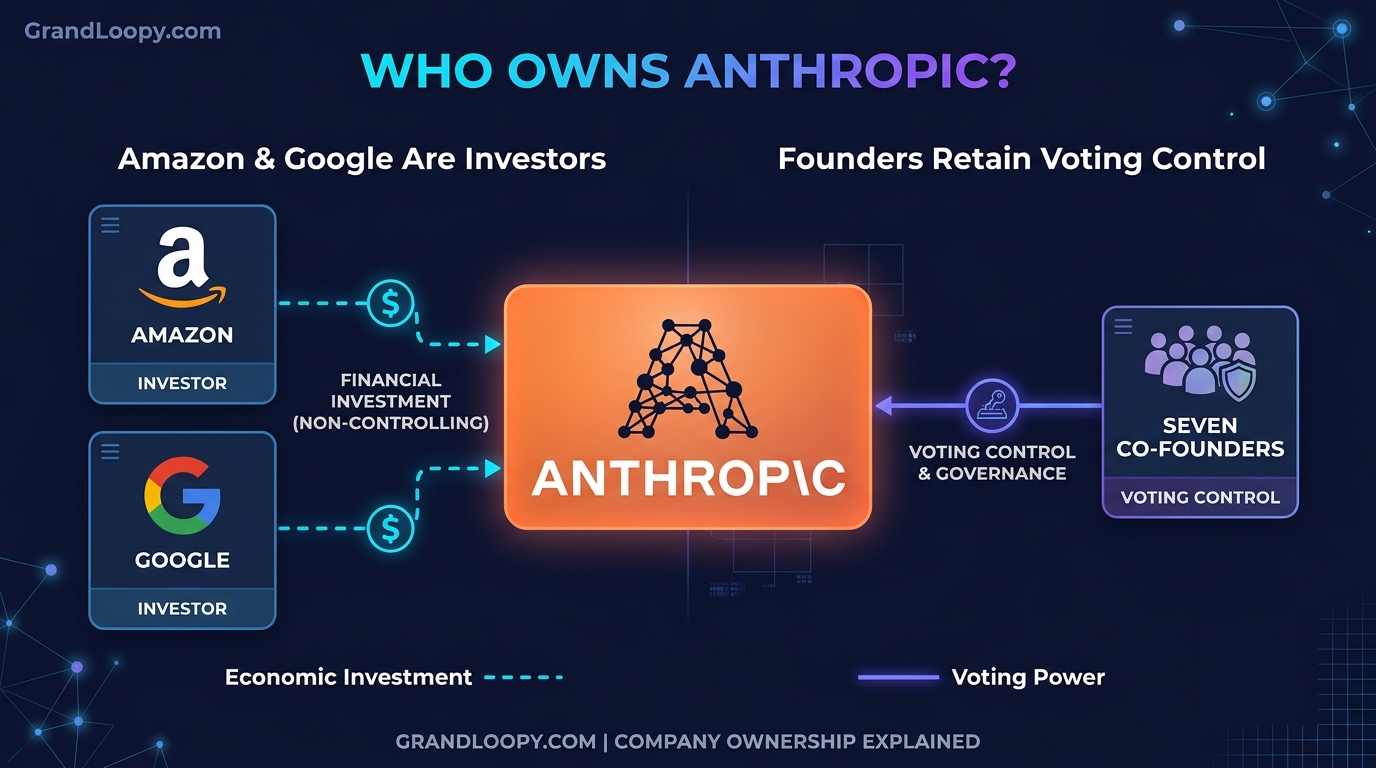
Anthropic has never published a full cap table, so treat every figure below as an economic estimate, dated, not a clean ownership ledger.
The same stakeholder has different percentages by source, and the table shows them side by side, never merged.
| Stakeholder | Stake | Source and Date | Control |
|---|---|---|---|
| Google / Alphabet | About 14%, capped at 15% | Court documents in U.S. v. Google, via New York Times | No votes, no board seats, no observer rights |
| Google / Alphabet | About 15% | Dealroom estimate at $1.5T valuation, November 2026 | No votes, no board seats |
| Amazon | About 9.7% | SaaS Market Cap, derived from Amazon 10-Q, June 2026 | Nonvoting preferred and convertible notes, no board seat |
| Amazon | About 12% | Dealroom estimate at $1.5T valuation, November 2026 | Nonvoting, 12% cap, waivable |
| Amazon | Could approach 20% if the cap is waived | PitchBook, conditional estimate, 2026 | Conditional, not a confirmed stake |
| Seven co-founders | About 11.25%, about 1.61% each | Forbes, May 29, 2026 | Majority voting control via Class F share |
| Seven co-founders | Under 7%, under 1% each | Bloomberg, May 29, 2026 | Majority voting control via Class F share |
| Employee option pool | About 11% | Dealroom estimate, November 2026 | No control as a block |
| Other shareholders | About 36% | Dealroom estimate, November 2026 | Various, no control as a block |
| Anthropic Public Benefit Fund | 5% | S-1, per MEXC, 2026 | No control stated |
PitchBook counts roughly 300 investors and more than $130 billion raised across 18 rounds.
The named lines above are a small slice of the register, and the rest is held by venture firms, institutional investors, and employees.
Other named investors include Spark Capital, ICONIQ, Menlo Ventures, and Coatue Management. They participated in the company financing, and none of them is presented as a controlling owner.
Amazon Stake: What Amazon Owns and What It Does Not
Amazon is Anthropic’s largest financial backer, and it does not own Anthropic. The two facts sit together, and the difference between them is the whole story.
Amazon has deployed roughly $18 billion in Anthropic. That figure comes from Visionary Talks in 2026, and it covers convertible notes plus nonvoting preferred stock.
Amazon does not hold Anthropic common stock.
Per its June 30, 2026 quarterly filing, the position is held as convertible notes plus nonvoting preferred stock.
The split is roughly $97.9 billion in notes and $92.5 billion in preferred, about $190.4 billion of carrying value, after Amazon marked the position up to Anthropic latest funding.
Amazon held about $6.2 billion in principal of outstanding convertible notes as of June 30, 2026.
Those notes can convert into Class N non-voting shares, with potential conversions totaling roughly 1.84 billion shares, subject to a 12% ownership cap that Amazon may waive.
Amazon is also Anthropic cloud computing infrastructure provider. The collaboration spans AWS cloud services and Amazon proprietary AI chips, Trainium and Inferentia, and Amazon is Anthropic’s largest customer as well as its largest investor.
Amazon has no board seat and no control. Its shares carry no vote, and the 12% cap limits its economic stake unless it is waived, and even then the shares are nonvoting.
Google Stake: What Google Owns and What It Does Not
Google is Anthropic’s second largest backer, and it does not own Anthropic either. Google stake is a minority, capped, nonvoting position, and Google has no board seat.
Google holds a minority stake reported near 14%, contractually capped at 15%. That figure comes from court documents in U.S. v.
Google, reported by the New York Times, and it carries no votes, no board seats, and no observer rights.
Google has a potential financing facility of up to $20 billion, but it had drawn down nothing as of June 30, 2026.
Access to the funds is subject to conditions such as compute partnerships and revenue milestones.
Google has committed up to $20 billion more by one source, and up to $40 billion more by another.
The two figures conflict by source, so both are shown here, and neither is presented as confirmed.
Google is also a cloud and distribution partner.
Claude runs on Google Cloud infrastructure, and Google distributes Claude through its cloud marketplace, but Claude is not a Google product, and it is not part of the Gemini brand.
Economic Ownership vs Voting Control
Economic ownership and voting control are not the same thing at Anthropic, and the split is deliberate. Amazon and Google own the most economically, and the founders control the votes.
| Party | Economic Stake | Voting Control |
|---|---|---|
| Amazon | Largest, mid-teens at most | None, nonvoting shares |
| About 14%, capped at 15% | None, no votes, no board seats | |
| Seven co-founders | About 7% to 11%, by source | Majority, via Class F share to Founder LLC |
| Long-Term Benefit Trust | None, Class T shares have no economic value | Elects a portion of the board, growing to a majority |
| Other investors and employees | The rest, about 36% plus the option pool | Various, no control as a block |
Investment amounts, economic ownership stakes, and voting rights are not identical. A dollar invested does not buy a vote at Anthropic, and that is by design.
Anthropic board is elected jointly by the company stockholders and by the Trust.
The board’s current members include Dario Amodei and Daniela Amodei, and the Trust authority is designed to grow into a majority of the board over time.
The Long-Term Benefit Trust
Anthropic created the Long-Term Benefit Trust, an independent body that is financially disinterested in Anthropic’s outcome.
Its members do not profit from the company performance, so their incentive is the public benefit purpose, not the share price.
The Trust holds a class of stock, Class T shares, that gives it the authority to elect and remove a portion of Anthropic board.
Anthropic states that authority is designed to grow into a majority of the board over time, and one source puts the timeline at within four years.
The Trust has no economic value. Its shares carry no right to dividends or sale proceeds, so the Trust cannot be bought, and it cannot profit from a sale.
The Trust is the reason Anthropic can take money from Amazon and Google without giving them control. The investors get economic exposure, and the Trust and the founders keep governance.
Valuation Timeline: $61.5B to $965B to $1.5T
Anthropic valuation climbed from about $61.5 billion to roughly $965 billion in a little over a year, and it is still moving. The timeline below shows each step, labelled by source and date.
| Date | Valuation | Event | Source |
|---|---|---|---|
| Early 2025 | About $61.5 billion | Earlier private valuation | Visionary Talks, 2026 |
| May 28, 2026 | $965 billion post-money | Series H, $65 billion raised | Anthropic, confirmed |
| Early July 2026 | Near $1.2 trillion | Secondary markets | Visionary Talks, 2026 |
| October 2026 | $1.8 to $2 trillion | IPO talk | Reporting, October 2026 |
| November 5, 2026 | About $1.5 trillion | IPO talk, down from October | Reporting, November 2026 |
The only valuation Anthropic has confirmed is $965 billion post-money, from the Series H announced on May 28, 2026.
The $1.5 trillion figure is reported IPO talk, not a confirmed valuation, and the IPO valuation is not set.
Series H raised $65 billion, led by Altimeter, Dragoneer, Greenoaks, and Sequoia. It was co-led by Capital Group, Coatue, D1, GIC, ICONIQ, and XN, and it was expected to be the last private round.
Run-rate revenue crossed $47 billion in May 2026.
That is the revenue pace at the time of the Series H, and it implies a valuation to revenue multiple of about 20.5x, derived, not an enterprise value multiple.
Anthropic has raised $141.1 billion since founding, per the S-1. It held $131.8 billion of cash and short-term investments on September 30, 2026, per Amendment No.
1, plus a revolving credit facility expanded to $15 billion in September 2026, maturing September 4, 2031.
Funding Rounds: Series A to Series H
Anthropic raised money in stages, and each round set a higher valuation.
The table below covers the rounds Anthropic announced with a valuation, and the Amazon and Google convertible notes and preferred purchases sit outside it.
| Round | Date | Amount | Valuation |
|---|---|---|---|
| Series A | 2021 | Not disclosed in this guide | Not disclosed in this guide |
| Series B | 2022 | Not disclosed in this guide | Not disclosed in this guide |
| Series C | 2023 | Not disclosed in this guide | Not disclosed in this guide |
| Series D | 2023 | Not disclosed in this guide | Not disclosed in this guide |
| Series E | 2024 | Not disclosed in this guide | Not disclosed in this guide |
| Series F | 2025 | Not disclosed in this guide | About $61.5 billion |
| Series G | 2025-2026 | Not disclosed in this guide | Not disclosed in this guide |
| Series H | May 28, 2026 | $65 billion | $965 billion post-money |
Only the Series H figures are confirmed in this guide, because the earlier rounds were not announced with a valuation in the sources used.
The funding history should be re-verified against Anthropic announcements and the S-1 at publication, and no round should be invented to fill the table.
Amazon and Google money sits outside the series rounds. Their convertible notes and preferred purchases are separate instruments, and they are covered in the stake sections above, not in the rounds table.
Anthropic IPO: S-1, Ticker ANT, and the Missing Price Range
Anthropic filed IPO registration documents with the US Securities and Exchange Commission on October 26, 2026, planning to list on Nasdaq under the proposed ticker symbol ANT.
That is the latest reporting, and it comes from TradingKey via Mitrade and from MEXC in November 2026.
Amendment No. 1, filed November 2, 2026, still has no price range.
As of November 5, 2026, neither the S-1 nor the amendment gives a price range, and a registration statement reports what investors paid, not what the next buyer will pay.
Earlier reporting said something different, and the conflict must be shown.
Visionary Talks and SaaS Market Cap reported a confidential S-1 submitted to the SEC on June 1, 2026, with no S-1 appearing on EDGAR, and no public ticker.
The two accounts are not necessarily contradictory.
A confidential filing in June can become a public filing in October, and the later reporting says the public S-1 exists.
The status should be re-verified on EDGAR at publication, and the filing date should be labelled by source.
The market’s current valuation expectation for Anthropic is approximately $1.5 trillion to $2 trillion, but the final offering valuation and listing performance remain uncertain.
The talk moved from $1.8 trillion to $2 trillion in October to about $1.5 trillion after the amended filing in November.
Amazon, Google, and Microsoft are shareholders, and they are also Anthropic largest suppliers and, in Amazon and Google’s case, its largest customers.
The S-1 discloses compute commitments and customer concentration, and that dual role is part of the IPO story.
The IPO size itself is not set yet. The S-1 sets out each shareholder position, but it does not set the offering size or the price, and those will be set at pricing.
Who Owns Claude Outputs? You Do, With a Copyright Caveat
Ownership of Claude and ownership of Claude outputs are two different questions, and they have different answers.
Anthropic owns Claude, and you own what Claude generates for you, subject to the terms, but ownership is not the same as copyright protection.
| Plan | Output Ownership | Training on Your Content | Commercial Use |
|---|---|---|---|
| Claude Free | Yours, Anthropic assigns all right, title, and interest | Consumer terms apply, check the current terms | Yes, subject to the terms |
| Claude Pro ($20 per month) | Yours, Anthropic assigns all right, title, and interest | Consumer terms apply, check the current terms | Yes, subject to the terms |
| Claude API | Yours, customer owns outputs | Anthropic may not train on customer content under commercial terms | Yes, subject to the terms |
| Claude Enterprise | Yours, customer owns outputs | Anthropic may not train on customer content under commercial terms | Yes, subject to the terms |
Anthropic Consumer Terms, Section 4, Rights and Responsibilities, say: Subject to your compliance with our Terms, we assign to you all of our right, title, and interest, if any, in Outputs.
That is the assignment that gives users ownership of what Claude generates.
Anthropic Commercial Terms say the customer retains all rights to its inputs and owns its outputs.
Anthropic disclaims any rights it receives to the customer content under those terms, and it assigns its right, title, and interest, if any, in outputs to the customer.
Ownership does not guarantee copyright protection. AI-generated content without substantial human contribution is not copyrightable under current US law, per Copyright Office guidance from 2023 to 2025, which requires human authorship.
Thaler v. Perlmutter, No. 23-5233, D.C. Circuit 2025, cert denied 2026, confirms the rule. Purely AI-generated works have no copyright protection, and a human must contribute creative authorship for a work to be protected.
Anthropic commercial terms state plainly that Anthropic may not train its models on customer content submitted through its business and API services.
That is a separate promise from output ownership, and it matters for business users.
Claude vs ChatGPT vs Gemini vs Grok: Who Owns Each
The four leading chatbots have four different owners, and the table below is the fastest way to keep them straight.
| AI Product | Company Behind It | Founded | Structure |
|---|---|---|---|
| Claude | Anthropic | 2021 | Public Benefit Corp, independent |
| ChatGPT | OpenAI | 2015 | Capped-profit company, Microsoft is a major investor |
| Gemini | Alphabet, Google DeepMind | 2023, DeepMind founded 2010 | Wholly owned subsidiary of Alphabet |
| Grok | xAI | 2023 | Private company, founded by Elon Musk |
Claude is the only one of the four owned by a public benefit corporation with an independent trust.
ChatGPT is owned by OpenAI, Gemini is owned by Alphabet, and Grok is owned by xAI, and each has a different governance structure.
Anthropic founders came from OpenAI, and that is why people ask if Claude is an OpenAI product. It is not, and Anthropic is a separate company with its own models, products, and governance.
Why People Confuse Investment With Ownership
People confuse investment with ownership because the numbers are large and the names are familiar.
Amazon put in $18 billion, Google put in billions more, and both companies’ names appear in every Anthropic story, so it is easy to assume one of them owns Claude.
The confusion is worse because Amazon and Google are also Anthropic cloud providers and customers.
Claude runs on AWS and Google Cloud, and Amazon and Google buy Claude through their cloud marketplaces, so the business relationship looks like ownership from the outside.
The confusion is worse still because Anthropic has never published a full cap table.
Without a public ledger, reporters estimate the stakes, and the estimates differ, so a reader who sees one number can mistake it for the whole story.
The test is simple: who votes, who sits on the board, and who sets product direction.
At Anthropic, the founders vote, the Trust elects the board, and Anthropic sets product direction, and Amazon and Google do none of those things.
What Is a Public Benefit Corporation?
A public benefit corporation, or PBC, is a company form that lets directors pursue a stated public benefit alongside profit.
Delaware law allows a PBC to name a public benefit purpose in its charter, and directors must balance that purpose with shareholder returns.
Anthropic’s stated purpose is the responsible development and maintenance of advanced AI for the long-term benefit of humanity.
That purpose is written into the company charter, and it is the standard the board and the Trust are meant to hold the company to.
A PBC is not the same as a B Corp.
A B Corp is a certification from a private organization, and a PBC is a legal corporate form under state law, so the two should not be confused.
A PBC is also not the same as a nonprofit.
Anthropic is a for-profit company, it raises capital, it earns revenue, and its shareholders can profit, but its directors must also serve the public benefit purpose.
Anthropic chose the PBC form because it wanted governance that could resist pressure to cut safety corners.
A normal corporation answers to shareholders alone, and a PBC answers to shareholders and to its stated purpose, which gives safety a legal seat at the table.
Why the Founders Left OpenAI
The seven founders left OpenAI in 2021 over disagreements about AI safety and commercial direction.
They believed advanced AI needed stronger safety governance than OpenAI was building, and they wanted to build a company where safety came first.
They did not leave to build a copy of OpenAI. They built Anthropic around a different structure: a public benefit corporation, an independent trust, and a research program focused on alignment, interpretability, and evaluations.
Constitutional AI is Anthropic’s signature safety method. It trains models to follow a written set of principles, and it publishes system cards that explain how each model was tested.
The founders kept the company independent on purpose. They took money from Amazon and Google, but they structured it as nonvoting, so the investors could not steer the research or the product.
The departure is the reason people ask if Claude is an OpenAI product. The people are the same, the company is different, and Claude is Anthropic work, not OpenAI work.
Anthropic Revenue and Growth
Anthropic run-rate revenue crossed $47 billion in May 2026. That is the revenue pace at the time of the Series H, and it is the figure behind the $965 billion valuation.
The valuation to revenue multiple is about 20.5x, derived from those two figures. That is a private market multiple, not an enterprise value multiple, and it reflects investor belief in future growth.
Anthropic has raised $141.1 billion since founding, per the S-1. That capital funds compute, research, hiring, and infrastructure, and it is one of the largest private raises in history.
Anthropic held $131.8 billion of cash and short-term investments on September 30, 2026, per Amendment No. 1.
That cash position is unusually large, and it gives the company room to fund training runs without new capital.
Anthropic expanded its revolving credit facility to $15 billion in September 2026. The facility matures September 4, 2031, and it is a backup source of capital on top of the cash.
Revenue growth is the reason the valuation climbed so fast. Anthropic went from about $61.5 billion to $965 billion in a little over a year, and revenue growth, not hype alone, drove that climb.
7 Mistakes to Avoid
Most mistakes around Claude ownership are easy to avoid, and the list below covers the seven most common ones.
1. Saying Google Owns Claude
Google is an investor and cloud partner, not the owner. Google stake is about 14%, capped at 15%, with no votes, no board seats, and no observer rights.
2. Saying Amazon Owns Claude
Amazon is an investor and cloud partner, not the owner. Amazon holds convertible notes and nonvoting preferred stock, with no board seat and no control.
3. Merging Conflicting Stakes Into One Number
Amazon is 9.7% by one source, 12% by another, and up to 20% conditionally by a third. Present all three with their sources and dates, and never pick one as the truth.
4. Presenting the IPO Valuation as Confirmed
$965 billion is confirmed, and $1.5 trillion is reported talk. The IPO valuation is not set, and neither the S-1 nor Amendment No. 1 gives a price range.
5. Confusing Economic Ownership With Voting Control
Amazon and Google own the most economically, and the founders control the votes. A dollar invested does not buy a vote at Anthropic, and that is by design.
6. Confusing Output Ownership With Copyright Protection
Users own Claude outputs under the terms, but purely AI-generated content has no copyright protection under current US law. Ownership and copyright are different things, and both matter.
7. Ignoring the Trust
The Long-Term Benefit Trust is the governance body that makes Anthropic independence work.
It holds Class T shares with no economic value, and it elects a portion of the board, growing to a majority over time.
Keep Reading on GrandLoopy
GrandLoopy does not have an AI ownership or AI company cluster yet, so there are no Anthropic, OpenAI, or valuation guides on this site to link to.
The closest live pages are the AI guides, and they fit the AI side of this topic.
Our guide to why ChatGPT gives different answers explains the seven reasons a chatbot answer changes.
It covers the model, the prompt, and the randomness behind the answer, and it pairs with the four-model ownership table in this guide.
Our guide to how to stop AI chatbots from making up sources shows how to check a chatbot answer against real sources.
It covers the verification habit that matters for ownership claims too, because the stakes in this topic conflict by source.
Our guide to how AI customer support is changing small online stores covers AI in small business.
It shows where AI actually runs in the real world, and every one of those chatbots is owned by a company with a story like Anthropic.
Our guide to how to tell if an image is AI-generated lists ten clues for spotting AI images.
It covers image generation, and the ownership of the image generator is the same question as the ownership of Claude, just for a different product.
Our guide to laptop fan running with nothing open explains why a computer gets hot and how to cool it.
It is the closest tech guide on the site, and it sits in the same AI and tech cluster as the guides above.
The site has no AI ownership, Anthropic, or valuation pages yet, so this article carries no topical internal links.
The follow up cluster should add who owns ChatGPT, who owns Gemini, who owns Grok, who owns DeepSeek, Anthropic vs OpenAI, and AI output copyright, so future AI ownership guides can link to each other.
Key Takeaways
Claude is owned by Anthropic, not Amazon, Google, OpenAI, or Microsoft. That is the answer, and everything else in this guide is the evidence behind it.
Amazon and Google are investors, not owners. They hold nonvoting shares, with no board seats and no control, and their stakes are capped.
The founders control the votes, and the Trust guards the mission. The Class F share keeps majority voting control with the seven founders, and the Trust elects a growing share of the board.
The confirmed valuation is $965 billion, and the IPO is filed but not priced. The $1.5 trillion figure is reported talk, and the price range is not in the filing.
You own what Claude generates, but copyright protection is a separate question. Purely AI-generated content has no copyright protection under current US law.
FAQs About Who Owns Claude AI
Who owns Claude AI?
Anthropic PBC owns Claude AI. Anthropic is a Delaware public benefit corporation founded in 2021, and it develops the models, operates the service, and licenses access.
Who owns Claude?
Anthropic owns Claude. Claude is Anthropic’s AI product line, not a separate company, and not a white label product licensed from somewhere else.
Who owns Anthropic?
Anthropic is privately held by many shareholders, including Amazon, Google, Microsoft, venture firms, institutional investors, employees, and the seven co-founders. No single outside company owns it, and Anthropic has never published a full cap table.
Is Claude owned by Google?
No, Google does not own Claude. Google is an investor and cloud partner with a minority stake near 14%, capped at 15%, with no votes, no board seats, and no observer rights.
Is Claude owned by Amazon?
No, Amazon does not own Claude. Amazon is the largest financial backer, with about $18 billion deployed, but it holds convertible notes and nonvoting preferred stock, with no board seat and no control.
Is Claude owned by OpenAI?
No, OpenAI does not own Claude or Anthropic. Anthropic was founded by former OpenAI employees, and it is a separate company with its own models and governance.
Is Claude owned by Microsoft?
No, Microsoft does not own Claude. Microsoft is a shareholder, per the S-1, not the owner, and details of its stake are thin.
Who founded Claude AI?
Seven former OpenAI employees founded Anthropic in 2021: Dario Amodei, Daniela Amodei, Tom Brown, Jack Clark, Jared Kaplan, Sam McCandlish, and Christopher Olah. Dario Amodei is CEO, and Daniela Amodei is President.
Who created Claude?
Anthropic created Claude. The company built the model family, the chat service, the API, and Claude Code, and it publishes them directly through anthropic.com and claude.com.
Who is Anthropic CEO?
Dario Amodei is Anthropic CEO and co-founder. He led the group of former OpenAI employees that founded the company in 2021.
Who is Anthropic President?
Daniela Amodei is Anthropic President and co-founder. She is Dario Amodei sister, and she sits on the board.
How much is Anthropic worth?
$965 billion is the last confirmed valuation, from the Series H on May 28, 2026.
Secondary markets marked it near $1.2 trillion in early July 2026, and IPO talk in November 2026 centers on about $1.5 trillion, which is not confirmed.
Is Anthropic a public company?
Not yet. Anthropic filed an S-1 on October 26, 2026 to list on Nasdaq under the ticker ANT, with Amendment No. 1 on November 2, 2026, and no price range set.
Is Anthropic going public?
It has filed to list, and the listing is not complete. The S-1 is filed, the ticker is ANT, the price range is not set, and the final offering valuation is uncertain.
What is Anthropic ticker symbol?
ANT is the proposed ticker symbol for the Nasdaq listing. The symbol is proposed, not confirmed, until the listing prices.
Who are Anthropic investors?
Amazon, Google, Microsoft, Spark Capital, ICONIQ, Menlo Ventures, Coatue, Sequoia, Altimeter, Dragoneer, Greenoaks, Capital Group, D1, GIC, XN, and Lightspeed, plus about 300 investors in total per PitchBook. Amazon and Google are the largest.
Who are Anthropic shareholders?
Amazon, Google, Microsoft, the seven co-founders, employees, preferred-round investors, and the Anthropic Public Benefit Fund, which holds 5% per the S-1.
Anthropic has never published a full cap table, so the complete list is not public.
Does Amazon own Anthropic?
No, Amazon does not own Anthropic. Amazon is the largest financial backer, but it holds nonvoting instruments, with no board seat and no control, and its stake is capped at 12% unless waived.
Does Google own Anthropic?
No, Google does not own Anthropic. Google holds a minority stake near 14%, capped at 15%, with no votes, no board seats, and no observer rights.
How much does Amazon own of Anthropic?
It depends on the source: about 9.7% by SaaS Market Cap, about 12% by Dealroom, and up to 20% conditionally by PitchBook if the 12% cap is waived.
All three are estimates, and none is a confirmed stake.
How much does Google own of Anthropic?
About 14%, capped at 15%, per court documents in U.S. v. Google. Dealroom puts it at about 15% at a $1.5 trillion valuation, and both figures agree it is a minority with no votes.
Can Amazon control Anthropic?
No, Amazon cannot control Anthropic. Its shares are nonvoting, it has no board seat, and the founders hold majority voting control through the Class F share.
Can Google control Anthropic?
No, Google cannot control Anthropic. Its shares carry no vote, it has no board seats or observer rights, and its stake is capped at 15%.
Who owns Claude AI outputs?
You do, subject to the terms. Anthropic assigns all of its right, title, and interest in outputs to the user, and commercial customers own their outputs outright.
Do I own what Claude generates?
Yes, under the terms, Anthropic assigns its rights in outputs to you. That applies across Free, Pro, API, and Enterprise, subject to compliance with the terms.
Can I buy Anthropic stock?
Not on the public market yet. Anthropic is private, and its shares trade only in secondary private markets, so most investors cannot buy them until the IPO prices.
What is the Anthropic Public Benefit Fund?
The Anthropic Public Benefit Fund holds a 5% stake, per the S-1. It is a fund that supports the public benefit purpose, and its exact role should be re-verified on the S-1 at publication.
What is Class F stock?
Class F is the special share that keeps majority voting control with the seven founders. Anthropic plans to issue one share of Class F common stock to Founder LLC, an entity formed by the founders.
What is Class T stock?
Class T is the share class held by the Long-Term Benefit Trust. It has no economic value, and it gives the Trust the authority to elect and remove a portion of the board.
Did Anthropic founders leave OpenAI over safety?
Yes, they left in 2021 over disagreements about AI safety and commercial direction. They built Anthropic around safety-first governance, a public benefit corporation, and an independent trust.
Conclusion
Who owns Claude AI? Anthropic does, a Delaware public benefit corporation founded in 2021 by seven former OpenAI employees.
Amazon and Google are major investors, not owners. Amazon deployed about $18 billion and Google holds about 14%, but both hold nonvoting shares, with no board seats and no control.
The founders control the votes, and the Long-Term Benefit Trust guards the mission. The Class F share keeps majority voting control with the seven founders, and the Trust elects a growing share of the board.
Anthropic is worth $965 billion on the last confirmed valuation, and it has filed to list on Nasdaq as ANT. The IPO valuation is not set, and the price range is not in the filing.
You own what Claude generates, but copyright protection is a separate question. Purely AI-generated content has no copyright protection under current US law, so ownership and copyright are not the same thing.
Check the source and the date before you quote a stake. Anthropic has never published a full cap table, and the same stakeholder has different percentages by source.
For the company itself, see Anthropic and Claude by Anthropic. For the ownership picture in one place, see Anthropic on Wikipedia. For the IPO, see Nasdaq.
For the copyright rules, see Copyright and Artificial Intelligence from the U.S. Copyright Office.
The SEC filing is named in plain text only, because sec.gov returned a 403 rate threshold to our check at writing time, so the S-1 is not linked.
Re-verify the filing on EDGAR at publication, because the IPO status conflicts by date in the sources used.