How to Make an Old Fashioned: Classic Recipe, IBA Spec and Tips
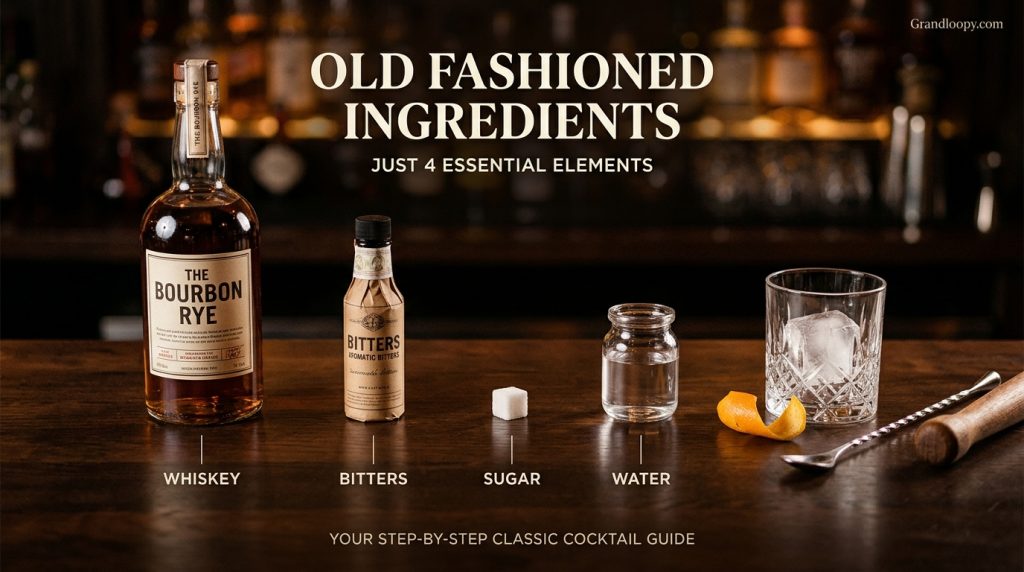
How to make an old fashioned starts with four parts and one order of operations. Whiskey, sweetener, Angostura bitters and water, built in the glass, stirred over ice and finished with expressed citrus peel.
Two standard pours exist, and this page prints both. The IBA specification pours 45 ml; most US bars pour 2 oz. Neither is wrong, and a good recipe says which one it is using.
The name is spelled in full, however the search was typed. Even “how to make an old fashion” means this drink: the Old Fashioned, carrying the final “ed” that its name has held since the 1880s.
What follows is a recipe card first, then the decisions. Bourbon or rye, cube or syrup, muddle or no muddle, and ice and stir: four choices explain nearly every difference between one bar’s drink and another’s.
The bottle guidance here is sourced guidance, not tasting notes. No hands-on tasting stands behind it; the proof and mash bill rules are attributed to the guides that published them, and bottle names appear as those guides’ picks.
Everything on this page is labelled by source. Pours carry their system, bottle picks carry their guide, and the one famous invention story carries its dispute.
The Recipe Card: Two Labelled Pours, One Classic Drink
The card below is the whole drink on one screen. Make either pour exactly as printed and you have a classic Old Fashioned; the sections after it explain what each choice changes.
|
Part |
IBA specification (45 ml) |
US bar pour (2 oz) |
|---|---|---|
|
Spirit |
45 ml bourbon or rye whiskey |
2 oz bourbon or rye whiskey |
|
Sweetener |
1 sugar cube |
1 sugar cube or simple syrup |
|
Bitters |
A few dashes Angostura |
2 dashes Angostura in most builds |
|
Water |
A few dashes plain water |
A splash of water with the cube |
|
Method |
Muddle the cube, fill with ice, add whiskey, stir gently |
Dissolve, add ice and whiskey, stir 15 to 30 seconds |
|
Garnish |
Orange slice or zest and a cocktail cherry |
Expressed orange or lemon peel |
|
Source framing |
The IBA card, in The Unforgettables category |
US bar practice across the fetched recipe pages |
The IBA text is carried, not quoted from its own site. The specification is reproduced in the Wikipedia Old Fashioned entry and in secondary carriers of the IBA card; the IBA’s own site is credited here in words and never linked from a constructed address.
The IBA Specification (45 ml)
- 45 ml bourbon or rye whiskey
- 1 sugar cube
- A few dashes Angostura bitters
- A few dashes plain water
- Ice cubes, to fill the glass
- Orange slice or zest, and a cocktail cherry
The IBA pour is the smaller, international standard. At 45 ml, about 1.5 oz, it keeps the drink tight and spirit forward, and it is the card the drink carries in the IBA Unforgettables category.
The US Bar Pour (2 oz)
- 2 oz bourbon or rye whiskey
- 1 sugar cube, or simple syrup per the equivalence table below
- 2 dashes Angostura bitters
- A splash of plain water
- One large ice cube
- Orange or lemon peel, expressed
The 2 oz pour is the field’s common US strand. MasterClass and Whisky Advocate both build at 2 oz with a sugar cube and 2 dashes, and the Pocket Bartender Old Fashioned guide prints the same pour for home makers.
One fetched recipe pours less, and it stays labelled as its own strand. Allrecipes builds at 1.5 oz bourbon with 2 tsp simple syrup; that measure is printed here as that site’s choice, never merged into the 2 oz standard.
The Classic Build, Step by Step
- Place the sugar cube in a rocks glass. Saturate it with the bitters and add the splash of plain water.
- Muddle until the sugar fully dissolves. Bitters alone will not dissolve a cube; the water does the work, per the Whisky Advocate Old Fashioned recipe.
- Fill the glass with ice. Use one large cube for the serving pour, or cubes to fill, as the IBA card directs.
- Add the whiskey. Pour your labelled measure, 45 ml or 2 oz, over the ice.
- Stir gently. Stir 15 to 30 seconds, until the glass is cold and the drink slightly diluted.
- Express the peel. Twist orange or lemon peel over the glass, run it around the rim, then drop it in.
- Add the cherry only if your card calls for it. The IBA garnish includes one; the purist builds leave it out.
Stir, never shake, a drink built only from spirits. Every classic build in the research stirs, because shaking aerates and clouds a spirit only drink and dilutes it past the point the stir controls.
The glass is part of the recipe. A rocks glass, also called an Old Fashioned glass, is the standard serve; ReserveBar’s blueprint specifies a double rocks of 10 to 12 oz, heavy bottomed and wide enough to stir in.
The tool list is short enough to fit in one drawer. A bar spoon for stirring, a muddler for the cube, a measure for the pour and a peeler for the garnish cover the whole build; everything else is optional.
Serve it as soon as the stir ends. The drink is balanced at the stir’s stop point; left sitting, the serving cube keeps diluting it.
Decision One: Bourbon or Rye
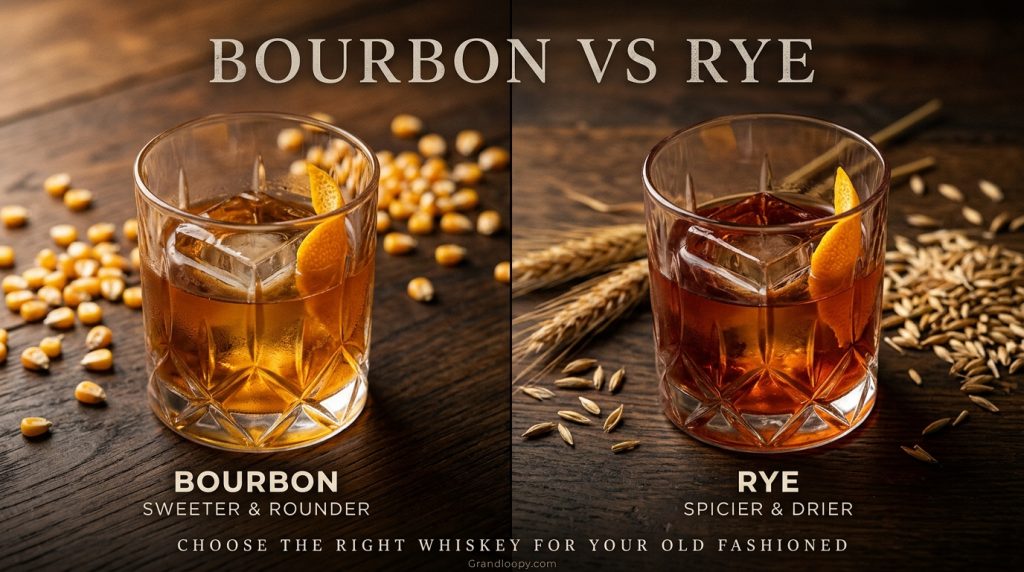
Bourbon and rye are both classic; the choice is character, not correctness. US law sets the base grains: bourbon is at least 51 percent corn, and rye whiskey is at least 51 percent rye grain.
|
Bourbon |
Rye |
|
|---|---|---|
|
Base grain, by US law |
At least 51 percent corn |
At least 51 percent rye |
|
Character, as the guides state it |
Sweeter, rounder; vanilla and caramel strands |
Drier, spicier, leaner |
|
In the drink |
A softer, rounder Old Fashioned |
A drier drink with spice against the sugar |
|
Guidance strand |
90 to 100 proof, with rye in the mash bill |
Bottled in bond ryes are the guides’ repeat picks |
The working proof rule is 90 to 100. Liquor Laboratory’s strand gives the reason: an 80 proof bourbon reads soft after sweetening and dilution, while rye in the mash bill supplies pepper and dry spice against corn sweetness.
BourbonProof’s strand agrees on the range and sorts by style. Classic balanced at 90 proof, bold and rye heavy at 100, a softer wheated style, and straight rye as the spicy end of the shelf.
Mash bill is the grain recipe behind the character table. Corn brings the sweetness, rye grain brings pepper and dry spice, and wheat brings softness, which is why the guides sort bottles by mash bill before brand.
Bottled in bond is the shelf label the guides keep naming. It marks a US government supervised standard for American whiskey, and bonded bottles at 100 proof recur in the picks: Old Grand-Dad Bonded, Evan Williams Bottled-in-Bond and Rittenhouse.
The bottles the fetched guides name are their picks, not a ranking built here. Four Roses Single Barrel, Buffalo Trace, Bulleit, Wild Turkey 101, Old Grand-Dad Bonded, Woodford Reserve, Rittenhouse Bottled-in-Bond and Sazerac Rye recur across the guides as dated strands.
Price is not the guide variable here. The fetched guides sort by proof and mash bill, not by shelf price, and their repeat picks are standard shelf bottles, not rare ones; a costly bottle at 80 proof fails their rule.
Wheated bourbon is the one genuine disagreement in the guides. Liquor Laboratory warns that soft wheated bottles can read shapeless in this drink, while BourbonProof lists the wheated style as a deliberate, sweeter choice. Both strands print; neither is hidden.
No tasting stands behind any name in this section. This page claims no hands-on testing of any bottle; it reports the rules and picks the published guides state, so the reader can judge the guidance by its source.
One guide adds a history framing, printed as its framing. Flight Wine Bar calls rye the more historically authentic pre-Prohibition base for the drink; that is that guide’s reading, offered beside the character table, not as a rule.
Decision Two: Sugar Cube, Simple Syrup or Demerara
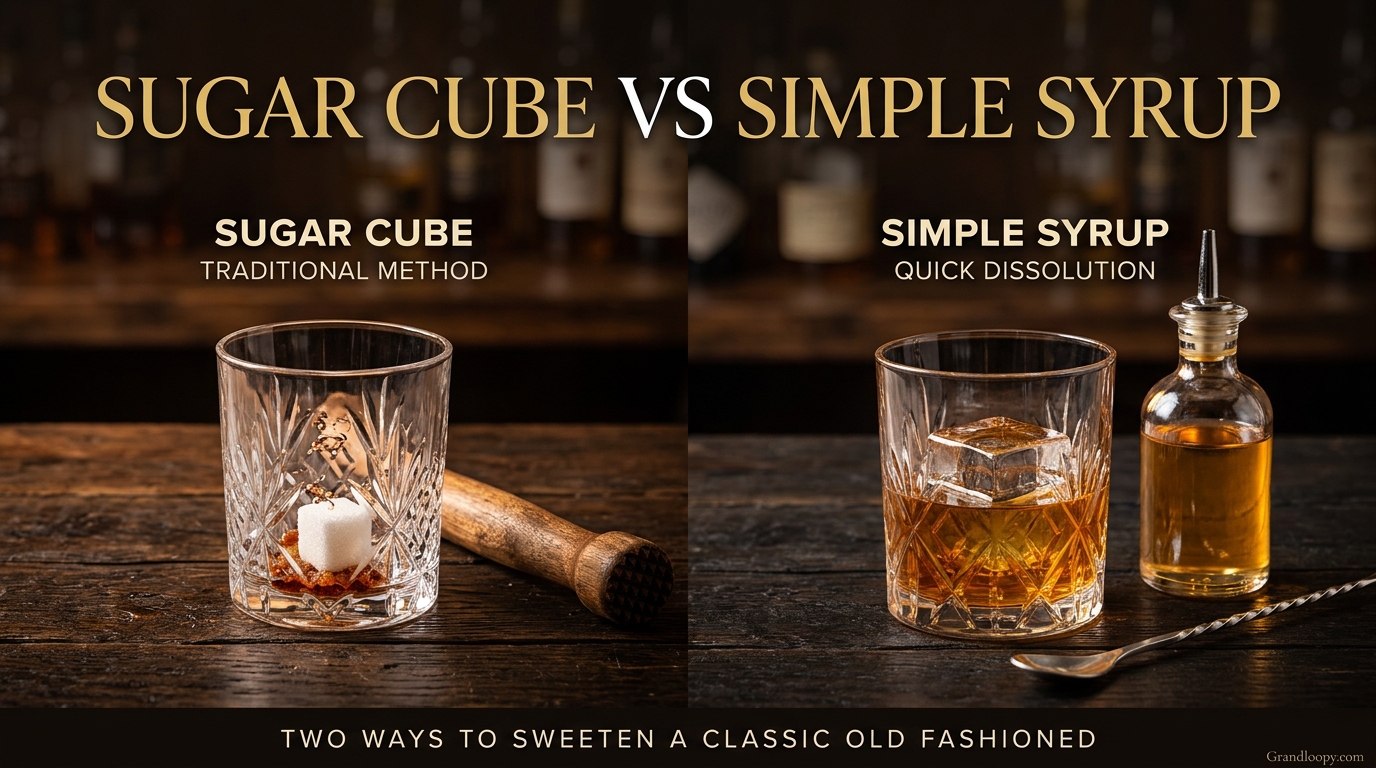
The sweetener decision is about dissolution before it is about flavor. Sugar that has not dissolved before the ice goes in stays gritty at the bottom of the glass, the most repeated failure in the research.
|
Sweetener |
Amount per drink |
Behavior |
|---|---|---|
|
1 sugar cube |
1 cube, about 1 tsp sugar |
The IBA and historical form; dissolves gradually, muddled with bitters and water |
|
Simple syrup, 1 to 1 |
1 tsp (MasterClass strand) to 1/2 oz (Pocket Bartender strand) |
Integrates instantly; the modern bar default |
|
Rich syrup, 2 to 1 |
Less by volume than 1 to 1 |
Sweeter per spoon; strengths do not sweeten equally |
|
Demerara cube or syrup |
1 cube, as the Gear Patrol build |
A deeper, molasses adjacent sweetness, per the guides |
The sources disagree on the syrup measure, so the spread prints honestly. MasterClass pairs one cube with 1 tsp simple syrup, while Pocket Bartender pairs one cube with 1/2 oz, or 15 ml, of syrup.
Syrup strength explains most of that spread. A 1 to 1 syrup and a rich 2 to 1 syrup do not sweeten equally by volume, so any equivalence holds only for the strength it was written for.
Making the syrups takes minutes and keeps the choice honest. Simple syrup is equal parts sugar and hot water, stirred clear; rich syrup doubles the sugar; demerara syrup swaps in demerara sugar for the same method.
Granulated sugar without a cube follows the same rule. A teaspoon of loose sugar dissolves like a cube when it meets bitters and water first; poured over ice dry, it sinks and stays gritty.
Demerara is the flavor upgrade the bartender builds reach for. Gear Patrol’s named build uses a demerara cube with rye and adds orange bitters; the deeper sweetness is an attributed preference in the guides, not a measured fact.
Cube or syrup, dissolve first either way. The IBA order, cube saturated with bitters and water and muddled smooth, exists because bitters alone will not dissolve sugar, a point the Whisky Advocate Old Fashioned recipe makes in its technique tips.
Decision Three: Muddle or No Muddle, the Two Schools
Muddling means two different things in this drink, and confusing them causes arguments. Every classic build muddles the sugar cube; the school question is whether fruit gets muddled or built in beside it.
|
School |
Fruit position |
Garnish |
Source strands |
|---|---|---|---|
|
Classic or purist |
No muddled fruit |
Expressed peel only, large ice |
Whisky Advocate, Pocket Bartender, Gear Patrol |
|
Muddled fruit |
Orange slice and cherry built in or muddled |
The fruit itself, in the glass |
Allrecipes build; Flavor Fix’s 20th century version |
|
Wisconsin brandy |
Orange slice and cherry muddled |
Soda top, ordered sweet, sour or press |
Regional supper club strands |
The purist school keeps the glass clean. Sugar, bitters, whiskey, ice and peel, nothing mashed; the fruit salad version is treated by these guides as a later accretion the classic does not need.
The muddled fruit school has its own dated paper trail. Flavor Fix dates the first cherry and orange recipe it cites to Julien J. Proskauer’s 1933 book What’ll You Have, which makes the fruity build a 20th century school, not the original.
The peel is a technique, not a decoration. Twist the peel over the glass so its oils spray the surface, run it around the rim, then drop it in; keep the bitter white pith out of the twist.
Orange peel is the default; lemon is the rye drinker’s variant. Orange reads rounder against bourbon’s sweetness, while lemon’s brighter oils suit rye’s spice in the Gear Patrol build, which expresses both peels over one drink.
The cherry follows the school, not a rule. The IBA garnish includes a cocktail cherry, the purist builds use peel only, and the Gear Patrol build states no cherry at all. Name your school and the garnish settles itself.
Soda has no place in the classic card. No fetched classic build tops the drink with soda; soda belongs to the Wisconsin school, where it is part of the recipe rather than a lengthener added by habit.
Decision Four: Ice and Stir, Dilution as an Ingredient
Dilution is an ingredient in this drink, not an accident. The water in the 1806 definition arrives in a modern build two ways: the splash that dissolves the sugar, and the melt from stirring and the serving cube.
Build order protects the dilution plan. Sugar dissolved first, then ice, then spirit: the stir starts from a finished base, so its seconds measure chilling and dilution only, not rescue work on undissolved sugar.
Stir time is how that second water dose is measured. Pocket Bartender gives 15 to 20 seconds; Gear Patrol stirs 20 to 30 seconds until the glass frosts. The stop point is chilled and slightly diluted, never watery.
The frost on the glass is the visible stop signal. Gear Patrol’s strand stirs until the outside of the glass frosts, a cue home makers can use when a timer feels fussy: cold glass, quiet drink, dilution done.
One large cube is the serving standard for a reason. A single large cube melts slower than small cubes or crushed ice, so it chills the drink while diluting it gently across its whole life.
Clear ice is the upgrade home makers ask about. The clear ice tutorial in the A Couple Cooks Old Fashioned recipe builds around one large clear cube; clear or not, size and hardness set the melt rate.
Regular cubes work, with a stated trade-off. They melt faster, so shorten the stir and serve promptly; a correctly stirred drink left sitting on melting ice still ends watery.
Chilling the glass buys control. A cold glass slows the melt, and wet ice dilutes on contact before the stir starts, so hard freezer ice is the better tool.
Respect the pour you chose. One build at 90 to 100 proof is a full strength drink, and the 2 oz pour carries more than the IBA 45 ml; the labelled pour is also how a host keeps servings honest.
The Wisconsin Brandy Old Fashioned: Sweet, Sour or Press
Wisconsin’s version is a different drink, not a garnish tweak. Brandy replaces whiskey entirely, the fruit is muddled as part of the build, and soda tops the glass; it belongs to the state’s supper club culture.
- Brandy, 2 oz
- 1 sugar cube
- Angostura bitters, a few dashes
- 1 orange slice and 1 maraschino cherry, for muddling
- Soda, to top
The build runs muddle, ice, brandy, soda. The cube, bitters, orange slice and cherry are muddled together, ice and brandy follow, and the soda finish is poured over the top at serving.
The order word is part of the drink’s name in Wisconsin. Sweet means topped with lemon-lime soda; sour means grapefruit soda or sour mix, and the strands vary by bar; press means half lemon-lime soda and half seltzer.
The supper club is the drink’s home context. Wisconsin supper clubs serve it before dinner as a house ritual, which is why the order words are standardized across the state.
Order it by its full name at a Wisconsin bar. Brandy old fashioned, then the finish word: sweet, sour or press. Asking for an old fashioned alone outside the state gets the whiskey classic instead.
Korbel is the default brandy strand across the regional sources. It is printed here as the guides’ default, not as a tested recommendation, and Wisconsin bars pour other brandies in the same build.
The famous origin story for the brandy habit is a legend, printed with its rebuttal. The story credits Korbel’s showing at the 1893 Chicago World’s Fair; Fodor’s, citing drinks author Jeanette Hurt, notes more than 20 other brandy exhibitors at that fair.
The rebuttal has a second half. Korbel stopped brandy production during Prohibition and did not restart until the 1960s, which sits awkwardly beside a story of uninterrupted fair driven fame. The tradition is real; the single cause is not proven.
Template Riffs: Rum, Mezcal and Coffee
A riff keeps the template and swaps one part. Spirit, sweetener, bitters and water survive a base change, which is why the Old Fashioned structure supports a whole family without changing its method.
Rum and agave builds are the family’s documented shelf: the ReserveBar guide to crafting an Old Fashioned builds its riff library on the same blueprint, with rum, tequila and mezcal versions beside the classic; each is a variation, labelled as one, never the classic card.
A rum Old Fashioned swaps in aged rum and keeps the bitters. The template holds because aged rum brings its own oak and sweetness; the build, the stir and the peel stay exactly where the classic puts them.
Mezcal and tequila builds lean on agave spirits the same way. Mezcal adds a smoke note of its own, tequila keeps the drink brighter, and both print as variations, never as the classic.
Coffee and maple versions change the sweetener or the aroma, not the structure. A coffee Old Fashioned keeps whiskey and bitters and adds coffee notes; a maple version swaps the sugar for maple syrup, measured like any syrup.
Smoked and spirit free versions sit at the family’s edge. Smoking adds aroma over a finished classic build, and a non alcoholic version follows the template with a spirit free base; both are honest when labelled riffs, not the classic.
Mistakes That Ruin an Old Fashioned
Every failure below is a skipped step, not bad luck. The drink has four ingredients and one method, so a ruined glass always traces to the build order, the ice, the proof or the sweetener.
- Undissolved sugar. The cube went in whole and never dissolved. Saturate it with bitters, add the splash of water, and muddle until no grains remain before ice or whiskey.
- Over dilution. Small or wet ice and a long stir wash the whiskey out. Use one large cube, stir inside the 15 to 30 second range, and serve promptly.
- A low proof bottle reading soft. An 80 proof bourbon can disappear under sugar and melt. The sourced guidance range is 90 to 100 proof with rye in the mash bill.
- Shaking a spirit only drink. Shaking aerates, clouds and over dilutes it. Stirring keeps the texture silky and the whiskey flavor central, which is the drink’s whole point.
- Pith in the peel. A thick, pith heavy twist adds bitterness instead of aroma. Cut the peel thin, express it over the glass, and let the oils do the seasoning.
- Too much sweetener for the syrup in use. A rich 2 to 1 syrup poured at a 1 to 1 measure overshoots. Measure by the strength you actually made, and adjust one variable at a time.
- A warm glass and tired garnish. A room temperature glass starts the melt early, and a dried out peel gives no oils. Chill the glass while you build, and cut the peel fresh.
- Guessing the bitters. Dash size varies by dasher top, so an unmeasured shake of the bottle can double the dose. Start at 2 dashes with a new bottle and adjust on the next build.
The Honest History: 1806 First, the Disputed Claim Boxed
The oldest document in this history is a definition, not a recipe. In May 1806, The Balance and Columbian Repository of Hudson, New York, answered a reader’s letter by defining cock-tail for its readers.
The definition is the template this drink still follows. The editor’s reply of 13 May 1806 called a cock-tail a potent concoction of spirits, bitters, water and sugar, and noted it was also called a bittered sling.
The name arrives in the 1880s, on paper. The term old-fashioned cocktails dates to 1880 in the Chicago Daily Tribune strand, and recipes under the name appear in late 1880s and 1890s books, Proulx in 1888 and Kappeler in 1895.
The form is older than the whiskey name. Jerry Thomas’s 1862 Bartenders Guide already carries an Old-Fashioned Holland Gin Cocktail, and David Embury listed the whiskey Old Fashioned among his six basic drinks in 1948.
The build also survived Prohibition on paper. Bartending guides kept printing whiskey cocktails through the 1920s and after, which is how both the purist card and the later fruity school reached modern bars with their paper trails intact.
Disputed: the Pendennis Club invention claim. The story says the drink was invented at Louisville’s Pendennis Club, founded in 1881, by or for Colonel James E. Pepper, and carried to the Waldorf in New York.
The claim comes from one late source. Albert Stevens Crockett’s Old Waldorf Bar Days carried it in 1931, decades after the supposed invention, and it has been repeated as Louisville lore ever since.
Historians reject it, on dated evidence. Robert Simonson, David Wondrich and Simon Difford note that old-fashioned cocktails were in print in February 1880, before the club opened, and the club’s documented drink was an Old Fashioned Toddy.
Louisville’s pride is real and separate. The city made the Old Fashioned its official cocktail in 2015; that designation is a pride strand, and this page prints it as one, never as evidence of invention.
No oldest cocktail claim survives the same test. The 1806 text defines a category of drink; it does not prove this named drink is the oldest cocktail, and this page prints no such absolute.
The modern revival restored the purist build. The craft cocktail revival of the 2000s brought back the cube, the large cube of ice and the expressed peel, and pushed the fruit salad build back into its own labelled school.
Putting It Together: Your First Three Builds
First build: the IBA card, exactly as printed. Forty five ml, one cube, the muddle, the gentle stir. It is the reference glass every later choice is measured against.
Second build: the US pour with syrup. Two ounces, measured syrup, the longer stir over one large cube. The difference between the two glasses is the pour lesson no table fully teaches.
Third build: change one decision only. Swap bourbon for rye, or cube for demerara, and keep everything else fixed; one variable at a time is how a home maker learns what each choice does.
For two or a crowd, scale the pour you chose. Double the labelled card exactly, keep bitters at the low end until tasted, and stir each glass to order; a batched mix still needs its dilution at serving.
Frequently Asked Questions
1. What are the ingredients in a classic Old Fashioned?
Whiskey, sweetener, Angostura bitters, water, ice and a citrus peel. That four part core, spirits, bitters, water and sugar, is the 1806 definition of a cocktail, and every classic build follows it.
2. How much whiskey goes in an Old Fashioned, 45 ml or 2 oz?
Both pours are standard, and the page prints them labelled. The IBA specification uses 45 ml, about 1.5 oz, while most US recipe pages use 2 oz; neither is an error.
3. What is the IBA recipe for an Old Fashioned?
The IBA recipe pours 45 ml of bourbon or rye. Add 1 sugar cube, a few dashes of Angostura and a few dashes of water, muddle smooth, fill with ice, stir gently, and garnish with orange and a cocktail cherry.
4. Should an Old Fashioned use bourbon or rye?
Either whiskey is classic; the guides frame it as character. Bourbon, at least 51 percent corn by US law, pours sweeter and rounder, while rye, at least 51 percent rye, pours drier, spicier and leaner.
5. What proof bourbon works best in an Old Fashioned?
The sourced guidance range is 90 to 100 proof. Liquor Laboratory gives the reason: an 80 proof bourbon reads soft after sweetening and dilution, and rye in the mash bill adds spice against corn sweetness.
6. Is a sugar cube or simple syrup better in an Old Fashioned?
Neither wins outright; they behave differently. The cube is the historical and IBA form and dissolves gradually, while syrup integrates instantly and is the modern bar default on many pages.
7. How much simple syrup equals one sugar cube?
The sources give a spread, so the page prints strands. MasterClass pairs 1 cube with 1 tsp simple syrup; Pocket Bartender pairs 1 cube with 1/2 oz of syrup, and syrup strength explains the difference.
8. What does demerara syrup change in an Old Fashioned?
Demerara gives a deeper, molasses adjacent sweetness, per the guides. The Gear Patrol bartender build uses a demerara cube with rye, 2 dashes of Angostura and 2 dashes of orange bitters.
9. How many dashes of bitters does an Old Fashioned need?
Two to four dashes of Angostura covers the fetched sources. MasterClass and Whisky Advocate use 2 dashes, A Couple Cooks uses 4, and ReserveBar prints a 2 to 4 dash range.
10. Can you use orange bitters instead of Angostura?
Orange bitters appear as an addition, not a straight replacement. The Gear Patrol build pours 2 dashes of orange bitters beside 2 dashes of Angostura; swapping them in alone makes a brighter riff.
11. Do you muddle the fruit in an Old Fashioned?
That is the school choice, and the page labels it. The purist school muddles only the sugar and garnishes with expressed peel, while the muddled fruit school builds in an orange slice and cherry.
12. Should an Old Fashioned have a cherry?
It depends on the school and the card. The IBA garnish includes a cocktail cherry beside the orange, the purist builds use peel only, and the Gear Patrol build states no cherry at all.
13. Is an orange slice or an orange peel the right garnish?
Peel is the purist and modern bar default. It is expressed over the glass so the oils season the drink, while a slice belongs to the muddled fruit school and to the IBA garnish strand.
14. Why do you twist the peel over an Old Fashioned?
Expressing the peel seasons the drink with citrus oils. Twist the peel over the glass, run it around the rim, then drop it in, keeping the bitter white pith out of the twist.
15. Do you shake or stir an Old Fashioned?
Stir, because the drink is spirit only. Shaking aerates it, clouds it and over dilutes it, while stirring with ice chills and dilutes in a controlled way and keeps the texture silky.
16. How long should you stir an Old Fashioned?
The fetched range is 15 to 30 seconds. Pocket Bartender gives 15 to 20 seconds, and Gear Patrol stirs 20 to 30 seconds until the glass frosts; stop at chilled and slightly diluted.
17. Why does an Old Fashioned use one large ice cube?
A large cube melts slower than small cubes or crushed ice. It chills the drink with less dilution across its whole life, a point Whisky Advocate, MasterClass and Pocket Bartender all support.
18. Can you make an Old Fashioned with regular ice cubes?
Yes, with a trade-off stated plainly. Regular cubes melt faster, so the drink dilutes quicker and the stir should be shorter; fill the glass well so the ice mass stays cold and dense.
19. What glass do you serve an Old Fashioned in?
Serve it in a rocks glass, also called an Old Fashioned glass. ReserveBar’s blueprint specifies a double rocks glass of 10 to 12 oz, with the heavy bottom and wide mouth the build needs.
20. What tools do you need to make an Old Fashioned at home?
The build needs very little equipment. A rocks glass, a bar spoon, a muddler for the cube, a measure for the pour, a peeler for the garnish, and ice, ideally one large cube.
21. Why is my Old Fashioned too sweet and how do I fix it?
Work the three usual causes in order. Too much sweetener for the syrup strength, too little dilution from a short stir, or a low proof whiskey reading soft; fix one variable at a time.
22. Why is my Old Fashioned watery?
Over dilution is the usual cause. Small or wet ice, too long a stir, or both will wash the drink out; use one large hard cube and stir inside the 15 to 30 second range.
23. Why is there undissolved sugar at the bottom of my Old Fashioned?
The cube was never fully dissolved before the ice went in. Bitters alone will not dissolve sugar, per Whisky Advocate: saturate the cube, add a splash of plain water, and muddle until the grains are gone.
24. How do you dissolve a sugar cube properly?
Follow the IBA order. Place the cube in the glass, saturate it with bitters, add a few dashes of plain water, then muddle and stir until fully dissolved before any ice or whiskey.
25. What is a Wisconsin Old Fashioned?
It is a distinct regional drink, not a garnish tweak. Brandy replaces whiskey, orange slice and maraschino cherry are muddled with cube and bitters, soda tops the glass, and it is ordered sweet, sour or press.
26. What does sweet, sour or press mean in Wisconsin?
The words name the soda finish. Sweet means lemon-lime soda, sour means grapefruit soda or sour mix by bar strand, and press means half lemon-lime soda and half seltzer or club soda.
27. Why does Wisconsin use brandy in Old Fashioneds?
Tradition is established; the famous cause is legend. Brandy, with Korbel as the default strand, is supper club practice, while the 1893 fair story is disputed on the exhibitor count and Korbel’s Prohibition production gap.
28. Did the Pendennis Club invent the Old Fashioned?
The claim is disputed, and the page prints it that way. Crockett’s 1931 book credits the Louisville club and Colonel Pepper, but historians note the term was in print in February 1880, before the club opened.
29. Where does the 1806 definition of cocktail come from?
It comes from a Hudson, New York newspaper of 1806. A reader’s letter on 6 May 1806 asked for a definition, and the editor’s 13 May reply defined cock-tail as spirits, bitters, water and sugar.
30. Why is it called an Old Fashioned?
Drinkers in the 1880s asked for a cocktail made the old way. The term dates to 1880 in the research strands, and recipes under the name appear in late 1880s and 1890s books, including Kappeler in 1895.
31. Is the Old Fashioned the oldest cocktail?
No sourced answer supports that absolute, so the page skips it. The 1806 text defines the cocktail category; it does not prove this named drink is the oldest cocktail in existence.
32. Can you make an Old Fashioned with brandy, rum or tequila?
Yes, as template riffs with the base swapped. ReserveBar’s riff family covers rum, mezcal, tequila and coffee builds, while brandy with muddled fruit and soda is the Wisconsin drink, a regional classic of its own.
33. How do you make an Old Fashioned for two or for a crowd?
Scale the labelled pour you chose, never a merged ratio. Double the IBA card or the 2 oz build exactly, keep bitters at the low end until tasted, and stir each drink over ice to order.
34. Can you batch Old Fashioneds ahead of time?
The mix can wait; the dilution cannot. Combine spirit, sweetener and bitters ahead if you like, then stir over ice at serving time, or add measured water deliberately and chill the batch.
35. How do you make a smoked Old Fashioned?
Smoking is a modern riff layer over the classic build. Bartenders add smoke aroma to the finished stirred drink; methods vary by source, so it prints as a bounded variation, never the original form.
36. Can you make an Old Fashioned without bitters?
Without bitters, it leaves the drink’s own definition. The 1806 template names bitters as one of four parts, so a bitters free pour is best labelled a sweetened whiskey serve instead.
37. What can replace Angostura bitters in an Old Fashioned?
The sourced swap is orange bitters used beside Angostura. The Gear Patrol build pairs them dash for dash; other aromatic bitters follow the same logic, but any full swap moves the drink toward a riff.
38. Is a wheated bourbon good in an Old Fashioned?
The guides disagree, and both strands print. Liquor Laboratory calls wheated bourbons softer and liable to read shapeless here, while BourbonProof lists the wheated style as a deliberate sweeter and softer choice.
39. What is the difference between an Old Fashioned and a Manhattan?
The sweetener and the serve separate them. An Old Fashioned sweetens with sugar or syrup and a splash of water, over ice with peel; a Manhattan sweetens with sweet vermouth and is served up, classically with a cherry.
40. How strong is an Old Fashioned in standard drinks?
Strength follows the pour and the proof, so both print labelled. The IBA 45 ml pour is smaller than the US 2 oz pour, and a 100 proof bottle delivers more alcohol than a 90 proof one.
41. How many calories are in an Old Fashioned?
This page prints no single calorie figure. No fetched source gives one with a stated basis for the classic build, and the one competitor figure found is unbased, so a figure enters only with its pour, proof and sweetener named.
42. Can you make a non alcoholic Old Fashioned?
Yes, as a spirit free riff on the template. A non alcoholic whiskey alternative takes the spirit role with the same sugar, seasoning and water structure, stirred over a large cube with expressed peel.
Conclusion
How to make an old fashioned well is mostly a matter of choosing honestly. Pick a labelled pour, dissolve the sweetener first, stir inside the range, and let the peel do the garnish work.
Make the classic once before choosing a school. The purist build teaches what the drink is; the muddled fruit and Wisconsin versions then read as deliberate choices rather than accidents of habit.
The recipe card at the top is the page to bookmark. It carries both pours, the method order and the garnish by school, in a form that survives being quoted.
More GrandLoopy explainers gather on the GrandLoopy home page as the drinks shelf grows. This page is its first entry: try the classic build this week, then pour the other labelled measure and compare what the difference actually is.