What Is Streetwear Fashion? Definition, History, Brands & Style
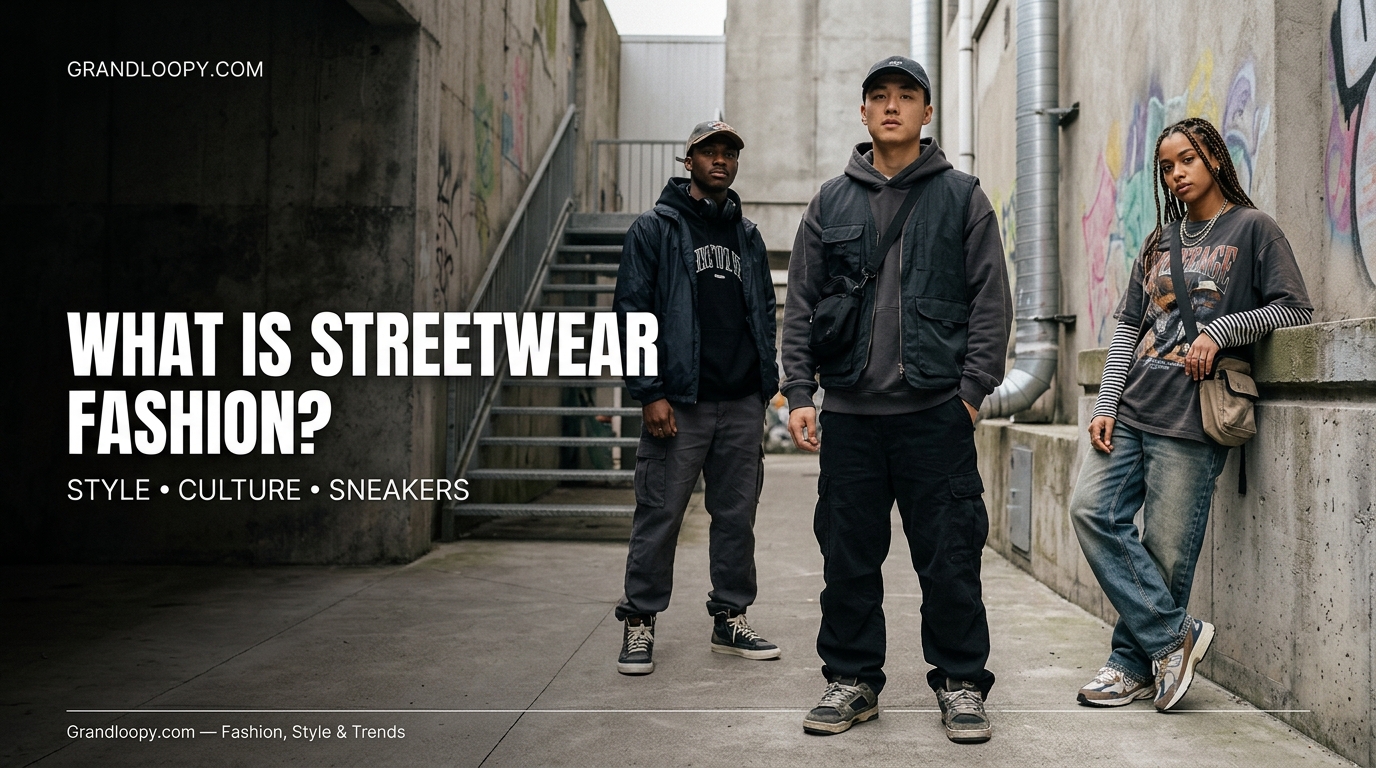
What is streetwear fashion? Streetwear is a style of casual clothing that grew out of New York hip-hop, California surf, and skate culture in the late 1970s and 1980s.
It is built on hoodies, graphic tees, baggy pants, and sneakers, sold through limited weekly drops, and now so influential that luxury houses from Louis Vuitton to Dior build collections around it.
Streetwear is more than a dress code.
It is a culture with its own history, its own brands, its own way of selling, and its own rules for putting an outfit together, and the sections below cover all four.
The Short Answer: What Streetwear Is
Streetwear is fashionable casual clothing that emerged from a blend of urban subcultures. Merriam-Webster defines it as a style featuring sneakers, hoodies, T-shirts, and baggy pants, inspired by hip-hop, skateboarding, and surfing.
The dictionary definition is simple, but it underplays the scale. Hypebeast calls streetwear a multi-billion-dollar retail phenomenon, rooted in the countercultures of the 1980s and 1990s, including graffiti, hip-hop, skate, and surf.
At its core, streetwear turns everyday garments into status symbols. A plain tee becomes valuable because of the logo on it, the scarcity behind it, and the culture it signals.
The dictionary definition
Merriam-Webster defines streetwear as a style of fashionable casual clothing that features sneakers, hoodies, T-shirts, and baggy pants. The style emerged from and is inspired by a blend of urban subcultures.
Oxford Learner’s Dictionary defines it more simply, as informal clothes worn by young people in cities, especially fans of a particular type of music, sport, or culture.
Wikipedia adds the history: streetwear is a style of casual clothing that gained global popularity in the 1990s.
It emerged from African-American culture in New York and incorporated sportswear, punk, Californian surf culture, skateboarding, 1980s nostalgia, and Japanese street fashion.
Streetwear vs street style
Streetwear and street style sound alike, but they are different things.
Streetwear is a category of clothes and brands that came out of skate, surf, and hip-hop scenes, so the word means hoodies, graphic tees, cargos, and sneakers.
Street style is broader. It is the way people actually dress on city sidewalks, which can include streetwear, or none of it.
A big blazer over a white tee, a slip skirt with trainers, or an all-black outfit built from three textures all count as street style.
The distinction matters for shopping. A streetwear label sells a category of clothes, while street style describes how any clothes are put together in public.
What streetwear is not
Streetwear is not fast fashion. Fast fashion copies trends quickly and sells them cheaply in huge volumes. Streetwear limits production on purpose, and scarcity is part of the value.
Streetwear is not a trend.
Hypebeast argues it should not be viewed as a trend within fashion, but as the fashion leg of a larger shift that gave power to popular culture spanning fashion, art, and music.
Streetwear is not just logos. A logo without the culture behind it is a fast-fashion copy. Real streetwear carries the history of the scenes that made it, from the skate park to the recording studio.
Where Streetwear Came From
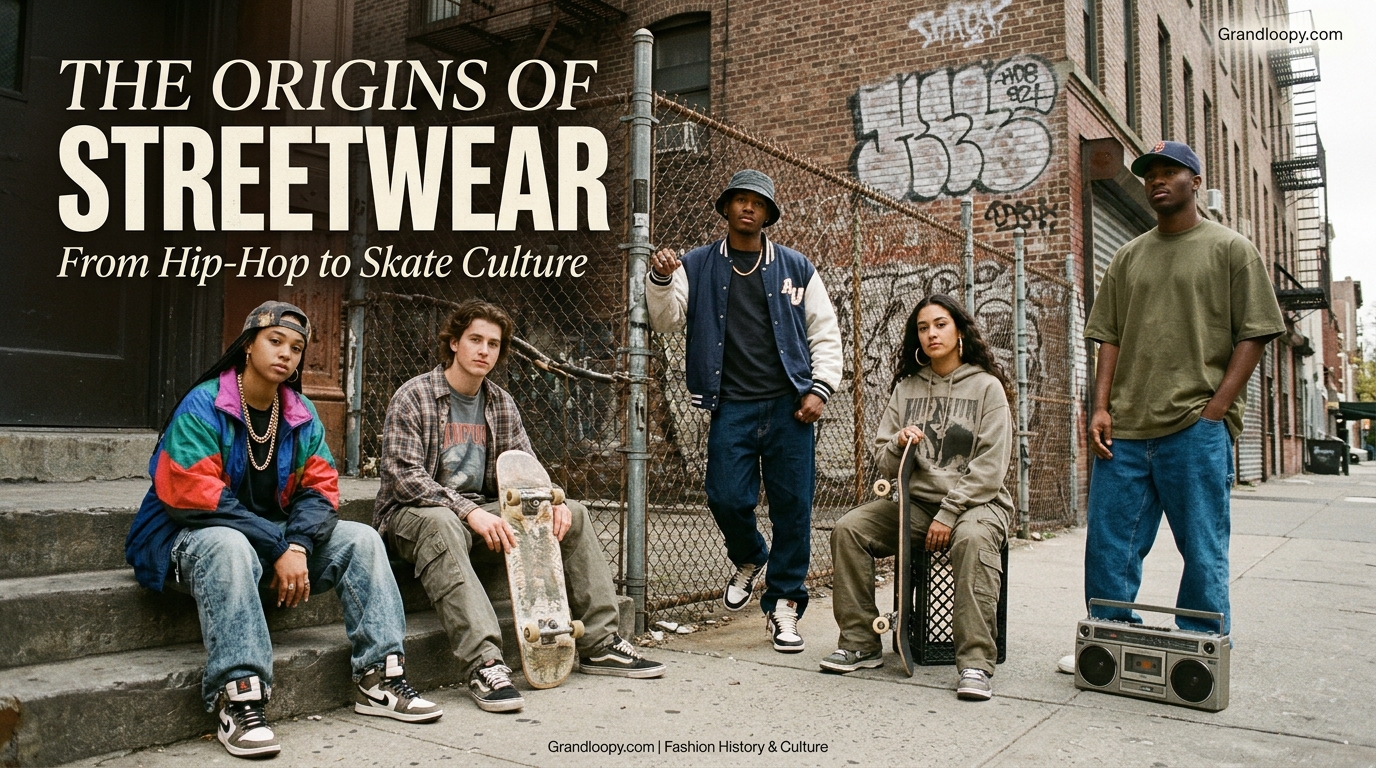
Streetwear was born in New York City in the late 1970s and early 1980s, inside the emerging hip-hop culture.
It then migrated to the West Coast and picked up Los Angeles surf culture and skate culture along the way.
The style spread through music, skateboarding, and graffiti before it ever reached a runway. By the 1990s it was global, and by 2017 it had reshaped luxury fashion itself.
The timeline below follows the movement from the Bronx blocks to the Paris runway, with the people and the moments that changed it.
New York hip-hop, late 1970s and 1980s
Streetwear is generally accepted to have been born out of the hip-hop culture of New York City in the late 1970s and early 1980s.
The scene consisted predominantly of African Americans, and the clothes were part of the culture, not a costume for it.
Early hip-hop style meant baggy jeans, oversized tees, high-top sneakers, chains, and caps. The look was comfortable, bold, and built for the street, the block party, and the stage.
Black-owned brands followed the scene. FUBU, Cross Colours, and Karl Kani dressed an African-American youth in search of cultural recognition, and their labels became part of the movement itself, as the 12Lunes history guide notes.
California surf and skate
While New York built streetwear on hip-hop, California built it on surf and skate. Skateboarders in the 1980s wore oversized T-shirts and baggy pants for comfort and mobility while riding.
Surfboard designer Shawn Stussy began selling printed T-shirts in the late 1980s, using the same trademark signature he placed on his custom surfboards. Those tees became Stüssy, one of the first global streetwear brands.
The two coasts met in the 1990s. New York attitude and California ease merged into one style, and the result was the streetwear the world recognizes today.
Dapper Dan and the luxury bridge
Dapper Dan, born Daniel Day, opened a 24-hour boutique on 125th Street in Harlem in 1982.
He made custom clothes for hip-hop artists who were shunned by traditional luxury brands, using luxury logos in new ways.
Hypebeast calls Dapper Dan pivotal in elevating streetwear to luxury as early as the 1980s. He proved that street style and high fashion could share the same garment.
The bridge became official in 2017, when Dapper Dan collaborated with Gucci. The same year, Supreme collaborated with Louis Vuitton, and the line between the street and haute couture disappeared.
Tokyo and Ura-Hara
Japan invented the business of streetwear, even though America invented the aesthetic. In the early 1990s, the Ura-Harajuku district in Tokyo, known as Ura-Hara, became a laboratory for youth fashion.
The scene revolved around Hiroshi Fujiwara, a DJ and designer who acted as a cultural translator between London, New York, and Tokyo.
His work brought American streetwear to Japan and Japanese design back to the West.
A Bathing Ape, known as BAPE, came out of this scene in 1993, founded by Nigo. BAPE introduced limited-edition drops and celebrity collaborations that the whole industry later copied.
Timeline: 1970s to 2026
| Year | What happened |
|---|---|
| Late 1970s | Hip-hop culture emerges in New York City; streetwear is born on the Bronx blocks |
| Late 1980s | Shawn Stussy starts selling printed T-shirts; surf and skate join the style |
| 1982 | Dapper Dan opens his 24-hour boutique on 125th Street in Harlem |
| 1993 | BAPE founded in Tokyo by Nigo; limited drops and celebrity collabs begin |
| 1994 | Supreme founded in New York City by James Jebbia as a skate shop |
| 1990s | Streetwear goes global; baggy denim and oversized jerseys define the decade |
| 2000s | Streetwear moves into high fashion; Off-White and BAPE bridge the gap |
| 2017 | Supreme x Louis Vuitton; Dapper Dan x Gucci; Supreme sold to Carlyle Group for an estimated $500 million |
| 2018 | Virgil Abloh becomes artistic director of Louis Vuitton menswear; Li Ning shows at Paris Fashion Week |
| 2021 | Virgil Abloh dies; Off-White continues under new creative direction |
| 2026 | Oversized layering, wide-leg denim, statement sneakers, and subtle flexing define the year |
The 6 Elements That Define Streetwear
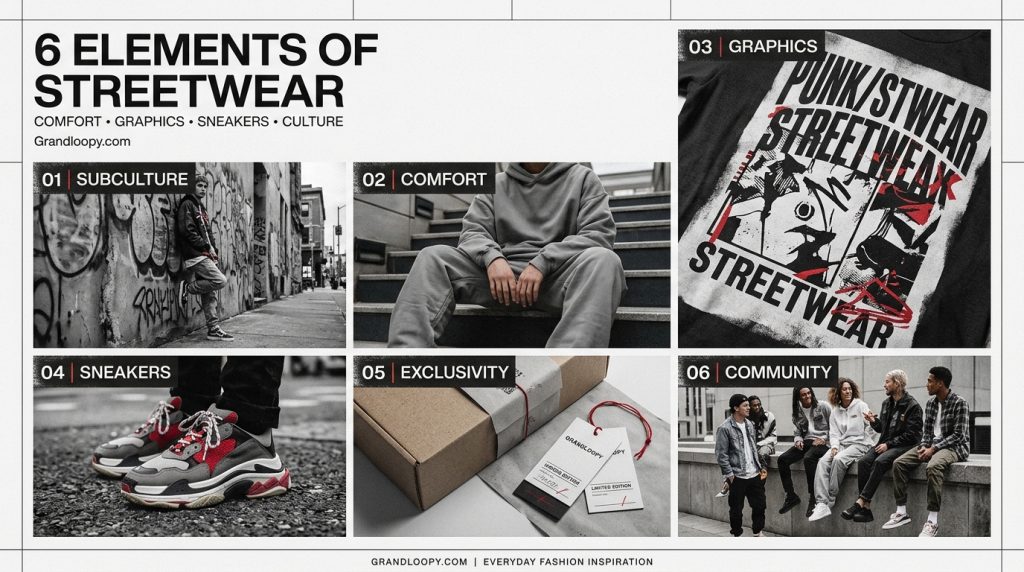
Six elements separate streetwear from every other fashion style. A garment needs most of them to read as streetwear, and a brand needs all of them to be taken seriously.
The list below follows the structure of the Yellowbrick guide, which calls these the six key elements that define streetwear and distinguish it from other styles.
Roots in subculture
Streetwear developed from urban subcultures that used clothing to express identity, creativity, and belonging. Skateboarding, hip-hop, surfing, punk music, and graffiti art all played a part.
The do-it-yourself aesthetic is central. Early streetwear was handmade, printed, and customized by the people who wore it, not designed in a corporate studio.
That history is the reason authenticity matters so much. A brand that borrows the look without the roots is treated as a copy, no matter how good the clothes are.
Casual and comfortable clothing
Comfort is one of the most recognizable characteristics of streetwear. Unlike styles that prioritize formal tailoring or structured silhouettes, streetwear focuses on relaxed clothing for everyday situations.
The silhouette is relaxed and oversized: oversized shirts, loose hoodies, baggy jeans, cargo pants, and relaxed-fit jackets. The clothes are built to move in, not to pose in.
Popular essentials include oversized graphic T-shirts, hoodies and sweatshirts, baggy jeans and cargo pants, track jackets and windbreakers, relaxed-fit shorts, and sneakers.
Bold graphics and logos
Visual elements are central to streetwear. Graphics, typography, logos, and illustrations help brands communicate their identities and make their products recognizable.
The graphic tee is the original streetwear canvas. Stüssy started by printing a signature on a tee, and Supreme built an empire on a red box logo.
Logos work as social signals. Wearing the right logo proves the wearer was somewhere, knew something, or waited in a specific line on a specific day.
Sneaker culture
Sneakers are the foundation of streetwear, not an accessory. Hypebeast notes that streetwear involves the production, promotion, sale, and resale of casual fashion, principally of footwear such as sneakers.
Classic silhouettes anchor the style: Nike SB Dunk Lows, Vans Old Skool, Air Jordans, and retro runners.
A clean white pair goes with everything, while a loud pair asks for the rest of the look in neutrals.
Sneaker culture has its own economy. Limited sneakers resell for many times their retail price, and the resale market is now a core part of the industry.
Exclusivity and the drop
Streetwear is commonly linked to exclusivity, because many brands limit production through artificial scarcity to drive demand. Limited-edition releases and resale markets follow from that choice.
The drop model works like this: release a limited number of units at a specific time, traditionally Thursday morning Eastern time, and never restock. Scarcity, not fabric, is what makes a tee expensive.
Supreme still runs Thursday drops that generate queues around the block. The queue is part of the product: waiting in line proves the buyer belongs to the culture.
Community and identity
Streetwear is a lifestyle shaped by music, art, sports, social movements, and the communities that influence fashion trends. It is an expression of a culture, a generation, and a way of life.
The culture around streetwear has been described as a social language, made up of implicit codes, cultural references, and signs of recognition. Knowing the codes matters as much as owning the clothes.
A 2025 study of young Americans at the undergraduate level found that many participated in streetwear fashion, but few knew its cultural roots.
The gap between wearing the clothes and knowing the history is now part of the conversation.
The 4 Types of Streetwear
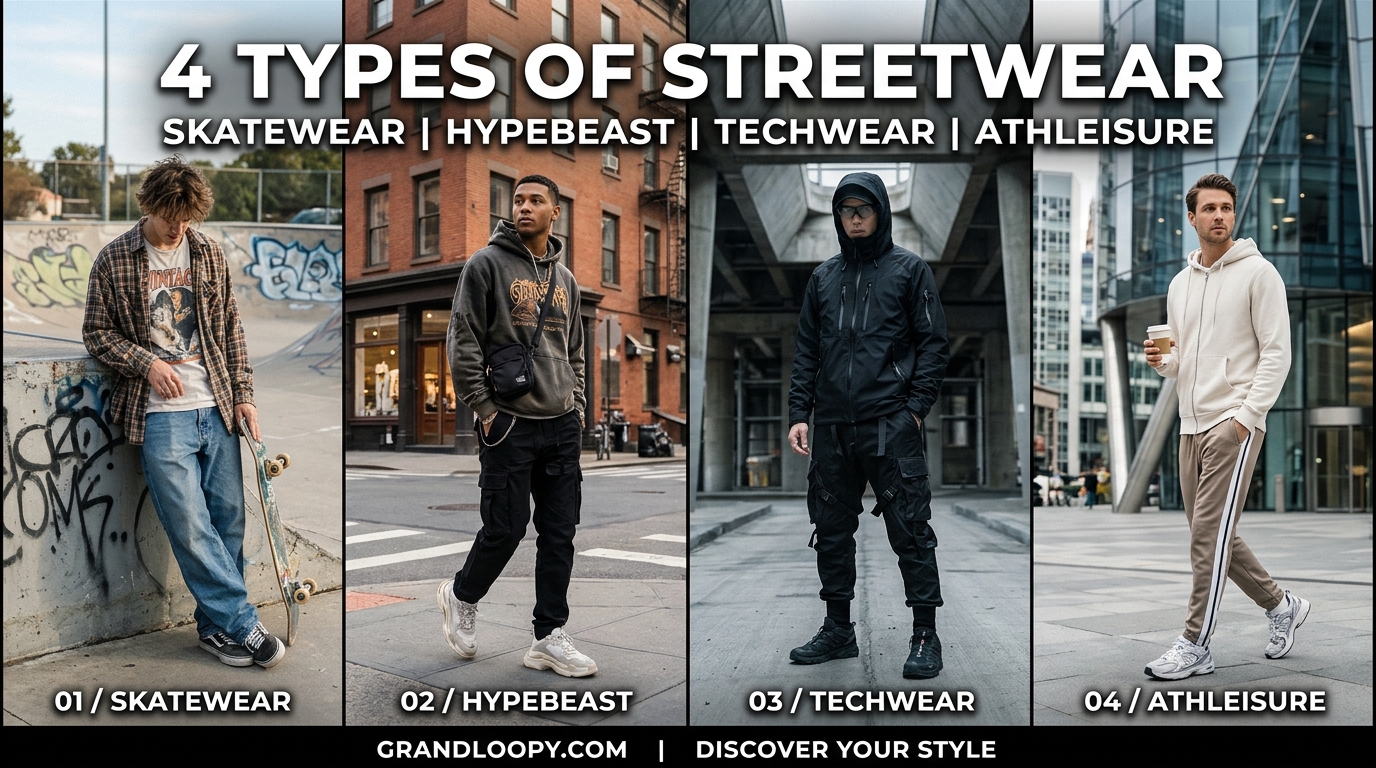
Modern streetwear splits into four distinct types, each with its own codes. Most wearers mix two or three, but knowing the types helps anyone build a wardrobe with intent instead of accident.
The four types below follow the Urban City Styles guide, which calls them the four core types defining modern streetwear in 2026.
Skatewear: the original streetwear
Skatewear is the oldest type, closest to the roots. It means vintage skate band tees, oversized flannels, baggy cargo pants, and chunky skate sneakers.
The 2026 update is clear: distressed and worn-in aesthetics now carry more street value than pristine pieces. Authenticity beats perfection, and a faded tee beats a fresh one.
How to style it: layer a vintage graphic tee under an unbuttoned flannel shirt, pair it with mid-wash baggy jeans, and finish with classic Vans Old Skool or Nike SB Dunk Lows. Simple, functional, timeless.
Hypebeast: the hype-driven collector
Hypebeast style is built around rare and limited pieces. The outfit starts with one grail item, a collaboration hoodie or rare sneakers, and everything else stays minimal.
The loud logo era is shifting. Subtle flexing now outranks billboard branding, and vintage hypebeast pieces from the 2000s BAPE golden era are appreciating rapidly.
How to style it: build the outfit around one statement piece, keep everything else minimal with black cargos and a clean tee, and let the grail piece speak without competing for attention.
Techwear: the futuristic function
Techwear is streetwear built on technical fabrics and function: waterproof shells, taped seams, hidden pockets, and adjustable straps. The look is futuristic, and the clothes are built to perform.
Sustainable tech fabrics are gaining serious traction in 2026, as brands prioritize both performance and planet. Mixing a techwear jacket with vintage streetwear creates a strong aesthetic contrast.
How to style it: pair technical cargo pants with a tapered fit, layer a techwear jacket over a simple black tee, and finish with streamlined sneakers such as Nike ACG or Salomon.
Athleisure: the sporty everyday
Athleisure is the most wearable type: athletic clothes worn as everyday fashion. Track pants, leggings, tennis-style skirts, hoodies, and sneakers, styled for the street rather than the gym.
The look is clean and sporty, with sleek athletic lines and little embellishment. It is the type most people already own without knowing the name.
How to style it: pair track pants with a clean hoodie and retro sneakers, or wear a tennis-style skirt with a sweatshirt and chunky trainers.
Keep the palette simple and let the silhouette do the work.
Four types compared
| Type | Roots | Signature pieces | 2026 trend |
|---|---|---|---|
| Skatewear | Skateboarding | Vintage band tee, flannel, baggy jeans, Vans | Distressed and worn-in over pristine |
| Hypebeast | Drop culture | Collab hoodie, rare sneakers, black cargos | Subtle flexing over loud logos |
| Techwear | Outdoor and military | Tech shell, tapered cargos, Salomon | Sustainable tech fabrics |
| Athleisure | Sportswear | Track pants, hoodie, retro sneakers | Clean lines, minimal branding |
The Brands That Built Streetwear
A handful of brands built streetwear, and each one owns a different part of it. Supreme owns the drop, Stüssy owns the surf roots, Off-White owns the luxury bridge, and BAPE owns the Japanese model.
The brand table below compares the founders, the founding years, and the signature pieces.
One date is disputed: sources disagree on whether Off-White was founded in 2012 or 2013, so both years are shown with their sources.
Supreme
Supreme was founded in New York City in 1994 by James Jebbia, as a small skateboarding store. It has grown into the most iconic streetwear brand in the world, with flagship stores in major cities.
The simple red box logo is one of the most recognized symbols in fashion. Supreme’s Thursday drops still generate queues around the block and massive resale markets on StockX.
In 2017, Supreme collaborated with Louis Vuitton, and the same year it was sold to The Carlyle Group for an estimated $500 million, according to Hypebeast. The sale marked the moment streetwear became big business.
Stüssy
Stüssy is one of the pioneers of the movement, originally inspired by Californian surf culture. Shawn Stussy started by printing his signature on surfboards, then on T-shirts, and the signature became the brand.
The brand is the oldest of the big four, and the most laid-back. It never chased the drop model as hard as Supreme, and its clothes stay closer to the surf and skate roots.
Stüssy is the proof that streetwear does not need hype to survive. Four decades after the first tees, the signature still sells.
Off-White
Off-White was founded by Virgil Abloh, and it became known for combining streetwear influences with luxury fashion and experimental design. Its signature marks are quotation marks, industrial belts, and diagonal stripes.
The founding year is disputed: one brand guide dates Off-White to 2012, another to 2013. The two years are never merged, because the sources disagree and neither is confirmed as the single correct date.
Abloh became artistic director of Louis Vuitton menswear in 2018, the first streetwear designer to hold the role. He died in 2021, and Off-White continues under new creative direction.
BAPE
A Bathing Ape, known as BAPE, was founded in Tokyo in 1993 by Nigo. It is known as the camo king, for its shark hoodies, camo prints, and ape head logo.
BAPE introduced limited-edition drops and celebrity collaborations before any Western brand did. Its golden era in the 2000s set the template for hype, and vintage BAPE pieces from that era are appreciating rapidly in 2026.
The brand is the Japanese model of streetwear: small runs, high prices, celebrity fans, and a store that feels like a clubhouse rather than a shop.
Palace, Fear of God, Corteiz, and the new wave
Palace is the London answer to Supreme, a skate brand with the same drop model and the same cult following. It proves the formula travels.
Fear of God and its Essentials line, founded by Jerry Lorenzo, bring American luxury to streetwear. The pieces are muted, oversized, and expensive, and they sell out without loud logos.
Corteiz is the new wave: a London brand built on scarcity, community, and drops that sell out in minutes. It shows the model still works for a brand founded in the 2020s.
Brand comparison
| Brand | Founded | Founder | Signature piece | Price tier |
|---|---|---|---|---|
| Supreme | 1994, New York | James Jebbia | Red box logo tee | Mid to high |
| Stüssy | Late 1980s, California | Shawn Stussy | Signature logo tee | Mid |
| Off-White | 2012 or 2013, disputed | Virgil Abloh | Quotation-mark tee, industrial belt | Luxury |
| BAPE | 1993, Tokyo | Nigo | Shark hoodie, camo | High |
| Palace | 2009, London | Lev Tanju | Tri-Ferg logo tee | Mid to high |
| Fear of God | 2013, Los Angeles | Jerry Lorenzo | Essentials hoodie | Luxury |
| Corteiz | 2017, London | Clint 419 | Alcatraz logo cargo | Mid to high |
The price tiers are relative, not fixed, because resale prices change daily.
A Supreme box logo tee retails for far less than it resells for, and a BAPE shark hoodie costs more at retail than a Stüssy tee.
The Drop: How Streetwear Is Sold
Streetwear is not sold like normal fashion. It is sold through drops: limited releases at a set time, with no restock, and the scarcity is the point.
The model bypasses traditional retail channels. Instead of seasonal collections in department stores, brands release small batches directly to their communities, and the community does the marketing.
What a drop is
A drop is a limited release of a product at a specific time, usually Thursday morning Eastern time for Supreme.
The brand announces the drop, the stock sells out in minutes, and the item never returns.
The drop model works because scarcity creates demand. When a tee is available for ten minutes and never again, owning it proves the buyer was there at the right moment.
Other brands run weekend drops or surprise drops, but the logic is the same: limited units, a fixed time, and no restock.
The economics of the drop
Streetwear is expensive because of scarcity, not fabric. A manufacturer guide reports that a typical heavyweight streetwear tee costs $8 to $15 to manufacture and print, retails for around $60, and can resell for $600.
Those figures are source-reported, not verified across the industry, and they describe a hyped release rather than an average tee. The pattern they show is real: the markup comes from scarcity, not from the cotton.
A manufacturer guide also claims streetwear became a $200 billion influence on global luxury after 2018.
That figure is unsourced in the guide, so it is reported as a claim, not as a verified market size.
| Stage | Price (source-reported) | What drives it |
|---|---|---|
| Manufacture and print | $8 to $15 | Blank, print, and labor |
| Retail | Around $60 | Brand, design, and drop |
| Resale | Up to $600 | Scarcity, hype, and grail status |
Thursday drops and queues
Supreme drops on Thursdays, and the queue is part of the ritual. Buyers line up outside the store, or wait in an online queue, and the fastest buyers get the stock.
The queue is social proof. A line around the block tells passersby that something important is happening, and the photos of the line spread the hype further.
Bots are the enemy of the drop. Brands fight automated buyers with captchas, raffles, and purchase limits, because a bot-bought drop kills the community feeling.
The resale market: StockX, GOAT, Grailed
When a drop sells out, the resale market takes over. StockX, GOAT, and Grailed are the three main platforms, and each one works differently.
| Platform | How it works | Best for |
|---|---|---|
| StockX | Stock-market style bidding, authentication on every sale | Sneakers and hyped tees, price tracking |
| GOAT | Buy now or bid, authentication, used and new | Sneakers, used pairs, wider selection |
| Grailed | Peer-to-peer listings, community-driven | Vintage and rare pieces, direct deals |
Resale prices are not fixed. A grail piece can sell for ten times retail, while a common drop can sell below retail, and the price moves with hype, not with quality.
Streetwear vs Fast Fashion vs High Fashion
Streetwear sits between fast fashion and high fashion, and it borrows from both.
It takes the speed and the casual clothes of fast fashion, and the exclusivity and the craft of high fashion, and it adds a culture neither one owns.
The comparison below is the clearest way to see the difference. The three columns are different business models, not just different price tags.
| Feature | Streetwear | Fast fashion | High fashion |
|---|---|---|---|
| Origin | Skate and hip-hop | Trend copying | Paris runways |
| Price signal | High, from scarcity | Low, from volume | High, from craft |
| Production | Limited drops | Mass production | Small runs, handmade |
| Silhouette | Oversized, architectural | Trend-led | Tailored, couture |
| Key brands | Supreme, Stüssy, Corteiz | Zara, Uniqlo, Fashion Nova | Louis Vuitton, Dior, Gucci |
| Wearer identity | Subculture insider | Trend follower | Luxury buyer |
| Resale | Strong, often above retail | Near zero | Strong for icons |
| Sustainability | Mixed, small runs help | Poor, high waste | Mixed, durable pieces |
Readers who want the fast-fashion side in detail can read the Zara fast fashion verdict, the Uniqlo fast fashion verdict, and the Quince fast fashion verdict.
Each one answers the verdict first, with the evidence behind it.
The Hypebeast four-part model
Hypebeast defines the current state of streetwear in four key ways.
Original streetwear brands are characterized by an accessible price point, comfortable clothing, and authenticity, with founding brands such as Supreme, BAPE, and Stüssy, plus newer players such as Palace.
Sportswear brands are the second part: leading athletic labels whose sneakers and athletic wear are integral to the streetwear style. Nike, Adidas, and Vans belong here, and their sneakers are the foundation of most outfits.
Luxury streetwear and mass-market streetwear are the other two parts. Luxury houses adopt streetwear codes at high prices, while mass brands sell streetwear-inspired clothes at low prices, and both stretch the definition in opposite directions.
How to Style Streetwear
Streetwear is easy to buy and hard to wear well. The difference between a good fit and a costume is proportion, and the rules below are the ones stylists repeat most often.
The section covers the four rules, the starter wardrobe, outfit formulas for men and women, streetwear over 30, and streetwear on a budget.
The 4 styling rules
- Master the oversized and fitted balance. Pair an oversized hoodie with tapered cargos or slim jeans, and avoid oversized on oversized unless the look is intentionally avant-garde.
- Layer with purpose. Start with a graphic tee, add an oversized hoodie as the middle layer, then finish with a vintage denim or bomber jacket, and let each layer peek through.
- Sneakers anchor the fit. Choose the shoes first and build upward, because chunky runners signal athleisure energy, classic Vans signal skate authenticity, and limited collabs signal hypebeast status.
- Mix vintage and modern. Pair a 90s vintage band tee with 2026 techwear cargos, because the contrast between old and new creates the most compelling outfits.
Those four rules come from the Urban City Styles guide, and they match the five pillars in the Klodsy street style guide.
The pillars are: balance one oversized piece with one fitted piece, choose the shoes first, layer so every piece shows, and mix price points and eras.
The 8-piece starter wardrobe
- The heavyweight hoodie. Look for 450 to 550 GSM French terry or loopback fleece, because below 450 the fabric clings and looks cheap, and above 550 it wears like a rug.
- The oversized graphic tee. One bold graphic, one clean logo tee, and one plain white tee cover most outfits.
- Baggy jeans. A mid-wash wide-leg pair is the most versatile, and dark denim looks slightly more polished.
- Cargo pants. Black cargos go with everything, and tapered cargos balance an oversized top.
- The bomber jacket. A cropped bomber adds structure to a loose outfit without adding bulk.
- The denim jacket. An oversized denim jacket layers over a hoodie and works in three seasons.
- Clean white sneakers. One versatile pair goes with jeans, cargos, dresses, and casual trousers.
- The cap and the crossbody bag. A simple cap and a crossbody bag finish the outfit without competing with it.
The starter list follows the HoodieOEM guide, which calls these the 8-piece starter vocabulary.
The hoodie weight and the tee count are the details that separate a good starter wardrobe from a random pile of clothes.
Outfit formulas for men
Start with a fitted tee, an oversized hoodie, and straight jeans, and finish with retro sneakers. The fitted tee keeps the outfit grounded while the hoodie adds the streetwear volume.
Try a hoodie under an overcoat for colder days. The overcoat adds polish, the hoodie adds the street, and the mix is the point.
Wear a bomber, a white tee, and cargo joggers for a weekend look. The bomber adds structure, the white tee adds contrast, and the joggers keep it comfortable.
Finish with a graphic tee, baggy jeans, and skate shoes. The graphic tee is the statement, the baggy jeans are the silhouette, and the skate shoes are the roots.
Outfit formulas for women
Wear an oversized blazer, a white tee, straight jeans, and retro sneakers.
A boxy blazer one size up, a fitted white tee, mid-wash straight jeans, and low retro sneakers make the most copied street style formula.
Try a slip skirt, a hoodie, and sneakers. The slip skirt adds softness, the hoodie adds the street, and the sneakers keep the outfit grounded.
Pair cargo pants, a cropped knit, and a cropped bomber. The cropped top balances the wide cargos, and the bomber adds a layer without bulk.
Wear wide-leg jeans, a baby tee, and an oversized denim jacket. The baby tee keeps the top fitted, the wide jeans add the volume, and the denim jacket ties the blues together.
Most formulas swap across with a size change. The rules are the same for men and women: one oversized piece, shoes chosen first, and every layer visible.
Streetwear over 30
Streetwear has no age limit, but the styling changes after 30. The clothes stay the same, and the logos get quieter.
Choose quality over hype. A heavyweight hoodie in a neutral color, clean cargos, and classic sneakers read as grown-up streetwear, while a head-to-toe logo outfit reads as a costume.
Keep one statement piece per outfit. A rare sneaker or a collaboration jacket is enough, and the rest of the outfit should be simple, well-fitted, and neutral.
Streetwear on a budget
Streetwear on a budget starts with basics, not grails. A heavyweight blank hoodie, a clean graphic tee, and black cargos cost less than one hyped drop and build more outfits.
Buy secondhand for the pieces that matter. Vintage BAPE, old Supreme, and deadstock sneakers hold their value, and a thrifted piece with history beats a new fast-fashion copy.
Support local brands when the budget allows. Independent brands keep streetwear connected to real scenes, and their prices reflect actual production costs rather than hype.
Readers who want to turn style knowledge into income can read how to make money with AI, which covers 12 real ways that pay in 2026, including selling and reselling online.
Streetwear in 2026
Streetwear in 2026 is oversized, layered, and quieter than the loud logo era. The silhouette is wide, the colors are muted, and the flex is subtle.
The trends below come from the 2026 guides, and each one is labelled by source, because trend reporting is a claim about the present, not a fact about the past.
2026 trends
| Trend | What it looks like | Source |
|---|---|---|
| Oversized layering | Loose hoodies, baggy tees, relaxed jackets | Medium, Urban City Styles |
| Wide-leg and baggy denim | Wide-leg jeans, relaxed cuts, vintage washes | Medium, DRAPE |
| Statement sneakers | Retro designs, basketball styles, chunky soles | Medium, DRAPE |
| Graphic tees and bold prints | Bold graphics, typography, illustrations | Medium, Yellowbrick |
| Techwear | Technical shells, tapered cargos, Salomon | Urban City Styles |
| Subtle flexing | Quiet logos, vintage grails, minimal branding | Urban City Styles |
| Vintage and modern mix | 90s band tee with 2026 techwear cargos | Urban City Styles |
DRAPE’s Style Report 2026 reports that streetwear is the number one style in its catalog, with 485 looks out of 1,700 analyzed, or 28.5 percent, dominated by greys and blacks.
That figure is DRAPE-reported, not an industry-wide measurement.
Is streetwear still popular?
Yes, streetwear is still popular in 2026, and the evidence is the market itself. Luxury houses still build collections around it, resale platforms still grow, and the style still tops trend reports.
The style has changed, not faded. The loud logo era is over, and the subtle era has begun, with vintage pieces, quiet branding, and quality fabrics taking the place of billboard logos.
Streetwear is now mainstream, which is both a win and a risk. Mainstream means the style reaches everyone, and it also means the culture that made it has to fight harder to stay visible.
Sustainability and local brands
Streetwear has a sustainability problem and a sustainability answer. The problem is hype: limited drops and resale encourage buying more than anyone wears. The answer is durability: a heavyweight hoodie lasts years, not seasons.
One independent-brand guide reports that quality independent pieces cost $0.40 to $2.00 per wear, against $0.80 to $3.50 for fast fashion.
They last 50 to 120 wears against 7 to 15, and 5 to 12 kg of CO2 against 15 to 35 kg.
Those figures are single-source and reported as such, not verified across the industry.
Local brands are the authenticity answer. Independent streetwear brands drive genuine cultural storytelling and limit drops for meaning, not just marketing, and they invest back into the local events and people that made the style.
Thrifted and secondhand streetwear is the cheapest sustainable choice. DrezRadar reports that 70 percent of Gen Z prefer thrifted or second-hand fashion over fast fashion, a figure that is DrezRadar-reported and labelled as such.
Fakes and Authentication
Where there is hype, there are fakes. Counterfeit Supreme, fake BAPE, and replica Off-White flood the resale market, and the fakes get better every year.
The section below gives the practical checks that catch most fakes, and the safe places to buy when the stakes are high.
How to spot fake Supreme
Check the box logo first. A real box logo has crisp edges, even stitching, and the correct red, while a fake often has fuzzy edges, uneven stitching, or a slightly wrong shade.
Check the tags and the wash label. Real Supreme uses specific tags, fonts, and care labels that change by season, and a fake often uses a generic tag or the wrong font.
Check the price. A grail piece selling far below the resale market price is almost always fake, because no seller gives away a $600 tee for $60.
Where to authenticate
Buy from the official drop when possible. The brand store, the brand website, and the official app are the only sources that cannot sell a fake.
Use authenticated platforms for resale. StockX and GOAT authenticate every sale before it ships, which removes most of the risk, though no system is perfect.
Use a third-party authenticator for expensive pieces. A professional check costs a small fee and saves a large loss, especially for vintage BAPE and rare collaborations.
Buying secondhand safely
Ask for proof of purchase before buying secondhand.
A receipt, an order confirmation, or a drop screenshot is not proof on its own, but a seller who cannot provide any of them is a warning sign.
Check the seller history. A seller with hundreds of positive reviews and a long history is safer than a new account with no history and a too-good price.
Pay through a protected method. A platform with buyer protection, or a payment method with dispute rights, gives a way back when a fake slips through.
Mistakes to Avoid
Most streetwear mistakes are styling mistakes, not buying mistakes. The list below covers the five that appear most often, and each one is easy to fix.
- Wearing every logo at once. One logo is a statement, and five logos are a billboard, so pick one piece to carry the branding and keep the rest quiet.
- Oversized on oversized. An oversized hoodie with baggy jeans and a long jacket drowns the wearer, so balance one oversized piece with one fitted piece.
- Ignoring the shoes. The sneakers anchor the outfit, so a great outfit with the wrong shoes looks unfinished, and the right shoes can save a simple outfit.
- Buying the hype, not the clothes. A hyped drop that does not fit the wardrobe is money spent on a box, so buy pieces that work with what is already owned.
- Forgetting the culture. Streetwear comes from real communities, so wearing the clothes without knowing the history is the fastest way to look like a tourist.
Frequently Asked Questions
What is streetwear fashion?
Streetwear fashion is a style of casual clothing that grew out of New York hip-hop, California surf, and skate culture, built on hoodies, graphic tees, baggy pants, and sneakers, and sold through limited drops.
What is streetwear?
Streetwear is a style of fashionable casual clothing featuring sneakers, hoodies, T-shirts, and baggy pants, inspired by a blend of urban subcultures such as hip-hop, skateboarding, and surfing.
What does streetwear mean?
Streetwear means clothing that comes from the street, not the runway. It means casual clothes shaped by skate, surf, hip-hop, graffiti, and punk, worn as a sign of identity and belonging.
Where did streetwear come from?
Streetwear came from New York hip-hop in the late 1970s and early 1980s, then picked up California surf and skate culture, and later Japanese street fashion in Tokyo.
Who started streetwear?
No single person started streetwear. The pioneers include Shawn Stussy in surf, James Jebbia in skate, and Dapper Dan in Harlem, who each built a different part of it.
What are the origins of streetwear?
Streetwear originated in African-American communities in New York City in the 1970s and 1980s, inside the emerging hip-hop scene, and it later incorporated surf, skate, punk, and Japanese street fashion.
What are streetwear brands?
The main streetwear brands are Supreme, Stüssy, Off-White, BAPE, Palace, Fear of God, and Corteiz, plus sportswear labels such as Nike, Adidas, and Vans, whose sneakers are integral to the style.
What is the best streetwear brand?
There is no single best streetwear brand.
Supreme is the most iconic, Stüssy is the oldest, Off-White is the most luxurious, and BAPE is the most Japanese, and the best choice depends on the wearer’s taste and budget.
Is Supreme streetwear?
Yes, Supreme is the defining streetwear brand. It was founded in New York City in 1994 by James Jebbia as a skate shop, and its red box logo is the most recognized symbol in streetwear.
Is Off-White streetwear?
Yes, Off-White is luxury streetwear. It was founded by Virgil Abloh in the early 2010s, and it combines streetwear influences with luxury fashion and experimental design.
Is BAPE streetwear?
Yes, BAPE is Japanese streetwear. A Bathing Ape was founded in Tokyo in 1993 by Nigo, and it is known for camo prints, shark hoodies, and limited-edition drops.
Is streetwear still popular in 2026?
Yes, streetwear is still popular in 2026. Luxury houses still build collections around it, resale platforms still grow, and DRAPE’s Style Report 2026 names it the number one style in its catalog.
Is streetwear fast fashion?
No, streetwear is not fast fashion. Fast fashion copies trends quickly and sells them cheaply in huge volumes, while streetwear limits production on purpose, and scarcity is part of the value.
Is streetwear luxury?
Streetwear can be luxury, but it is not always luxury. Off-White, Fear of God, and the Supreme x Louis Vuitton collaboration are luxury streetwear, while Stüssy and Palace sit at mid-range prices.
Is streetwear high fashion?
Streetwear and high fashion have merged. Luxury houses now adopt streetwear codes, and streetwear brands use runway presentation and designer collaborations, so the line between them has largely disappeared.
What is the difference between streetwear and street style?
Streetwear is a category of clothes and brands from skate, surf, and hip-hop scenes. Street style is how people actually dress on city sidewalks, which can include streetwear, or none of it.
What is the difference between streetwear and urban wear?
Urban wear is a broader and more refined category than streetwear. Streetwear is heavily influenced by hip-hop and skateboard culture, while urban wear often mixes street pieces with more polished, tailored items.
What is the difference between streetwear and hip-hop fashion?
Hip-hop fashion is one root of streetwear, not the whole tree. Streetwear also includes surf, skate, punk, and Japanese street fashion, while hip-hop fashion stays closer to the music and the artists.
What is hypebeast?
A hypebeast is a person who builds outfits around rare and limited pieces, usually a collaboration hoodie or rare sneakers, and keeps everything else minimal so the grail piece speaks.
What is a streetwear drop?
A drop is a limited release of a product at a specific time, usually Thursday morning Eastern time, with a limited number of units and no restock.
How does a streetwear drop work?
A brand announces the drop, releases a limited number of units at a set time, and the stock sells out in minutes. Buyers queue online or outside the store, and the item never returns.
Why is streetwear so expensive?
Streetwear is expensive because of scarcity, not fabric.
A tee that costs $8 to $15 to manufacture can retail for around $60 and resell for $600, because the drop is limited and the demand is high.
Why is streetwear limited edition?
Streetwear is limited edition because scarcity creates value. Limited production drives demand, builds community, and turns a garment into a status symbol that proves the buyer was there.
What is the resale market for streetwear?
The resale market is where sold-out drops are bought and sold again, mainly on StockX, GOAT, and Grailed. Prices move with hype, and a grail piece can sell for many times its retail price.
How do I style streetwear?
Style streetwear by following the four rules: balance one oversized piece with one fitted piece, layer with purpose, choose the sneakers first, and mix vintage with modern.
Conclusion
What is streetwear fashion? It is casual clothing from hip-hop, surf, and skate culture, built on hoodies, graphic tees, baggy pants, and sneakers, sold through limited drops, and now powerful enough to shape luxury fashion.
The style started on the Bronx blocks and the California beaches, passed through Harlem and Tokyo, and reached the Paris runway in 2017.
The clothes changed, the prices changed, and the audience changed, but the core stayed the same: comfort, identity, and community.
Readers who want the closest cousin to streetwear can read the Y2K fashion guide, which covers a different movement with its own two aesthetics, Cyber Y2K and McBling.
Readers who want the dress code for a different room can read the business casual guide and the business casual woman guide.
Streetwear rewards knowledge over money. A wearer who knows the history, the brands, and the rules can build a better wardrobe on a budget than a buyer who only chases the hype.