How to Stop AI Chatbots From Making Up Sources: 10 Practical Tips
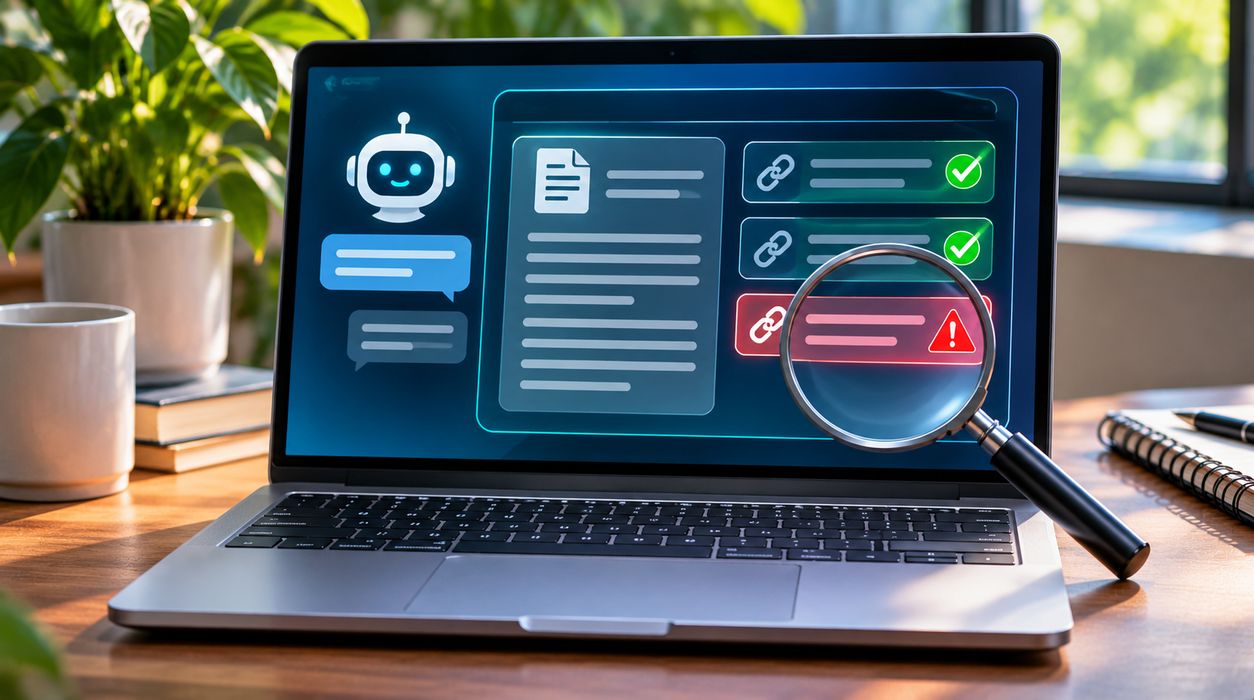
You ask an AI chatbot to find scientific studies, industry reports, or trustworthy websites supporting an important claim. Within seconds, it produces a polished answer containing article titles, author names, publication dates, and links.
Everything looks professional.
But when you click the references, something is wrong. One link leads to a missing page. Another article does not exist. A third source is real, but it does not support the claim the chatbot made.
This is a common problem known as AI citation hallucination.
If you have encountered an AI chatbot making up sources, understanding why it happens and how to prevent it can save you from publishing inaccurate information.
AI tools can help researchers, students, writers, and business professionals find and organize information. However, they can also invent references or misrepresent genuine sources.
The solution is not simply asking an AI system to be more accurate. Reliable research requires clear instructions, trustworthy source material, and independent verification.
This guide explains ten practical ways to reduce fabricated citations and build a more dependable AI research workflow.
Quick Answer: How Do You Stop AI Chatbots From Making Up Sources?
You cannot guarantee that an AI chatbot will never invent a reference, but you can significantly reduce the risk.
The most useful strategies include:
- Use web search or research tools when available.
- Ask for sources that can be independently verified.
- Provide original documents whenever possible.
- Require direct links to the supporting evidence.
- Check article titles, authors, dates, and publishers.
- Verify academic references using scholarly databases.
- Confirm that each source supports the specific claim.
- Instruct the chatbot to acknowledge missing evidence.
- Separate verified facts from assumptions.
- Review every important citation before publishing.
The central principle is simple: an AI-generated citation is a lead to investigate, not proof that a claim is true.
What Are AI Hallucinated Sources?
An AI hallucinated source is a reference generated by an artificial intelligence system that is nonexistent, inaccurate, or incorrectly associated with a claim.
These errors can appear in several forms.
Completely Fabricated References
A chatbot might invent a research paper with a realistic title, plausible author names, and a credible-looking journal.
The citation may follow a recognized academic style, making it difficult to identify as fabricated without checking.
Incorrect Publication Details
Sometimes a genuine article exists, but the chatbot provides the wrong publication year, author, journal, or title.
Broken or Invented URLs
An AI response may include a website address that does not lead to the claimed resource.
A link can look legitimate without pointing to a real page.
Misleading Source Attribution
A source may exist, but the chatbot incorrectly claims that it supports a particular statement.
This is especially dangerous because a quick check may confirm that the source exists while overlooking the unsupported claim.
Why Do AI Chatbots Invent References?
Large language models generate text using patterns learned during training and information available in the current interaction.
They do not automatically verify every statement against an authoritative database.
When asked to produce a bibliography, a model may generate text that resembles a legitimate citation even when it lacks reliable evidence for that reference.
For example, it may combine a real researcher’s name with a plausible article title and journal.
The result can appear convincing despite being inaccurate.
Confidence Does Not Guarantee Accuracy
A chatbot may express an incorrect answer with the same confidence as a correct one.
The wording of a response is not a reliable measure of its factual accuracy.
This also helps explain why AI systems can give different responses to identical questions.
Related Grandloopy article: Why Does ChatGPT Give Different Answers to the Same Question?
Planned internal URL: https://grandloopy.com/why-does-chatgpt-give-different-answers/
Use this link only after confirming that the article has been published at this address.
1. Use Web Search Instead of Relying Only on Model Knowledge
One of the most effective ways to improve source reliability is to use an AI tool with access to current search results.
Without external retrieval, a chatbot may rely primarily on information learned during training and the context supplied by the user.
This can create problems when researching:
- Recently published studies
- New regulations
- Current statistics
- Product specifications
- Industry developments
- Updated technical documentation
A search-enabled chatbot can retrieve sources instead of generating references solely from learned patterns.
How to Ask for Search-Based Evidence
Try this prompt:
“Search for reliable sources about this topic. Provide the original article title, publisher, publication date, and direct URL. Do not invent references. If you cannot find a source, say so.”
This instruction establishes clearer expectations.
However, search-enabled AI systems can still make mistakes.
Always open the resulting links and inspect the original content.
For additional guidance, see OpenAI’s explanation of ChatGPT accuracy and hallucinations.
2. Provide the Original Documents Yourself
When accuracy is essential, giving the chatbot a specific document can be more reliable than asking it to locate information independently.
For example, you might upload:
- A research paper
- A company annual report
- An official policy document
- A technical manual
- A government publication
- A verified dataset
Then ask the chatbot to answer using only that material.
Example Prompt
“Use only the attached report. Identify the sections supporting each factual claim. If the report does not contain the requested information, state that clearly.”
This reduces the need for the model to generate unsupported references.
Ask for Page Numbers
If you upload a PDF, request page numbers and short supporting excerpts.
For example:
“Summarize the findings and provide the page number supporting each conclusion.”
Afterward, check the cited pages yourself.
AI systems can misread documents or provide incorrect page references, so human verification remains necessary.
3. Ask for Direct Links to Original Sources
A citation should make it easy to locate the evidence.
Generic references such as “According to researchers” or “A recent study found” are insufficient for serious research.
Instead, request direct links to the original publication.
A Better Source Request
“Provide the exact title, author or organization, publication date, and direct URL for every source. Avoid homepage links when a specific article is available.”
This makes verification easier.
Original Sources vs. Secondary Sources
An original source may be a scientific paper, government dataset, company filing, or official announcement.
A secondary source summarizes or interprets original information.
Both can be useful, but they serve different purposes.
For example, a news article discussing a government report may provide helpful context.
However, if you need a precise statistic, checking the original report is usually preferable.
Do Not Trust Links Based on Appearance
A realistic-looking URL may still be fabricated.
Always open it and confirm that the expected document exists.
4. Verify Academic Citations With Google Scholar
Academic citations require particular care because fabricated references can undermine research papers, assignments, and professional reports.
Google Scholar is a useful starting point for locating scholarly literature.
How to Check an AI-Generated Citation
- Copy the article title.
- Open Google Scholar.
- Search for the title inside quotation marks.
- Compare the listed authors.
- Check the publication year.
- Review the journal or publisher.
- Locate the original paper when possible.
What If You Cannot Find the Article?
Try searching by author names and distinctive keywords.
The chatbot may have provided an incorrect title or publication year.
If you still cannot verify the source, do not include it in your final bibliography.
Important Limitation
Google Scholar is useful but not exhaustive.
A missing result does not automatically prove a paper never existed.
Search the publisher’s website, relevant library databases, or other authoritative sources before making that conclusion.
5. Check DOIs and Publication Metadata
A DOI, or Digital Object Identifier, is a persistent identifier commonly assigned to scholarly publications and other research outputs.
For example, a journal article may have a DOI that begins with “10.” followed by a publisher-specific identifier.
AI systems can invent DOI strings just as they can invent article titles.
Therefore, a DOI should be verified rather than accepted at face value.
How to Verify a DOI
- Copy the DOI supplied by the chatbot.
- Open a DOI resolver or a trusted metadata service.
- Check whether the identifier resolves.
- Compare the title, authors, and publication details.
- Confirm that the resulting publication is relevant.
A useful resource is Crossref Metadata Search, which supports searches by title, author, DOI, and other publication information.
Does a Valid DOI Prove the Claim?
No.
A valid DOI helps establish that an identifiable research output exists.
It does not prove that the paper supports the chatbot’s statement.
You still need to examine the actual research.
6. Require Evidence for Each Important Claim
One of the most common citation problems is attaching a real source to an unsupported statement.
For example, imagine an AI chatbot claims:
“Remote workers are 40% more productive than office workers.”
It then provides a genuine article about remote work.
The article’s existence does not establish that the specific 40% figure is correct.
Use a Claim-to-Source Table
Ask the chatbot to organize information like this:
| Claim | Supporting Source | Evidence to Check |
|---|---|---|
| Claim A | Original report | Relevant section or table |
| Claim B | Research paper | Findings or results |
| Claim C | Official statistics | Dataset and reporting period |
This structure makes unsupported claims easier to identify.
Ask for Precise Evidence
A useful prompt is:
“For each factual claim, identify the exact source and the section supporting it. If the evidence is indirect or uncertain, explain the limitation.”
Then verify the cited passages.
This is particularly important for numerical claims, quotations, and scientific conclusions.
7. Tell the AI to Acknowledge Uncertainty
AI chatbots may sometimes generate plausible answers instead of clearly acknowledging missing information.
You can reduce this problem by explicitly allowing the model to say that it cannot verify something.
Example Prompt
“Do not invent citations, statistics, quotations, or publication details. If reliable evidence is unavailable, write ‘Source not verified’ and explain what information is missing.”
This instruction encourages transparent uncertainty.
However, it does not guarantee that every unsupported claim will be identified correctly.
Why This Matters
A missing citation is often easier to correct than a fabricated one.
If the chatbot says it cannot find reliable evidence, you can continue researching.
If it invents a reference, you may waste time investigating a publication that never existed.
Avoid Forcing a Specific Number of Sources
Suppose you ask for exactly 20 scientific studies on a narrow topic.
If fewer suitable studies are readily available, the model may struggle to fulfill the request accurately.
A better instruction is:
“Find up to 20 relevant studies. Include only references that can be verified. Fewer results are acceptable.”
This prioritizes evidence quality over quantity.
8. Separate Verified Facts From AI Suggestions
Not every statement in an AI response has the same evidentiary status.
Some information may come directly from a source.
Other statements may be interpretations, assumptions, or suggestions generated by the model.
Separating these categories improves transparency.
Use Three Labels
Ask the chatbot to classify its output as:
Verified information: Claims supported by sources that have been checked.
Interpretation: Reasonable analysis based on the available evidence.
Unverified information: Claims that still require confirmation.
Remember that a chatbot’s own “verified” label is not proof of verification.
You must still inspect the evidence.
Why This Helps Writers
Imagine preparing a technology article.
The AI might accurately describe a manufacturer’s official feature while also speculating about future product updates.
If both statements appear in the same paragraph without clarification, readers may mistake speculation for fact.
Clear labeling helps prevent that confusion.
Related Grandloopy article: How to Tell If an AI-Generated Image Is Fake.
Planned internal URL: https://grandloopy.com/how-to-tell-if-an-image-is-ai-generated/
This related article discusses the broader importance of verifying AI-generated material.
9. Review Citations Before Publishing AI-Written Content
Writers and website owners should treat citation verification as part of the editorial process.
A well-written article can still contain serious factual errors.
Before publishing, inspect every external reference.
Editorial Citation Checklist
For each source, confirm:
- The URL opens successfully.
- The article or document exists.
- The publisher is correctly identified.
- The title matches the cited material.
- The publication date is accurate.
- The source supports the relevant statement.
- The information has not become outdated.
- The quotation, if any, is accurate.
Why Citation Quality Matters for SEO
Search engines aim to provide helpful, reliable information.
Adding links to authoritative websites does not automatically make an article accurate or improve its rankings.
The value comes from using trustworthy evidence to support useful content.
For website publishers, original explanations, clear sourcing, and editorial review are more meaningful than simply adding a long list of references.
Avoid Irrelevant Internal Links
Internal links should help readers discover closely related information.
For example, a discussion of AI reliability can naturally connect to troubleshooting articles about how technology behaves unexpectedly.
Related Grandloopy article: Why Does My Laptop Fan Run When Nothing Is Open?
Planned internal URL: https://grandloopy.com/laptop-fan-running-when-nothing-is-open/
Although this article addresses hardware troubleshooting rather than AI citations, both topics demonstrate the importance of identifying the actual cause of a technical problem.
10. Build a Repeatable AI Research Workflow
The most dependable approach is to use AI as one component of a structured research process.
Instead of asking for a finished article with references in one step, divide the work into smaller tasks.
Step 1: Define the Research Question
Write a specific question.
For example:
“What evidence supports the effectiveness of AI-assisted customer service for small businesses?”
Step 2: Identify Suitable Sources
Decide which types of evidence are appropriate.
These may include academic papers, official statistics, company reports, or primary research.
Step 3: Collect Sources
Use search tools, scholarly databases, or official websites to locate relevant publications.
Step 4: Verify Publication Details
Check titles, authors, dates, and identifiers.
Step 5: Extract Supported Findings
Read the relevant sections and record the evidence.
Step 6: Ask AI to Organize the Findings
Provide the verified information and request a structured summary.
Step 7: Review the Draft
Check that each important claim accurately reflects its source.
Step 8: Publish Only After Verification
Remove unsupported statements or clearly label them as uncertain.
This workflow requires more effort than generating an instant answer, but it produces a more dependable result.
Can AI Chatbots Be Trusted for Academic Research?
AI chatbots can assist with research tasks such as brainstorming, summarizing, explaining terminology, and organizing notes.
However, they should not replace scholarly databases, original publications, or critical evaluation.
A chatbot may accurately summarize one study while misrepresenting another.
It may also omit important limitations or combine findings from unrelated research.
Appropriate Uses of AI in Research
AI can help you:
- Develop research questions
- Understand unfamiliar terminology
- Organize literature review notes
- Compare supplied documents
- Improve writing clarity
- Generate questions for further investigation
Higher-Risk Uses
Extra caution is needed when asking AI to:
- Generate complete bibliographies without verification
- Provide exact quotations from inaccessible documents
- Invent missing publication information
- Interpret specialized findings without source material
- Make definitive claims about disputed research
For academic work, follow your institution’s policies on AI assistance and citation practices.
Why Fake AI Citations Are Dangerous
Fabricated citations are more than a minor formatting problem.
They can affect trust, decision-making, and professional credibility.
Academic Consequences
Students and researchers may submit nonexistent references, potentially violating academic integrity requirements.
Business Consequences
A company may rely on an inaccurate market statistic when making financial or strategic decisions.
Journalism Consequences
An invented source can undermine the credibility of an article or publication.
Legal and Medical Consequences
Unsupported claims in high-stakes fields can create serious risks.
Professional review and primary-source verification are essential in these contexts.
Public Misinformation
Fabricated citations can make false claims appear credible.
Readers may assume that a statement is trustworthy because it includes a professional-looking reference.
Does Asking AI to Double-Check Its Sources Work?
It can help identify some mistakes, but it is not sufficient by itself.
If you ask a chatbot to review its previous answer, it may recognize an inconsistency.
However, the same system may repeat the original error or generate another unsupported explanation.
Better Approach
Instead of asking:
“Are these citations real?”
Try:
“Check each citation against an accessible original publication. Report the title, publisher, URL, and whether the specific claim is supported. Mark anything you cannot independently verify.”
Even then, inspect the links yourself.
The strongest verification comes from independent evidence rather than repeated AI assurances.
Does Web Search Eliminate AI Hallucinations?
No.
Search-enabled AI systems can still misinterpret retrieved information, select unreliable sources, or attach a citation to the wrong claim.
Search improves access to evidence, but it does not guarantee accurate reasoning.
A retrieved page may also contain outdated or incorrect information.
Therefore, source quality and claim verification remain important.
Example
Suppose a chatbot retrieves a genuine article about smartphone battery performance.
It might incorrectly conclude that every software update permanently reduces battery capacity.
The source may discuss temporary background activity rather than permanent damage.
Related Grandloopy article: Why Is My Phone Battery Draining Faster After an Update?
Planned internal URL: https://grandloopy.com/phone-battery-draining-after-update/
This example illustrates why a real source must be interpreted accurately.
How to Write a Better AI Research Prompt
A carefully designed prompt can make source verification easier.
Here is a reusable example:
“Research the following topic using reliable, accessible sources. Prioritize original research, official documentation, and authoritative organizations.
For each factual claim, provide the supporting source title, publisher, publication date, and direct URL.
Do not invent citations, DOI numbers, quotations, statistics, or author names.
If a source cannot be verified, clearly mark it as unverified.
Separate confirmed facts from interpretations and suggestions.
Do not claim that a source supports information unless the relevant evidence can be identified.”
This prompt establishes useful boundaries.
It does not guarantee perfect accuracy, but it encourages a more transparent research process.
Common Mistakes When Using AI Citations
Mistake 1: Trusting Professional Formatting
A reference formatted in APA, MLA, or Chicago style can still be fabricated.
Mistake 2: Checking Only Whether a Link Opens
A working URL does not prove that the source supports the claim.
Mistake 3: Treating Every Research Summary as Accurate
AI summaries can omit qualifications or misrepresent conclusions.
Mistake 4: Asking for Too Many Sources
Large source lists can increase the amount of material requiring verification.
Mistake 5: Using Outdated Information
A real source may no longer reflect current evidence or regulations.
Mistake 6: Publishing Without Editorial Review
AI-generated content still requires human responsibility.
Mistake 7: Confusing Plausibility With Evidence
A claim that sounds reasonable is not necessarily supported by research.
Frequently Asked Questions
Why does ChatGPT make up sources?
ChatGPT generates language based on learned patterns and available context. Without reliable verification, it can produce plausible but nonexistent references.
Can AI generate fake research papers?
AI can generate fabricated titles, author names, journals, and publication details. These references should be checked against trusted databases.
How can I check whether an AI citation is real?
Search the exact title, verify the authors and publication details, check the publisher, and confirm any DOI.
Is Google Scholar enough to verify references?
Google Scholar is a useful starting point, but it is not exhaustive. Publisher websites and other scholarly databases may be needed.
Can a real citation still be misleading?
Yes. A genuine publication may not support the statement attached to it.
Does using web search prevent fake citations?
Search can reduce reliance on unsupported model-generated references, but it does not eliminate mistakes.
Should I trust AI-generated statistics?
Not without checking the original dataset, report, or publication.
Can AI verify its own references?
AI can assist with verification when it has access to suitable sources, but independent human checking remains important.
What should I do if an AI-generated source does not exist?
Remove the reference, search for genuine evidence, and revise any claims that depended on the fabricated citation.
What is the safest way to use AI for research?
Collect reliable sources, verify their details, provide them to the AI, review the resulting summary, and check important claims before publication.
Final Thoughts
An AI chatbot making up sources can create serious problems for researchers, students, publishers, and professionals.
The most effective solution is not to rely on a single prompt or assume that a confident answer is correct.
Instead, combine clear instructions, source retrieval, original documents, citation verification, and careful editorial review.
Check whether each publication exists, whether its details are accurate, and whether it actually supports the claim being made.
AI can accelerate research and improve productivity, but trustworthy information still depends on evidence.
When you treat AI-generated references as starting points rather than established facts, you can take advantage of artificial intelligence without sacrificing accuracy or credibility.

Ryan Mitchell is a passionate writer and digital content creator dedicated to sharing insightful, engaging, and informative articles across multiple niches. With a strong interest in technology, lifestyle, trending topics, and online media, Ryan Mitchell focuses on delivering well-researched and reader-friendly content that inspires and informs audiences worldwide.