Is Cider Fast Fashion? Yes, Ultra Fast: The Evidence, the Smart Fashion Claim, and the Ratings
Is Cider fast fashion is a yes or no question, so here is the answer first. Yes. Cider is fast fashion, and on the published evidence it qualifies as ultra fast fashion, the faster category beyond it.
The evidence is structural, not vibes. A brand founded in 2020, selling trend copies at very low prices, dropping new collections at a reported weekly to fortnightly rhythm, and rated at the bottom of the best known independent ethics scale.
That rating has a name. Good On You, the fashion ethics directory, gives Cider its lowest overall grade: We Avoid. Its planet and people scores are both Very Poor, the lowest on each axis.
The brand disagrees, politely and in marketing language. Cider calls its system smart fashion: production adjusted to real time demand, a recycled line, a take back program. This page audits that claim piece by piece instead of repeating it.
Three evidence layers decide the verdict. The brand’s own claims, the independent ratings, and a dated external definition of ultra fast fashion from the OECD in October 2025. Keep the layers separate and the answer stays clean.
The technology angle matters here more than in older fast fashion. Algorithmic trend tracking, social commerce, and data driven test batches are the machinery, a theme running through GrandLoopy’s AI technology coverage.
A note on what this verdict is not. It is not a claim that every Cider garment is identical, or that every shopper should feel guilty. It is a classification of a business model, with the receipts shown and the counterarguments included.
What would change the verdict gets its own section, because a verdict that cannot be changed by evidence is just an opinion. Cider could publish its way to a better rating. So far, it has not.
The Short Answer, With the Rating Attached
Yes, Cider is fast fashion, and the more precise label is ultra fast fashion. It replicates trends at algorithmic speed, sells them at very low prices, and turns its catalog over constantly.
The independent rating agrees. Good On You’s full rating explainer for Cider sets out the axis scores behind the directory grade: Very Poor for planet, Very Poor for people, and It’s a Start for animals, combining into We Avoid overall.
No serious source defends the opposite verdict. The disagreement in coverage is about degree and detail: how fast exactly, how bad relative to SHEIN, and whether the brand’s sustainability language is progress or greenwashing.
The verdict in one table
|
Question |
Answer |
Evidence layer |
|---|---|---|
|
Is Cider fast fashion? |
Yes |
Model, cadence, prices |
|
Is it ultra fast fashion? |
Yes, on OECD criteria |
OECD definition, October 2025 |
|
Is it ethical? |
Rated no |
Good On You, People: Very Poor |
|
Is it sustainable? |
Rated no |
Good On You, Planet: Very Poor |
|
Is it the same as SHEIN? |
No, a separate company |
Corporate record |
|
Does it make any efforts? |
Yes, claimed and partial |
Brand sustainability page |
Read the last row carefully. Efforts and verdicts coexist. A brand can run a recycled line and a take back scheme and still be an ultra fast fashion operation, because the classification describes the whole model.
What Counts as Fast Fashion, and What Counts as Ultra Fast
Fast fashion is a model, not a price tag or a style. Its marks are speed, volume, trend replication, and low prices, achieved by compressing the time between a trend appearing and a copy being sold.
Traditional fashion worked in seasons. Design, production, and retail ran months ahead, in a few collections a year. Fast fashion cut that to weeks and multiplied the collections until the season stopped meaning anything.
Ultra fast fashion cuts it again. The OECD’s October 2025 analysis describes a demand driven online model with production cycles of days, lead times of days to two weeks, and small test batches, roughly 30 to 10,000 units, reordered by real time data.
The OECD adds the warning that matters most. Designed for speed, scale, and flexibility, the model can structurally amplify labor, human rights, and environmental risks, whatever any single factory’s audit says.
The five criteria used on this page
Criterion one: cycle speed. New styles arrive continuously, measured in days or weeks, not seasons. A brand passing this test never really has a final collection.
Criterion two: trend replication. Designs track runway looks, celebrity outfits, and viral social posts closely and quickly. Originality is optional; recognition is the product.
Criterion three: price architecture. Prices sit far below the cost of durable construction and living wage labor done slowly. The low price is an output of the model, not a promotion.
Criterion four: data driven volume. Many styles in small test batches, winners reordered, losers deleted. Total style count and total garments stay high even when each batch is small.
Criterion five: opacity. Supplier lists, audit outcomes, wage evidence, and materials data are missing or partial. In rating methodology, unpublished evidence scores as failure, which is why transparency is a criterion, not a courtesy.
The Brand in Brief
Cider launched in 2020 in Hong Kong, founded by Michael Wang, Fenco Lin, and Yu Oppel, with a fourth friend appearing in some accounts. It sells as Shop Cider, direct to consumer, social first.
Production centers on Guangzhou, China’s garment manufacturing hub, with supplier cities including Hangzhou and Dongguan named in coverage. The brand also describes a Los Angeles presence in some materials; the factories are in China either way.
Growth ran on TikTok. Hauls, try ons, and influencer seeding made the brand a Gen Z default. Good On You’s September 2026 alternatives piece counts roughly 27,000 TikTok videos under the brand’s haul hashtag.
Reported revenue passed 200 million dollars, according to one fashion publication’s account. Treat that as a single strand figure, useful for scale, not audited financials. The company is private and publishes no accounts.
In 2026 the brand began opening physical stores, per Good On You’s reporting. Stores change the model’s edges, adding retail inventory to the online test system, without changing its speed or price architecture.
The founder playbook, honestly framed
As a startup case, Cider is impressive: zero to global recognition in about five years on data, social distribution, and supply chain proximity. The mechanics are the same ones catalogued in GrandLoopy’s step by step guide to starting a small business, run at unusual speed in one category.
That admiration has a limit. The same compression that makes the business remarkable is what the ethics ratings measure. Speed is not a side effect of the model. Speed is the model, and the costs sit where the speed is manufactured.
The Test, Criterion by Criterion
Apply the five criteria to the public record and the verdict stops being an impression. Each row below names the evidence and its kind, because mixing brand claims with independent findings is how this topic gets muddy.
|
Criterion |
Cider evidence |
Verdict |
|---|---|---|
|
Cycle speed |
New collections reported weekly to every 1 to 2 weeks |
Passes (ultra fast) |
|
Trend replication |
Runway and viral trend copies are the catalog’s stated concept |
Passes |
|
Price architecture |
T-shirts roughly $8 to $25, dresses roughly $25 to $50, by source |
Passes |
|
Data driven volume |
Smart fashion model; constant new SKUs; haul driven demand sensing |
Passes |
|
Opacity |
Partial supplier information; no living wage evidence; ratings cite missing data |
Passes |
Five for five is not a close call. Brands near the boundary usually fail one or two criteria, most often price or opacity. Cider’s model was designed inside the ultra fast pattern from launch, not adapted into it later.
The cadence conflict, printed honestly
Sources disagree on the exact rhythm. Reviewers report new collections weekly, every 1 to 2 weeks, and in one rating page’s account every 4 to 6 weeks with dozens of styles per cycle. The disagreement is about the count, not the conclusion.
Print the range, not a winner. At the slowest reported cadence, Cider still releases collections roughly monthly with constant new arrivals between drops. Every reported version sits far inside fast fashion territory.
The same discipline applies to prices. Bands differ by source and by date, so this page prints source dependent ranges and treats any single precise price list as one snapshot, not a fact about the brand.
The Smart Fashion Claim, Audited
Cider’s own sustainability page makes a coherent pitch. Fashion should be accessible, the brand says, and its smart fashion model produces on demand, adjusting output to real time customer feedback so less is wasted than in traditional retail.
Claim one: on demand production. The mechanism is plausible; test batches and reorders genuinely reduce unsold inventory per style. But the claim would need published sell through and waste data to count as evidence, and the brand publishes none.
Claim two: responsible supply chain. The brand maintains a Zero Tolerance Policy for suppliers and says it works to require factory registration with standards such as SMETA, SEDEX, QES, or BSCI. Registration expectations are process claims; audit outcomes and wage records are the evidence, and those stay unpublished.
Claim three: recycled materials. Since 2022 the brand has partnered with suppliers on Global Recycled Standard certified items, and says it has launched over 450 such items in its #ReCider category. Real, and a minority: the rating evidence describes a range overwhelmingly built on conventional synthetics.
Claim four: the Take Back Bag. The brand’s #ReCider Take Back Bag program quotes reuse shares and per bag savings figures. Those are brand published figures, printed here as claims, not as measured results from an independent audit.
The audit verdict
The pattern across all four claims is the same shape: a real mechanism, described warmly, with the measurement missing. That pattern has a name in consumer protection language, and the name is the greenwashing risk, whether or not the intent is cynical.
Small batches deserve one nuance. Test and reorder can cut the unsold rate per design while raising the total number of designs and garments. A system can waste less per style and more overall. Both things can be true, and for ultra fast fashion, usually are.
The Ratings: Good On You, Axis by Axis
Good On You rates fashion brands on published evidence across three axes. Its Cider entry is the most cited independent assessment available, which is why this page shows its working instead of just its headline grade.
|
Axis |
Grade |
Stated basis |
|---|---|---|
|
Planet |
Very Poor |
Few lower impact materials; no meaningful hazardous chemical action; no biodiversity action |
|
People |
Very Poor |
Insufficient published labor information to score higher; no living wage evidence |
|
Animals |
It’s a Start |
Avoids leather, down, fur; uses wool and exotic hair without traceability or a welfare policy |
|
Overall |
We Avoid |
The lowest of five overall grades |
Notice what the grades measure. They score disclosed practice, not intentions and not marketing quality. A brand improves its rating primarily by doing and publishing verifiable things, in that order.
The materials finding is concrete. The rating describes a range overwhelmingly made from fabrics like virgin polyester and spandex. Synthetics shed microfibers, depend on fossil feedstocks, and do not biodegrade, which is why the fiber mix carries the planet grade.
The people finding is an absence. There is no published evidence of living wages, and not enough supply chain information to rate the brand higher. Absence of evidence is treated as failure here because, at this scale, disclosure is itself a practice.
Ratings move, and this page dates them. The directory grade summarized here reflects Good On You’s assessment as updated in its September 2026 coverage. If Cider publishes more, the grade can rise, and this page’s verdict section says exactly what would do it.
Materials, Chemicals, and the Waste Question
The range is mostly synthetic. Polyester, spandex, viscose, and conventional cotton dominate the product pages reviewers sampled, with recycled fibers concentrated in the labeled minority line. That mix is the standard ultra fast fiber profile.
One research strand deserves careful labeling. Fashion coverage of Greenpeace Germany’s 2022 testing reported that 15 percent of tested SHEIN and Cider items contained toxic chemical levels above EU regulatory limits. This page carries it as a secondary strand, attributed, not as a fresh test of today’s catalog.
Waste works at two levels. Per garment, cheap construction shortens useful life. System wide, constant newness trains single wear and few wear habits, especially for occasion pieces bought for one event and one post.
The environmental ledger is bigger than one brand’s catalog. The same demand for instant, data driven everything drives the footprint questions examined in GrandLoopy’s investigation of whether AI is bad for the environment, where speed and scale, not any single product, carry the impact.
Durability, from the review record
Reviewer consensus on quality is hit or miss: some pieces surprise, many are thin, sizing varies, and construction matches the price. That variability is itself a model output. At these prices and speeds, consistency is the first casualty.
Cost per wear reverses the bargain. A 15 dollar dress worn twice costs 7.50 per wear. A 60 dollar dress worn thirty times costs 2 dollars per wear, and it is still in the wardrobe when the cheap one is in the bin.
Cider Versus SHEIN, Versus Zara
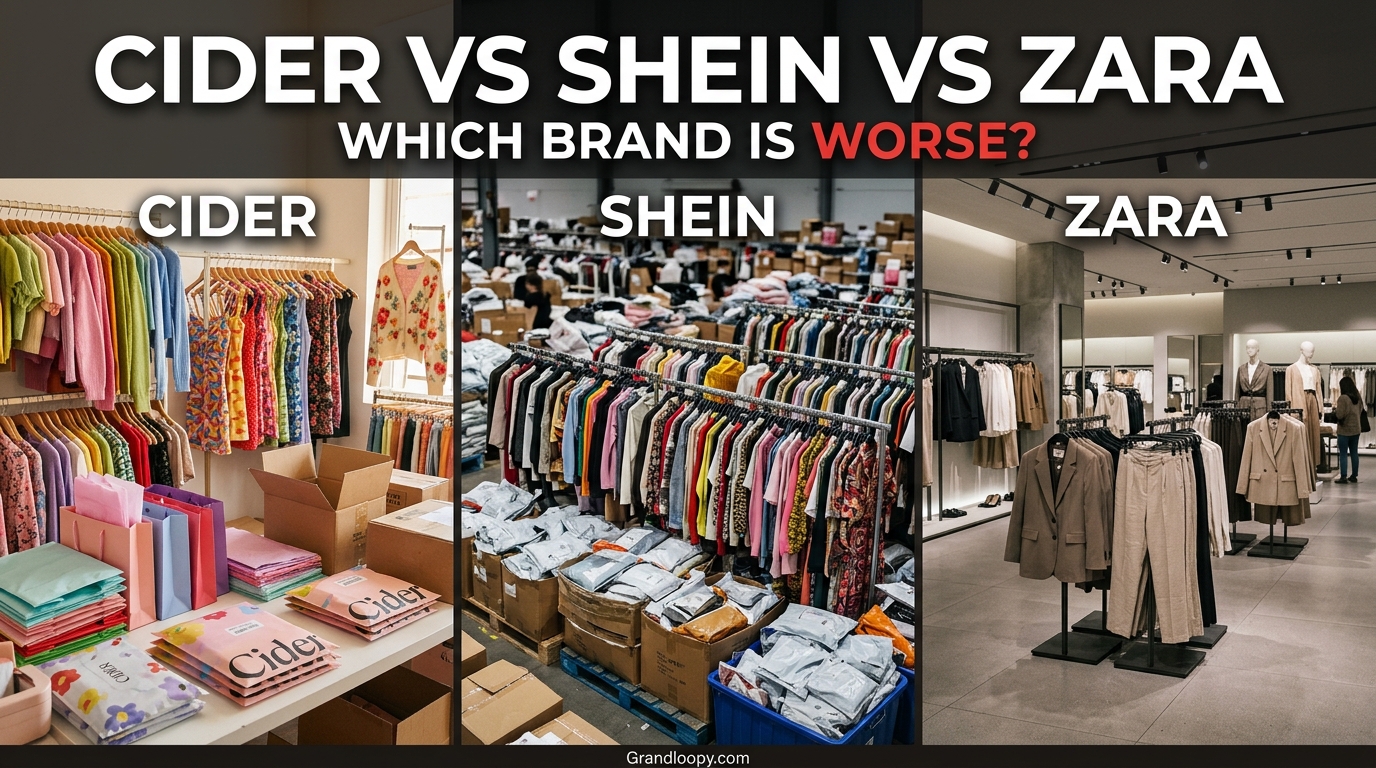
The SHEIN question arrives in almost every search, so it gets a direct answer. Cider and SHEIN are separate companies. They share a model family, a Guangzhou sourcing base, and an audience. They do not share ownership.
|
Dimension |
Cider |
SHEIN |
Zara |
|---|---|---|---|
|
Generation |
Ultra fast |
Ultra fast, largest scale |
Fast fashion original model |
|
Cadence |
Weekly to fortnightly collections (reported) |
Thousands of new SKUs daily (reported) |
Rapid seasonal drops, store led |
|
Price band |
Low; tees roughly $8 to $25 |
Lowest; broader catalog |
Higher; mid market |
|
Channel |
Online first; stores opening 2026 |
Online |
Stores plus online |
|
Ethics rating |
We Avoid (Good On You) |
Also rated at the bottom by Good On You |
Higher than both, still fast fashion |
Scale is the honest difference. SHEIN operates the same playbook at a multiple of Cider’s volume. “Less bad than the biggest ultra fast brand” is a comparison, not a category change, and the category is what the question asks about.
Zara marks the older speed. Its model compressed seasons into weeks and built the template. Ultra fast brands then removed the store bottleneck, added algorithmic trend sensing, and cut the cycle again. Cider belongs to the second generation, not the first.
Quality comparisons follow price. Reviewers generally place Cider’s quality near or slightly above SHEIN’s at a slightly higher price, and below the mid market chains. Treat that as reviewer consensus, a strand, not a laboratory result.
What Would Change the Verdict
A verdict page owes readers its falsification conditions. Cider’s rating, and this page’s classification, would genuinely move if the brand published the following and an independent party verified it.
1. A complete supplier list with audit outcomes
Names and addresses of factories, the share of production each represents, and audit results rather than audit intentions. Partial lists of showcase factories do not test the supply chain; they decorate it.
2. Living wage evidence
Wage data against a recognized living wage benchmark for the main production base. Policies prohibiting low pay are not evidence of adequate pay, and the people grade turns on exactly this gap.
3. A published materials mix
The percentage of the range in lower impact fibers, by units sold, updated yearly. A 450 item recycled line means one thing in a 5,000 item catalog and another in a 50,000 item one. The denominator is the disclosure.
4. Chemical and waste reporting
Hazardous chemical management results and unsold inventory and waste figures. The smart fashion claim becomes evidence the day the brand publishes its sell through and destruction numbers for others to check.
5. A slower catalog
Fewer styles, longer selling lives, and designs carried across seasons. No disclosure package can reclassify a model whose speed and volume stay at ultra fast levels; the category describes the operating rhythm itself.
If You Shop There Anyway: Harm Reduction Without Illusions
Not every reader will stop, and pretending otherwise helps no one. Budgets are real, sizes are real, and ethical alternatives still underserve plus size shoppers in particular. These habits cut harm without pretending the model changes.
1. Buy for thirty wears, not one event
Ask the thirty wears question before checkout: with what you own, how many times will this genuinely be worn? Occasion pieces fail this test most often, and they are the catalog’s most disposable corner.
2. Check the fiber label first
Choose the cotton, viscose, or recycled option over virgin polyester when the same style offers a choice. Fiber is the one product level variable a shopper fully controls, and it drives washing impact and end of life.
3. Skip the haul format
Hauls manufacture urgency and basket size. Buying one considered piece instead of eight speculative ones cuts returns, waste, and the regret pile, and it quietly opts out of the demand signal the model trains on you.
4. Wash less, wash cold, keep longer
Care is a durability policy. Cold washing, air drying, and minor repairs extend the working life of lightly built garments. A year added to a garment’s life outweighs most other footprint choices a wearer makes.
5. Route the exit properly
Resell, swap, or donate wearable pieces, and use take back schemes for the genuinely worn out. Landfill is the worst exit and, for synthetics, a centuries long one.
Alternatives, and the Access Problem Honestly
Rated alternatives exist at several price points, and Good On You’s rated alternatives to Cider best sellers collects better scoring brands making similar best selling pieces. The honest catch is price and range: few match ultra fast prices, because those prices are the problem being rated.
Secondhand is the closest substitute. The same garments circulate on resale platforms at similar prices with no new production behind them. Buying Cider secondhand keeps the look and skips the manufacturing order entirely.
The access gap is real. Shoppers who rely on ultra fast brands for extended sizes, trend access, or strict budgets face thinner ethical options. Naming that gap matters more than shaming the shoppers standing in it; the fix is supply, not scolding.
Mistakes Readers Make With This Question
Mistake one is treating “not as bad as SHEIN” as a passing grade. The question is categorical. A brand can be smaller than the worst case and still be a textbook case.
Mistake two is counting a recycled line as a sustainable brand. A certified minority inside a conventional majority is a product line, not a transformation, until the published mix says otherwise.
Mistake three is trusting the word demand. On demand describes batch sizing, not volume. A system can produce only what is ordered and still produce vastly more than anyone needs, one small batch at a time.
Mistake four is checking the marketing page instead of the rating. Brand sustainability pages are claims documents. Directories like GrandLoopy’s technology and consumer library exist to keep the claim and the evidence in different rooms.
General information only: this page classifies a business model from published claims, independent ratings, and dated research strands, each labeled. Ratings change as brands disclose more; check the directory date before quoting any grade.
How Ratings Work, and Why Absence Scores as Failure
New readers often ask why a brand can score Very Poor for people without a specific factory scandal attached to its name. The answer is methodological, and it is the most important idea on this page.
Rating systems score evidence, and garment supply chains are exactly as ethical as their documentation. A brand that will not say where its clothes are made, by whom, at what wages, under which audits, has not earned the benefit of the doubt at global scale.
That standard is not bias. It is the same standard applied to food safety and financial reporting: the party profiting from the system carries the burden of proof. Fashion escaped that norm for decades because its factories sit far from its customers.
Brands complain that ratings punish small companies lacking reporting departments. Cider is not that case: a private company with reported nine figure revenue and a global logistics operation can afford a supplier list. Choosing not to publish is a resource decision.
The practical takeaway for shoppers is a habit, not a boycott list. Before buying, spend two minutes in a rating directory. If the entry is mostly absence, the price in the cart is being subsidized by someone you cannot see.
The US Buyer Context in 2026
American shoppers built Cider’s largest audience, and two recent changes shape what buying from it now means. Neither changes the classification, but both change the checkout.
First, the tariff shift. Review coverage reports that the United States suspended the de minimis exemption in 2025, the rule that once let small parcels from China enter duty free. Apparel shipments now attract duties that reviewers describe as adding substantially to delivered prices.
That change attacks the model’s price architecture directly. Ultra fast fashion depended on thousands of tiny, untaxed, air shipped parcels. Taxing the parcel narrows the price gap between Cider and slower domestic options more honestly than any awareness campaign has.
Second, the store openings. Physical retail, reported through 2026, moves the brand toward the older fast fashion footprint: inventory on shelves, local returns, a presence regulators and journalists can walk into. Visibility tends to produce documentation, which is what the ratings have been asking for.
Watch the directory, not the discourse. If stores, tariffs, and scrutiny push Cider toward publishing suppliers, wages, and materials data, the grade will move and this page’s falsification section will have done its job. If only the marketing moves, nothing has changed.
Frequently Asked Questions
1. Is Cider fast fashion?
Yes. Cider replicates trends at high speed, sells at very low prices, and turns its catalog over constantly.
That is the fast fashion model by definition, and the independent ratings agree with the classification.
2. Is Cider ultra fast fashion?
Yes, on the OECD criteria. The October 2025 OECD analysis defines ultra fast fashion by cycles of days, small test batches, and data driven reordering.
Cider’s speed, prices, and social commerce model fit that faster category.
3. What is the difference between fast fashion and ultra fast fashion?
Speed and data separate them. Fast fashion compressed seasons into weeks; ultra fast fashion compresses them into days, sells online only or online first, and lets real time sales data decide what gets made next.
4. Why is Cider considered fast fashion?
Its model checks every box. Rapid trend replication, weekly to fortnightly collections in most reports, ultra low prices, a vast rotating catalog, and an opaque supply chain.
No single trait decides it; together they are conclusive.
5. Is Cider the same company as SHEIN?
No. Cider and SHEIN are separate, competing companies.
They share a similar ultra fast model, a Guangzhou sourcing base, and an audience, which is why they are compared so often.
6. Is Cider as bad as SHEIN?
Comparable, at smaller scale. Both sit at the bottom of independent ethics ratings, and both run the same playbook.
SHEIN operates at a multiple of Cider’s volume, so similar is accurate and identical is not.
7. Is Cider ethical?
Rated no. Good On You gives Cider its lowest overall grade, We Avoid, with a Very Poor people score.
The brand publishes too little labor information, and no living wage evidence, to rate higher.
8. Is Cider sustainable?
Rated no. Good On You scores the planet axis Very Poor: few lower impact materials, a range dominated by virgin synthetics, and no meaningful published action on hazardous chemicals or waste.
9. What is Cider’s Good On You rating?
We Avoid, the lowest grade. The axis scores are Very Poor for planet, Very Poor for people, and It’s a Start for animals, per the directory assessment reflected in its September 2026 coverage.
10. What does a We Avoid rating mean?
It is a do not buy signal. Good On You’s five grades run from Great down to We Avoid.
The lowest grade means the published evidence shows little or no meaningful action across the rating issues.
11. Is Cider greenwashing?
The risk is real, the intent is unknowable. The brand’s sustainability language describes real mechanisms, a recycled line, a take back scheme, demand led batches, but publishes almost no measured outcomes.
Claims without measurements are where greenwashing lives.
12. What is Cider’s smart fashion model?
Its name for demand led production. Cider says smart fashion means producing based on real time customer feedback and data, adjusting output to demand instead of forecasting seasons, which it argues creates less waste than traditional retail.
13. Does on demand production make Cider sustainable?
Not by itself. Test batches can cut unsold stock per style while raising total styles and total garments.
Sustainability turns on volume, materials, wages, and waste data, and the brand publishes none of those measures.
14. How often does Cider release new clothes?
Constantly, with a reported range. Coverage reports new collections weekly, every 1 to 2 weeks, and in one account every 4 to 6 weeks.
Every reported cadence is far inside fast fashion territory.
15. How many new styles does Cider release?
No verified total exists. The brand does not publish a style count, and estimates in coverage vary widely.
What is consistent across sources is a large, fast rotating catalog rather than any single number.
16. Why is Cider so cheap?
The model is built for cheapness. Direct to consumer sales, Guangzhou supplier networks, small test batches, synthetic fabrics, and enormous trend volume remove cost at every step.
Low prices are an output of that system.
17. Where is Cider clothing made?
Primarily in China. Coverage consistently places production in Guangzhou’s garment hub, with Hangzhou and Dongguan named among supplier cities.
The brand’s own supplier disclosures are partial, which is part of the transparency problem.
18. Where is Cider based?
Founded in Hong Kong, producing in China. The brand launched in Hong Kong in 2020 and describes a Los Angeles presence in some materials.
Its factories are in China regardless of where its offices sit.
19. When was Cider founded and by whom?
In 2020, by friends. Michael Wang, Fenco Lin, and Yu Oppel are the named founders in most accounts, with a fourth friend appearing in some versions.
They built it as a social first, direct to consumer brand.
20. Does Cider publish its factory list?
Only partially. The brand names some supplier relationships and standards expectations on its sustainability page.
Raters and reviewers conflict on how complete that disclosure is, and no full list with audit outcomes is published.
21. Are Cider factory workers paid a living wage?
No evidence says so. Good On You’s people grade reflects exactly this gap: there is no published living wage evidence for Cider’s supply chain, and policies against low pay are not the same as wage records.
22. What materials does Cider use most?
Mostly synthetics. Reviewers and raters describe a range dominated by polyester, including virgin polyester, plus spandex, viscose, and conventional cotton.
Recycled fibers appear mainly in the labeled #ReCider minority line.
23. What is the #ReCider collection?
Its recycled product line. #ReCider covers items made with recycled materials, including Global Recycled Standard certified products the brand says number over 450 since a 2022 supplier partnership.
It is a minority of the range.
24. Did Greenpeace find toxic chemicals in Cider clothing?
A 2022 test reported findings. Fashion coverage of Greenpeace Germany’s 2022 testing reported 15 percent of tested SHEIN and Cider items exceeded EU toxic chemical limits.
It is a dated secondary strand, not a test of today’s catalog.
25. Is Cider worse than Zara or H&M?
Different model, similar family. Zara pioneered fast fashion with rapid store led drops at mid market prices.
Cider runs the faster, cheaper, online ultra fast version, and Zara’s ethics ratings, while imperfect, sit above Cider’s.
26. Is Cider legit, or is it a scam?
Yes, it is a real retailer. Orders ship and arrive, and the company is a substantial private business.
Legit means functioning, though; it says nothing about ethics, quality consistency, or sustainability, which rate poorly.
27. Is Cider quality good?
Hit or miss, per reviewers. Some pieces surprise buyers; many are thin, inconsistent in sizing, and built to the price.
Variability is a predictable output of the speed and cost structure, not bad luck.
28. How long do Cider clothes last?
Usually a season or less of regular wear. Light construction and synthetic fabrics wear out faster than mid market garments.
Cost per wear often ends up higher than a pricier, durable equivalent worn for years.
29. Is Cider better than SHEIN in quality?
Roughly comparable, per reviewer consensus. Cider is often placed slightly above SHEIN on quality at slightly higher prices.
That is a review strand, not a laboratory finding, and both brands vary piece by piece.
30. Does Cider use child labor?
No public evidence answers this either way. The honest position is that Cider publishes too little supply chain information for anyone to verify labor conditions, including on child labor.
That opacity is itself the rated failure.
31. Is Cider vegan or cruelty free?
Mostly, but not certified. The range avoids leather, down, and fur, which earns an It’s a Start animal score.
It does use wool and exotic animal hair without traceability or a published animal welfare policy.
32. Does Cider copy independent designers?
Allegations exist, as across ultra fast fashion. Rapid trend replication has drawn design theft and cultural appropriation accusations in coverage.
The speed of the model makes close copying a structural risk, not an occasional accident.
33. What is a Cider haul?
A bulk try on video genre. Creators order many pieces, model them rapidly, and post the haul.
Good On You counted roughly 27,000 TikTok videos under Cider’s haul hashtag in its September 2026 coverage.
34. Why is Cider so popular on TikTok?
Its distribution is social. The brand was built social first: trend sensing from the same feeds that sell the product, influencer seeding, and haul content that turns buyers into the advertising channel.
35. Did US tariffs change Cider prices in 2025?
Review coverage says the math changed. The United States suspended the de minimis duty exemption in 2025, so small parcels from China now attract duties.
Reviewers report apparel tariffs adding substantially to delivered prices.
36. Is buying Cider secondhand more ethical?
Yes, meaningfully. A secondhand Cider garment creates no new production order, so its manufacturing footprint is already spent.
It remains a short lived garment, but the largest harm, making another one, is avoided.
37. What are the best ethical alternatives to Cider?
Use rated directories, not vibes. Good On You’s alternatives roundup collects better scoring brands making similar pieces.
Expect higher prices and smaller trend ranges; that difference is precisely what the rating is measuring.
38. How can I tell if a fashion brand is fast fashion?
Run the five criteria. Continuous drops in days or weeks, trend copying, prices too low for durable construction, a huge rotating catalog, and no published supplier or wage evidence.
Three or more means fast fashion.
39. What would Cider have to do to stop being fast fashion?
Publish and slow down. A full supplier list with audit outcomes, living wage evidence, a published materials mix, chemical and waste reporting, and a catalog with fewer styles living longer.
Disclosure alone cannot reclassify ultra fast speed.
40. Should I stop buying from Cider?
That is a values and budget call. The evidence says the model is harmful and the brand is rated at the bottom.
Shoppers with real budget or size constraints can cut harm with fewer, longer worn, secondhand first purchases.
41. Is Cider opening physical stores?
Yes, per 2026 reporting. Good On You’s September 2026 coverage notes the brand opening bricks and mortar stores.
Stores extend the model into retail inventory without changing its speed or price structure.
42. How do I shop more responsibly if I still buy Cider?
Buy fewer, longer lived pieces. Apply the thirty wears test, read fiber labels, skip haul sized baskets, wash cold and repair, and exit garments through resale or donation.
Harm reduction is real even when abstinence is not.
Conclusion
Is Cider fast fashion has a clean answer because the evidence layers agree. The model is ultra fast by the OECD criteria, the prices and cadence confirm it, and the best known independent rating places the brand at the bottom of its scale.
Hold the two honest nuances alongside the verdict. The brand’s smart fashion mechanisms are real but unmeasured, and the shoppers who rely on its prices and sizes face a genuine access gap in ethical alternatives. Neither nuance changes the classification.
Use the five criteria on the next brand you wonder about, and check its rating before its marketing. If Cider publishes its suppliers, wages, materials mix, and waste numbers, this verdict should be revisited. Until then, the answer stands: yes, ultra fast fashion.