What Are Business Days? Definition, Rules, and 2026-2027 Calendars
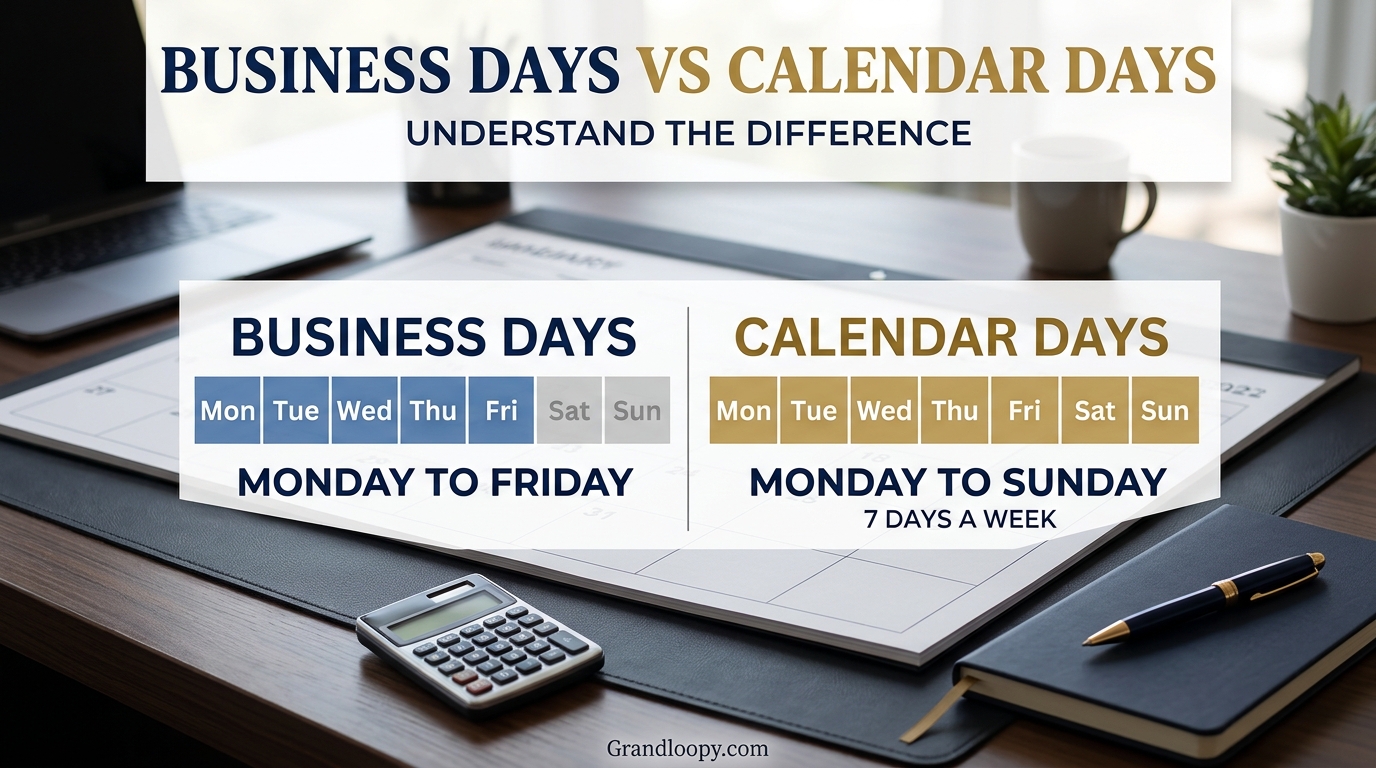
Business days are the days when banks, courts, government offices, and most companies do their regular work. In the United States, that means Monday through Friday, excluding federal holidays.
That one sentence answers the question for most people. The trouble starts when money or a deadline depends on the count. Saturday counts under some rules and not others.
The federal calendar and the bank calendar disagree by a day or two each year.
Even the number of business days in 2026 is disputed online, and most pages that print a number never say which calendar they used.
Each question is answered with the rule behind it.
The standard definition comes first, with the full 2026 and 2027 holiday tables and the correct year counts with the arithmetic shown.
A counting method with worked examples follows, plus the separate definitions used by banks, mortgage lenders, courts, the IRS, and the stock market.
What Is a Business Day? The Short Answer
A business day is any weekday, Monday through Friday, that is not a federal holiday. Saturdays, Sundays, and the eleven federal holidays are not business days under the standard definition.
The standard definition covers most situations: shipping estimates, refund timelines, contract deadlines, and bank processing. But it is a default, not a law.
Banks, lenders, courts, and agencies each define the term for their own rules, and those definitions differ in ways that change real deadlines.
When a rule, contract, or notice defines “business day” for itself, that definition controls. The general meaning is only a fallback. Always check the governing definition before counting days that carry money or legal consequences.
The Standard Definition
The most widely used meaning covers the five weekdays when government offices, banks, and most businesses are open. Government offices set the pattern, and banks and carriers follow it closely.
Private businesses may open on more days, but their extra days do not change the standard count.
A business day does not require a specific business to be open. It refers to the days when the broader commercial infrastructure operates: banks process transactions, courts accept filings, and carriers move packages.
A shop open on Sunday does not make Sunday a business day.
The eleven federal holidays are excluded across nearly every framework. Federal law names them in 5 U.S.C. 6103, and the Office of Personnel Management publishes the observed dates each year.
The full tables are in the holiday section.
Business Hours: The 9 to 5 Convention
A business day is conventionally understood as 8 hours, typically 9:00 a.m. to 5:00 p.m. local time. That window is a cultural norm, not a legal requirement.
No federal statute sets business hours for all purposes.
Actual hours vary widely by industry. Bank branches often open at 9:00 a.m. and close in the late afternoon. Retail stores commonly run seven days a week with longer hours.
Hospitals, utilities, and emergency services operate around the clock.
The hours matter mainly through cutoff times. A wire transfer sent after a bank’s afternoon cutoff counts as sent the next business day.
A court filing delivered after the clerk’s office closes gets stamped the next business day. The day matters, and so does the hour.
Why No Single Law Defines It
No single federal statute defines “business day” for all purposes. Each regulatory area supplies its own definition, tailored to the transactions it governs. Banking, mortgage lending, tax, courts, and consumer protection each use different words.
That is why a day can count under one rule and not another. Saturday counts when measuring the three-day mortgage rescission window, but not when measuring check-hold periods.
The sections on regulations below lay out every major definition side by side.
The practical lesson is simple. Never assume the Monday-to-Friday rule applies to a specific deadline. Find the rule that governs your transaction, read its definition, and count from there.
Business Days vs Calendar Days vs Working Days vs Banking Days

Four similar terms cause most of the confusion. Calendar days count every day. Business days skip weekends and holidays.
Working days usually means the same as business days, but can also mean the days a specific person or company works. Banking days are a narrower legal term tied to bank operations.
The table below separates the four terms. Use it whenever a deadline, estimate, or contract uses one of these words and you need to know exactly which days count.
| Term | What it counts | Typical uses |
|---|---|---|
| Calendar day | Every day, including weekends and holidays | Age, rental periods, Net 30 payment terms, general deadlines |
| Business day | Monday to Friday, minus federal holidays | Shipping estimates, refunds, contracts, bank processing |
| Working day | Usually the same as a business day; sometimes a specific employer’s schedule | Payroll, leave requests, project timelines |
| Banking day | Part of a business day when a bank is open for substantially all functions | Check holds, funds availability under Regulation CC |
The working day distinction matters for shift workers and retail staff. A shop open Tuesday through Saturday has five working days a week, but its working days are not the standard business days.
Payroll and scheduling systems must track the employer’s own calendar, not the federal one.
The banking day distinction matters for deposits. A branch open Saturday morning for deposits only may not be conducting substantially all of its functions.
In that case, Saturday is not a banking day, and a check deposited Saturday is treated as deposited Monday for funds availability.
Business Days to Calendar Days Conversion
Converting business days to calendar days depends on where the count starts. A count that starts Monday converts cleanly. A count that starts Friday, or spans a holiday, stretches much further.
The table below gives the usual ranges.
| Business days | Calendar days | Common uses |
|---|---|---|
| 1 | 1 to 3 | Next-day processing, urgent deadlines |
| 2 | 2 to 4 | Express delivery, check clearing |
| 3 | 3 to 5 | ACH transfers, rescission and cooling-off windows |
| 5 | 7 | One work week, standard processing |
| 7 | 9 to 11 | Standard shipping |
| 10 | 14 | Two work weeks, bank investigations |
| 20 | 28 | Four work weeks, monthly cycles |
| 30 | 42 | Six work weeks, extended processing |
The ranges assume no holidays fall inside the count. A holiday adds a day to the calendar span.
The worked examples in the counting section show how Thanksgiving week stretches a 5-business-day shipment to 10 calendar days.
One conversion is exact and worth memorizing. Five business days always equals one work week, which is 7 calendar days when no holiday intervenes. Ten business days equals two work weeks, or 14 calendar days.
Which Days Count as Business Days?
Monday, Tuesday, Wednesday, Thursday, and Friday count as business days, unless a federal holiday falls on that weekday. Saturday and Sunday do not count under the standard definition.
A federal holiday on a weekday removes that day from the count.
The table below gives the day-by-day answer. It reflects the standard United States definition used for shipping, banking, contracts, and government deadlines.
| Day | Business day? | Notes |
|---|---|---|
| Monday | Yes, unless a holiday | Most federal Monday holidays fall here |
| Tuesday | Yes, unless a holiday | Rarely a holiday |
| Wednesday | Yes, unless a holiday | Veterans Day 2026 falls on a Wednesday |
| Thursday | Yes, unless a holiday | Thanksgiving always falls on a Thursday |
| Friday | Yes, unless a holiday | Observed holidays often land on Friday |
| Saturday | No, with exceptions | Counts for mortgages, cooling-off, and some shipping |
| Sunday | No | Excluded under every major definition |
Is Saturday a Business Day?
Saturday is not a business day in most United States contexts. Banks, courts, the IRS, and most contracts count only weekdays.
A deadline that lands on a Saturday usually moves to the next business day, normally Monday.
Shipping and retail are the main exceptions. The Postal Service delivers mail and packages on Saturdays as a standard part of its schedule. Private carriers offer Saturday delivery for some services, often at a premium.
Saturday can be a delivery day without being a business day for transit-time counting.
Two federal rules count Saturday as a business day. The mortgage rescission and disclosure rules count every calendar day except Sundays and federal holidays. The FTC cooling-off rule uses the same broader definition.
Both are covered in detail in the regulations section.
One banking rule can also count Saturday. Under Regulation E, a business day is any day a bank’s offices are open for substantially all business functions.
A branch fully open on Saturday could make Saturday count for electronic transfer deadlines. Most Saturday branches offer limited services, so this exception rarely applies.
| Context | Does Saturday count? | Rule |
|---|---|---|
| Bank processing (Reg CC) | No | Saturday excluded by name |
| Electronic transfers (Reg E) | Only if the bank is fully open | Substantially-all-functions test |
| Mortgage rescission / disclosure | Yes | All days except Sundays and federal holidays |
| FTC cooling-off rule | Yes | All days except Sundays and federal holidays |
| Court filings | No | Deadlines extend past weekends |
| IRS deadlines | No | Deadlines move to the next business day |
| USPS delivery | Yes, as a delivery day | Saturday is a standard delivery day |
| UPS / FedEx transit time | Usually no | Depends on service level and area |
| Most contracts | No, unless defined otherwise | The contract definition controls |
| Retail and restaurants | Yes, as an operating day | Not a business day for deadlines |
Is Sunday a Business Day?
Sunday is not a business day under any major United States definition. Every framework excludes it: banking, mortgages, courts, tax, consumer protection, and shipping estimates. Sunday is the one universal exclusion.
Sunday operations still exist. Retail stores, restaurants, and some delivery services operate on Sundays.
The Postal Service delivers Priority Mail Express on Sundays in many areas, and Amazon delivers seven days a week in much of the country.
Operating on Sunday does not make it a business day for counting purposes.
The practical rule is simple. Never count Sunday in a business-day calculation unless a specific contract or rule says otherwise. If a deadline lands on Sunday, it moves to Monday under nearly every framework.
Do Federal Holidays Count?
Federal holidays do not count as business days, even when they fall on a weekday. The eleven holidays in 5 U.S.C. 6103 are excluded from business-day calculations across virtually every regulatory framework.
A holiday on a Tuesday removes that Tuesday from the count.
Observed holidays count the same way. When a holiday falls on a weekend, the observed weekday is the day off, and that weekday is excluded.
The observed date, not the calendar date, is what a careful count must skip.
Private businesses may stay open on federal holidays. A store open on Columbus Day does not make Columbus Day a business day for banks, courts, or shipping.
The federal calendar governs deadlines even when a private business is open.
Federal Holidays 2026 and 2027: The Full Observed-Date Tables
Federal law designates eleven public holidays. They are named in 5 U.S.C. 6103, and the Office of Personnel Management publishes the dates federal employees observe each year.
The official schedule is on the OPM federal holidays page.
Five holidays fall on fixed calendar dates: New Year’s Day, Juneteenth, Independence Day, Veterans Day, and Christmas Day. Six fall on set weekdays: Martin Luther King Jr.
Day, Washington’s Birthday, Memorial Day, Labor Day, Columbus Day, and Thanksgiving Day. The weekday holidays never need shifting, because they always land on a weekday.
The fixed-date holidays create the interesting cases. When one falls on a Saturday or Sunday, the observed day shifts to a weekday, and the shifted day is the one that drops out of business-day counts.
The next section explains the rule.
The Observed-Date Rule
When a holiday falls on a Saturday, it is observed on the preceding Friday. When it falls on a Sunday, it is observed on the following Monday.
This is the OPM rule for most federal employees, and it is the rule careful business-day counts follow.
The observed date is the day federal offices close. A count that skips only the calendar date will miss the observed Friday and count a holiday as a working day.
That single mistake explains the most common counting error on the internet, covered in the next section.
The rule also creates a year-end jump. When January 1 falls on a Saturday, the holiday is observed on December 31 of the previous year.
That is why calendar 2027 contains twelve observed federal holidays, and calendar 2028 contains only ten.
2026 Federal Holidays: Observed Dates
In 2026, ten holidays fall on their calendar dates, and one shifts. Independence Day falls on Saturday, July 4, so it is observed on Friday, July 3.
All eleven observed days fall on weekdays, which is why 2026 has eleven weekday holidays to remove.
| Holiday | Calendar date | Observed (day off) |
|---|---|---|
| New Year’s Day | Thursday, January 1 | Thursday, January 1 |
| Birthday of Martin Luther King, Jr. | Monday, January 19 | Monday, January 19 |
| Washington’s Birthday | Monday, February 16 | Monday, February 16 |
| Memorial Day | Monday, May 25 | Monday, May 25 |
| Juneteenth National Independence Day | Friday, June 19 | Friday, June 19 |
| Independence Day | Saturday, July 4 | Friday, July 3 (observed) |
| Labor Day | Monday, September 7 | Monday, September 7 |
| Columbus Day | Monday, October 12 | Monday, October 12 |
| Veterans Day | Wednesday, November 11 | Wednesday, November 11 |
| Thanksgiving Day | Thursday, November 26 | Thursday, November 26 |
| Christmas Day | Friday, December 25 | Friday, December 25 |
Juneteenth is the newest federal holiday, added as the eleventh in 2021. It commemorates June 19, 1865, and it is observed on its calendar date whenever that date is a weekday.
In 2026 it falls on a Friday, so no shifting is needed.
Thanksgiving week deserves a note. Thanksgiving Day itself is a federal holiday, but the Friday after Thanksgiving is not. Many employers close that Friday anyway, and the stock market closes early.
A count using the federal calendar treats that Friday as a business day, while a count using a company calendar may not.
2027 Federal Holidays: Observed Dates
Calendar 2027 contains twelve observed federal holidays. Three holidays shift from weekends, and New Year’s Day 2028, which falls on a Saturday, is observed on Friday, December 31, 2027.
That extra observed day inside 2027 is why the 2027 business-day count drops to 249.
| Holiday | Calendar date | Observed (day off) |
|---|---|---|
| New Year’s Day | Friday, January 1 | Friday, January 1 |
| Birthday of Martin Luther King, Jr. | Monday, January 18 | Monday, January 18 |
| Washington’s Birthday | Monday, February 15 | Monday, February 15 |
| Memorial Day | Monday, May 31 | Monday, May 31 |
| Juneteenth National Independence Day | Saturday, June 19 | Friday, June 18 (observed) |
| Independence Day | Sunday, July 4 | Monday, July 5 (observed) |
| Labor Day | Monday, September 6 | Monday, September 6 |
| Columbus Day | Monday, October 11 | Monday, October 11 |
| Veterans Day | Thursday, November 11 | Thursday, November 11 |
| Thanksgiving Day | Thursday, November 25 | Thursday, November 25 |
| Christmas Day | Saturday, December 25 | Friday, December 24 (observed) |
| New Year’s Day 2028 | Saturday, January 1, 2028 | Friday, December 31, 2027 (observed) |
The December 31, 2027 observance catches many counters by surprise. A year count that uses only the eleven 2027 holidays will overstate the year’s business days by one.
The correct 2027 count removes all twelve observed weekdays.
The same jump runs in reverse for 2028. Calendar 2028 has only ten observed federal holidays, because its New Year’s Day was already observed in 2027.
Year counts must always use observed dates, not the eleven holiday names alone.
Good Friday, Columbus Day, and Veterans Day: The Three-Calendar Split
Three days split the calendars apart. Good Friday is not a federal holiday, so federal offices and most banks are open, but the stock exchanges close.
Columbus Day and Veterans Day are federal holidays, so federal offices and banks close, but the stock exchanges stay open.
The table below shows which institutions close on each day. Anyone counting business days for a trade settlement, a bank transfer, or a government filing must use the right column.
| Day | Federal offices | Banks (Fed) | Stock markets |
|---|---|---|---|
| Good Friday (Apr 3, 2026) | Open | Open | Closed |
| Columbus Day (Oct 12, 2026) | Closed | Closed | Open |
| Veterans Day (Nov 11, 2026) | Closed | Closed | Open |
| Day after Thanksgiving | Open | Open | Early close, 1:00 p.m. ET |
| Christmas Eve | Open | Open | Early close, 1:00 p.m. ET |
Some guides claim the exchanges close on all eleven federal holidays plus Good Friday. That is wrong.
The exchanges close on nine federal holidays plus Good Friday, for ten closures in 2026, because they stay open on Columbus Day and Veterans Day.
The NYSE publishes its own calendar, linked in the markets section below.
State and local offices add a fourth layer. Some states close on Good Friday, and some close on additional state holidays.
A deadline involving a state agency or state court must use that state’s calendar, not the federal one.
How Many Business Days Are in 2026 and 2027?
There are 250 business days in 2026 on the federal calendar, and 249 business days in 2027. Both years have 261 weekdays and 104 weekend days.
The difference comes entirely from the observed holidays: eleven in 2026, twelve in 2027.
The arithmetic is simple and worth showing. Start with the weekdays, then subtract the observed holidays that fall on weekdays. Every observed holiday in both years falls on a weekday, so the subtraction is exact.
| Year | Weekdays | Observed holidays | Business days (federal) |
|---|---|---|---|
| 2026 | 261 | 11 | 250 |
| 2027 | 261 | 12 | 249 |
The 250 vs 251 Conflict, Explained
Some calculator websites report 251 business days for 2026. That figure counts only ten weekday holidays, because it treats Independence Day as falling on a Saturday and therefore not removing a weekday.
It misses the observed Friday, July 3, when federal offices actually close.
The error is easy to make and easy to check. Count the weekdays in 2026: 261. List the observed holidays: all eleven fall on weekdays, including Friday, July 3. Subtract: 261 minus 11 equals 250.
Any source reporting 251 for the federal calendar has skipped the observed date.
The 2027 figures online disagree even more, with 249, 250, 251, and 253 all published. The correct federal count is 249, because twelve observed holidays fall on weekdays in 2027.
Sources reporting higher numbers have missed one or more observed shifts, usually the December 31, 2027 observance of New Year’s Day 2028.
When sources disagree, the fix is to name the calendar. A count without a named calendar cannot be checked. The rest of this section names the calendar for every figure it gives.
Federal Calendar vs Bank Calendar
The bank calendar differs from the federal calendar. The Federal Reserve publishes its own holiday schedule, and it does not shift Saturday holidays to the preceding Friday.
When a holiday falls on Saturday, the Federal Reserve simply observes it on Saturday, when its systems are already closed, and Friday stays a business day for banks.
That single difference adds one bank business day in 2026 and three in 2027. The Federal Reserve schedule is published as release K.8, on the Federal Reserve holidays page.
| Calendar | 2026 | 2027 | Why it differs |
|---|---|---|---|
| Federal (OPM) | 250 | 249 | Saturday holidays observed on Friday |
| Bank (Federal Reserve) | 251 | 252 | Saturday holidays not shifted to Friday |
| Stock markets | 251 trading days* | 252 trading days* | Open on Columbus Day and Veterans Day, closed on Good Friday |
The market figures are approximate, marked with an asterisk, because early closes and any special closures change the count.
The point of the table is the pattern: three calendars, three answers, each correct for its own purpose. Use the calendar that matches your transaction.
For most people, the federal calendar is the right default. For bank transfers, check clearing, and wire deadlines, the bank calendar governs. For trade settlement, the market calendar governs.
Mixing calendars is how deadlines get missed by exactly one day.
Month-by-Month Business Days, 2026 and 2027
A month holds between 19 and 23 business days on the federal calendar. The table below gives every month for both years, after removing observed federal holidays.
Use it for payroll planning, project schedules, and monthly deadline counts.
| Month | 2026 | 2027 |
|---|---|---|
| January | 20 | 19 |
| February | 19 | 19 |
| March | 22 | 23 |
| April | 22 | 22 |
| May | 20 | 20 |
| June | 21 | 21 |
| July | 22 | 21 |
| August | 21 | 22 |
| September | 21 | 21 |
| October | 21 | 20 |
| November | 19 | 20 |
| December | 22 | 21 |
| Full year | 250 | 249 |
November 2026 is the shortest month of the year at 19 business days, with Veterans Day and Thanksgiving both inside it.
March 2027 is the longest at 23, because it has no federal holiday and five full weeks. Monthly counts swing by four days, which is why monthly deadlines should always be counted, never estimated.
The average month holds about 20.8 business days. That average hides real variation, so it works for rough planning only. For payroll, billing, and scheduling, use the month table, not the average.
Quarter Counts and Working Hours
Quarter totals follow from the month table. The first quarter holds 61 business days in both years.
The full-year totals reconcile exactly: 61 plus 63 plus 64 plus 62 equals 250 for 2026, and 61 plus 63 plus 64 plus 61 equals 249 for 2027.
| Quarter | 2026 | 2027 |
|---|---|---|
| Q1 (Jan-Mar) | 61 | 61 |
| Q2 (Apr-Jun) | 63 | 63 |
| Q3 (Jul-Sep) | 64 | 64 |
| Q4 (Oct-Dec) | 62 | 61 |
| Full year | 250 | 249 |
At a standard 8-hour day, 2026 holds 2,000 working hours on the federal calendar, and 2027 holds 1,992. The bank calendar gives 2,008 hours in 2026 and 2,016 in 2027.
These figures assume no vacation, sick leave, or company closures, so real working hours per employee run lower.
The 2,000-hour figure is a useful planning anchor. It appears in salary-to-hourly conversions, project estimates, and capacity planning.
Always state which calendar the figure uses, because the bank and federal totals differ by a full day or more.
How to Count Business Days Correctly

Counting business days is a four-step process. Skip a step, and the count drifts by a day or more. The method below works for deadlines, delivery estimates, and payment windows under the standard definition.
Regulation-specific counts add their own rules, covered in the next section.
The Four-Step Counting Method
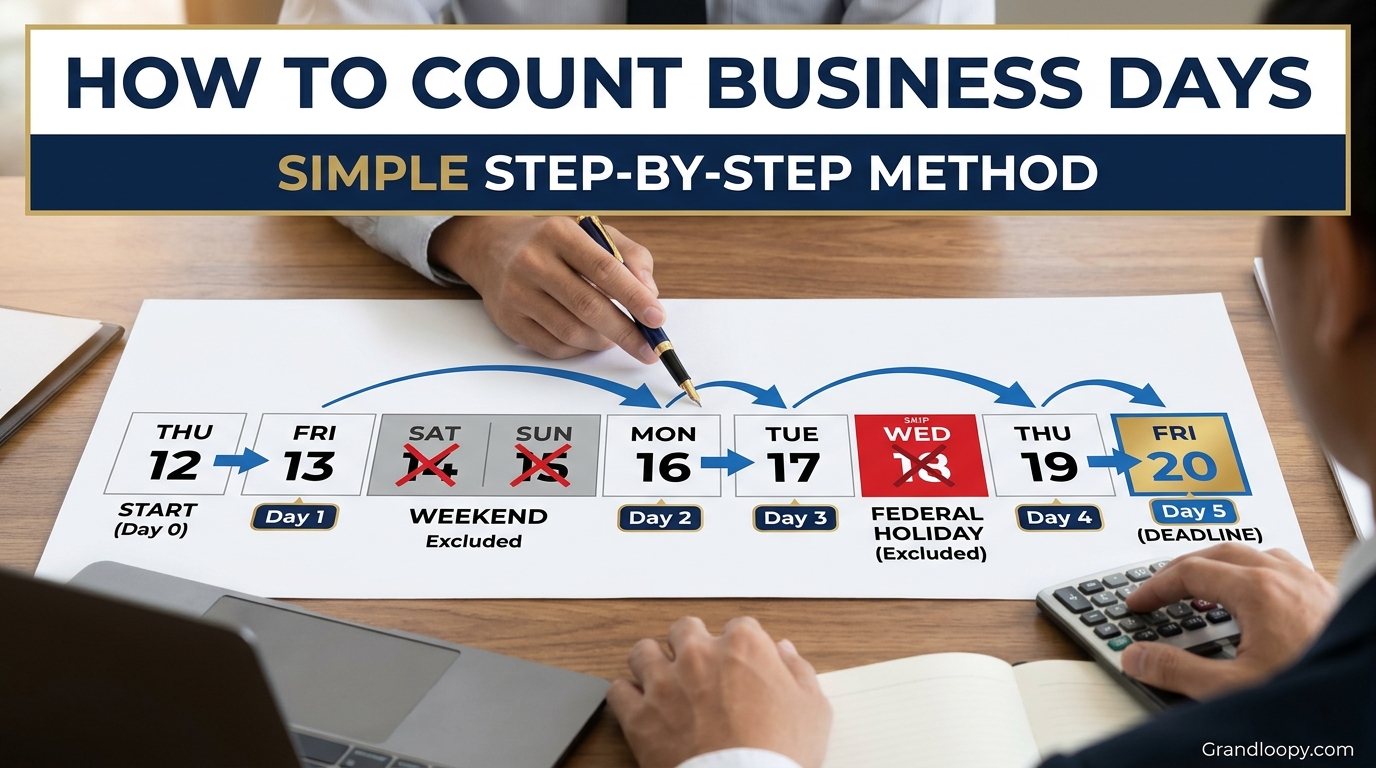
- Start the day after the triggering event. If you receive a notice on Monday, day one is Tuesday. The day of the event itself is not counted.
- Count only eligible days. Under the standard definition, skip Saturdays, Sundays, and federal holidays. Under the broader mortgage and cooling-off definitions, skip only Sundays and federal holidays.
- Use observed holiday dates. Skip the observed Friday or Monday, not just the calendar date of the holiday. Check the OPM schedule for the year in question.
- Watch for cutoff times. A transaction submitted after the relevant cutoff counts as submitted the next business day. Cutoffs apply to wires, ACH batches, court filings, and carrier pickups.
The formula behind the method is simple. Business days equal calendar days minus weekend days minus weekday holidays minus any other days off.
A calculator applies the same formula; doing it by hand requires only a calendar and the holiday list.
For date ranges, decide whether both endpoints count. Counting the days in a leave period usually includes both the first and last day. Counting days after an event excludes the event day.
The wording of the notice or contract decides which applies.
Does the Start Date Count?
Usually, no. When a rule says “within 3 business days of Monday,” the count runs Tuesday, Wednesday, Thursday. Day one is the next business day after the triggering event, not the event day itself.
Federal courts follow this rule explicitly under Rule 6.
Delivery estimates follow the same convention. An order placed on Friday starts counting on Monday, because the order day is not day one.
Shipping estimates that say “ships in 5 business days” mean five counted days after the order date, not including it.
Some contexts differ. A hotel stay, a rental period, or a leave request may count both endpoints. When the wording is ambiguous, ask the sender which convention applies. One clarifying question prevents a missed deadline.
Worked Example: 5 Business Days Across Thanksgiving
Suppose you order a product on Friday, November 20, 2026, and the store says it ships in 5 business days. Counting starts Monday, November 23, which is day one.
Tuesday the 24th is day two, and Wednesday the 25th is day three.
Thursday, November 26 is Thanksgiving, a federal holiday, so it is skipped. Friday the 27th is day four, and Monday the 30th is day five.
The expected ship date is Monday, November 30, 2026, which is 10 calendar days after the order.
The example shows why holiday weeks stretch timelines. A 5-business-day promise made before Thanksgiving takes twice as long in calendar days as the same promise made in an ordinary week.
Holiday calendars matter as much as the number of days.
Worked Example: 3 Business Days for a Mortgage Rescission
Suppose you close on a home equity loan on Thursday, June 18, 2026. The rescission rule counts every calendar day except Sundays and federal holidays, so Saturday counts.
But Friday, June 19 is Juneteenth, a federal holiday, so it is skipped.
Day one is Saturday, June 20. Day two is Monday, June 22, because Sunday is excluded. Day three is Tuesday, June 23. Your right to cancel expires at midnight on Tuesday, June 23, 2026.
Some published guides get this example wrong by counting Friday, June 19 as day one.
That mistake moves the deadline a full day early and could cost a borrower the last day of a cancellation right. Always skip federal holidays, even under the broader definition that counts Saturdays.
Five Counting Mistakes to Avoid
- Counting the start date. Deadlines and delivery estimates almost always start counting the day after the event. Counting the event day shortens every deadline by one.
- Using the calendar holiday instead of the observed date. July 4, 2026 is a Saturday, so the day off is Friday, July 3. A plain weekday count misses it.
- Assuming Saturday never counts. Saturday counts for mortgage rescission, Closing Disclosure timing, and the FTC cooling-off rule. Check the governing rule.
- Assuming Saturday always counts for shipping. Saturday delivery exists, but transit-time estimates usually exclude it. The service level, not the carrier name, decides.
- Forgetting the year-end jump. When January 1 falls on a Saturday, the holiday is observed on December 31 of the previous year. It happens again at the end of 2027.
A sixth mistake deserves mention: using the wrong calendar. Federal, bank, market, state, and company calendars differ. A count is only as good as the calendar behind it. Name the calendar before you count.
Business Day Definitions by Regulation
The standard definition is a starting point, not the whole story. Six major regulatory frameworks define “business day” differently, and each definition changes real deadlines.
The table below summarizes them, and the sections that follow explain each one.
| Framework | Definition | Saturday counts? | Key deadlines |
|---|---|---|---|
| Regulation CC | Calendar day other than Saturday, Sunday, or federal holiday | No | Check holds, funds availability |
| Regulation E | Any day the bank is open for substantially all functions | Only if fully open | Error reports, liability limits |
| Regulation Z (general) | Day the creditor is open for substantially all functions | Only if open | Most lending disclosures |
| Regulation Z (specific) | All calendar days except Sundays and federal holidays | Yes | Rescission, Closing Disclosure |
| FRCP Rule 6 | Counts every day; extends past weekends and holidays | Counted, deadline extends | Court filings |
| FTC cooling-off rule | All calendar days except Sundays and federal holidays | Yes | Door-to-door cancellations |
| IRS | Deadline moves past Saturdays, Sundays, and legal holidays | No | Tax filings and payments |
The pattern is clear. Banking and tax rules exclude Saturday. Mortgage and consumer-protection rules include it. Court rules count every day but extend the endpoint.
Knowing which pattern applies is the core skill of business-day counting.
Regulation CC: Banking Days and Check Holds
Regulation CC, the federal rule on check holds and funds availability, defines a business day as a calendar day other than a Saturday, a Sunday, or a listed federal holiday.
The definition appears in 12 CFR 229.2, published in the Electronic Code of Federal Regulations.
The regulation also defines a separate term, “banking day.”
A banking day is the part of a business day when a bank is open to the public for carrying on substantially all of its banking functions.
The distinction decides when deposited funds must become available.
A Saturday branch that accepts deposits but does not process loans may not meet the substantially-all test.
In that case, Saturday is not a banking day, and a Saturday deposit is treated as made on Monday for hold calculations. The rule protects consumers by tying availability to real processing capacity.
Regulation E: Electronic Transfers and the Saturday Exception
Regulation E governs electronic fund transfers: debit card purchases, ATM withdrawals, direct deposits, and electronic bill payments.
It defines a business day as any day when the offices of the financial institution are open for carrying on substantially all business functions, under 12 CFR 1005.2.
This definition can include Saturday. If a bank’s offices are fully open on Saturday, performing substantially all functions, Saturday counts as a business day for Regulation E deadlines.
Most Saturday branches offer limited services, so the exception rarely changes a count in practice.
The deadlines measured in Regulation E business days carry real money. Reporting a lost or stolen debit card within two business days caps liability for unauthorized charges at 50 dollars.
Reporting later can raise liability to 500 dollars. After an error report, the bank generally has 10 business days to investigate and one business day to correct a confirmed error.
Consumers have up to 60 days after a statement is sent to report an error. But the two-business-day liability clock starts when the consumer learns of the loss or theft, not when the statement arrives.
Speed matters more than the statement cycle.
Regulation Z: The Two Mortgage Definitions
Mortgage regulations use two different definitions of “business day,” and mixing them up can cost a cancellation right or delay a closing. Both appear in 12 CFR 1026.2, the definitions section of Regulation Z.
The general definition covers most lending purposes. A business day is any day the creditor’s offices are open to the public for substantially all business functions.
Under this definition, if the lender is closed on Saturday, Saturday is not a business day.
The specific definition covers the right of rescission and mandatory mortgage disclosure waiting periods. It counts every calendar day except Sundays and the federal holidays. Under this definition, Saturday counts.
The broader definition applies to two of the most important consumer deadlines in real estate.
The right of rescission lets a borrower cancel certain home-secured loans, such as a home equity loan or a refinance, but not a purchase mortgage.
The borrower has until midnight of the third business day after closing to cancel for any reason. Because Saturday counts, a loan closing on Wednesday gives until Saturday at midnight, not the following Monday.
The Closing Disclosure rule requires the lender to deliver the disclosure at least three business days before the scheduled closing. Saturdays count here too.
If closing is set for Wednesday, the lender must deliver by the preceding Saturday at the latest. The Consumer Financial Protection Bureau publishes a Closing Disclosure explainer, and the rule text is in Regulation Z.
Federal Courts: Rule 6 Counting
Federal courts use a specific counting method laid out in Federal Rule of Civil Procedure Rule 6. When a deadline is stated in days, the day of the triggering event is excluded.
Every day is then counted, including Saturdays, Sundays, and holidays.
The extension rule saves deadlines that land on non-business days. If the last day falls on a Saturday, Sunday, or legal holiday, the deadline extends to the next day that is none of those.
A deadline landing on Saturday moves to Monday, unless Monday is a holiday.
Electronic filing has its own cutoff. A document filed electronically on the last day is timely if submitted by midnight in the court’s time zone.
For physical filings, the deadline is when the clerk’s office closes, typically 5:00 p.m. A document hand-delivered at 5:01 p.m. can be stamped as filed the next business day.
If the clerk’s office is physically inaccessible on the last day, the deadline extends.
Weather, power failure, or another emergency can close the office, and the extension runs to the first accessible day that is not a Saturday, Sunday, or legal holiday.
State courts have their own versions of this rule, so check the local rules for state filings.
The FTC Cooling-Off Rule: Saturday Counts
The Federal Trade Commission’s cooling-off rule gives buyers until midnight of the third business day after a qualifying sale to cancel and receive a full refund.
The rule is codified at 16 CFR Part 429 and covers sales made at the buyer’s home and at certain temporary locations.
The rule covers sales of 25 dollars or more made at the buyer’s home, and sales of 130 dollars or more made at temporary locations like hotel meeting rooms, convention centers, or fairgrounds.
For this rule, “business day” means every calendar day except Sundays and federal holidays, so Saturday counts.
If a salesperson comes to the door on Wednesday, the buyer has until Saturday at midnight to cancel. The rule does not apply to purchases made entirely online, by mail, or by phone.
It also does not cover insurance, securities, or real estate transactions.
The cooling-off rule is a federal floor, not a ceiling. Some states give buyers longer cancellation windows or cover more transaction types. Check state law before assuming the federal three-day window is the only protection.
The IRS: Tax Deadlines, D.C. Holidays, and the Postmark Rule
The IRS follows a straightforward rule.
When a tax filing or payment deadline falls on a Saturday, Sunday, or legal holiday, the deadline moves to the next day that is not a Saturday, Sunday, or legal holiday.
The rule is explained in IRS Publication 509, Tax Calendars.
For IRS purposes, “legal holiday” includes any legal holiday observed in the District of Columbia, not just federal holidays. That means D.C. Emancipation Day, April 16, can push the normal April 15 tax deadline.
When April 15 falls on a Friday and Emancipation Day is observed that Friday, the deadline moves to the following Monday.
Statewide holidays can also delay a filing deadline, but only if the IRS office where the return must be filed is located in that state.
A statewide holiday does not affect the deadline for federal tax deposits. The distinction matters for businesses filing in states with their own holidays.
The postmark rule is the IRS’s most taxpayer-friendly counting rule. If a return or payment is mailed, the postmark date, not the delivery date, counts as the filing date.
A return postmarked on or before the deadline, properly addressed, with correct postage, is timely even if it arrives days later. The rule is in 26 U.S.C. 7502.
The Stock Market: T+1 Settlement and Market Holidays
Stock and bond trades on United States exchanges settle on a T+1 basis: one business day after the trade date.
The Securities and Exchange Commission shortened the cycle from two business days effective May 28, 2024. Sell shares on Monday, and the transaction settles Tuesday. Sell on Friday, and settlement occurs the following Monday.
The major exchanges close on nine federal holidays plus Good Friday, for ten closures in 2026. They stay open on Columbus Day and Veterans Day, unlike federal offices and banks.
The exchanges also close early at 1:00 p.m. ET on the day after Thanksgiving and on Christmas Eve.
The market calendar is published by each exchange. The NYSE holidays and trading hours page lists every closure and early close. Traders and investors should check it before assuming a settlement date around any holiday.
Cryptocurrency markets work differently. Crypto trades settle continuously, 24 hours a day, seven days a week, with no business-day concept.
The contrast highlights what business days really are: a convention of traditional finance, not a law of nature.
Business Days in Banking and Payments
Banks process transfers, payments, and settlements only on business days. The Federal Reserve’s payment systems, including the Fedwire Funds Service and the National Settlement Service, operate Monday through Friday, excluding holidays.
When those systems close, interbank settlement stops.
That is why a transfer started on Friday afternoon often does not appear until Tuesday.
The money leaves the sending bank on Friday, waits through the weekend, settles on Monday, and posts on Tuesday in some cases. Same-bank transfers may move faster, because they never touch the Federal Reserve systems.
Instant payment services are changing this picture. Real-time payment rails operate outside the traditional business-day window, and small businesses increasingly rely on them for cash flow timing.
The shift is covered in the guide to how instant payments are changing small business cash flow.
ACH, Wires, and Check Clearing Timelines
Each payment type moves on its own business-day schedule. The table below gives typical ranges reported by banking guides.
Actual timing depends on the bank, the cutoff time, and whether the transfer is domestic or international.
| Transaction type | Business days | Notes |
|---|---|---|
| ACH direct deposit | 1 to 2 | Employer to employee; often available by 9:00 a.m. on payday |
| ACH bank transfer | 1 to 3 | Between personal accounts at different banks |
| Same Day ACH | Same day | Cutoff windows apply; two submission windows daily |
| Wire transfer, domestic | Same day | Usually processed the same business day if sent before cutoff |
| Wire transfer, international | 1 to 5 | Intermediary banks and foreign holidays add time |
| Check clearing | 1 to 2 | Most banks; Regulation CC governs availability |
| Credit card settlement | 1 to 3 | Merchant settlement after the sale |
International wires deserve a warning. Funds may pass through intermediary banks in different countries, each with its own holiday calendar and business hours.
A wire sent on a United States business day can stall on a foreign holiday and arrive days later than the estimate.
Check deposits follow Regulation CC availability rules. The first 225 dollars of a check deposit must generally be available by the next business day, with the remainder following the bank’s disclosed schedule.
Large deposits and new accounts can face longer holds.
Cutoff Times That Move Your Transaction a Day
Cutoff times are the hidden half of business-day counting. A transaction submitted after the cutoff counts as submitted the next business day, even if the bank’s website accepted it.
Every payment system has its own cutoff, and every bank sets its own.
Fedwire’s funds-transfer business day opens at 9:00 p.m. ET the night before and closes at 7:00 p.m. ET. Individual banks set their own cutoffs well before that closing window.
Some banks require outgoing domestic wires by 3:00 p.m. local time, while others accept them as late as 5:00 p.m. ET.
Same Day ACH has two main submission windows: a morning deadline at 10:30 a.m. ET with settlement at 1:00 p.m. ET, and an afternoon deadline at 2:45 p.m. ET with settlement at 5:00 p.m. ET.
Payments submitted after these windows, or on a weekend, settle on the next business day.
The practical advice is to ask for the cutoff before sending anything time-sensitive. A wire sent at 4:00 p.m. on Friday may count as a Monday wire.
A Same Day ACH payment sent at 3:00 p.m. misses the afternoon window. Cutoffs turn hours into days.
What Happens to a Friday Afternoon Transfer
A transfer initiated on Friday afternoon follows a predictable path. If it misses the Friday cutoff, it is treated as received on Monday. It settles Monday night or Tuesday, depending on the payment type.
The recipient may not see the funds until Tuesday or Wednesday.
The same logic applies to bill payments. A bill payment due on a weekend or holiday is typically collected on the next business day.
Scheduling payments a day early avoids late fees when a due date falls on a non-business day.
Payroll follows the same calendar. Direct deposits scheduled for a Friday payday are typically available by 9:00 a.m. that morning.
When payday falls on a holiday, employers usually pay on the preceding business day, though policies vary by employer.
Business Days in Shipping and Delivery
Carriers count transit time in business days unless a service says otherwise.
A “3-5 business day” delivery estimate excludes weekends and holidays, which is why a package ordered on Thursday often arrives later than customers expect. The ship date usually does not count as day one.
The distinction between a delivery day and a transit day matters. A carrier can deliver on Saturday while excluding Saturday from its transit-time calculation.
The package moves on Saturday, but the guaranteed window does not count Saturday unless a premium Saturday service was purchased.
Holiday weeks stretch every estimate. A ground shipment ordered before Thanksgiving can take more than nine calendar days for a five-business-day transit time. Always check the carrier holiday schedule before promising a delivery date.
How Carriers Count Transit Time
Transit time starts the day after pickup or drop-off. The carrier counts business days from that starting point, skipping weekends and the carrier’s own holidays.
The count ends on the delivery day, which may itself be a Saturday for services that deliver on Saturdays.
Carrier holidays do not always match federal holidays. Some carriers operate on Columbus Day and Veterans Day. Others close on additional days. The carrier’s published holiday calendar controls, not the federal list.
Service levels change the count. Overnight services count one business day. Two-day services count two. Ground services count three to seven business days depending on distance.
The service name, not the carrier brand, decides how Saturday is treated.
USPS, UPS, and FedEx Saturday Rules
The three major United States carriers treat Saturday differently. The table below summarizes the standard position for each. Service-level details change, so verify the specific service before quoting a date.
| Carrier | Saturday delivery | Saturday in transit time? |
|---|---|---|
| USPS | Yes, standard for mail and packages | Yes, often included in service standards |
| UPS | Yes, mainly for time-critical shipments | Usually no, unless Saturday Delivery service is purchased |
| FedEx Express | Some services, some areas | Usually no for standard services |
| FedEx Home Delivery | Yes, Tuesday to Saturday schedule | Yes, Saturday is a scheduled delivery day |
The Postal Service is the outlier. Saturday delivery is standard for most USPS services, and Saturday is often included in its service standards.
USPS does not deliver regular mail on federal holidays, though Priority Mail Express may still move.
UPS treats Saturday as a business day only for time-critical shipments. Packages scheduled for Saturday delivery must carry a Saturday Delivery label, and orders for those deliveries must be placed Monday through Friday.
Standard ground transit excludes Saturday.
FedEx Home Delivery runs Tuesday through Saturday, designed to reach residential customers when they are home.
FedEx Express generally operates Monday through Friday, with some Saturday delivery and pickup available at no extra charge in certain areas.
The distinction between the two FedEx services is the most common source of Saturday confusion.
What “Ships in 3-5 Business Days” Really Means
“Ships in 3-5 business days” describes processing time, not delivery time. The seller needs three to five business days to prepare and hand the package to the carrier.
Transit time starts after that, adding its own business days.
A product ordered Monday that “ships in 3-5 business days” leaves the warehouse between Thursday and the following Monday. Ground transit then adds three to seven more business days.
The total calendar time from order to delivery can reach two weeks, even though each quoted number sounds short.
The honest way to read any shipping estimate is to add the parts. Processing days plus transit days, skipping weekends and holidays in each part, gives the real window.
Sellers who quote a single number without separating the parts invite missed expectations.
Business Days in Contracts and Everyday Life
Contracts use “business day” constantly, and they usually define it.
A typical definition reads: “a day, other than a Saturday, Sunday, or public holiday, on which banks in New York are open for general business.”
The named city matters, because bank holidays vary by location and by bank.
When a contract defines the term, that definition controls over the general meaning. A contract that defines business days as Monday through Saturday counts Saturday.
A contract tied to London banking days follows the United Kingdom holiday calendar. Read the definition clause before counting any contractual deadline.
When a contract says only “days” without the word “business,” it usually means calendar days. Federal courts follow this principle: deadlines stated in days require counting every intermediate day, including weekends and holidays.
The wording choice is deliberate, and courts enforce it.
Net 30 Means Calendar Days, Not Business Days
Payment terms like Net 30, Net 60, and Net 90 standardly mean calendar days from the invoice date. Net 30 means payment is due 30 calendar days after invoicing, including weekends and holidays.
Some guides incorrectly describe these terms as business days, which would stretch a 30-day term to 42 calendar days.
The confusion arises because invoicing and payment processing happen on business days. A payment due on a Sunday is typically processed Monday, but the due date itself is still measured in calendar days.
The due date and the processing date are different things.
Businesses that want business-day payment terms must say so explicitly, writing “Net 30 business days” in the contract. Without the word “business,” the standard reading is calendar days.
Clear invoicing language prevents disputes, and the move to electronic invoicing has made terms easier to state precisely, as covered in the guide to why small businesses are switching to digital invoices.
Payroll, PTO, Returns, and SLAs
Payroll runs on business days. Pay periods end on business days, direct deposits land on business days, and holidays shift paydays.
A biweekly payroll with 26 pay periods a year occasionally produces a 27th pay period, which affects salary budgeting and benefit deductions.
Paid time off is usually counted in business days. A five-day vacation uses five PTO days, Monday through Friday, even though it spans seven calendar days.
A holiday inside a vacation week typically does not consume a PTO day, because the holiday is already a paid day off.
Return windows mix both conventions. Some retailers give 30 calendar days for returns. Others give 14 business days. The policy wording decides, and the difference can be a full week.
Always check whether a return window says “days” or “business days” before assuming.
Service level agreements (SLAs) usually measure response and resolution times in business hours, not calendar hours.
A “4-hour response” SLA measured in business hours means four hours during the business day, which can stretch across a weekend.
Support teams increasingly use automation to cover gaps, a shift covered in the guide to how AI customer support is changing small online stores.
State Holidays and Company Closures
States add their own holidays on top of the federal list. Texas closes state offices on additional days. Massachusetts observes Patriots’ Day. California observes Cesar Chavez Day for state workers.
A deadline involving a state office or state court must account for that state’s calendar.
Company closures add another layer. Many employers close the day after Thanksgiving, Christmas Eve, or the week between Christmas and New Year. These closures are company policy, not law, and they vary by employer.
A deadline measured against a company’s own calendar must use that company’s closure list.
Banks sometimes close on days that are not federal holidays. Some banks close on Good Friday. Some close early on Christmas Eve or New Year’s Eve.
The bank’s own calendar, not the federal list, decides whether a branch transaction can be completed that day.
Business Days Around the World
The Monday-to-Friday week feels universal, but it is a convention, not a law of nature. Several countries place their weekend on Friday and Saturday. One country works Sunday through Friday with only Saturday off.
Scheduling across these weeks without knowing the pattern guarantees missed meetings and stalled deadlines.
The table below maps the main patterns. Within each pattern, sector exceptions exist: banks, shops, government offices, and schools do not always follow the same week. Verify the specific institution before scheduling anything important.
| Weekend | Working days | Examples |
|---|---|---|
| Saturday-Sunday | Monday to Friday | United States, Canada, United Kingdom, most of Europe, India, China, Japan, Australia, UAE (since 2022) |
| Friday-Saturday | Sunday to Thursday | Saudi Arabia, Qatar, Kuwait, Bahrain, Oman, Egypt, Jordan, Iraq, Bangladesh |
| Friday-Saturday (Shabbat) | Sunday to Thursday or Sunday to Friday | Israel |
| Saturday only | Sunday to Friday | Nepal |
| Thursday-Friday | Saturday to Wednesday | Iran (2025 reform, single source) |
The Sunday-Thursday Week
Across much of the Middle East, the working week runs Sunday through Thursday, with Friday and Saturday as the weekend. Friday prayers anchor the rest period, and Saturday acts as the second day off.
Government offices, banks, and stock exchanges follow this pattern.
Saudi Arabia moved from a Thursday-Friday weekend to a Friday-Saturday weekend in 2013, aligning one more working day with global markets.
A royal order of June 23, 2013 set Sunday through Thursday as the official working days for ministries, government bodies, financial institutions, the central bank, and the stock exchange.
The practical consequence is a four-day overlap with the Western week. A United States business and a Saudi business share Monday through Thursday as common working days.
Friday is a working day in the United States and a weekend day in Saudi Arabia. Sunday is the reverse.
The UAE Change of 2022
The United Arab Emirates made the most visible recent change. On January 1, 2022, the federal government moved to a four-and-a-half-day week: 7:30 a.m. to 3:30 p.m.
Monday through Thursday, and 7:30 a.m. to 12:00 p.m. on Friday, with a Saturday-Sunday weekend.
Most private companies in the UAE followed the federal lead and now share the Saturday-Sunday rhythm. The governments of Abu Dhabi, Dubai, Ajman, Umm Al Quwain, Ras Al Khaimah, and Fujairah adopted similar systems.
Sharjah went further: its government works Monday through Thursday, with Friday, Saturday, and Sunday off.
References written before 2022 describe the old UAE week and are now wrong. Scheduling a Dubai government counterpart as though Saturday were a working day will fail.
Treat Saturday and Sunday as the weekend, and expect a short Friday.
Israel, Nepal, and Iran
Israel does not have a single working week. Government ministries on the five-day week work Sunday through Thursday, and ministries on the six-day week work Sunday through Friday.
The Saturday rest day reflects Shabbat, from sunset Friday to nightfall Saturday. Israeli labor law requires a continuous weekly rest of at least 36 hours, which for Jewish employees must include Saturday.
The Bank of Israel’s payment system runs on the longer week.
Its ZAHAV real-time settlement calendar gives Sunday through Friday as operating days, with Fridays and holiday eves as short business days ending at 2:00 p.m. rather than 6:30 p.m.
The Bank works only until 1:15 p.m. on Fridays.
Nepal is the outlier with a six-day week. Only Saturday is a weekend day, and Sunday through Friday are working days.
Iran’s parliament approved a five-day workweek with a Thursday-Friday weekend in March 2025.
That reform would make Saturday through Wednesday the working days, but it is reported by a single source and should be verified before reliance.
Scheduling Across Working Weeks
Cross-border deadlines need both calendars. A “5 business day” promise between a United States company and a Gulf company can mean different dates depending on whose calendar counts.
The contract should name the governing calendar explicitly, just as it names the governing law.
Banking follows the local week. A payment from New York to Riyadh must clear both the United States business day and the Saudi business day.
A Friday payment from New York waits through the Saudi weekend, and a Sunday payment from Riyadh waits through the United States weekend.
The shared working days between any two patterns are the days that matter. United States and Gulf partners share four days. United States and Nepal partners share five.
Mapping the overlap before setting a deadline prevents the most common international scheduling error.
Business Days and Your Business: Planning Around the Calendar
Business-day counting is a daily operations skill, not an academic exercise. Founders set launch dates around bank processing. Managers set payroll around holidays. Sellers set delivery promises around carrier calendars.
Every one of those decisions uses the rules set out above.
New businesses feel the calendar most sharply. Bank accounts open on business days, filings are processed on business days, and vendor payments clear on business days.
A launch planned for a holiday week needs an extra week of buffer. The full setup sequence is covered in the guide to how to start a business in 10 steps.
Business plans should name their calendar assumptions. A financial projection that assumes 250 working days a year is using the federal calendar. A projection that assumes 261 is counting holidays as working days.
Stating the assumption keeps projections honest, and the planning framework is covered in the guide to how to write a business plan.
Deadline Planning for Small Businesses
Build a company calendar at the start of each year. Mark the eleven federal holidays with their observed dates. Add state holidays that affect your offices. Add company closures like the day after Thanksgiving.
Share the calendar with every employee who sets deadlines.
Set external deadlines with a buffer day. A client promise of “5 business days” should be planned as six internally, so a cutoff miss or a carrier delay does not break the promise.
The buffer day is the cheapest insurance a small business can buy.
Review recurring deadlines quarterly. Payroll dates, tax deposits, rent payments, and subscription renewals all shift when holidays move. A quarterly review catches the shifts before they cause late fees or missed filings.
Billing Cycles and Subscription Timing
Subscription billing usually runs on calendar cycles, not business days. A monthly subscription renews on the same calendar date each month, whether or not that date is a business day.
The payment processing behind the renewal still follows business days, which is why a renewal dated Sunday may not settle until Monday.
The distinction matters for dunning and failed payments. A card charged on a weekend may not clear until Monday, and a retry scheduled for “the next business day” follows the bank calendar.
Businesses offering subscriptions should state their billing and retry rules in plain language, a practice covered in the guide to why small businesses are offering subscription services.
Annual planning benefits from the same discipline. Budget 250 working days for a standard United States operation, not 261 and not 365. Subtract vacation and sick leave separately.
The result is a realistic capacity figure that survives contact with the calendar.
Frequently Asked Questions
What are business days?
Business days are the weekdays, Monday through Friday, that are not federal holidays. They are the days when banks, courts, government offices, and most companies do their regular work.
Saturdays, Sundays, and the eleven federal holidays are not business days under the standard definition. Some rules count Saturday, including mortgage rescission and the FTC cooling-off rule.
What is a business day?
A business day is a single weekday, Monday through Friday, that is not a federal holiday. It is conventionally understood as an 8-hour day, typically 9:00 a.m. to 5:00 p.m. local time.
The term has different legal definitions in different regulations. Banking, mortgage, tax, and court rules each define it for their own purposes.
Which days of the week are business days?
Monday through Friday are business days, unless a federal holiday falls on that weekday. Saturday and Sunday are weekend days and do not count under the standard definition.
A federal holiday on a weekday removes that day from the count. An observed holiday on a Friday or Monday removes that weekday instead.
Is Saturday a business day?
Usually, no. Saturday is not a business day for banks, courts, the IRS, or most contracts. A deadline landing on Saturday normally moves to Monday.
Saturday counts for mortgage rescission, Closing Disclosure timing, and the FTC cooling-off rule. It is also a standard delivery day for the Postal Service and for FedEx Home Delivery.
Is Sunday a business day?
No. Sunday is excluded under every major United States definition of business day. No banking, mortgage, court, tax, or consumer-protection rule counts Sunday.
Retail stores and some delivery services operate on Sundays, but operating on Sunday does not make it a business day for counting deadlines or transit times.
Do business days include federal holidays?
No. Federal holidays are excluded from business-day counts even when they fall on a weekday. The eleven holidays in 5 U.S.C. 6103 are removed across nearly every framework.
Observed holidays are excluded the same way. When a holiday falls on a weekend, the observed weekday is the day that drops out of the count.
What are the 11 federal holidays?
The eleven federal holidays are New Year’s Day, the Birthday of Martin Luther King, Jr., Washington’s Birthday, Memorial Day, and Juneteenth National Independence Day.
The rest are Independence Day, Labor Day, Columbus Day, Veterans Day, Thanksgiving Day, and Christmas Day.
They are named in 5 U.S.C. 6103. The Office of Personnel Management publishes the observed dates each year for federal employees.
What happens when a federal holiday falls on a Saturday?
The holiday is observed on the preceding Friday. That Friday becomes the day off for federal employees, and it is excluded from business-day counts.
In 2026, Independence Day falls on Saturday, July 4, so it is observed on Friday, July 3. In 2027, Juneteenth and Christmas Day both fall on Saturdays and shift to Fridays.
How many business days are in 2026?
There are 250 business days in 2026 on the federal calendar. The year has 261 weekdays, and eleven observed federal holidays fall on weekdays, so 261 minus 11 equals 250.
The bank calendar gives 251, because the Federal Reserve does not shift Saturday holidays to Friday. Some websites report 251 for the federal calendar by missing the observed Friday, July 3.
How many business days are in 2027?
There are 249 business days in 2027 on the federal calendar. The year has 261 weekdays, and twelve observed holidays fall on weekdays, including December 31, 2027, which observes New Year’s Day 2028.
The bank calendar gives 252 for 2027. The three-day gap comes from the three Saturday holidays the Federal Reserve does not shift to Friday.
How many business days are in a month?
A month holds between 19 and 23 business days on the federal calendar, depending on how weekends and holidays fall. The average is about 20.8 business days per month.
November 2026 is the shortest month at 19 business days. March 2027 is the longest at 23. Always count the specific month rather than using the average.
How do you count business days?
Start the day after the triggering event. Count only eligible days, skipping Saturdays, Sundays, and federal holidays under the standard definition. Use observed holiday dates, and watch for cutoff times.
For a deadline stated as “within 3 business days of Monday,” the count runs Tuesday, Wednesday, Thursday. The event day itself is not counted.
Does the start date count when counting business days?
Usually, no. Day one is the next business day after the triggering event. Federal courts follow this rule explicitly, and delivery estimates use the same convention.
Some contexts count both endpoints, such as leave periods and rental stays. When the wording is ambiguous, ask which convention applies before counting.
What does “5 business days from today” mean?
It means five counted business days starting the next business day after today, skipping weekends and holidays. In an ordinary week, 5 business days equals 7 calendar days.
Across a holiday week, the same promise stretches further. Five business days counted across Thanksgiving week can span 10 calendar days.
How long is 10 business days?
Ten business days equals two work weeks, or 14 calendar days when no holiday intervenes. Each holiday inside the count adds one calendar day to the span.
Bank error investigations use a 10-business-day window under Regulation E. That window can stretch to 16 or 17 calendar days across a holiday week.
What does “ships in 3-5 business days” mean?
It means the seller needs three to five business days to process the order and hand the package to the carrier. Transit time is separate and adds its own business days after that.
The count starts the day after the order, skipping weekends and holidays. A Friday order with a 3-5 business day processing time ships between the following Wednesday and Friday in an ordinary week.
What is the difference between business days and calendar days?
Calendar days count every day, including weekends and holidays. Business days count only weekdays that are not federal holidays. Five business days equals seven calendar days in an ordinary week.
The distinction matters most for deadlines and delivery estimates. A “30-day” deadline and a “30-business-day” deadline differ by about twelve days.
Are business days and working days the same thing?
Usually, yes. Both terms normally mean Monday through Friday, excluding federal holidays, and they are used interchangeably in business, legal, and shipping contexts.
Working days can also mean the days a specific person or company works. A shop open Tuesday through Saturday has five working days, but they are not the standard business days.
What is the difference between a business day and a banking day?
A business day is a weekday that is not a federal holiday.
A banking day is the part of a business day when a bank is open for substantially all of its banking functions, under Regulation CC.
A Saturday branch offering limited services may not meet the banking-day test. Deposits made that Saturday are treated as made on the next banking day for funds availability.
Is Good Friday a business day?
Yes, for most purposes. Good Friday is not a federal holiday, so federal offices and most banks are open. It falls on April 3, 2026.
The stock exchanges close on Good Friday, so it is not a trading day or a settlement day. Some state offices and some banks also close, so check the specific institution.
Is Columbus Day a business day for the stock market?
Yes. The stock exchanges stay open on Columbus Day, even though it is a federal holiday. Federal offices and banks close, but markets trade normally.
Veterans Day works the same way: federal holiday, banks closed, markets open. The market calendar differs from the federal calendar on both days.
Is the day after Thanksgiving a business day?
Yes, on the federal calendar. The day after Thanksgiving is not a federal holiday, so federal offices and banks are open. Many private employers close it as a company holiday.
The stock market closes early at 1:00 p.m. ET that day. A count using a company calendar may treat it as a day off, while the federal calendar counts it.
Do banks process transactions on Saturday?
Generally, no. Interbank processing stops on weekends because the Federal Reserve’s payment systems operate Monday through Friday. Transfers and deposits started Saturday are processed from the next business day.
Some branches open Saturday mornings for deposits, withdrawals, and account questions. Those limited services do not make Saturday a processing day for ACH, wires, or check clearing.
Does the IRS count Saturday as a business day?
No. When a tax deadline falls on a Saturday, Sunday, or legal holiday, the IRS moves it to the next day that is none of those. Saturday never serves as a tax deadline day.
Legal holidays for IRS purposes include District of Columbia holidays, including D.C. Emancipation Day on April 16, which can shift the April tax deadline.
What does “business day” mean in a contract?
It means whatever the contract defines it to mean. A typical definition excludes Saturdays, Sundays, and public holidays, and ties the term to banks being open in a named city.
The contract definition controls over the general meaning.
When a contract says only “days” without the word “business,” it usually means calendar days. Read the definition clause before counting any contractual deadline.
Conclusion
Business days are Monday through Friday, excluding federal holidays.
That definition answers most questions, and the sections above answer the rest: the Saturday exceptions, the calendar conflicts, the regulation-specific definitions, and the international weeks.
The numbers to remember are 250 for 2026 and 249 for 2027 on the federal calendar, with 251 and 252 on the bank calendar.
The habit to remember is simpler: name the calendar, find the governing definition, and count from the day after the event. Those three steps prevent nearly every business-day mistake.
Calendars change slowly, but they do change. Holiday observances shift each year, market calendars update annually, and other countries revise their working weeks, as the UAE did in 2022.
Check the official schedule for the year and the institution that governs your deadline, and the count will take care of itself.