How Long Is a Business Day? Hours, Rules, and 2026-2027 Dates

How long is a business day? A business day is 8 hours long, usually from 9:00 AM to 5:00 PM, Monday through Friday, excluding federal holidays.
That short answer works for most everyday questions.
The longer answer matters when money or a deadline is involved, because banking, mortgage, court, tax, and shipping rules each define the length and the end of a business day differently.
Readers who only need the definition and the counting rules can start with What Are Business Days? Definition, Rules, and 2026-2027 Calendars, which covers that question in full.
The page below answers a different question: how many hours a business day lasts, when it starts and ends, and how the answer changes by industry, country, and regulation.
The Short Answer: 8 Hours, 9 to 5
A business day lasts 8 hours in the United States and in most Western countries. The standard window runs from 9:00 AM to 5:00 PM local time, Monday through Friday.
Weekends and federal holidays do not count. A Saturday, a Sunday, or a federal holiday never starts a new business day for banks, courts, or most contracts.
The 8-hour figure is a working window, not a full calendar day.
A business day is one of five working days in a week, and five of them add up to a 40-hour week.
Why 8 hours is the standard
The 8-hour day comes from labor history, not from a single law. Workers and employers settled on eight hours of work, eight hours of rest, and eight hours of leisure during the industrial era.
That pattern became the default schedule for offices, banks, and government agencies. It spread because banks, courts, and shipping carriers all needed the same clock to move money and papers.
No federal statute says a business day is 8 hours. The Fair Labor Standards Act sets a 40-hour week, and 40 divided by five days gives 8 hours per day.
The math is the standard, not the statute.
A business day is not 24 hours
A calendar day lasts 24 hours, from midnight to midnight. A business day lasts only the working part of that day, usually 9:00 AM to 5:00 PM.
That difference causes most deadline mistakes. A promise of “1 business day” does not mean 24 hours from now. It means the next working day, inside its working hours.
An order placed at 6:30 PM on a Tuesday does not start its clock on Tuesday. Standard operations closed at 5:00 PM, so the order logs as arriving Wednesday morning, and Wednesday becomes day zero.
The 9 to 5 phrase
The phrase “9 to 5” describes the standard business day in one breath. It comes from the hours themselves: 9:00 AM to 5:00 PM is exactly eight hours.
Some offices run 8:00 AM to 4:00 PM or 8:30 AM to 4:30 PM and still count as one business day. The start and end times move, but the length stays near eight hours.
Government agencies often run 7:00 AM to 3:30 PM. That window is still eight and a half hours on the clock, and it still counts as one business day.
How Many Hours Are in a Business Day?
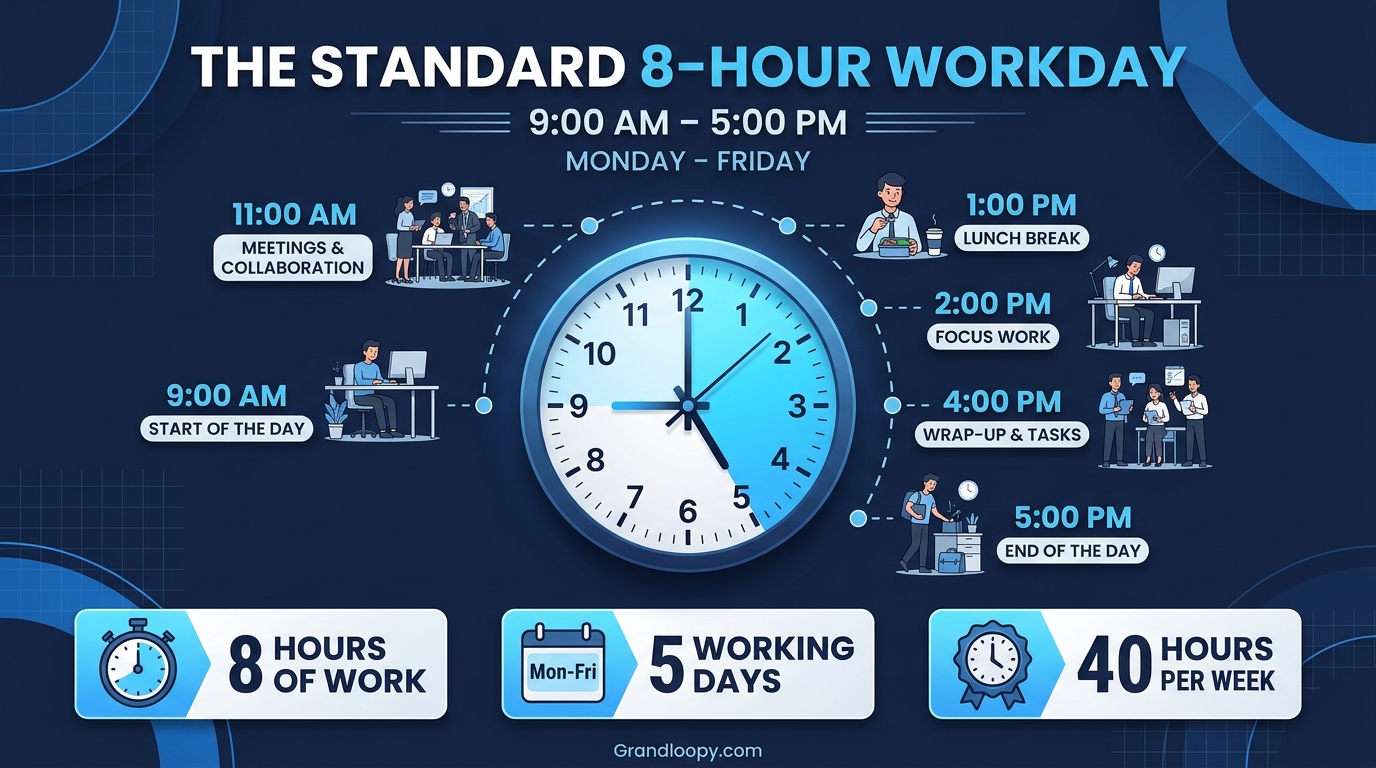
A business day holds 8 working hours in the standard model. That number is the baseline for payroll, shipping estimates, bank processing, and contract deadlines.
Some industries stretch the day to 10 or 12 hours. Those longer days still count as one business day for shipping and financial purposes, because the definition follows the calendar, not the clock.
Other industries run 24 hours with rotating shifts. Hospitals, hotels, and airports never close, yet their business days still follow the Monday-to-Friday calendar for billing and deadlines.
The 8-hour standard
Office work, banking, and government all use the 8-hour day as the norm. A full-time employee works five of these days each week, for a total of 40 hours.
The 8-hour day includes short breaks in most workplaces. A 10 to 15 minute break during the morning and another in the afternoon are part of the working day.
Lunch is different.
A 30 to 60 minute lunch break is usually unpaid and sits outside the 8 hours of paid work in many jobs.
That is why a 9 to 5 day can feel like nine hours on the clock.
Where the 8-hour day came from
The 8-hour day grew out of the industrial revolution. Workers pushed for a day split into three equal parts: work, rest, and leisure.
Unions and employers adopted the pattern over decades. By the mid-20th century, the 8-hour, 5-day week was the default in the United States and Western Europe.
Businesses kept the pattern because it made scheduling predictable. When every office, bank, and carrier opens and closes at the same hours, money and papers move on a shared clock.
The FLSA and the 40-hour week
The Fair Labor Standards Act (FLSA) defines a standard workweek as 40 hours. An employer must pay overtime to most workers who go past 40 hours in a week.
The FLSA does not define a business day. It sets the workweek, and the 8-hour day follows from dividing 40 by five. That distinction matters when a contract or a regulation uses the term.
Employers avoid scheduling more than 40 hours because overtime costs money. That is one reason the 8-hour day stays so stable in practice.
The 2,000-hour year
At 8 hours per day, the 2026 federal calendar holds 2,000 working hours. That figure uses 250 federal business days, the count for 2026.
The bank calendar holds 2,008 hours in 2026, because banks count 251 business days. The 8-hour difference comes from the way the Federal Reserve treats Saturday holidays.
These totals are useful for payroll and budgeting. A salary quoted per year divides cleanly by 2,000 hours to give an hourly rate, which is why the 2,000-hour figure appears in so many calculators.
Lunch Breaks and Partial Days
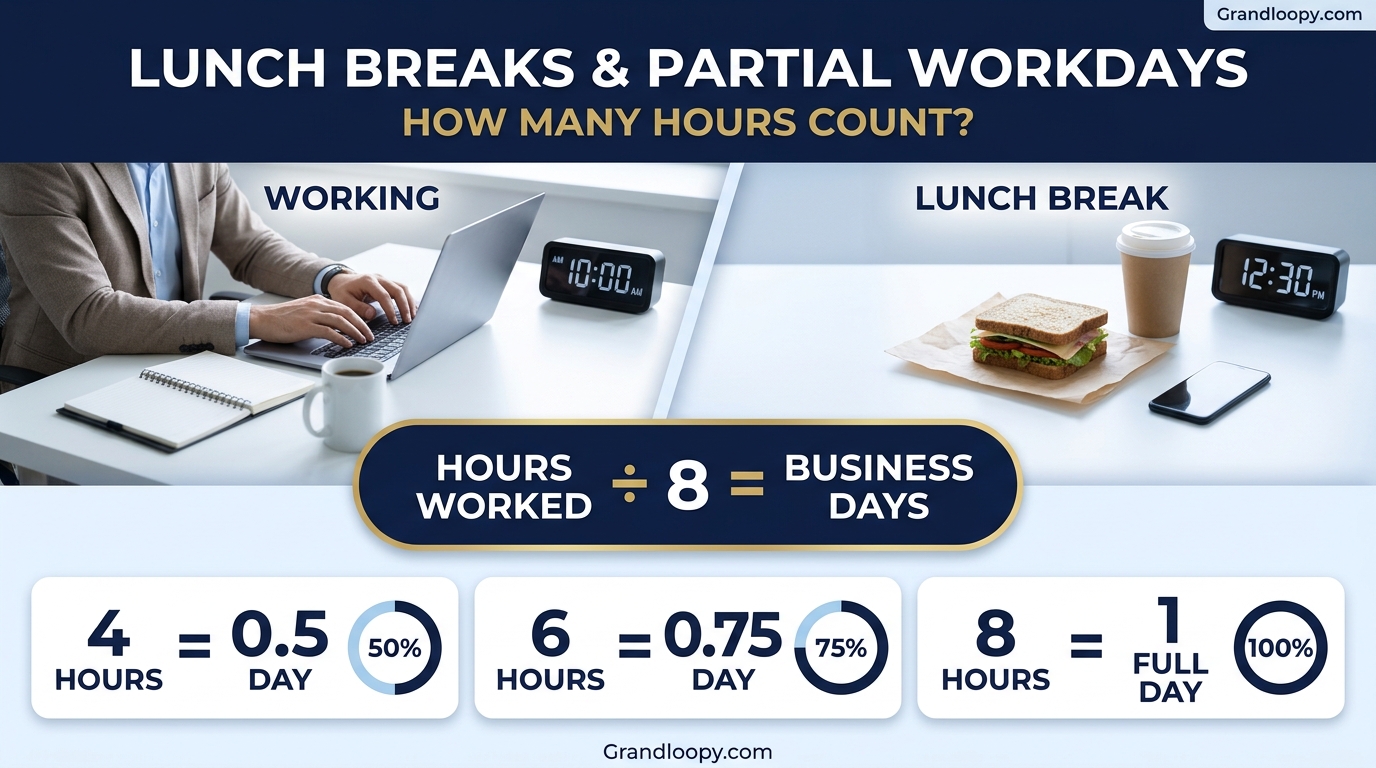
A business day is 8 hours of work, but the clock on the wall often shows nine hours. Lunch explains the gap, and partial days explain the rest.
Some days are shorter than 8 hours.
A half day, a late start, or an early finish still counts as part of a business day, and the formula below converts hours into fractions of a day.
Do lunch breaks count?
A lunch break of 30 to 60 minutes is usually unpaid and sits outside the 8 hours of paid work.
A worker on a 9 to 5 schedule often spends nine hours at the office and works eight.
Short breaks of 10 to 15 minutes are different. They are usually paid and count as part of the working day, because the worker stays available and on the premises.
The rules vary by state and employer. Some states require a meal break after a set number of hours, and some employers pay for lunch. The contract or the employee handbook controls the answer.
Partial business days and the hours formula
A partial business day happens when a worker puts in fewer than 8 hours. The conversion is simple: divide the hours worked by 8.
The formula is hours worked divided by 8. A 4-hour shift equals 0.5 business days, and a 6-hour shift equals 0.75 business days.
Payroll systems use this formula to prorate pay and leave. A worker who takes a half day uses half a day of leave, not a full day.
Worked examples
- 8 hours worked divided by 8 equals 1 business day.
- 10 hours worked divided by 8 equals 1.25 business days.
- 12 hours worked divided by 8 equals 1.5 business days.
- 4 hours worked divided by 8 equals 0.5 business days.
- 6 hours worked divided by 8 equals 0.75 business days.
These fractions matter for freelancers and contractors. A client who pays per business day needs the formula to price a half day or a 10-hour day fairly.
The same formula helps project managers. A task that takes 20 hours needs 2.5 business days of one worker, or 1.25 days of two workers.
What Counts as a Business Day?

A business day is a weekday, Monday through Friday, that is not a federal holiday.
That rule is the core of the definition, and the full version lives in What Are Business Days? Definition, Rules, and 2026-2027 Calendars.
The sections below give the short version with the 2026 and 2027 holiday tables, because the length of a business day only matters once the day itself counts.
Private employers are not required to close on federal holidays. The federal holiday list governs government offices, banks, and markets, and most businesses follow it by convention.
Federal holidays 2026
The United States recognizes 11 federal holidays each year. The Office of Personnel Management publishes the official schedule, and the 2026 dates are in the table below.
| Holiday | 2026 observed date | Day of week |
|---|---|---|
| New Year’s Day | January 1 | Thursday |
| Birthday of Martin Luther King, Jr. | January 19 | Monday |
| Washington’s Birthday | February 16 | Monday |
| Memorial Day | May 25 | Monday |
| Juneteenth National Independence Day | June 19 | Friday |
| Independence Day | July 3 (observed) | Friday |
| Labor Day | September 7 | Monday |
| Columbus Day | October 12 | Monday |
| Veterans Day | November 11 | Wednesday |
| Thanksgiving Day | November 26 | Thursday |
| Christmas Day | December 25 | Friday |
July 4, 2026 falls on a Saturday, so federal employees observe it on Friday, July 3. The Federal Reserve Banks stay open that Friday, but the Board of Governors is closed.
The 2026 federal calendar holds 250 business days. The bank calendar holds 251, because the Federal Reserve does not observe Saturday holidays on Friday.
Federal holidays 2027
The 2027 schedule has 12 observed days, because three holidays fall on weekends and one belongs to the next year. The Office of Personnel Management publishes the full table.
| Holiday | 2027 observed date | Day of week |
|---|---|---|
| New Year’s Day | January 1 | Friday |
| Birthday of Martin Luther King, Jr. | January 18 | Monday |
| Washington’s Birthday | February 15 | Monday |
| Memorial Day | May 31 | Monday |
| Juneteenth National Independence Day | June 18 (observed) | Friday |
| Independence Day | July 5 (observed) | Monday |
| Labor Day | September 6 | Monday |
| Columbus Day | October 11 | Monday |
| Veterans Day | November 11 | Thursday |
| Thanksgiving Day | November 25 | Thursday |
| Christmas Day | December 24 (observed) | Friday |
| New Year’s Day 2028 | December 31 (observed) | Friday |
Juneteenth falls on a Saturday in 2027, so it is observed Friday, June 18. Independence Day falls on a Sunday, so it is observed Monday, July 5.
Christmas Day falls on a Saturday in 2027, so it is observed Friday, December 24. New Year’s Day 2028 also falls on a Saturday, so it is observed Friday, December 31, 2027.
The 2027 federal calendar holds 249 business days. The bank calendar holds 252, again because the Federal Reserve treats Saturday holidays differently.
Observed holidays: Saturday vs Sunday rules
When a holiday falls on a Saturday, federal employees observe it on the preceding Friday. When it falls on a Sunday, they observe it on the following Monday.
The Federal Reserve follows a different rule. Its Banks stay open on the preceding Friday when a holiday falls on Saturday, while the Board of Governors closes.
That split is the reason the federal and bank calendars differ by one day each year.
The observed-day rule matters for deadline counting. A deadline that lands on an observed holiday rolls forward to the next business day, just like a deadline that lands on a weekend.
Is Saturday a Business Day?
Saturday is not a business day in the standard definition. Banks, courts, and the IRS all exclude Saturday from the count, with a few important exceptions below.
The exceptions are the whole point of this section. A single rule does not cover every situation, and the table below shows which rule applies where.
Saturday rules by context
| Context | Is Saturday a business day? | Governing rule |
|---|---|---|
| Banking (Reg CC) | No | 12 CFR 229.2 |
| Electronic transfers (Reg E) | Yes, if the bank is open | 12 CFR 1005.2 |
| Mortgages, general (Reg Z) | Depends on the creditor | 12 CFR 1026.2 |
| Mortgages, specific (Reg Z) | Yes | 12 CFR 1026.2 |
| Courts (FRCP Rule 6) | No | Federal Rules of Civil Procedure |
| Cooling-off (FTC) | Yes | 16 CFR 429 |
| Taxes (IRS) | No | IRS Publication 509 |
| USPS delivery | Yes | USPS schedule |
| UPS and FedEx delivery | Premium service only | Carrier schedules |
| Stock markets | No | NYSE and Nasdaq calendars |
The table shows why a single answer fails. Saturday counts for a mortgage rescission and for a cooling-off period, but it does not count for a bank deposit or a court filing.
Why banks, courts, and the IRS disagree
Each rule was written for a different purpose. Banking rules protect the payment system, court rules protect filing deadlines, and tax rules protect the filing calendar.
Regulation CC excludes Saturday because the settlement systems shut down on weekends. A check deposited on Saturday cannot clear until Monday, no matter when the branch opens.
Regulation E includes Saturday when the bank is open, because electronic transfers can move on Saturdays. The rule follows the bank’s actual operations, not the calendar.
The lesson is simple: check the governing definition before counting. The contract, the regulation, or the court rule that controls the deadline also controls whether Saturday counts.
Which Definition Governs Your Situation?
There is no single federal definition of a business day that covers every purpose. Five regulations and one court rule each define the term for their own area.
The sections below give each definition in plain language, with the citation so a reader can check the source. The decision table at the end matches each situation to its rule.
Banking: Regulation CC
Regulation CC defines a business day as any Monday through Friday that is not a federal holiday. Saturdays, Sundays, and federal holidays are always excluded.
The same regulation defines a banking day more narrowly. A banking day is the part of a business day when a bank office is open to the public and performing its core functions.
A branch that opens at 9:00 AM and closes at 4:00 PM has a banking day of seven hours.
A deposit made after the branch closes still arrives on a business day, but it misses that banking day.
The LegalClarity guide to business days for banks explains the business day and banking day distinction in detail, with the Federal Reserve holiday list.
Electronic transfers: Regulation E
Regulation E defines a business day as any day a bank is open for substantially all of its functions. A Saturday counts when the bank is open on Saturday.
The rule covers electronic fund transfers, including debit card transactions, direct deposits, and ATM withdrawals. It also sets the error-resolution clock.
A consumer has 60 days to report an error on a statement. The bank then has 10 business days to investigate, and the Saturday rule can shorten that window.
Liability limits also follow this rule. A lost card reported within two business days caps losses at $50, while a later report can raise the cap to $500.
Mortgages: Regulation Z
Regulation Z has two definitions of a business day, and the right one depends on the rule being applied. The general definition covers days the creditor is open for substantially all business functions.
The specific definition covers all calendar days except Sundays and federal holidays. Saturday counts under the specific definition, which governs the right of rescission and the Closing Disclosure waiting period.
That difference is worth real money. A borrower who closes on a Thursday has three specific business days to cancel, and Saturday counts as one of them.
The rescission example in the mistakes section shows the math done correctly.
Courts: FRCP Rule 6
Federal Rule of Civil Procedure 6 counts every day, including weekends and holidays, when measuring a period. The period extends when the last day falls on a Saturday, Sunday, or legal holiday.
A filing due in 10 days counts 10 calendar days, not 10 business days. If day 10 lands on a Saturday, the deadline moves to Monday.
State courts follow their own rules, and they differ. A state deadline that says “business days” may use the state court rule, so the local rule controls.
Cooling-off: FTC rule
The FTC cooling-off rule gives a buyer three business days to cancel a sale made at home or at a temporary location.
The rule applies to sales of $25 or more at home, and $130 or more at a temporary location.
Saturday counts under this rule. A sale made on a Friday gives the buyer until midnight on Tuesday to cancel, because Saturday, Monday, and Tuesday are all business days.
The rule covers door-to-door sales and sales at trade shows, fairs, and hotel rooms. It does not cover online sales, car sales, or sales made at a permanent store.
Taxes: IRS Publication 509
The IRS follows the federal holiday calendar plus the District of Columbia legal holidays. Emancipation Day, April 16, is a DC holiday that moves tax deadlines.
A tax deadline that lands on a weekend or holiday moves to the next business day. The postmark rule in 26 USC 7502 treats a timely mailed return as timely filed.
IRS Publication 509 lists the tax calendars for the year, including the dates for estimated payments and information returns. The publication is the source to check before counting a tax deadline.
Decision table: which definition applies
| Situation | Definition | Saturday counts? | Source |
|---|---|---|---|
| Bank deposit or check hold | Regulation CC | No | 12 CFR 229.2 |
| Electronic transfer error | Regulation E | Yes, if open | 12 CFR 1005.2 |
| Mortgage rescission | Regulation Z, specific | Yes | 12 CFR 1026.2 |
| Mortgage, other purposes | Regulation Z, general | Depends | 12 CFR 1026.2 |
| Court filing | FRCP Rule 6 | No, extends | Federal Rules of Civil Procedure |
| Door-to-door cancellation | FTC cooling-off | Yes | 16 CFR 429 |
| Tax filing or payment | IRS Publication 509 | No | 26 USC 7502 |
| Shipping estimate | Carrier schedule | Premium only | UPS, FedEx, USPS |
Use the table by finding the row that matches the situation, then reading the Saturday rule in that row. When two rules could apply, the contract or the regulation that names the deadline controls.
Cut-Off Times: When a Business Day Actually Ends
A business day does not last 24 hours for deposit purposes. Banks set daily cut-off times, and a deposit made after the cut-off counts as arriving the next banking day.
The cut-off is the real end of the business day for money. A deposit made at 6:00 PM on a Friday may not start processing until Monday, even though Friday was a business day.
The LegalClarity guide to business day hours, holidays, and deadlines covers the cut-off rules and the hold periods in detail, with the federal holiday list.
Bank deposit cut-offs
Federal rules set minimum thresholds for how early a bank can set its cut-off. An in-person deposit at a branch cannot have a cut-off earlier than 2:00 PM local time.
An ATM or off-site deposit cannot have a cut-off earlier than 12:00 noon. Banks may set later deadlines, and many do: 5:00 PM, 9:00 PM, or even 11:00 PM for mobile deposits.
Banks may set different deadlines for different deposit methods or branch locations. The deposit agreement lists the cut-off for each method, and that agreement controls.
The Friday-afternoon trap
A deposit made on Friday afternoon after the cut-off does not count as received until Monday, the next banking day. The weekend pauses the clock, and the hold period starts on Monday.
The same trap applies to wire transfers and orders. A transfer sent at 6:30 PM on a Tuesday logs as arriving Wednesday morning, because standard operations closed at 5:00 PM.
The fix is simple: submit before the cut-off. A deposit made at 1:00 PM on Friday starts its clock on Friday, while the same deposit at 3:00 PM may not start until Monday.
Wire, ACH, and Fedwire hours
Domestic wire transfers usually settle the same business day when sent before the bank cut-off. Wire cut-offs run from 3:00 PM to 5:00 PM local or Eastern time, depending on the bank.
ACH transfers take 1 to 3 business days for standard delivery.
Same Day ACH moves the same day, with submission windows at 10:30 AM and 2:45 PM Eastern time, and settlement at 1:00 PM and 5:00 PM.
Fedwire runs from 9:00 PM Eastern on the prior day to 7:00 PM Eastern on the business day.
International wires take 1 to 3 business days or longer, depending on the destination and the correspondent banks.
Hold periods: next, second, fifth business day
| Deposit type | Funds available by |
|---|---|
| Cash deposited in person | Next business day |
| Electronic payments | Next business day |
| U.S. Treasury checks | Next business day |
| Cashier’s checks deposited in person | Next business day |
| Checks drawn on the same bank | Next business day |
| Local checks | Second business day |
| Government checks not deposited in person | Second business day |
| Deposits at an ATM the bank does not own | Fifth business day |
The first $275 of any check deposit must be available by the first business day after the deposit. New accounts open less than 30 days face stricter availability rules.
Hold periods count business days, not calendar days. A local check deposited on Friday is available by Tuesday, because Saturday and Sunday do not count.
How Long Is a Business Day by Industry?
Not every industry keeps 9 to 5 hours. Retail, healthcare, and hospitality run longer days, and some run around the clock.
The business day still counts as one day for shipping and finance, because the definition follows the calendar.
The table below gives the typical hours for each industry, with notes on what changes the length. The sections after the table explain the three cases that cause the most confusion.
Industry hours comparison
| Industry | Typical business day | Notes |
|---|---|---|
| Banking and finance | 9:00 AM to 5:00 PM | Cut-offs at 2:00 PM in person, noon at ATM |
| Stock markets | 9:30 AM to 4:00 PM | NYSE and Nasdaq, Monday to Friday |
| Government offices | 7:00 AM to 3:30 PM | Federal offices, shorter window, still one day |
| Shipping and logistics | 8:00 AM to 6:00 PM | Cut-offs 4:00 PM to 6:00 PM |
| Courts and legal | 8:30 AM to 4:30 PM | Filings close at 5:00 PM or midnight |
| SaaS and tech support | 8:00 AM to 6:00 PM | 24/7 tiers pause the queue on holidays |
| Customer service | 8 to 12 hours | Multiple shifts, often 24/7 |
| Healthcare | 24 hours | 12-hour rotating shifts |
| Retail | 8:00 AM to 9:00 PM | Longer hours for customer service |
| Hospitality | 24 hours | Staff available at all times |
Banking and finance
Banks run 9:00 AM to 5:00 PM in most branches, but the business day for deposits ends at the cut-off, not at closing time.
A branch that closes at 5:00 PM may stop accepting deposits for that day at 2:00 PM.
Stock markets run 9:30 AM to 4:00 PM Eastern time. Settlement follows the T+1 rule, which has applied since May 28, 2024: a trade settles one business day after the trade date.
Markets close 10 days in 2026: the nine federal holidays that fall on weekdays, plus Good Friday on April 3.
Markets stay open on Columbus Day and Veterans Day, which catches many people by surprise.
Shipping and logistics
Carriers run 8:00 AM to 6:00 PM for pickup and delivery, with cut-offs between 4:00 PM and 6:00 PM. A package dropped off after the cut-off ships the next business day.
USPS delivers on Saturdays as a standard service. UPS and FedEx charge a premium for Saturday delivery, and FedEx Home Delivery runs Tuesday through Saturday.
Shipping estimates count business days, not calendar days. A “3 business day” delivery ordered on Friday arrives on Wednesday, because the weekend does not count.
Courts and legal
Courts run 8:30 AM to 4:30 PM in most jurisdictions, with electronic filing cut-offs at 5:00 PM or midnight. A filing made after the cut-off counts as filed the next business day.
Deadlines follow FRCP Rule 6 in federal court: count every day, and extend the deadline when the last day falls on a weekend or holiday. State courts follow their own rules.
Law firms keep business hours for client work, but the court clock is the one that matters.
A filing made at 11:00 PM through an electronic portal still counts as that day when the cut-off is midnight.
Government offices
Federal offices run 7:00 AM to 3:30 PM in many agencies. The window is shorter than the private sector, but it still counts as one business day.
Government offices close on all 11 federal holidays. A permit, a license, or a filing that needs a government office cannot move on a holiday, no matter when it is submitted.
State and local offices follow state holiday schedules, which differ from the federal list. A state office may close on a day the federal government stays open, and the reverse also happens.
Retail, healthcare, hospitality
Retail stores run 8:00 AM to 9:00 PM or longer, because customers shop after work.
Those long hours do not change the business day for shipping or finance: a retail order still ships on the next business day.
Healthcare runs 24 hours with 12-hour rotating shifts. A hospital never closes, yet its billing, insurance, and administrative deadlines still follow the Monday-to-Friday calendar.
Hospitality runs 24 hours as well. A hotel desk is always staffed, but a refund, a contract, or a payment still processes on business days, and a weekend submission waits until Monday.
How Long Is a Business Day Around the World?
The Monday-to-Friday, 9 to 5 pattern is Western, not universal. The Middle East runs Sunday to Thursday, parts of Asia run six-day weeks, and Europe splits the day around a long lunch.
Anyone who works across borders needs the local schedule.
A deadline that falls on a Friday in the United States may land on a weekend in Saudi Arabia, and a Monday in the United States may be a workday in Israel.
International hours
| Region | Standard workweek | Typical hours |
|---|---|---|
| United States | Monday to Friday | 9:00 AM to 5:00 PM |
| United Kingdom | Monday to Friday | 9:00 AM to 5:00 PM |
| Canada | Monday to Friday | 9:00 AM to 5:00 PM |
| Australia | Monday to Friday | 9:00 AM to 5:00 PM |
| Germany | Monday to Friday | 8:00 AM to 5:00 PM |
| France | Monday to Friday | 9:00 AM to 5:00 PM, 35-hour week |
| Spain | Monday to Friday | 9:00 AM to 1:00 PM, 4:00 PM to 7:00 PM |
| Japan | Monday to Friday | 8:30 AM to 7:00 PM |
| India | Monday to Friday | 10:00 AM to 6:00 PM |
| Middle East | Sunday to Thursday | 8:00 AM to 5:00 PM |
| UAE | Monday to Friday, 4.5 days | Friday ends at noon |
| Israel | Sunday to Thursday or Friday | Varies, Shabbat observed |
| Nepal | Sunday to Friday | Saturday only weekend |
United States, UK, Canada, Australia
The United States, the United Kingdom, Canada, and Australia all run Monday to Friday, 9:00 AM to 5:00 PM. The pattern is so similar that cross-border deadlines rarely surprise anyone.
The differences sit in the holiday lists. The UK has bank holidays, Canada has provincial holidays, and Australia has state holidays, and each list removes different days from the calendar.
Business hours in these countries still vary by industry and city.
London banks open at 9:00 AM, Sydney offices open at 9:00 AM local time, and the time zones do the rest of the work.
Europe
Germany runs 8:00 AM to 5:00 PM, a longer day than the US standard. France runs a 35-hour week by law, which usually means shorter days or a shorter week.
Spain splits the day around a siesta: 9:00 AM to 1:00 PM, then 4:00 PM to 7:00 PM.
The split makes the Spanish business day longer on the clock, even though the working hours stay near eight.
Finland runs 8:00 AM to 4:15 PM for government agencies, and banks close at 4:30 PM. Shops stay open on Saturdays, but business-to-business work still follows Monday to Friday.
Middle East and Asia
Saudi Arabia, Qatar, Bahrain, Kuwait, Oman, Egypt, Jordan, and Iraq run Sunday to Thursday, with Friday and Saturday as the weekend. Friday is a day of rest and prayer in Islamic cultures.
The UAE runs a 4.5-day week since January 1, 2022: Monday to Friday, with Friday ending at noon and Saturday and Sunday as the weekend. Sharjah runs Monday to Thursday only.
Japan runs 8:30 AM to 7:00 PM, significantly longer than Western norms, with a culture of overtime.
India runs 10:00 AM to 6:00 PM, with IT and customer support extending hours to match US and UK time zones.
During Ramadan, Middle East hours often shrink to 8:00 AM to 2:00 PM to accommodate fasting. A deadline set during Ramadan needs the shorter window, not the standard one.
Working days by country
| Country | Working days 2026 | Working days 2027 |
|---|---|---|
| United States (federal) | 250 | 249 |
| United States (bank) | 251 | 252 |
| United Kingdom | 253 | 253 |
| Germany | 254 | 256 |
| France | 252 | 254 |
| Spain | 254 | 254 |
| Portugal | 252 | 253 |
| Brazil | 252 | 254 |
| Russia | 247 | 249 |
| Canada | 253 | 254 |
| Australia | 255 | 255 |
The counts come from working-day calculators and differ by source, because each country counts its holidays differently.
The US figures are verified by date math; the others are calculator-reported and should be checked against the local holiday list.
Australia holds the most working days in this table at 255, and Russia the fewest at 247 in 2026. The spread is eight days, which is more than a full working week.
How to Count Business Days
Counting business days means skipping weekends and holidays. The rules below work for shipping, banking, contracts, and most deadlines, but the governing definition always wins when two rules disagree.
A calculator does the math, but the rules below show the logic. Anyone who understands the logic can check a calculator’s answer instead of trusting it blindly.
The counting rules
- Start with the trigger day. The day an order is placed or a deadline starts is usually day zero, not day one.
- Skip Saturdays and Sundays. Weekends never count in the standard definition.
- Skip federal holidays. Check the OPM schedule for the year, including observed days.
- Skip the cut-off. A submission after the daily cut-off starts its clock the next business day.
- Roll forward. A deadline that lands on a weekend or holiday moves to the next business day.
- Check the governing rule. Banking, mortgage, court, and tax rules count Saturday differently.
Most counting mistakes come from step one or step four. People count the trigger day as day one, or they forget the cut-off and start the clock a day early.
1 to 5 business days, worked examples
| Business days | Hours | Order Monday | Order Friday |
|---|---|---|---|
| 1 | 8 hours | Tuesday | Monday |
| 2 | 16 hours | Wednesday | Tuesday |
| 3 | 24 hours | Thursday | Wednesday |
| 4 | 32 hours | Friday | Thursday |
| 5 | 40 hours | Next Monday | Next Friday |
Five business days equal one work week, which is seven calendar days when no holiday falls inside the week. A “5 business day” delivery ordered on Monday arrives the next Monday.
An order placed on Friday needs the weekend added. One business day from Friday is Monday, and three business days from Friday is Wednesday.
Shipping converts business days to calendar days at a rough ratio.
One business day is 1 to 3 calendar days, 3 business days is 3 to 5, 5 is 7, and 7 is 9 to 11.
The ratio shifts when a holiday lands inside the window.
How many business days in 2026 and 2027
The 2026 federal calendar holds 250 business days, and the bank calendar holds 251. The 2027 federal calendar holds 249, and the bank calendar holds 252.
The month tables below use the federal calendar. Bank counts run one to three days higher in most months, because the Federal Reserve does not observe Saturday holidays on Friday.
| Month | 2026 | 2027 |
|---|---|---|
| January | 20 | 19 |
| February | 19 | 19 |
| March | 22 | 23 |
| April | 22 | 22 |
| May | 20 | 20 |
| June | 21 | 21 |
| July | 22 | 21 |
| August | 21 | 22 |
| September | 21 | 21 |
| October | 21 | 20 |
| November | 19 | 20 |
| December | 22 | 21 |
| Total | 250 | 249 |
March is the longest month in both years, with 22 business days in 2026 and 23 in 2027. January 2027 is the shortest, with 19, because New Year’s Day falls on a Friday.
The quarterly split for 2026 puts 61 business days in the first quarter. The other quarters are not always equal, because holidays cluster in the summer and the winter.
Business days to calendar days
Converting business days to calendar days means adding the weekends back in. One business day is one calendar day when it falls midweek, and three calendar days when it spans a weekend.
A week of business days is seven calendar days. Two weeks of business days is 14 calendar days, and a month of business days is about 30 calendar days.
The conversion breaks when a holiday falls inside the window. A five-business-day delivery that crosses Thanksgiving takes nine calendar days, not seven, because the holiday adds a day.
Common Mistakes
Most business day mistakes come from trusting a single rule for every situation. The mistakes below appear in top-ranking pages, and each one costs time or money when it reaches a real deadline.
The 10-holiday error
One top-ranking guide says the United States has 10 federal holidays. The correct number is 11, set by 5 USC 6103 and published by the Office of Personnel Management.
The error usually comes from dropping Juneteenth, which became a federal holiday in 2021. A count that omits Juneteenth undercounts the holidays and overcounts the business days by one.
Always check the count against the OPM federal holidays schedule. The OPM page lists all 11 holidays with the observed dates for each year.
Net 30 is calendar days
Some guides treat Net 30 as 30 business days. Net 30 means 30 calendar days from the invoice date, and the payment is due on the 30th calendar day.
A Net 30 term that meant business days would stretch to 42 calendar days, or six weeks.
No supplier intends that, and no contract reads that way unless it says “30 business days” in plain words.
The rule is simple: Net 30 is calendar days, and “30 business days” is a different term that must be written out. The two are never interchangeable.
The FLSA does not define business days
Several guides cite the FLSA as the source for the business day definition. The FLSA defines a 40-hour workweek, and it does not define a business day at all.
The 8-hour day follows from the 40-hour week, not from a definition in the statute. Citing the FLSA for the definition is a category error, even though the math is right.
The real sources are the regulations themselves: Regulation CC for banking, Regulation E for electronic transfers, Regulation Z for mortgages, and FRCP Rule 6 for courts.
The rescission example done wrong
One legal guide gives a rescission example that fails to skip Juneteenth.
The example closes on a Thursday in June 2026 and counts Friday, June 19 as a business day, but June 19 is Juneteenth, a federal holiday.
The correct example closes on Thursday, June 18, 2026. Friday, June 19 is Juneteenth and does not count.
Saturday, June 20 counts under the Regulation Z specific definition, and the right to cancel expires at midnight on Tuesday, June 23.
The mistake is worth real money. A borrower who follows the wrong example could miss the rescission deadline by a day and lose the right to cancel the loan.
Assuming your bank’s hours are the rule
A bank branch that opens on Saturday does not make Saturday a business day. Regulation CC excludes Saturday from the business day count, even when the branch is open and taking deposits.
The deposit still counts, but it counts as arriving on the next banking day. A Saturday deposit starts its hold period on Monday, and the funds follow the Monday clock.
The same logic applies to online and mobile deposits. A mobile deposit made on Sunday starts processing on Monday, because Sunday is never a business day under Regulation CC.
Best Practices for Counting Business Days
Good counting is a habit, not a talent. The practices below keep deadlines safe, and they take less time than fixing a missed deadline.
Check the governing definition first
Before counting, find the rule that controls the deadline. A mortgage, a bank deposit, a court filing, and a shipping estimate each use a different definition.
The contract or the regulation that names the deadline also names the definition. Read that part first, and count second.
Use the official holiday list
Use the OPM schedule for federal holidays and the Federal Reserve K.8 holidays observed page for bank holidays. The two lists differ, and the difference is one day a year.
Bookmark both pages and check them each January. Holiday dates move when they fall on weekends, and the observed day is the day that counts.
Submit before the cut-off
Submit deposits, wires, and orders before the daily cut-off. A submission made an hour early starts its clock a full day sooner than one made an hour late.
Set a personal cut-off one hour before the official one. The buffer covers slow connections, long lines, and forms that need a second look.
Keep a counting worksheet
Keep a one-page worksheet with the month tables and the Saturday rules. A worksheet beats a calculator when the question is which days count, not how many.
Small business owners who plan cash flow around instant payments should read How Instant Payments Improve Small Business Cash Flow alongside the month tables, because faster payments change which days matter.
Expert Tips
Experts in banking, law, and logistics agree on a few practical points that never appear in the standard guides. The tips below come from those practices, not from theory.
Tip 1: Treat Friday afternoon as Monday
Anything submitted after 2:00 PM on Friday should be planned as a Monday submission. The cut-off and the weekend stack, and the work starts on Monday either way.
Tip 2: Watch the holiday before the deadline
A holiday that falls inside a counting window adds a day, and a holiday that falls on the deadline moves the deadline. Check the whole window, not just the deadline date.
Tip 3: Keep the receipt
Keep the confirmation or receipt for every deposit, filing, and order. The receipt proves the submission time, and the submission time decides which business day counts.
Tip 4: Ask the bank for its cut-off list
Banks set different cut-offs for branches, ATMs, and mobile deposits. Ask for the list in writing, and keep it with the account papers.
Tip 5: Use digital invoices for speed
Digital invoices move faster than paper, and faster invoicing means fewer deadline disputes. Why Small Businesses Are Switching to Digital Invoices explains the shift and the time it saves.
Frequently Asked Questions
How long is a business day?
A business day is 8 hours long, usually 9:00 AM to 5:00 PM, Monday through Friday, excluding federal holidays. The length changes by industry and by regulation, but 8 hours is the standard answer.
How many hours is a business day?
A business day holds 8 working hours in the standard model. Some industries run 10 or 12 hours, and some run 24 hours with shifts, but the business day still counts as one day.
Is a business day 8 hours?
Yes, a business day is 8 hours in the standard model, from 9:00 AM to 5:00 PM.
Lunch is usually unpaid and sits outside the 8 hours, which is why the clock can show nine hours.
Is a business day 24 hours?
No, a business day is not 24 hours. A calendar day lasts 24 hours, but a business day lasts only the working part, usually 9:00 AM to 5:00 PM, or 8 hours.
Is a business day 9 to 5?
Yes, a business day is usually 9 to 5, or 9:00 AM to 5:00 PM.
Some offices run 8:00 AM to 4:00 PM or 7:00 AM to 3:30 PM, and those windows still count as one business day.
What time does a business day start and end?
A business day usually starts at 9:00 AM and ends at 5:00 PM local time. Banks end earlier for deposits, with cut-offs at 2:00 PM in person and 12:00 noon at ATMs.
What is a business day?
A business day is a weekday, Monday through Friday, that is not a federal holiday.
The full definition, with the counting rules and the 2026 and 2027 calendars, is covered in What Are Business Days? Definition, Rules, and 2026-2027 Calendars.
How long is 1 business day?
One business day is 8 hours and means the next working day. An order placed on Monday arrives on Tuesday, and an order placed on Friday arrives on Monday.
How long is 2 business days?
Two business days is 16 hours of work and means two working days. An order placed on Monday arrives on Wednesday, and an order placed on Friday arrives on Tuesday.
How long is 3 business days?
Three business days is 24 hours of work and means three working days. An order placed on Monday arrives on Thursday, and an order placed on Friday arrives on Wednesday.
How long is 5 business days?
Five business days is 40 hours of work and means one full work week. An order placed on Monday arrives the next Monday, and five business days is seven calendar days without a holiday.
How long is 3 business days from Friday?
Three business days from Friday is Wednesday of the next week. Friday is day zero, Monday is day one, Tuesday is day two, and Wednesday is day three.
How long is 5 business days from Monday?
Five business days from Monday is the next Monday. Monday is day zero, and the five working days run Tuesday through the next Monday.
How many business days are in a week?
A week holds five business days, Monday through Friday. A week with a federal holiday holds four, and a week with two holidays holds three.
How many business days are in 2026?
2026 holds 250 federal business days and 251 bank business days. The difference comes from the Federal Reserve staying open on Friday, July 3, when Independence Day falls on a Saturday.
How many business days are in 2027?
2027 holds 249 federal business days and 252 bank business days. The federal count is lower because 12 observed days fall in the year, including December 31 for New Year’s Day 2028.
Does Saturday count as a business day?
Saturday does not count as a business day in the standard definition, but it counts under Regulation E when the bank is open, under the Regulation Z specific definition, and under the FTC cooling-off rule.
The governing rule decides.
Is Sunday a business day?
No, Sunday is never a business day under any of the major definitions. A deadline that lands on a Sunday always rolls forward to the next business day.
Is a federal holiday a business day?
No, a federal holiday is not a business day. Banks, courts, and government offices close, and the settlement systems shut down, so the day does not count for deadlines.
What are the federal holidays in 2026?
The 11 federal holidays in 2026 are New Year’s Day, Martin Luther King Jr. Day, Washington’s Birthday, Memorial Day, and Juneteenth.
Independence Day (observed July 3), Labor Day, Columbus Day, Veterans Day, Thanksgiving Day, and Christmas Day complete the list.
What are the federal holidays in 2027?
The 2027 schedule has 12 observed days: the 11 holidays plus December 31 for New Year’s Day 2028.
Juneteenth is observed June 18, Independence Day July 5, and Christmas Day December 24, because all three fall on weekends.
What is the difference between a business day and a calendar day?
A calendar day lasts 24 hours and includes weekends and holidays. A business day lasts 8 working hours and excludes weekends and federal holidays. Five business days is seven calendar days without a holiday.
What is the difference between a business day and a banking day?
A business day is the whole weekday that counts for deadlines.
A banking day is the part of that day when a bank office is open for substantially all of its functions, usually 9:00 AM to 4:00 PM or 5:00 PM.
What is Regulation CC?
Regulation CC is the federal rule on the availability of funds and the collection of checks, at 12 CFR Part 229.
It defines a business day as Monday through Friday, excluding federal holidays, and sets the maximum hold periods for deposits.
What is the bank cut-off time for deposits?
A bank cannot set an in-person cut-off earlier than 2:00 PM local time, or an ATM cut-off earlier than 12:00 noon.
Many banks set later cut-offs, up to 5:00 PM, 9:00 PM, or 11:00 PM for mobile deposits.
Conclusion
How long is a business day? Eight hours, usually 9:00 AM to 5:00 PM, Monday through Friday, excluding federal holidays. That answer covers most questions, and it is the number to remember.
The full answer adds the cut-off times, the Saturday rules, and the regulations that change the length for banks, mortgages, courts, taxes, and shipping.
A deposit after 2:00 PM, a Saturday under Regulation Z, and a holiday inside a counting window each move the deadline by a day.
Readers who plan a business should start with How to Start a Business in 10 Steps (2026 Guide) and How to Write a Business Plan: 9 Steps (2026 Guide).
Readers who want the dress code for those business days can use What Is Business Casual? Guide for Men and Women (2026).
Small business owners who want faster payments and smoother operations can read How AI Customer Support Is Transforming Small Online Stores.
They can also read How to Make Money With AI: 12 Real Ways That Pay in 2026.
The business day stays 8 hours, but the tools around it keep getting faster.