How to Write a Business Plan: The Complete Step-by-Step Guide for 2026

How to write a business plan comes down to nine sections, written in the right order, with real numbers behind every claim.
A business plan is a written document that explains what your business does, who it serves, how it makes money, and what evidence supports the claim that it will work.
The U.S. Small Business Administration (SBA) calls a business plan a roadmap for how to structure, run, and grow a business.
Lenders and investors both want to see one before they put money behind an idea.
This guide walks through all nine sections in reading order, then teaches the writing order, because the two are different.
It adds a worked cash flow example, a template comparison, and a lender checklist that most guides leave out.
Businesses with a formal written business plan are 16% more likely to achieve viability than those without one, according to the SBA, as reported by Crestmont Capital.
That figure is the best reason to write the plan before you need it.
What Is a Business Plan?
A business plan is a strategic document that describes a company, its goals, and how it plans to achieve them. It typically covers market analysis, operations, and financial projections.
It has two audiences, and they read it differently. You read it to make decisions, while a lender or investor reads it to judge risk, and both need the same document to serve them.
A business plan differs from a business proposal. A proposal pitches a specific product or service to a prospective customer, while a plan describes the whole business and its future.
A business plan also differs from a pitch deck.
A deck is a short visual summary for investors, while a plan is the full document with the numbers, the research, and the reasoning behind the pitch.
Writing a plan forces you to validate your ideas, spot gaps in your strategy, and present a credible case to investors or lenders. The thinking is the value, not the paper.
Steve Blank, who teaches entrepreneurship at Stanford and UC Berkeley, put it bluntly in The Startup Owner’s Manual: no business plan survives first contact with customers. The plan is a starting point, not a promise.
Do you need a business plan? Yes, if you want a loan, an investor, a lease, or a partner.
No, if you are self-funding a tiny service business, but even then a one-page plan keeps you honest.
Traditional vs Lean vs One-Page: Which Format Fits You?
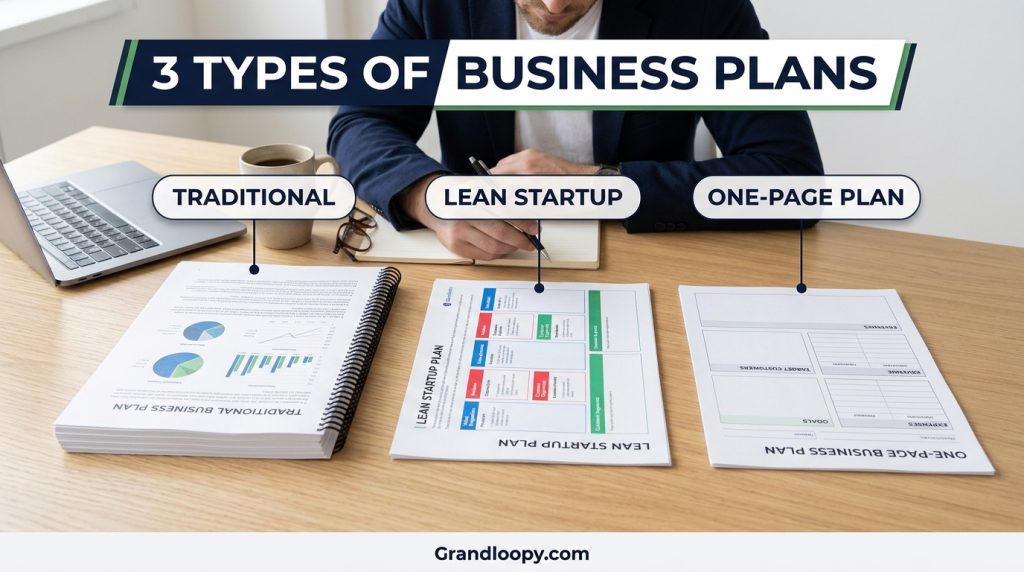
The SBA recognizes two main formats: a traditional plan and a lean startup plan. A one-page plan is a shorter version of the lean format, and all three are legitimate tools for different jobs.
A traditional plan is the full, detailed document, typically 15 to 30 pages. It is the format lenders and investors expect, and it withstands real scrutiny.
A lean startup plan fits on one page and uses nine building blocks: key partnerships, key activities, key resources, value proposition, customer relationships, customer segments, channels, cost structure, and revenue streams.
A lean plan can be created in as little as one hour, per the SBA.
That speed makes it the right first draft, and the traditional plan is the right version to share outside the company.
| Format | Length | Time to write | Best for | Weakness |
|---|---|---|---|---|
| Traditional | 15 to 30 pages | 3 to 4 weeks | Bank loans, investors | Slow to update |
| Lean startup | One page | About 1 hour | Fast decisions, launches | Too thin for lenders |
| One-page plan | One page | 1 to 2 hours | Internal focus, partners | No financial detail |
| Business Model Canvas | One canvas | Half a day | Testing assumptions | Not a funding document |
Rule of thumb: if money from a bank or investor is involved, start with the traditional plan, then add a one-page lean summary on top.
If the reader is you or a cofounder, start lean and expand later.
The SBA’s own caveat is that if you hand a lean plan to a lender or investor, expect them to come back asking for more.
That is not a rejection, but it is a delay you can avoid.
Many founders now start with a Business Model Canvas, the framework popularized by Alexander Osterwalder, to map assumptions before expanding the strongest ones into a full document.
The canvas tests the model, and the plan documents it.
The 9 Sections of a Business Plan
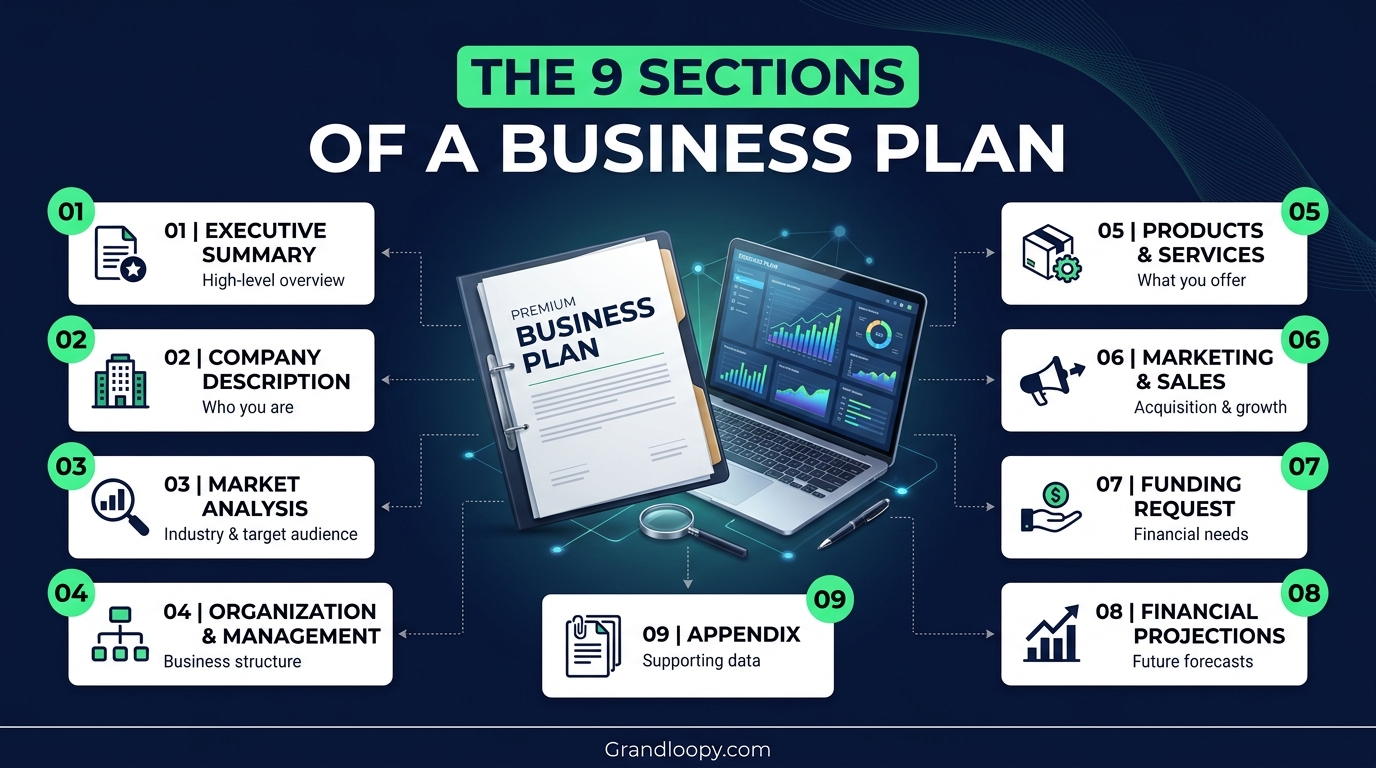
The traditional format has nine sections, and the SBA lists them in this order.
They are executive summary, company description, market analysis, organization and management, service or product line, marketing and sales, funding request, financial projections, and appendix.
Readers expect this order, so do not invent your own. A lender who cannot find the financials in the usual place assumes they are missing, and a missing section reads as a missing answer.
Each section answers one question about viability. The summary answers why this business, the market section answers who pays, the financials answer whether it makes money, and the funding request answers what you need.
| Section | Question it answers | Typical length |
|---|---|---|
| 1. Executive summary | Why this business, why now? | 1 to 2 pages |
| 2. Company description | What do you do and for whom? | 1 to 2 pages |
| 3. Market analysis | Who pays, and how big is the market? | 2 to 4 pages |
| 4. Organization and management | Who runs it, and why trust them? | 1 to 2 pages |
| 5. Service or product line | What do you sell, and at what price? | 1 to 3 pages |
| 6. Marketing and sales | How do customers find you? | 2 to 3 pages |
| 7. Funding request | How much, for what, and how repaid? | 1 to 2 pages |
| 8. Financial projections | Do the numbers work? | 3 to 5 pages |
| 9. Appendix | What proves it? | As needed |
Established businesses should include 3 to 5 years of historical income statements, balance sheets, and cash flow statements.
New businesses should provide a 5-year outlook with monthly or quarterly projections for year one, per the SBA.
The sections below walk through each one in reading order, with what to write, what to leave out, and the mistake that sinks it.
The writing order comes later, because you write the executive summary last.
Section 1: Executive Summary (Write It Last)
The executive summary is a short overview of the whole plan, written last but placed first. It is the one section every reader gets through even if they read nothing else.
Keep it to one or two pages. It needs a mission statement, a concise description of what you sell, a snapshot of your financial position and outlook, and how much funding you are seeking.
Write it in five sentences first: what you sell, who buys, why now, how you make money, and how much funding you need. If any sentence is weak, the section it summarizes is weak too.
Lead with the problem, not the product. A lender reads dozens of summaries, and the ones that open with a real customer problem earn the next page.
Include headline financials when you seek funding: year-one revenue, break-even month, and the funding ask. A summary without numbers is a pitch, not a plan.
Do not write the summary first. Every other section feeds it, and a summary written before the financials is a guess dressed as a conclusion.
Common mistake: copying the marketing copy from your website into the summary. A lender wants facts and numbers, not adjectives, and superlatives without evidence damage trust.
Section 2: Company Description
The company description is a snapshot that explains your business structure and what you do. It covers the products or services you sell and the customers you serve.
Start with the problem your business solves, in detail. Name the specific consumers, organizations, or businesses you serve, then list your competitive advantages.
Competitive advantages must be genuinely defensible: an expert team, a prime location, a cost structure rivals cannot match, or a patent.
A claim like “great customer service” is not an advantage, because every competitor says it.
State your legal structure plainly: LLC, sole proprietorship, partnership, or corporation. Lenders check this early, and a mismatch with your registration documents raises questions.
Write your mission statement in one sentence: what you do, for whom, and why it matters. A mission that needs a paragraph to explain is not a mission, it is a ramble.
Add your vision statement in one more sentence: where the business is headed in five years. The mission is today, the vision is the destination, and the plan is the route.
Include your location and why it matters. A storefront lives or dies on foot traffic, a service business on travel time, and an online business on shipping costs, so location is strategy, not trivia.
Section 3: Market Analysis
Market analysis shows you understand demand and your positioning in the business world. It estimates market size and defines your ideal customer, including their buying habits and preferences.
Size your market in three layers: TAM, SAM, and SOM.
TAM is the total addressable market, SAM is the share you can serve, and SOM is the share you can realistically obtain in the first years.
Worked example: a cleaning service in one city might face a $40 million TAM for all cleaning, a $4 million SAM for residential cleaning in its districts, and a $200,000 SOM for year one.
The shrinking numbers show honesty, not weakness.
Research competitors by reading their websites, reviews, and prices. List three to five direct competitors and three indirect ones, with what each does well and where each is weak.
Read one-star reviews first. They reveal the gaps competitors leave open, and your market analysis should name the gap your business fills, not just list names.
Define your target customer with specifics: age, income, location, and buying habits. A plan that says “everyone aged 18 to 65” has not done the work.
Use public data for market size: Census Bureau business formation statistics, industry reports, and trade associations.
Cite the source and the date for every market statistic, because an unsupported number is a red flag.
Never write that you have no competition. Lenders read that as weak research, because every business competes with something, even if it is the customer doing nothing.
Section 4: Organization and Management
This section answers who runs the business and why a lender should trust them. It covers your legal structure, your team, and your advisors.
Present each key person with a short bio: role, relevant experience, and one achievement that proves they can do this job. A resume dump belongs in the appendix, not here.
Include an organizational chart, even for a solo founder. It shows who does what, who reports to whom, and which roles you will hire next, in what order.
Name your advisors: an accountant, an attorney, and a mentor. A plan with no advisors reads as a founder who works alone, and lenders prefer founders who seek counsel.
Be honest about gaps. If you have no sales experience, say so and name the hire or advisor who covers it. A named gap with a plan beats a hidden gap a lender discovers.
Management experience matters more than the idea. Lenders fund operators, not concepts, and a team with relevant wins outweighs a clever product from an unproven team.
Section 5: Service or Product Line
This section describes what you sell and why customers buy it. It covers your products or services, your pricing, and your plans for new offerings.
Describe each product or service in one paragraph: what it is, what problem it solves, and what the customer gets. Lead with the benefit, then the feature.
Explain your pricing strategy with numbers. Show your price, your cost, and your margin per unit, and explain why the price is right for your customer and your market.
Cover your intellectual property if you have any: patents, trademarks, copyrights, or trade secrets. A pending patent is worth naming, and an unprotected idea is worth admitting.
Note your supply chain briefly: who supplies you, what it costs, and what happens if a supplier fails. A single supplier with no backup is a risk a lender will ask about.
Do not list every feature you plan to build. A product line with twenty future features and no current sales is a wish list, and lenders discount it to zero.
Section 6: Marketing and Sales
The marketing and sales section explains how customers find you, why they buy, and how you keep them. It covers your customer segments, channels, and sales forecast method.
Segment your customers into two or three groups with different needs. A restaurant might serve lunch workers, weekend families, and event bookings, and each group needs a different message.
Describe your channels: your website, social media, local advertising, referrals, and partnerships. Name the one channel that will bring your first customers, because focus beats a list of ten.
Structure your approach around the four Ps: product, price, place, and promotion. The framework is old, and lenders still recognize it, which is why it belongs here.
Explain your sales process step by step: how a stranger becomes a lead, how a lead becomes a buyer, and how a buyer becomes a repeat customer. A process with no steps is a hope.
Base your sales forecast on a method, not a wish. Show the math: visitors times conversion rate times average sale, with each input sourced or justified.
Your first customers are your best marketing. Our guide to how to start a business in 10 steps covers finding your first 5 to 10 paying customers, and that section pairs with this one.
Section 7: Funding Request
The funding request states how much money you need, what it is for, and how it will be repaid. It is the section lenders read first after the summary, and vagueness here kills applications.
State the amount in the first sentence. “Need money to grow” is not a request, and a lender will not guess the number for you.
Write a use of funds statement as a line-item table, not a paragraph.
Equipment, staffing, inventory, and lease deposits each get a line with a dollar figure, because specifics are credible and round numbers are not.
A weak use of funds statement looks like this: “$250,000 for business operations and growth.”
A strong one lists $80,000 for equipment, $60,000 for inventory, $50,000 for six months of rent, and $60,000 for working capital.
Explain how the loan will be repaid, from cash flow, with the monthly payment shown. A repayment plan that only works when everything goes right is a plan a lender will reject.
Lenders weigh the five Cs of credit. Character is your experience, track record, and credit history. Capacity is cash flow strong enough to cover loan payments.
Capital is how much of your own money is invested. Collateral is assets that secure the loan. Conditions are the loan purpose and the market you operate in.
Most lenders require a minimum debt service coverage ratio, or DSCR, of 1.25.
That means for every $1.00 in debt payments, your business must generate $1.25 in income, and your plan should show the ratio clearly.
For SBA loans, a business plan is typically required as part of the application package.
The SBA’s underwriting standards are detailed, and a plan that addresses market analysis, management qualifications, use of proceeds, and repayment strategy speeds up the review.
SBA 7(a) and 504 cumulative loan limits doubled to $10 million, per Policy Notice 5000-879058, implemented in July 2026, as reported by PrometAI.
Re-verify the current limit on the SBA site at publication, because loan rules change.
| What the reader weights | Bank lender | Investor |
|---|---|---|
| First question | Can this business repay the debt? | Can this business grow fast? |
| Key number | DSCR, minimum 1.25 | Growth rate and market size |
| Cash flow vs revenue | Cash flow matters most | Revenue growth matters most |
| Risk section | Required, with a plan B | Noted, but upside leads |
| Collateral | Often required | Rarely required |
| Use of funds | Line-item breakdown | Milestones and hiring |
| Tone | Steady repayment, certainty | Ambition, big outcome |
Writing for investors when a lender will read it is a common mistake. An investor wants upside, while a lender wants certainty, so tone down the growth talk and show steady repayment instead.
Section 8: Financial Projections
Financial projections are the proof that the business can make money. They include an income statement, a balance sheet, and a cash flow statement, and lenders read them before the narrative.
The income statement shows revenue minus expenses and taxes. The balance sheet shows what you own, what you owe, and what is left. The cash flow statement shows when money actually moves in and out.
Cash flow is the statement that matters most for a lender. A business can show a profit on paper and still miss payroll, because invoices arrive late and rent arrives on time.
Taxes shape every projection, so check the IRS small business and self-employed pages for the current rates and rules. A projection that ignores tax is a projection that overstates cash.
Show year-one projections monthly or quarterly. The SBA expects new businesses to provide a 5-year outlook with monthly or quarterly projections for the first year.
Add a break-even analysis: the month when revenue covers costs. State it plainly, because a plan that never breaks even is a plan that needs more funding, not more optimism.
Worked example: a freelance marketing consultant, year one. The figures below are illustrative, invented for this example, and not real business data.
They show the shape a lender wants to see: revenue growing as clients accumulate, costs staying flat, and a break-even month.
| Month | Revenue | Costs | Net cash flow | Cumulative cash |
|---|---|---|---|---|
| Month 1 | $2,000 | $3,500 | -$1,500 | -$1,500 |
| Month 2 | $2,500 | $3,500 | -$1,000 | -$2,500 |
| Month 3 | $3,500 | $3,600 | -$100 | -$2,600 |
| Month 4 | $4,000 | $3,600 | $400 | -$2,200 |
| Month 5 | $5,000 | $3,800 | $1,200 | -$1,000 |
| Month 6 | $6,000 | $3,800 | $2,200 | $1,200 |
| Month 9 | $7,000 | $4,000 | $3,000 | $8,700 |
| Month 12 | $8,000 | $4,200 | $3,800 | $19,500 |
The example breaks even in month 4 and turns cumulative cash positive in month 6. A lender reads that as a founder who knows the cash gap is $2,600 and has planned for it.
Run a slow-case stress test next to the main forecast. Show what happens if sales run at 80% of forecast: can you still pay the loan, and what costs do you cut first?
| Scenario | Year-1 revenue | Year-1 net cash flow | Can you still repay? |
|---|---|---|---|
| Base case | $62,500 | $19,500 | Yes, with room |
| Slow case, 80% of sales | $50,000 | $7,000 | Yes, but tight |
| Bad case, 60% of sales | $37,500 | -$5,500 | No, needs a plan B |
The slow case is the table most plans skip, and it is the one lenders ask for.
A founder who shows the bad case has thought about risk, and a founder who hides it has not.
If you have no trading history, build projections from comparable businesses. Use competitor prices, industry benchmarks, and your own first contracts, and label every assumption with its source.
Never let projections grow 40% or more annually with no explanation. That is the pattern lenders flag as unrealistic, and it marks a plan as written by someone who has never run the numbers.
Section 9: Appendix
The appendix holds the evidence that supports the main document: credit histories, resumes, product photos, patents, letters of reference, and permits.
Include legal documents when they exist: registration papers, leases, and licenses. A lender who asks for a document and finds it already attached moves faster.
Add detailed market research tables, your full financial statements, and any contracts you already hold. The appendix is where the detail lives so the main text can stay readable.
Keep the appendix organized with a contents list. A 30-page appendix with no index is a drawer, not evidence, and nobody will dig through it.
Do not pad the appendix to look thorough. Ten strong pages of evidence beat fifty pages of filler, and a lender can tell the difference in minutes.
How to Write Your Business Plan Step by Step

Write the sections in this order: customer and market first, products and operations second, financials third, funding request fourth, and executive summary last. The order matters, because each section feeds the next.
Start by defining your customer, because everything else flows from who pays. A plan that starts with the product usually ends up describing a product nobody asked for.
Do your market research before you write a word of the plan. Interview five to ten potential customers, and write down what they actually say, not what you hoped they would say.
Draft the financials before the narrative sections that describe them. A marketing plan written before the numbers is a wish list, while one written after them is a budget.
Set a realistic schedule: most DIY writers need three to four weeks, working a few hours a week.
Rushing the plan into a weekend produces a document that reads like it was written in a weekend.
A 3-to-4-week writing calendar. Week one: market research and customer interviews. Week two: company description, product line, and organization sections. Week three: financial projections and funding request.
Week four: executive summary, appendix, and a full read-through.
Ask a mentor or advisor to review the draft before you send it anywhere. Free mentoring from SCORE is a real option, and a second pair of eyes catches the optimistic assumption you stopped seeing.
The U.S. Chamber guide to starting a business walks through the launch steps around the plan. Read it alongside this guide when you are ready to file and register.
Review and update the plan every quarter. Compare actual sales and costs to the forecast, and rewrite the sections that proved wrong, because a plan that never changes is a plan you stopped using.
How Long Should a Business Plan Be?
A traditional business plan runs 15 to 30 pages, and a bank-ready plan typically lands at 15 to 25 pages. Length is a signal: too short looks thin, and too long looks padded.
Give each section a page budget before you start writing. A budget stops the market analysis from swallowing the financials, which is the most common imbalance.
| Section | Page budget | Word budget |
|---|---|---|
| Executive summary | 1 to 2 pages | 400 to 800 words |
| Company description | 1 to 2 pages | 400 to 800 words |
| Market analysis | 2 to 4 pages | 800 to 1,600 words |
| Organization and management | 1 to 2 pages | 400 to 800 words |
| Service or product line | 1 to 3 pages | 400 to 1,200 words |
| Marketing and sales | 2 to 3 pages | 800 to 1,200 words |
| Funding request | 1 to 2 pages | 400 to 800 words |
| Financial projections | 3 to 5 pages | 800 to 1,500 words plus tables |
| Appendix | As needed | Evidence only |
A lean plan is one page, not fifteen.
Do not pad a lean plan to look traditional, and do not cut a traditional plan to one page to save time, because each format serves a different reader.
How Much Does It Cost to Write a Business Plan?
Writing a business plan costs anywhere from $0 to $15,000, depending on whether you do it yourself, use software, hire a freelancer, or hire a firm.
The figures below are competitor-reported ranges, not quotes, and prices vary by market.
A do-it-yourself plan costs nothing but time, typically 40 to 80 hours spread over three to four weeks. Free SBA and SCORE templates provide the structure, so the cost is your evenings.
Paid business plan software typically costs a monthly subscription, and it adds financial templates and formatting. It is the middle option for founders who want structure without hiring a writer.
Hiring a professional writer typically costs $2,000 to $15,000, according to StartupOwl, depending on the business complexity and the writer’s experience.
A simple service business sits at the low end, and a funded startup sits at the high end.
| Route | Typical cost | Time | Best for |
|---|---|---|---|
| DIY with free templates | $0 | 40 to 80 hours | Simple businesses, self-funded |
| Paid software | Monthly subscription | 20 to 40 hours | Founders who want structure |
| Freelance writer | $2,000 to $5,000 | 2 to 3 weeks | Funded startups, busy founders |
| Consulting firm | $5,000 to $15,000 | 3 to 6 weeks | Complex plans, big raises |
A hired writer does not replace the founder. You still need to supply the numbers, the market research, and the strategy, because a writer cannot invent your business for you.
Budget for a review as well as a draft. A few hours with a mentor or accountant costs little and catches the errors that cost loans.
Free Business Plan Templates Compared
The SBA publishes free sample plans on its business planning pages, including a traditional sample and a lean startup sample. They are the most authoritative free option, because lenders recognize them.
SCORE offers a free startup business plan template with nine sections and eleven worksheets, updated in May 2026.
The worksheets force you to fill in the numbers instead of skipping them, which is exactly the discipline a first-time writer needs.
Free online templates from business software sites vary in quality.
Some are excellent, and some are thin outlines with a sales pitch attached, so check the template against the SBA nine sections before you trust it.
Paid software adds financial formatting and guided prompts, and it is worth the subscription if you dislike spreadsheets. It does not add judgment, so a bad plan in software is still a bad plan.
| Template | Price | Format | Best for | Watch out for |
|---|---|---|---|---|
| SBA sample plans | Free | Traditional and lean | Loan applications | Thin on financials |
| SCORE template | Free | 9 sections, 11 worksheets | First-time writers | Long, needs patience |
| Free online templates | Free | Varies | Quick starts | Quality varies widely |
| Paid software | Subscription | Guided, formatted | Financials and formatting | Cost, no judgment added |
Use the SBA sample plans as your baseline. The SBA’s planning pages are the official starting point, and any template you choose should cover the same nine sections.
SCORE’s template is named in plain text here because its site returns a bot-check page to automated checks at writing time; verify the link yourself before publishing.
The SBA link above was verified live at writing time.
Business Plan for a Bank Loan vs for Investors
The same business can need two versions of its plan, because a lender and an investor ask different questions. The comparison table in the funding request section shows what each reader weights.
For a bank loan, lead with cash flow, collateral, and repayment. Show the DSCR, the use of funds, and the slow-case stress test, because those are the lender’s first three checks.
For investors, lead with market size, growth, and the team. Show the TAM and SAM numbers, the customer acquisition cost, and the milestones the funding buys.
Do not send the investor version to a lender. Growth talk without a repayment plan reads as risk, and a lender will price that risk into a rejection.
Do not send the lender version to an investor either. A plan that reads like a loan application tells an investor you are thinking small, and investors fund ambition.
Keep one master document and two summaries. The financials stay the same, the emphasis changes, and the executive summary is rewritten for each audience.
Can You Use AI to Write a Business Plan?
Yes, with limits, and the limits matter. AI can draft sections, summarize research, and format tables, but it cannot know your market, your costs, or your customers.
The Federal Reserve’s 2026 Report on Employer Firms, from the 2025 Small Business Credit Survey, found that 46% of small employer firms use AI.
Among AI users, 83% use it for writing or marketing, and 71% said it increased productivity.
Only 7% of AI users have fully integrated it into how the business runs, according to the same survey. Most are still experimenting, which is the right posture for a business plan too.
Use AI to draft, then verify every number, every market claim, and every competitor statement by hand. AI invents plausible statistics, and a lender who checks one invented figure stops trusting the rest.
Never let AI write your financial projections from nothing. A cash flow forecast needs your real costs and your real prices, and an AI tool has neither.
Lenders can spot AI-written plans. Generic language, perfect formatting, and zero specific numbers are the tells, and a plan that reads like everyone else’s plan gets treated like everyone else’s plan.
Our guide to why ChatGPT gives different answers explains why the same prompt returns different drafts, and that is a warning against copying an AI draft without checking it.
Common Mistakes That Sink a Business Plan
Most failed plans fail on the same five mistakes, and all five are avoidable. Fix them before you send the plan anywhere, because lenders see them every week.
Mistake one: a vague funding request. “Need money to grow” tells a lender nothing, while a line-item use of funds tells them everything.
Mistake two: optimistic projections with no explanation. Forecasts that grow 40% or more annually, with no working shown, are the fastest way to lose a lender’s trust.
Mistake three: no competitor analysis. A plan that claims no competition, or lists competitors without a single weakness, shows the writer did not do the research.
Mistake four: ignoring risks. A plan with no risk section reads as naive, while a plan with a named risk and a plan B reads as honest.
Mistake five: inconsistent numbers. If the summary says $500,000 in revenue and the financials say $400,000, the lender trusts neither, so check every figure twice.
One more mistake: writing for the wrong reader. A plan aimed at investors, sent to a bank, fails, and a plan aimed at a bank, sent to investors, fails too.
Match the plan to the audience.
How to Update Your Business Plan
A business plan is a living document, not a one-time homework assignment. The best founders review it quarterly and rewrite the sections that proved wrong.
Compare actual sales and costs to the forecast every quarter. The gap between forecast and reality is the most valuable information in the document, because it shows what you misunderstood.
Update the market analysis when a competitor launches, closes, or changes prices. A market section that is two years old is a history lesson, not an analysis.
Rewrite the financial projections when the business changes: a new product, a new channel, or a price change all make the old forecast wrong.
A stale forecast is worse than no forecast, because it looks authoritative while being wrong.
Keep a change log at the back of the plan. Date each update, note what changed, and note why, so a reader can see the plan is maintained rather than abandoned.
Keep Reading on GrandLoopy
A business plan sits inside a bigger launch, and the guides below cover the steps around it. Each one is live on GrandLoopy and verified at writing time.
Start with the full process in how to start a business in 10 steps, where the plan is step three of the launch.
That guide covers the legal structure, registration, and bank account steps this plan points to.
Cash flow is where most plans go wrong, so read how instant payments are changing small business cash flow before you write your projections.
Faster payments change the timing of your cash, and timing is what the cash flow statement measures.
Your revenue model shapes the financials, so why small businesses are offering subscriptions helps you think about recurring revenue. Recurring revenue makes projections steadier, and lenders notice steady.
Invoicing is part of the financials too, so why small businesses are switching to digital invoices covers the billing side. Getting paid faster is a cash flow strategy, not just an admin choice.
GrandLoopy has no dedicated business plan template page yet, and no business plan for a bank loan page, no investor plan page, and no financial projections template page.
Those are the natural follow-ups to this guide, and they would close the cluster this article opens.
Key Takeaways
A business plan has nine sections, in the SBA’s order: executive summary, company description, market analysis, organization and management, service or product line, marketing and sales, funding request, financial projections, and appendix.
Write it in a different order: customer and market first, financials second, funding request third, and executive summary last. The summary is the easiest section to write when the rest is done.
A traditional plan takes three to four weeks and runs 15 to 30 pages, while a lean plan takes about an hour and fits on one page.
Use the lean plan for yourself and the traditional plan for lenders and investors.
The financials are the proof. Show the three statements, the break-even month, and a slow-case stress test, because lenders read the numbers before the narrative.
Lenders check the five Cs of credit and most require a DSCR of at least 1.25. Your funding request should answer both, with a line-item use of funds statement.
Never invent statistics or projections. Label every figure by source and date, show your working, and run the slow case, because a plan with one invented number loses trust in all of them.
Frequently Asked Questions
What is a business plan?
A business plan is a written document that explains what your business does, who it serves, how it makes money, and what evidence supports it. It typically covers market analysis, operations, and financial projections.
What are the 9 sections of a business plan?
The nine sections are executive summary, company description, market analysis, organization and management, service or product line, marketing and sales, funding request, financial projections, and appendix.
The SBA lists them in that order, and readers expect it.
How long should a business plan be?
A traditional business plan runs 15 to 30 pages, and a bank-ready plan typically lands at 15 to 25 pages.
A lean plan fits on one page, and a one-page plan is the same idea in a shorter form.
How much does it cost to write a business plan?
Writing a business plan costs $0 to $15,000, depending on the route.
DIY with free templates costs nothing but 40 to 80 hours, while hiring a professional writer typically costs $2,000 to $15,000, according to StartupOwl.
Do I need a business plan?
Yes, if you want a loan, an investor, a lease, or a partner. No, if you are self-funding a tiny service business, but even then a one-page plan keeps you honest and focused.
How do I write an executive summary?
Write it last, after every other section is done. Cover what you sell, who buys, why now, how you make money, and how much funding you need, in one to two pages with headline financials.
How do I write financial projections?
Build three statements: income, balance sheet, and cash flow. Show year one monthly or quarterly, state the break-even month, and add a slow-case stress test at 80% of forecast sales.
What is the difference between a traditional and a lean business plan?
A traditional plan is a detailed 15 to 30 page document for lenders and investors. A lean plan is a one-page summary of nine building blocks, written in about an hour, for fast decisions.
Can I write a business plan myself?
Yes, and most founders do. Free SBA and SCORE templates provide the structure, and 40 to 80 hours over three to four weeks is the typical time.
A mentor review is worth more than a hired writer.
What do lenders look for in a business plan?
Lenders look for cash flow, collateral, and a clear repayment plan. They weigh the five Cs of credit and most require a debt service coverage ratio of at least 1.25.
How do I write a business plan for a bank loan?
Lead with cash flow, collateral, and repayment. Show the DSCR, a line-item use of funds statement, and a slow-case stress test, and keep the growth talk modest.
How do I write a business plan for investors?
Lead with market size, growth, and the team. Show the TAM and SAM numbers, customer acquisition cost, and the milestones the funding buys, and keep the upside front and center.
How do I write a business plan for an SBA loan?
Use the traditional nine-section format and address all four underwriting areas. Cover market analysis, management qualifications, use of proceeds, and repayment strategy, and follow the SBA’s own guidance pages.
What is a lean startup plan?
A lean startup plan is a one-page document built from nine building blocks: key partnerships, key activities, key resources, value proposition, customer relationships, customer segments, channels, cost structure, and revenue streams.
What is a one-page business plan?
A one-page business plan is a short summary of your business model, target market, and financial goals on a single page. It is useful for internal focus and early conversations, not for lenders.
How long should each section of a business plan be?
Use the page budget in this guide. Executive summary and company description get one to two pages each, market analysis two to four, and financial projections three to five, plus tables.
How do I write financial projections with no sales history?
Build from comparable businesses. Use competitor prices, industry benchmarks, and your own first contracts, and label every assumption with its source.
What is a good DSCR for a small business loan?
Most lenders require a minimum DSCR of 1.25. That means for every $1.00 in debt payments, your business must generate $1.25 in income, according to Wise Business Plans.
What are the five Cs of credit?
The five Cs are character, capacity, capital, collateral, and conditions. They cover your track record, your cash flow, your own investment, your assets, and the loan purpose and market.
How much does it cost to hire someone to write a business plan?
Hiring a professional writer typically costs $2,000 to $15,000, according to StartupOwl. A freelance writer sits at the low end, and a consulting firm at the high end, and you still supply the numbers.
Can I use AI to write my business plan?
Yes, for drafting, but verify everything by hand. AI invents plausible statistics, and a lender who checks one invented figure stops trusting the rest. Never let AI write your financials from nothing.
Will a lender accept a lean business plan?
Usually not as a final document.
If you hand a lean plan to a lender, expect them to ask for more, per the SBA’s own guidance, so start with the traditional format when money is involved.
What goes in a business plan appendix?
The appendix holds the evidence. Add credit histories, resumes, product photos, patents, letters of reference, permits, leases, and detailed financial statements, with a contents list.
How often should I update my business plan?
Review it every quarter. Compare actual sales and costs to the forecast, update the market analysis when competitors change, and rewrite the financials when the business changes.
What is the difference between a business plan and a pitch deck?
A business plan is the full document with the numbers and research. A pitch deck is a short visual summary for investors, and it points back to the plan for the detail.
Conclusion
How to write a business plan is a skill you learn once and reuse for every venture.
Nine sections, written in the right order, with real numbers and a slow-case stress test, will outwork any template filled with guesses.
Start with the customer, build the financials from your real costs, and write the executive summary last.
That order is the difference between a plan that convinces a lender and a plan that gets set aside.
Download the free SBA sample plans, fill in the SCORE worksheets, and set aside three to four weeks.
Then get a mentor to read the draft, because a second pair of eyes catches the optimism you stopped seeing.
Your plan is ready when a lender can find the funding request, the DSCR, and the break-even month in under a minute. If they cannot, keep editing, because the plan is not finished yet.