How Many Business Days in a Year? 2026 Count and Method

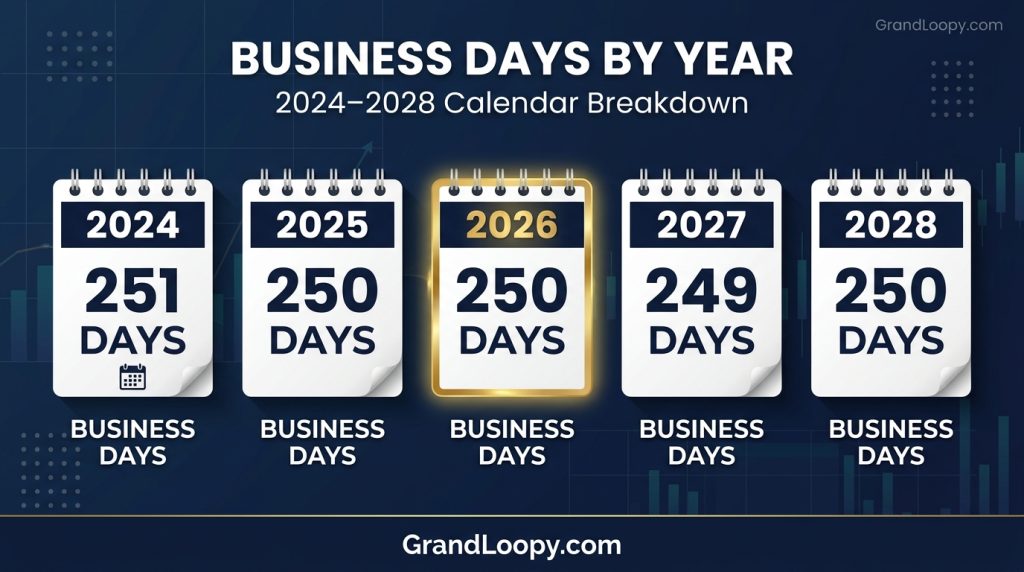
How many business days in a year has no single answer, and the honest count for the United States is 250 in 2026. The year before it held 250 as well, and the year after it holds 249.
The number moves because the calendar moves. A year is 52 full weeks plus one or two extra days, and where those days land decides whether weekdays total 260, 261 or 262.
Holidays move the count a second time. Eleven federal holidays subtract from the weekdays, and weekend holidays still subtract, because the federal rule observes them on the nearest weekday instead.
The holiday list and its observance rule come from one authority: the Office of Personnel Management federal holidays page publishes the schedule and the rule that a Saturday holiday is observed on Friday and a Sunday holiday on Monday.
A third layer hides inside the word itself. Business day can mean weekdays only, federal days, banking days, trading days or the days one employee actually works, and each meaning gives a different total.
This page prints every count with its label attached. The year table comes first, the five step method beside it, then the definitions, the three calendars, and the month and quarter tables planners actually use.
The Short Answer: 250 in 2026, and the Years Around It
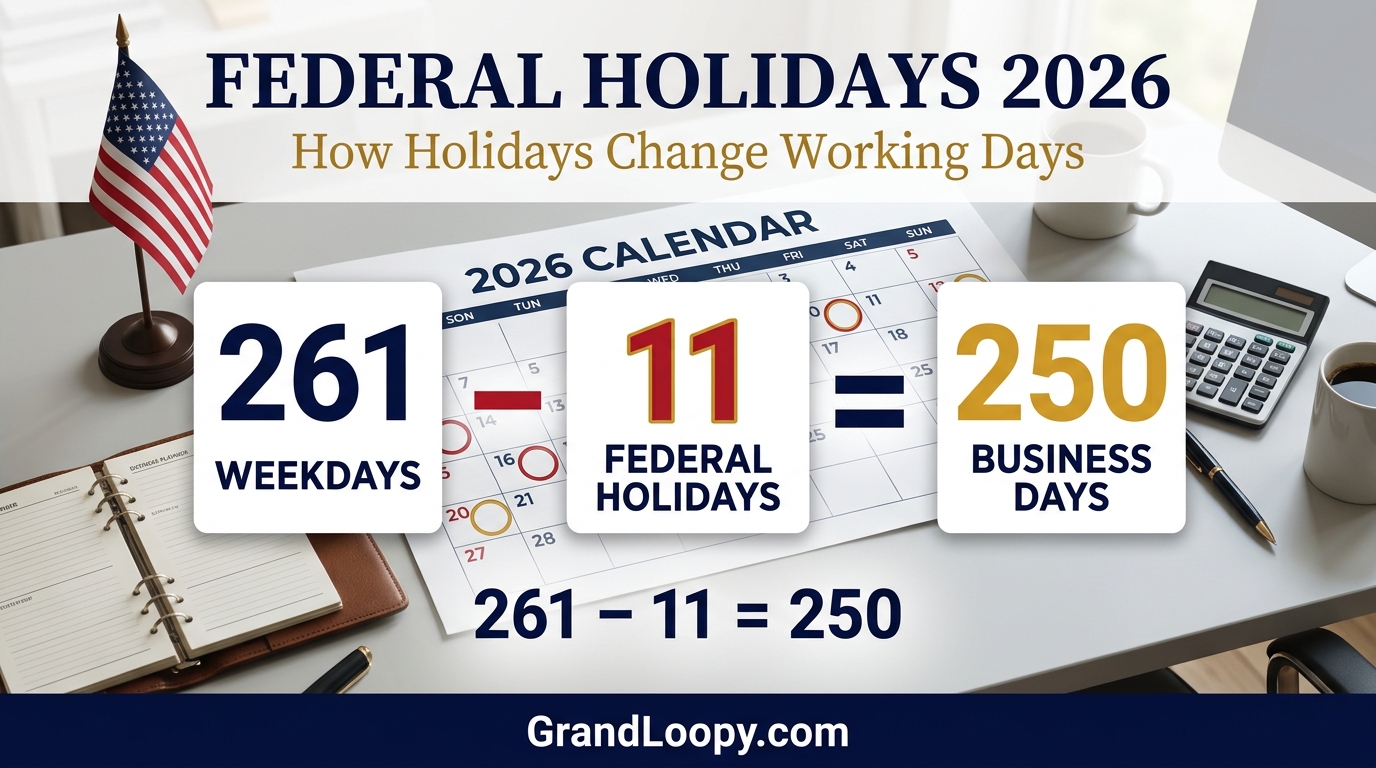
For 2026, the federal count is 250 business days. The year holds 261 weekdays, and all 11 federal holidays are observed on weekdays inside it, so the subtraction is 261 minus 11.
The five year window runs 249 to 251. Leap year 2024 holds 251, the highest count here, while 2027 holds 249, the lowest, and 2025, 2026 and 2028 each hold 250 for different reasons.
Weekdays alone run higher than most headlines admit. The familiar 260 figure is only the floor set by 52 full weeks, and the real weekday range across these five years is 260 to 262.
Two independent calculators publish this same table: the CalculatorEver business days calculator and the DigitalCalculators business days calculator both reach 251, 250, 250, 249 and 250 by the same federal rule, which makes the table corroborated, not just computed.
Use the row for your year, never the range. A payroll budget, a contract window or a project plan built on the wrong row starts one or two days off before any work begins.
|
Year |
Total days |
Weekend days |
Weekdays |
Observed federal holidays |
Business days |
|---|---|---|---|---|---|
|
2024 |
366 |
104 |
262 |
11 |
251 |
|
2025 |
365 |
104 |
261 |
11 |
250 |
|
2026 |
365 |
104 |
261 |
11 |
250 |
|
2027 |
365 |
104 |
261 |
12 |
249 |
|
2028 |
366 |
106 |
260 |
10 |
250 |
Read the table as a method result, not a trivia answer. Every column is a step in the count, and the next section walks those steps so any reader can rerun them on 2029 alone.
The Five Step Method Anyone Can Rerun
The count takes five steps and no special tool. Each step removes one layer, and the worked figures below use 2026, the year most readers are planning against right now.
Step 1: Count the Days in the Year
A common year holds 365 days and a leap year holds 366. The year 2026 is a common year, so the count starts at 365 before anything is removed from it.
Step 2: Remove the Weekends
Saturdays and Sundays leave the weekdays. The year 2026 holds 104 weekend days, which leaves 261 weekdays, and this weekday figure is where the quick 260 style answers stop too early.
Step 3: Build the Federal Holiday List
The federal list holds 11 holidays. They run from New Year’s Day through Christmas Day, including Juneteenth, the newest entry, which joined the list in 2021 and still catches older counts off guard.
The full dated schedule sits with the authority: the Office of Personnel Management federal holidays page lists each holiday with its observed date for the year, which is the version a count should copy, not a memory of last year’s dates.
Step 4: Apply the Observance Rule
A weekend holiday is observed on the nearest weekday. A Saturday holiday moves to the preceding Friday and a Sunday holiday to the following Monday, under the federal statute that governs pay and leave.
The rule crosses year boundaries once in this window. When January 1 falls on a Saturday, its observance lands on the previous December 31, which is how 2027 loses a twelfth weekday below.
Step 5: Subtract and Label the Result
Subtract the observed holidays from the weekdays. For 2026 that is 261 minus 11, giving 250, and the label matters as much as the arithmetic: these are federal business days, one definition among five.
State the label wherever the number travels. A figure copied into a contract, a payroll sheet or a client email should carry its year and its calendar with it, or it invites a one day dispute later.
Why the Count Moves: Two Anomaly Years
Most years differ by a day, and two years in this window explain the whole system. The year 2027 shows how a year loses an extra day, and 2028 shows how a leap year can hold the fewest weekdays.
2027: The Year That Loses Twelve Weekdays
The year 2027 holds the same 261 weekdays as 2026, yet finishes one day lower. Three fixed date holidays fall on weekends that year, and each one is still observed on a weekday inside it.
The twelfth subtraction arrives from the next year. New Year’s Day 2028 falls on a Saturday, so its observance pulls back to Friday, December 31, 2027, and the last weekday of 2027 becomes a holiday.
Twelve is the most a year can lose under the current holiday set. No planning table that copies 2026 forward survives 2027 intact, which is why the year table prints each year separately instead of repeating one.
2028: A Leap Year With the Fewest Weekdays
Leap year 2028 starts on a Saturday, and that start day decides everything. Its two extra days are Saturday and Sunday, so they add no weekdays at all and the year stays at the 260 floor.
Its holiday subtraction is also the smallest here. The 2028 New Year observance was already spent in 2027, so only 10 holidays subtract inside 2028, and 260 minus 10 lands back on 250.
A leap day adds a business day only when it lands on a weekday. February 29, 2028 is a Tuesday and counts, but a leap day can fall on a weekend, and 2032 proves it with a Sunday leap day.
The Definition Ladder: Five Counts, One Name
Business day is five different counts wearing one name. Pages that print one number without its definition are answering different questions, and the ladder below separates the rungs so each total stays honest.
|
Definition |
2026 count |
Who counts this way |
|---|---|---|
|
Weekdays only |
261 |
Quick answers and the 2,080 hour convention |
|
Federal business days |
250 |
Payroll, contracts and federal business |
|
Banking days |
251 operating weekdays |
Payments, transfers and settlement |
|
Trading days |
251 full sessions, plus 2 early closes |
Stock market planning and settlement |
|
Actual worked days |
225 to 235 after vacation bands |
Capacity and billable day planning |
Weekdays Only: 261 in 2026
The weekdays only count ignores holidays entirely. It is the right base for the method and the wrong answer for planning, because no workplace treats all 261 of those days as available working time.
Federal Business Days: 250 in 2026
The federal count is the default planning number. It subtracts the 11 federal holidays as observed, and most payroll, contract and service level language that names business days is silently using this calendar.
Private employers are not bound to close on federal holidays. A company can work some of them, which is why the rung below the federal one, the company rung, is where individual schedules are really set.
Banking Days: The Federal Reserve Calendar
A banking day is a day the Federal Reserve operates. Payments settle, transfers clear and deposit promises count on this calendar, which matches the federal list on most dates and breaks from it on one rule.
The Saturday rule is the break: the Federal Reserve K.8 holiday schedule states that for Saturday holidays the Reserve Banks stay open the preceding Friday, and only the Board of Governors closes that day.
Friday, July 3, 2026 is the named example. Federal offices closed for the observed Independence Day, while Reserve Banks operated and payments settled, so a transfer timed that week followed the banking count, not the federal one.
The Fed fully closes on 10 weekdays in 2026 and 9 in 2027. That is one fewer than the federal count each year, and a regional republication sits at: the Federal Reserve Bank of Chicago calendars page.
Trading Days: The Market Calendar
A trading day is a weekday the exchanges stay open. The market sets its own holiday list, and it disagrees with the federal calendar in both directions inside a single year.
The 2026 exchange schedule is laid out by: the Motley Fool stock market holidays guide, which lists the closures and the two early closes at 1 p.m. Eastern, the day after Thanksgiving and Christmas Eve.
The session total for 2026 is 251 full days: the Quadcode trading days count reaches the same figure from the exchange calendar, counting 261 weekdays minus 10 closures, a total the next section unpacks date by date.
Actual Worked Days: The Cascade After Holidays and Vacation
The last rung is personal, and it is the one capacity planning needs. Start from the federal count for the year, then remove what the employer and the employee each take away from it.
Company holidays come out first. A firm that closes the day after Thanksgiving or a full Christmas week removes days the federal calendar counts as business days, and its internal total drops below 250.
Vacation bands set the realistic range. From 250 in 2026, 15 vacation days leave 235 worked days, 20 leave 230 and 25 leave 225, each figure before sick time removes anything further.
Sick days and appointments trim the edges last. No table can print this rung exactly for a reader, but the cascade gives the honest planning band: most full time schedules land in the 220s and 230s, not at 250.
Three Calendars, Three Counts in 2026
The federal, banking and market calendars remove different days from the same 261 weekdays. They agree on the total by coincidence in 2026 and disagree on the dates, which is where real deadlines succeed or fail.
|
Calendar |
Weekday closures in 2026 |
Working days |
|---|---|---|
|
Federal business days |
11 |
250 |
|
Federal Reserve operating days |
10 |
251 |
|
NYSE and Nasdaq trading days |
10 |
251 full sessions |
Good Friday splits the calendars in spring. Friday, April 3, 2026 is a working day for federal offices and banks, because it is not a federal holiday, while the exchanges close and no trade can settle that day.
Columbus Day and Veterans Day split them in the other direction. Both are federal holidays, so the Federal Reserve closes and payments do not settle, while the exchanges stay open and trading runs as normal.
Bond markets follow a fourth schedule again: the AARP stock market holidays summary notes that bond markets close on Columbus Day and Veterans Day as well as Good Friday, so one October Monday can be a trading day and a non banking day at once.
December 31, 2027 is the sharpest single date in the window. It is a federal holiday under the pulled back observance, and a trading day at the same time, because the exchanges stay open on the Friday before a Saturday New Year.
Plan each deadline on its own calendar. A payment, a trade and a filing due the same week can run on three different counts, and naming the calendar beside the date is the whole fix.
Business Days by Month and by Quarter
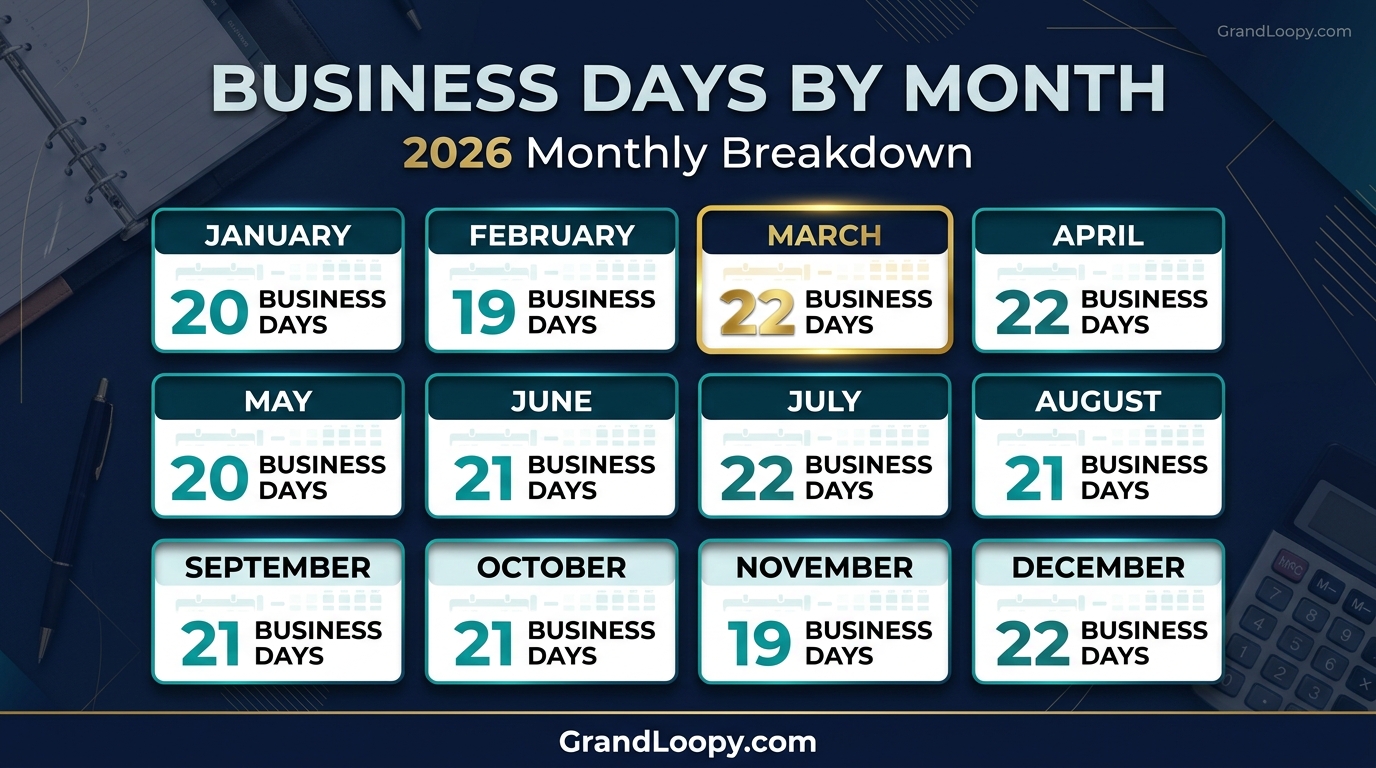
Annual totals hide the months planners actually staff. November runs short every year, March runs long in this window, and a project scheduled against the monthly average misprices both ends of the year.
|
Month |
2025 |
2026 |
2027 |
|---|---|---|---|
|
January |
21 |
20 |
19 |
|
February |
19 |
19 |
19 |
|
March |
21 |
22 |
23 |
|
April |
22 |
22 |
22 |
|
May |
21 |
20 |
20 |
|
June |
20 |
21 |
21 |
|
July |
22 |
22 |
21 |
|
August |
21 |
21 |
22 |
|
September |
21 |
21 |
21 |
|
October |
22 |
21 |
20 |
|
November |
18 |
19 |
20 |
|
December |
22 |
22 |
21 |
|
Year total |
250 |
250 |
249 |
November 2025 is the lightest month in the window, at 18. It pairs a 30 day frame with Veterans Day and Thanksgiving, and December deadlines that ignore that dip arrive with less working time than planned.
March 2027 is the heaviest month, at 23. March carries no federal holiday, and in 2027 its 31 days arrange into 23 weekdays, which makes it the natural month for work that needs long uninterrupted runs.
Quarters stay steadier than months. The first quarter holds 61 business days in each of 2025, 2026 and 2027, the second holds 63, the third holds 64, and the fourth holds 62, 62 and then 61.
|
Quarter |
2025 |
2026 |
2027 |
|---|---|---|---|
|
Q1 |
61 |
61 |
61 |
|
Q2 |
63 |
63 |
63 |
|
Q3 |
64 |
64 |
64 |
|
Q4 |
62 |
62 |
61 |
The monthly average is a labelled convenience, not a plan. Business days per month average about 20.8 in 2025 and 2026 and about 20.75 in 2027, and the table above exists because real months swing from 18 to 23 around it.
Work Hours: What the 2,080 Figure Really Counts
The famous 2,080 work hours is a convention, not a count of any real year. It is 52 weeks times 40 hours, which equals 260 weekdays at eight hours, and 260 is the floor, not the figure for 2025, 2026 or 2027.
|
Count basis |
Days |
Hours at 8 per day |
|---|---|---|
|
Weekdays, 2024 |
262 |
2,096 |
|
Weekdays, 2025 to 2027 |
261 |
2,088 |
|
Weekdays, 2028 |
260 |
2,080 |
|
Business days, 2024 |
251 |
2,008 |
|
Business days, 2025, 2026, 2028 |
250 |
2,000 |
|
Business days, 2027 |
249 |
1,992 |
The federal business year is a rounder number than the convention. At 250 business days and eight hours, 2025, 2026 and 2028 each hold exactly 2,000 business hours, and 2027 holds 1,992, which salary and capacity math can use directly.
Salary conversions should name their basis. An annual salary divided by 2,080 gives the conventional hourly rate, while dividing by the year’s real business hours gives the planning rate, and confusing the two understates daily costs.
Payroll planning starts with the calendar, then the business setup. Owners setting up pay cycles for a new company can pair these tables with: the guide to starting a small business, which covers the registration and setup steps around the count.
Pay periods follow their own arithmetic. A year holds 26 biweekly pay periods in most years and 27 in some, 24 semi monthly periods and 12 monthly ones, and none of those counts is the business day count itself.
Counting Deadlines: Worked Examples
Most readers meet business days inside a deadline, not a table. A refund promise, a filing window or a delivery estimate counts forward from a start date, and two conventions decide where the count lands.
The start day usually does not count. Most contract readings and calculators exclude the start date and count from the next business day, while some tools let the user include it, and that one choice moves every result by a day.
Worked example one: ten business days from a Saturday start. Ten business days after Saturday, November 21, 2026 lands on Monday, December 7, 2026 under the federal calendar, the same landing date: the Cash Fundamentals business days calculator reaches in its own worked examples.
Worked example two: a window crossing Christmas. Ten business days counted from Monday, December 21, 2026 crosses Christmas Day and New Year’s Day, so it lands in the second week of January rather than inside two neat calendar weeks.
Worked example three: the three to five day promise. A transfer promised in 3 to 5 business days counts on the Federal Reserve calendar, so it can include a Friday that federal offices close and exclude Columbus Day entirely.
State the convention beside every computed date. Writing the calendar, the start rule and the holiday list next to a deadline date costs one line and prevents the most common dispute this topic produces.
The Spreadsheet Method: NETWORKDAYS and WORKDAY
A spreadsheet reruns the whole method in two functions. Both skip Saturdays and Sundays on their own, and both take a holiday range as their third input, which is where the calendar choice enters the formula.
NETWORKDAYS counts the business days between two dates. Give it the start date, the end date and a range listing the holidays for the years involved, observed dates included, and it returns the federal count for that span.
WORKDAY adds or subtracts business days from a date. Give it a start date, a number of days and the same holiday range, and it walks forward or backward across weekends and holidays to the landing date.
The holiday list you feed decides the calendar you get. A federal list returns the federal count, a company list returns the company count, and a list missing the observed Friday dates returns a count that is quietly one day high.
Keep the formula and the table in agreement. If a spreadsheet result disagrees with the year table, the holiday range is the first suspect, because the functions themselves only apply what the list contains.
Build the holiday range once and reuse it. One column of observed federal holidays per year, extended each autumn when the next schedule publishes, keeps every formula on the page’s method instead of on memory.
Mistakes That Produce the Wrong Number
The errors in this field repeat, and each one is avoidable. The list below names the failure, the wrong figure it produces, and the check that catches it before the number reaches a plan or a contract.
- Using an average as an exact count. A single figure printed for every year misses 2024 by one day and 2027 by one day in the other direction, so check the year row before using any total.
- Subtracting only some holidays. A count that removes four holidays instead of 11 lands several days high, and every figure derived from it, monthly averages and hours included, inherits the same error.
- Assuming a leap year always adds a business day. The extra day counts only when it lands on a weekday, and leap 2028 holds fewer weekdays than the common years around it, so check the start day first.
- Mixing calendars without a label. Subtracting Good Friday from a federal count, or counting Columbus Day as a market closure, blends two calendars into a number that matches neither, so name the calendar beside the count.
- Copying last year’s table forward. Holiday observance shifts every year, and 2027 loses a day that 2026 keeps, so a reused table is a stale table even when its format still looks current.
- Counting the start day twice. Including the start date and then counting forward the full window adds a phantom day, so write the start rule beside the result wherever the deadline matters.
- Forgetting the pulled back observance. A Saturday January 1 spends its holiday in the previous December, and a count that only looks inside one calendar year misses that subtraction entirely.
Business Days Beyond the United States
Other countries answer this question with different holiday lists, and their totals move by ten days or more. The United States spine of this page does not travel, because the holiday subtraction is national by definition.
Treat foreign figures as their own sources’ figures. One calculator’s country table puts England and Wales at 253 business days in 2026, higher than the United States on a shorter holiday list, and such figures print as that source’s output, not as verified counts here.
The method, unlike the number, does travel. Days, minus weekends, minus that country’s public holidays as observed, reruns anywhere, and a reader working across borders should run it separately for each country’s calendar.
Frequently Asked Questions
1. How many business days are in a year?
The exact federal count runs 249 to 251 in the current window. It is 251 in 2024, 250 in 2025, 250 in 2026, 249 in 2027 and 250 in 2028, counting weekdays minus observed federal holidays.
2. How many business days are in 2026?
2026 holds 250 federal business days. The year has 261 weekdays, and all 11 federal holidays are observed on weekdays inside it, including Independence Day on Friday, July 3.
3. How many business days were in 2025?
2025 holds 250 federal business days. It has 261 weekdays and 11 observed federal holidays, and the subtraction lands on the same total as 2026 by a different route.
4. How many business days are in 2027?
2027 holds 249, the lowest count in the window. It has 261 weekdays but loses 12 to observed holidays, because the 2028 New Year observance pulls back to December 31, 2027.
5. How many business days are in 2024?
2024 holds 251, the highest count in the window. The leap year starts on a Monday, so both extra days are weekdays, giving 262 weekdays minus 11 observed holidays.
6. How many business days are in 2028?
2028 holds 250 federal business days. The leap year starts on a Saturday, so it has only 260 weekdays, and only 10 holidays subtract because its New Year observance fell in 2027.
7. How many weekdays are in a year?
A year holds between 260 and 262 weekdays. Fifty-two full weeks give 260, and the extra day or two takes the weekday of January 1, and of January 2 in a leap year.
8. Why does the number of business days change every year?
Three moving parts set the count each year. The start weekday fixes the extra days, leap placement moves one day, and weekend holidays still observe on weekdays under the federal rule.
9. What is a business day?
A business day is a weekday that is not a holiday on the calendar doing the counting. Weekdays only, federal days, banking days, trading days and worked days are five different counts.
10. Is Saturday a business day?
Saturday is not a business day under the standard federal, banking and market calendars. Some carriers and employers define their own operating days, so a promise should be read against its own calendar.
11. Is a federal holiday a business day?
An observed federal holiday is not a federal business day. Private employers may still work it, banks follow the Federal Reserve calendar, and the stock market stays open on two of them.
12. How many federal holidays are there in the United States?
The United States has 11 federal holidays. They run from New Year’s Day to Christmas Day, and Inauguration Day adds a twelfth only for federal employees in the Washington area.
13. What are the 11 federal holidays?
The 11 run from New Year’s Day through Christmas Day. The list adds the King holiday, Washington’s Birthday, Memorial Day, Juneteenth, Independence Day, Labor Day, Columbus Day, Veterans Day and Thanksgiving.
14. How do you calculate business days in a year?
Count in five steps. Total the days, remove weekends for weekdays, build the 11 federal holidays, apply the weekend observance rule, then subtract the holidays observed on weekdays inside the year.
15. What is the formula for business days?
Business days equal total days minus weekend days minus observed federal holidays. For 2026 the arithmetic is 365 minus 104 minus 11, which gives 250, and spreadsheets automate the same steps.
16. How many business days are in a month?
A month holds 18 to 23 business days in the 2025 to 2027 window. The average sits near 20.8, but planning against the average fails in short months like November.
17. Which month has the fewest business days?
November 2025 has the fewest, at 18 business days. November pairs a 30 day frame with Veterans Day and Thanksgiving, which makes it the lightest planning month in most years.
18. Which month has the most business days?
March 2027 has the most, at 23 business days. March carries no federal holiday, and in 2027 its 31 days arrange into 23 weekdays with nothing subtracted from them.
19. How many business days are in a quarter?
A quarter holds 61 to 64 business days in the current window. The first quarter holds 61 in each of 2025, 2026 and 2027, while the third quarter holds 64 in all three.
20. How many business days are in a leap year?
A leap year holds 250 or 251 business days in this window. Leap 2024 holds 251 because it starts on a Monday, while leap 2028 holds 250 because it starts on a Saturday.
21. Does a leap year always have more business days?
No, a leap year can hold fewer business days than a common year. Leap 2028 has 260 weekdays, fewer than the 261 in 2025, 2026 and 2027, because its extra days fall on the weekend.
22. Why does 2027 have fewer business days than 2026?
2027 loses one more weekday than 2026 does. Three fixed date holidays fall on weekends and still observe on weekdays, and the 2028 New Year observance lands on December 31, 2027.
23. Why does 2028 have only 260 weekdays?
2028 starts on a Saturday, which caps its weekdays at the floor. Its two extra days are Saturday and Sunday, so they add no weekdays and the year stays at 260.
24. What happens when a federal holiday falls on a weekend?
A weekend holiday is observed on the nearest weekday. A Saturday holiday moves to the preceding Friday and a Sunday holiday to the following Monday, and that observed weekday is what subtracts.
25. Why was July 3, 2026 a federal holiday?
July 3, 2026 was a federal holiday because July 4 falls on a Saturday that year. The observance rule moves a Saturday holiday to the preceding Friday for federal pay and leave.
26. Why does 2027 lose December 31 as a business day?
December 31, 2027 is spent because January 1, 2028 falls on a Saturday. Its observance moves back to the last Friday of 2027, which is also why 2028 subtracts only 10 holidays.
27. How many work hours are in a year?
The federal business year holds exactly 2,000 work hours in 2025, 2026 and 2028. That is 250 business days at eight hours, while 261 weekdays at eight hours gives 2,088 hours.
28. Where does the 2,080 work hours figure come from?
The 2,080 figure is 52 weeks times 40 hours. It equals 260 weekdays at eight hours, the floor count, and no federal business year in the current window actually holds 260 days.
29. How many working days does the average employee actually work after PTO?
Start at 250 and subtract what the employer and employee remove. From the 2026 federal count, 15 vacation days leave 235 worked days, 20 leave 230 and 25 leave 225, before sick time.
30. How long is 10 business days in calendar days?
Ten business days usually spans two calendar weeks. It covers 14 calendar days in a clean run, and longer when a federal holiday falls inside the window, especially near Christmas and New Year.
31. How long are 20 business days?
Twenty business days spans about four calendar weeks. That is 28 calendar days across four weekends in a clean run, and more whenever federal holidays land inside the span.
32. What does within 3 to 5 business days actually mean?
It is a processing promise counted on the promiser’s own calendar. The window counts weekdays that are not holidays on that calendar, usually starting the next business day, so the named calendar decides the arrival date.
33. Do business days count the day you start?
Most conventions exclude the start day and count from the next business day. Some calculators expose an include or exclude toggle, and a governing contract’s wording decides when the deadline matters.
34. How do I add business days to a date?
Move forward one calendar day at a time, counting only weekdays that are not observed holidays. In a spreadsheet, the WORKDAY function with a holiday range performs the same walk automatically.
35. How do I count business days between two dates?
Count the weekdays inside the span, then remove observed federal holidays that land on them. The NETWORKDAYS function does both steps given the two dates and a holiday range, under your stated convention.
36. How do I calculate business days in Excel or Google Sheets?
Use NETWORKDAYS for counts and WORKDAY for adding days. Both skip weekends automatically, and neither knows your holidays until you supply the list, so the list you feed decides the calendar.
37. What is the difference between a business day and a banking day?
A banking day is a day the Federal Reserve operates, and its Saturday rule differs. Reserve Banks stay open the Friday before a Saturday holiday, so the Fed closes on 10 weekdays in 2026, not 11.
38. Is Good Friday a business day?
Good Friday is a business day on the federal and banking calendars, but not on the market calendar. Federal offices and banks operate on April 3, 2026, while the exchanges close.
39. How many trading days are in a year?
The exchanges hold 251 full sessions in 2026. They close on 10 weekdays, stay open on Columbus Day and Veterans Day, close on Good Friday, and add two early closes.
40. Why is the stock market open on Columbus Day but banks are closed?
Different authorities set the two calendars for different work. Columbus Day is a federal holiday, so the Federal Reserve closes and payments do not settle, while the exchanges choose to trade that day.
41. Why is the Federal Reserve open on July 3, 2026 if federal offices are closed?
The two calendars apply different Saturday rules. Federal employees observe the Saturday holiday on Friday, while the Reserve Banks stay open that Friday and only the Board of Governors closes.
42. When did Juneteenth become a federal holiday?
Juneteenth became a federal holiday in 2021, the newest of the 11. Counts built from older 10 holiday lists now understate the subtraction by one day every year.
Conclusion
How many business days in a year is a method question wearing the clothes of a single number. The federal count is 251 in 2024, 250 in 2025 and 2026, 249 in 2027 and 250 in 2028.
Rerun the five steps instead of memorizing a figure. Any year yields to the same count: its days, minus its weekends, minus its federal holidays as they are observed inside it.
Label every number you pass on. A count without its year, its calendar and its start day convention invites exactly the one day error this page exists to prevent.
Keep planning from the tables, not the averages. More business and work explainers live on the GrandLoopy home page, and owners setting up payroll can start with the guide to starting a small business.