Is Handshake AI Legit? Verdict, Pay, Risks, and the Lawsuit

Is Handshake AI legit? Yes, it is a real program run by a real company, and it pays fellows weekly through Stripe.
That verdict comes with a caution. Fellows report sudden suspensions, unpaid hours, and long waits for work, and a proposed class action now tests whether fellows were misclassified as contractors.
You will learn what Handshake AI is, how much it pays, how to join, what can go wrong, and how to tell a real offer from a fake one.
The Short Answer: Is Handshake AI Legit?
Handshake AI is legit in the sense that matters most: a real company runs it, real work exists, and most fellows get paid.
Handshake launched the program in January 2025, according to a Stripe case study, and the program page lists more than 188,000 fellows and more than 500 million dollars in payouts.
Those numbers come from Handshake itself, checked in November 2026, so treat them as the company reporting on its own program.
Stripe reports more than 15 million dollars in weekly payouts to fellows, which is independent confirmation that money moves through the program at scale.
The caution is real too. Business Insider reported in March 2026 that five contractors on OpenAI projects had their accounts suspended without warning, and four said they were not paid for hours they had logged.
Reddit complaints cluster around the same problems: sudden removals, empty work queues, and pay disputes.
A count of 1,654 Reddit discussions from June to August 2026 found 55 percent negative, 41 percent neutral, and only 4 percent positive.
None of that makes Handshake AI a scam. It makes the program unstable work, and unstable work is a different risk from fraud.
Apply if a role matches your background and you are eligible, then judge each project on its own terms before you take the work.
| Question | Short answer |
|---|---|
| Is Handshake AI legit? | Yes, it is a real program run by Handshake, the college career network. |
| Does it pay real money? | Yes, weekly through Stripe, from about 17 dollars an hour to 100 dollars or more. |
| Is it a scam? | No, but scammers impersonate it, and some fellows lose pay after sudden suspensions. |
| Is it a job? | No, fellows are 1099 independent contractors, not employees. |
| Is it worth it? | Yes for the right role, as side income, not as a stable full-time income. |
Pros and cons at a glance
| Pros | Cons |
|---|---|
| Real company with a decade of history behind it | Work is unstable and can stop at short notice |
| Weekly pay through Stripe | Sudden suspensions can cost you unpaid hours |
| High rates for credentialed experts, up to 100 dollars an hour or more | Waits of weeks to months before a first paid project |
| Flexible, remote, expert-level work | Some roles pay as little as 10 dollars an hour plus a per-task fee |
| Training and certification through the MOVE forum | A proposed class action alleges misclassification, with no ruling yet |
What Is Handshake AI? Three Different Things, One Name
The name Handshake AI causes most of the confusion about this program. Handshake uses it for three different things, and search results mix them up constantly.
First is the Handshake AI Fellowship, the paid AI-training program. Fellows write prompts, grade AI answers, and build evaluation data for frontier AI labs.
Second is Handshake hiring AI, a set of employer tools that includes Hiring Intelligence and AI applicant review. These help recruiters sort applications and find candidates.
Third is the Handshake AI data partnership, a program that pays companies to license their business records to AI labs after removing identifying details.
Nearly every searcher means the Fellowship when they ask whether Handshake AI is legit. The Fellowship leads the sections below, and the other two sit in clearly labelled sections.
One listing site gets this badly wrong. TechJockey describes Handshake AI as talent acquisition software with a price starting at 450 dollars, which is the employer hiring product, not the Fellowship.
Never use that listing as evidence about the Fellowship, its pay, or its legitimacy. The two products share a brand name and little else.
| What it is | Who it is for | What it pays |
|---|---|---|
| Handshake AI Fellowship | Students, graduates, PhDs, and credentialed experts | Hourly or per-task pay for AI-training work |
| Handshake hiring AI | Employers who recruit early-career talent | Employers pay Handshake, not the other way around |
| Handshake AI data partnership | Established companies with business records | 100,000 to 4 million dollars by scope, per Handshake |
What Is the Handshake AI Fellowship?
The Handshake AI Fellowship hires people with subject knowledge to help AI labs improve their models. Fellows are not employees, and they are not hired for a job in the usual sense.
Fellows work as 1099 independent contractors, matched to a project rather than choosing one. You sign up, verify your identity, and wait to be invited to a project.
The work itself is expert work. Fellows develop domain-specific prompts, assess AI responses, judge output quality, and correct answers with academic citations.
Subjects run from law and finance to virology and music theory, across nearly 200 areas of specialty. Handshake also sells reinforcement learning environments, benchmarks, and evaluation sets to AI labs.
Handshake manages everything in-house, from sourcing and training experts to quality control and producing data on its own annotation platform.
One rule is absolute. Handshake publishes an Original Work policy that bans pasting a chatbot answer into a task, and breaking it can end your account.
Experts will not work on content moderation or harmful, explicit material, according to Handshake own announcement. That is a stated boundary, not a guess.
What fellows actually do
Prompt writing is the core task. A fellow writes a hard, realistic question in their own field, one that tests whether the model truly understands the subject.
Grading is the second task. A fellow compares two or more AI answers to the same prompt and ranks them, explaining which is better and why.
Correction is the third task. A fellow fixes a wrong AI answer, adds the right reasoning, and cites an academic source to back it up.
Evaluation sets are the fourth task. Fellows help build the test questions that AI labs use to measure a model, before it ships.
Each task type has its own quality bar, and each project sets its own pay rate. A fellow sees the rate before any work begins.
Who the work is for
The clients are frontier AI labs, the companies building the largest language models. Handshake does not publish a client list, but Business Insider reporting confirms OpenAI projects ran through the program.
The work matters because AI labs need human experts to test models in fields where a wrong answer has real consequences.
A model that invents a legal citation or a wrong drug dose needs a human who can catch it.
That is why credentialed experts earn the highest rates. A PhD in chemistry or a licensed lawyer brings knowledge the model cannot fake.
Generalist work exists too, for people with reliable judgment rather than a credential. It pays far less, and it is the work most applicants actually get.
Who Runs Handshake AI?
Handshake runs it. The company started in 2014 as a career platform for university students, founded by Garrett Lord and two Michigan Tech computer science students.
Garrett Lord is still chief executive. The company legal name on app stores is Stryder Corp., and its headquarters are in San Francisco.
Handshake is best known as the college career network. Its own announcement says it works with 1,500 university partners in the United States and Europe, plus a network of 18 million students and alumni.
That network includes 3 million graduate-level scholars, according to the same announcement. More than 500,000 of them hold PhDs, and more than 50,000 of those PhDs are in STEM fields.
Those figures come from Handshake itself, so they are the company reporting on its own reach.
A separate tracker lists 25 million job seekers and 1,600 plus university partners, which is a different count from a different source.
Never merge those two counts into one number. They measure different things, on different dates, by different methods.
The company launched Handshake AI in January 2025, according to a Stripe case study. The official announcement followed later, published in October 2026 and updated in November 2026.
Handshake AI has its own team, its own program page, and its own research presence, including an account for its research and benchmarks.
| Fact | Detail | Source and date |
|---|---|---|
| Company founded | 2014, by Garrett Lord and two Michigan Tech students | Wikipedia company entry |
| Legal name | Stryder Corp., doing business as Handshake | Google Play developer listing |
| Headquarters | San Francisco, United States | Company listings |
| Handshake AI launched | January 2025 | Stripe case study |
| University partners | 1,500 in the US and Europe | Handshake announcement, October 2026 |
| Students and alumni | 18 million, including 3 million graduate-level scholars | Handshake announcement, October 2026 |
| PhDs in the network | More than 500,000, with 50,000 plus in STEM | Handshake announcement, October 2026 |
| Areas of specialty | Nearly 200 | Handshake announcement, October 2026 |
How big is the program?
Handshake own program page lists more than 188,000 fellows and more than 500 million dollars in payouts, checked in November 2026.
A review site reports a wider community of more than 750,000 people around the program. That is a community count, not a fellow count, so never use it as the number of fellows.
Stripe reports more than 15 million dollars in weekly payouts to fellows. That figure is independent, and it confirms the program moves serious money.
One business tracker reports nearly 1 billion dollars in annualized revenue from AI training as of April 2026, citing Dealroom. That is competitor-reported, not verified on Handshake own pages, so label it as such.
Scale figures disagree because each source counts something different, on a different date. Present them side by side, never as one merged number.
How Much Does Handshake AI Pay?
Pay is the first thing every searcher wants, and it is also the most misunderstood part of the program. There is no single rate.
The official program page advertises pay of up to 100 dollars an hour. That is a ceiling, not a promise, and most fellows never see it.
General evaluation work pays about 17 dollars an hour, according to multiple reviews checked in November 2026. That is the floor for work that needs reliable judgment rather than a credential.
Credentialed work pays about 60 dollars an hour and up, per a tracker of AI gig platforms. A degree, a license, or a publication record moves you into this band.
Specialized fields pay up to 100 dollars an hour or more. Law, medicine, and software engineering are the fields reviewers name most often.
A live role tracker found a median top rate of 80 dollars an hour across 246 open roles. That is the middle of the advertised rates, not the middle of what fellows actually earn.
Garrett Lord, the chief executive, said on a podcast that contractors average more than 100 to 125 dollars an hour, as reported by Business Insider in March 2026.
Treat that as a ceiling or an average across the highest-paid roles, never as a promise for your field. The same reporting shows generalist work at a fraction of that rate.
One first-hand reviewer earned 919 dollars and 99 cents since June 2026, on two projects. The first paid 100 dollars an hour and dropped the reviewer after about a week.
The second project paid 125 dollars an hour and added 540 dollars in incentives while the reviewer waited for the client to start. That is one person experience, not a typical outcome.
| Role type | Typical pay | Who qualifies |
|---|---|---|
| General evaluation | About 17 dollars an hour | Reliable judgment, no credential needed |
| Credentialed expert work | About 60 dollars an hour and up | Degree, license, or publication record |
| Specialized fields | Up to 100 dollars an hour or more | Law, medicine, software engineering, PhDs |
| Median advertised top rate | 80 dollars an hour across 246 open roles | Live role tracker, November 2026 |
| Chief executive claim | 100 to 125 dollars an hour average | Podcast, reported by Business Insider, March 2026 |
Hourly pay versus per-task pay
Projects pay in two ways, and the difference decides whether a role is worth taking. Hourly projects pay for time worked, while per-task projects pay for each approved task.
Hourly projects can set a maximum handling time for each task. That cap is called a time cap, and it matters more than the hourly rate.
If a task runs past the cap, your paid time stops at the cap, and you still have to finish and submit the task.
A long task can pay far less per hour than the advertised rate.
Per-task projects carry a different risk. One reviewer saw roles paying 10 dollars an hour plus 120 dollars per approved task, and the 120 dollars is lost if the task is not approved.
Always read the project terms before you accept. Check the rate, the time cap, the approval rule, and whether unpaid work is possible.
A role with a high advertised rate and a tight time cap can pay less than a role with a lower rate and no cap. The terms decide, not the headline.
| Pay model | How it works | Main risk |
|---|---|---|
| Hourly | Paid for time worked on a project | Time caps stop paid time even if the task is unfinished |
| Per-task | Paid a fee for each approved task | Fee is lost if the task is not approved |
| Hourly plus incentive | Hourly rate plus a bonus while waiting for work | Incentives stop when the project ends |
What “up to 100 dollars an hour” hides
The phrase “up to” does all the work in Handshake advertising. It describes the best-paid roles, not the typical ones.
Most applicants start in general evaluation, where the rate is far lower. The path to the high rates runs through a credential, a strong assessment, and a project that needs your exact field.
Work is also uneven. A project can start, pause, or end with short notice, and a fellow can be removed for missing quality standards.
One reviewer was dropped from a 100 dollar an hour project after about a week. The rate was real, and the work was short-lived.
Judge a role by the rate, the terms, and the likely duration together. A high rate on a one-week project is a bonus, not an income.
How and When Does Handshake AI Pay?
Handshake AI pays weekly, and the cycle is fixed. Each pay period runs from Monday at midnight to Sunday at 11:59 pm, Pacific time.
Payouts reach the pay partners by Wednesday afternoon, according to Handshake payments help article. Funds land in the fellow account within a few days after that.
Payments run through Stripe, the payment processor. Fellows enter their bank details directly into Stripe, never into a form sent by email or chat.
Onboarding and payments also run through Deel, according to contributor reports. Deel handles the contractor paperwork for some projects.
Tax details go through TaxBandits. Fellows complete a W-9 or a W-8 at sign-up, and they receive a 1099-NEC in the United States at tax time.
No tax comes out at source, because fellows are independent contractors. Setting aside money for tax is the fellow responsibility, not Handshake.
Work that breaks the platform rules is not eligible for payment, according to Handshake own payment documentation. That rule is why some fellows report unpaid hours after a suspension.
Track your hours yourself, with dates and task names, so you have a record if a dispute arises. Workers report that they cannot always see how their hours or pay were calculated.
| Step | Detail |
|---|---|
| Pay period | Monday 12:00 am to Sunday 11:59 pm, Pacific time |
| Payout timing | Reaches pay partners by Wednesday afternoon |
| Funds landing | Within a few days after the payout is sent |
| Payment processor | Stripe, with bank details entered directly into Stripe |
| Contractor paperwork | Deel for onboarding and payments on some projects |
| Tax forms | W-9 or W-8 at sign-up, 1099-NEC in the US |
| Tax withheld | None at source, fellows are independent contractors |
Check the official program page, which states the pay and the fellowship model in Handshake own words.
Handshake AI Program | Paid, Remote AI Training Work for Experts and Generalists is the page to apply from, and the only sign-up link you should trust.
Stripe own case study confirms the scale of the payouts and the weekly rhythm of the program.
Handshake AI scales to Hundreds of Millions in Payouts | Stripe describes the payment flow and the growth of the program from the processor side.
How to Join Handshake AI
Signing up is easy, and that is part of the appeal. Getting matched to a paid project is the hard part.
Start at the official program page at joinhandshake.com/ai and click Sign up now. Do not use a link from an email, a message, or a job board.
Create a Handshake account if you do not have one, then verify your phone number and confirm that you are authorized to work in the United States.
Add your expertise and a PDF resume, then accept the agreements. Handshake wants to know your field, your degree, and your credentials, because matching runs on those details.
Wait to be invited to a project. You do not choose a project, and you cannot start work until a match arrives.
Once selected, verify your identity through Persona, with a government ID and a selfie. Then set up your tax details and your Stripe payout account.
Finish the project onboarding and any assessment, then log the paid hours you work. Payouts run weekly, on the cycle described above.
Sign-up steps in order
- Go to joinhandshake.com/ai and click Sign up now.
- Create a Handshake account and verify your phone number.
- Confirm US work authorization, because the program requires it.
- Add your expertise and a PDF resume, with your field and credentials.
- Accept the agreements, including the contractor terms.
- Wait for a project invitation, which can take weeks or months.
- Verify your ID through Persona, with a government ID and a selfie.
- Set up tax details and Stripe payouts, then finish onboarding and any assessment.
Who can join?
The program is open to students, graduates, PhDs, and working professionals, not only to current students. Some reports say students are fast-tracked, but non-students join too.
You must be based in the United States and authorized to work there. The fellowship requires a US location, and working from abroad can end your account.
Contributors in India describe access as invite-only in practice, arriving through LinkedIn messages or third-party recruiters. That is a contributor report, not an official rule.
Graduate students, postdocs, researchers, and people with recent academic credentials fit the program best, because the highest-paid work needs a credential.
Generalist roles exist for people without a degree, but they pay far less, and they are the roles most applicants actually get.
What documents do you need?
A government ID and a selfie go through Persona, the identity verification provider. Handshake requires this because AI labs need confidence that the person doing the work is who they say they are.
A phone number is verified at sign-up. A PDF resume and a list of your expertise are needed for matching.
Tax details go through TaxBandits, and bank details go directly into Stripe. Never enter ID, tax, or bank details into a Google Form, a WhatsApp chat, or an email attachment.
That rule is the single best protection against the fake recruiters who copy the program. Real Handshake uses Persona, TaxBandits, and Stripe, and nothing else.
What Are the Real Risks?

The biggest risk is not fraud, it is instability. Handshake AI is real, and the work can still disappear without warning.
Removal without a clear explanation is the most reported problem in worker accounts. Contributors describe being dropped from project channels and task queues with no stated reason, then getting template replies from support.
Some removals leave completed work unpaid. An evidence review of 38 Reddit threads found 11 accounts across 3 threads reporting removal with completed work left unpaid, between June 2025 and July 2026.
Business Insider reported in March 2026 that five contractors on OpenAI projects had their accounts suspended without warning between late December and January, and four said they were not paid for that work.
One was told the decision was final, with no appeal. Those are worker accounts, not court findings, but the pattern repeats across many threads.
Handshake own rules explain how that can happen. Work found to violate platform rules is not eligible for payment, and the Original Work policy bans pasting chatbot answers into tasks.
Support can feel slow during a review. Handshake help center says reviews can take up to two weeks, and it advises against submitting multiple tickets while you wait.
Complaints by category
A tracker scored 1,654 Reddit discussions about Handshake AI posted between June 1 and August 17, 2026. By its count, 55 percent were negative, 41 percent neutral, and 4 percent positive.
Payments were the top complaint, with 362 threads. Technical issues came next with 298 threads, then empty queues with 254, and account deactivation with 248.
Those numbers come from one tracker, and Reddit skews negative, because people with a problem post more than people without one. The ranking of the complaints still tells you where the pain sits.
| Complaint category | Reddit threads, June to August 2026 |
|---|---|
| Payments | 362 |
| Technical issues | 298 |
| Empty queues | 254 |
| Account deactivation | 248 |
| Total discussions scored | 1,654, with 55 percent negative, 41 percent neutral, 4 percent positive |
The wait is the first real cost
Waits of weeks to several months before a first paid project are common, according to contributor reports. Some applicants are never matched at all.
Handshake over-onboards. It pays a large group for onboarding, then keeps fewer people than it trained for continuing work.
Heavy filtering after onboarding is the norm. An invitation does not promise ongoing work, and the chance of being offboarded is high.
Plan your rent around it and you might regret it, as one review puts it. Good side income, unstable, is the fair summary.
Pay disputes run against a record you cannot see
Contributors say they cannot verify how their hours or pay are calculated. Five accounts across four threads reported this problem in the evidence review.
That is why keeping your own record matters. Log the date, the task, and the hours for every session, and keep screenshots of your submitted work.
If a dispute arises, you will have evidence to show support, and support will have a concrete record to check.
Other risks to know
Projects can start, pause, or end with short notice. A project that pays well this month can vanish next month, with no warning.
VPN use can trip automated security checks. Trustpilot reviews describe a ban tied to a router-level VPN, and multiple reviews warn against changing IP addresses and locations.
Working from abroad can end your account, because the program requires a US location. Do not test that rule.
Using outside AI tools on a task can end your account too. Handshake Original Work policy bans pasting chatbot answers, and reviewers say enforcement is strict.
The Lawsuit: Boggs v. Stryder Corp.
A proposed class action now tests the contractor model behind the Fellowship. It is the single biggest open question about the program.
The case is Boggs v. Stryder Corp., filed in the United States District Court for the Northern District of California, case number 3:26-cv-07498-TSH.
Sean Boggs filed the complaint on July 20, 2026, and served it on July 29, 2026. The defendants are Stryder Corp., doing business as Handshake, and Handshake AI Solutions, LLC.
The complaint alleges that fellows are misclassified as independent contractors and owed unpaid wages. The claims cover minimum wage and overtime under federal law, and misclassification under California Labor Code section 2775.
Specific allegations include pay rates set unilaterally, a requirement to use the company own platform, weekly caps on billable hours, unpaid onboarding and meetings, and retaliation against workers who raised pay concerns.
One allegation puts a number on the pay: about 4 dollars per chat interaction on a first project. That figure is an allegation in the complaint, not a finding by any court.
An order on September 8, 2026 vacated Handshake response deadline while an amended complaint was pending. No answer or motion to dismiss had been filed as of late August 2026.
On October 22, 2026, the court stayed the case pending mediation before Jill Sperber, scheduled for February 4, 2027. A status report is due by February 5, 2027.
The December 24, 2026 case management conference and associated deadlines are stayed too. If mediation does not resolve the case, the plaintiff files an amended complaint within 30 days after the stay is lifted.
These are allegations, and none of the claims has been tested in court. A lawsuit does not make a company illegitimate, but it does tell you the contractor model is being tested.
The court record is public. The stay order and the docket are available through the federal court record system, and the case number above is enough to find them.
Boggs v. Stryder Corp., et al, USCOURTS-cand-3 26-cv-07498 | GovInfo lists the case details, the parties, and the October 22, 2026 stay order in the federal record.
| Date | Event |
|---|---|
| July 20, 2026 | Complaint filed in the Northern District of California |
| July 29, 2026 | Complaint served on the defendants |
| September 8, 2026 | Order vacates Handshake response deadline pending an amended complaint |
| October 22, 2026 | Court stays the case pending mediation |
| December 24, 2026 | Case management conference stayed, no hearing held |
| February 4, 2027 | Mediation scheduled before Jill Sperber |
| February 5, 2027 | Status report due to the court |
What the lawsuit means for fellows
If the case succeeds, fellows could be owed unpaid wages, and the contractor model could change. That is a possible outcome, not a prediction.
If mediation settles it, the terms may stay private, and the program may continue unchanged. Most class actions settle before a ruling.
For now, the practical effect is small. The program keeps running, fellows keep getting matched, and payouts continue weekly.
What changes is the risk picture. A fellow should know that the legal status of the work is contested, and should keep records of hours, onboarding time, and pay.
Similar cases are pending against other AI-training companies.
A case against DataAnnotation parent Surge Labs, called Cavalier, is also undecided, and a court granted preliminary approval to a 12.5 million dollar settlement over near-identical claims against Scale AI Outlier and Remotasks platforms.
That pattern shows the issue is industry-wide, not unique to Handshake. The whole AI-training contractor model is being tested in court at once.
How to Spot a Fake Handshake AI Offer
The platform is real, which is exactly why scammers copy it. A fake recruiter can borrow a trusted name and ask for the same documents a real program asks for.
Handshake publishes its own fraud guide, and it lists the fake domains scammers use. The known fake domains are joinhandhsake.com, joinhandshake-careers.com, and joinhandshake.net.
Note the spelling. The first fake domain swaps two letters in the real name, which is easy to miss at a glance.
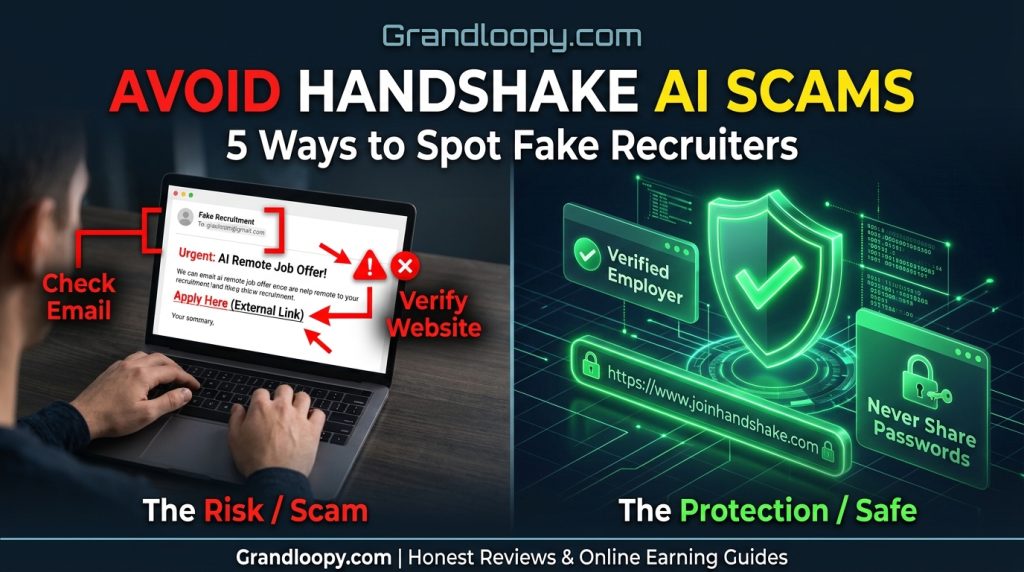
Fake recruiters use Gmail addresses posing as project leads. Real Handshake email ends in joinhandshake.com, and real recruiters write from a company account, not a personal one.
Fake recruiters send Google Forms asking for a Handshake code or password. Real Handshake never asks for a password or a code through a form.
Fake recruiters use WhatsApp. Real Handshake never uses WhatsApp to contact workers, and it texts only people who opted in.
ID, tax, and bank details go only through Persona, TaxBandits, and Stripe. Any message that asks for those details anywhere else is fake.
Job scams are growing fast. Reported losses to job scams in the United States more than tripled from 90 million dollars in 2020 to 286 million dollars in 2023, according to the Federal Trade Commission.
Task scams are growing too. The FTC received about 20,000 task scam reports in the first half of 2024, compared with about 5,000 in all of 2023.
Those figures cover all job scams, not Handshake AI specifically. They show why the fake-recruiter check matters before you share any document.
Job scammers are looking to hire you | Consumer Advice is the FTC guide to spotting a fake recruiter, and it lists the same warning signs Handshake own fraud guide lists.
| Check | Real Handshake AI | Fake recruiter |
|---|---|---|
| Email domain | Ends in joinhandshake.com | Gmail, Yahoo, or a look-alike domain |
| Contact channel | Official site and email, texts only if you opted in | WhatsApp, Telegram, or an unexpected text |
| Password or code | Never asked for through a form | Google Form asking for a code or password |
| ID and tax details | Only through Persona and TaxBandits | Asked for by email, chat, or a form |
| Bank details | Only directly into Stripe | Asked for by email, chat, or a form |
| Sign-up link | joinhandshake.com/ai, typed by you | A link inside a message |
| Upfront payment | Never asked for | Fee to join, to get work, or to get paid |
The five-minute check before you reply
Do not reply while you check. Every step below uses details you find yourself, never the links, names, or numbers the message gives you.
First, find the job on the company own site. Type joinhandshake.com yourself, go to the AI page, and look for the role. A real role is listed there.
Second, check the sender email domain against the company site. Compare the part after the at sign with the company web address, letter by letter.
Third, search the recruiter name with the words scam, review, or complaint. The FTC suggests this check, and it surfaces past reports fast.
Fourth, never enter ID, tax, or bank details anywhere except Persona, TaxBandits, and Stripe. If the message asks for them anywhere else, stop.
Fifth, report the message at ReportFraud.ftc.gov if it fails any check. Reporting helps the next person who gets the same message.
Handshake AI vs the Alternatives
Handshake AI is one of several platforms that pay people to train AI models. The rivals differ in pay, entry bar, payout speed, and removal risk.
Mercor is the closest rival for credentialed experts. It hires for similar AI-training work, and it is often named in the same breath as Handshake by applicants.
DataAnnotation is the largest rival by headcount, and it is also facing a misclassification case, called Cavalier, in San Francisco Superior Court. Its pay and its risks rhyme with Handshake.
Outlier is the best-known rival, run by Scale AI, and it is the subject of a 12.5 million dollar preliminary settlement over misclassification claims. A sibling review covers it in detail.
Is Outlier AI Legit? 2026 Review covers the rival program with the same verdict-first structure, so you can compare the two side by side.
Toloka is the established European rival, now operating through Mindrift. It pays per task, and simple tasks pay little, so the hourly rate depends on speed and accuracy.
Scale AI and Appen are the older data-labeling platforms. Both pay less than Handshake for most roles, and both have longer histories of contractor complaints.
One comparison site rated both Handshake AI and Toloka as legit, with caveats. The caveats differ, but the pattern is the same: real program, unstable work.
| Platform | Typical pay | Entry bar | Payout | Main risk |
|---|---|---|---|---|
| Handshake AI | 17 to 100 dollars an hour or more | Credential helps, generalists accepted | Weekly through Stripe | Sudden suspensions, lawsuit pending |
| Mercor | Similar expert rates | Credentialed experts preferred | Weekly | Selective matching, uneven work |
| DataAnnotation | Similar to Handshake | Assessment and qualification | Weekly | Misclassification case pending |
| Outlier | Similar expert rates | Assessment and qualification | Weekly | 12.5 million dollar settlement over misclassification |
| Toloka (Mindrift) | Per task, simple tasks pay little | Lower bar, open tasks | Twice monthly | Low pay on simple tasks |
| Scale AI | Lower than Handshake for most roles | Assessment | Varies | Contractor complaints, settlement |
| Appen | Lower than Handshake for most roles | Lower bar | Varies | Low rates, uneven work |
Which platform should you pick?
Pick Handshake AI if you have a credential in law, medicine, software, or a PhD field, and you want the highest advertised rates. The university network gives it an edge on expert matching.
Pick Mercor or DataAnnotation if Handshake has no project for your field. The three platforms draw from the same pool of AI labs, so a role on one is often a role on another.
Pick Toloka if you want open tasks with a low entry bar. The pay is lower, but you can start faster, and the work is steadier in volume.
Apply to more than one platform, because matching is the bottleneck everywhere. A fellow who waits on one platform can wait for months, while another platform matches them in weeks.
Never pay to join any of these platforms. A real AI-training platform pays you, and any fee to join, to get work, or to get paid is a scam.
The Handshake AI Data Partnership (for Companies)
The data partnership is a separate program, and it is for companies, not for fellows. If you were offered AI-training work, this section is not about you.
Handshake AI pays established companies to license their business records, such as email and accounting history, and passes them with identifying details removed to AI developers for training and testing models.
The public license page sets the bar at 20 or more full-time employees and 3 or more years in operation. Smaller or younger companies do not qualify.
Payments to date run from 100,000 to 4 million dollars by scope, according to the public pages. The license page reports 250 million dollars paid out to more than 1,000 partner companies.
Handshake team handles the transfer, and its own process removes direct and indirect identifiers before training use. Residual risk is acknowledged on the public pages.
Other buyers exist. Micro1 and Mercor advertise similar programs, and in August 2026 Google won a bankruptcy auction for Spirit Airlines de-identified corporate data, with court approval still pending as of early October.
The question for a company is not whether the offer is real, but what leaves the building and on what terms. Get anything found only in partner materials confirmed in writing before you sign.
Your company keeps ownership of its records under the license model, according to the public pages. The license is a license, not a sale.
Is Handshake AI Worth It?
Yes, for the right person and the right role. No, as a stable full-time income, and no if you need rent money on a fixed date.
The best case is a credentialed expert with a PhD, a law degree, or a medical license, matched to a project in their field.
Paid 100 dollars an hour or more, with steady work for months, it is the ideal outcome for a fellow.
The typical case is a generalist who waits weeks for a first project, works at about 17 dollars an hour, and loses the project after a few weeks.
The worst case is a fellow who logs hours, gets suspended without warning, and is not paid for that work. That outcome is rare, but it is documented.
Judge the program by the role, not by the brand.
A 125 dollar an hour project in your field is worth taking, and a 10 dollar an hour project with a per-task approval risk is not.
Read the project terms before you accept, track your hours yourself, and keep a second income while you wait for a match.
| Your situation | Verdict | Why |
|---|---|---|
| PhD or licensed professional in a high-demand field | Yes, apply | Highest rates, best matching, expert-level work |
| Graduate student with a credential and free time | Yes, apply | Good side income, builds AI industry experience |
| Generalist with no credential | Maybe, apply and see | Low pay, long waits, but no cost to apply |
| Needs stable full-time income | No, do not rely on it | Work is unstable and can stop at short notice |
| Outside the United States | No, do not apply yet | Program requires US location and work authorization |
How to make money with AI beyond Handshake
Handshake AI is one way to earn from AI, and it is not the only one. Other routes pay differently, and some are steadier.
How to Make Money With AI: 12 Real Ways That Pay in 2026 covers twelve routes, from AI training work to building and selling AI-powered products, with the pay and the entry bar for each.
Freelance AI work, prompt engineering, and AI-assisted content work all sit in the same cluster. The skill that pays best is the one you already have, applied to AI.
Running contractor work like a business helps too. A 1099 contractor is a one-person business, with tax, records, and invoicing to manage.
How to Start a Business in 10 Steps (2026 Guide) covers the basics of setting up, tracking income, and keeping records, which apply to a contractor as much as to a founder.
The work itself teaches you about AI
Grading AI answers teaches you how models fail. A fellow who reads a hundred wrong answers learns the failure patterns fast.
One failure pattern is invented sources. Models cite papers, cases, and statistics that do not exist, and a human expert is the only reliable check.
How to Stop AI Chatbots From Making Up Sources explains the problem and the checks that catch it, which is the same skill fellows use on every task.
Another pattern is inconsistent answers. The same question can get a different answer each time, for reasons that are not obvious.
Why Does ChatGPT Give Different Answers? 7 Reasons explains why models vary, and why a human grader has to judge each answer on its own merits.
A third pattern is fake media. AI images and video are getting harder to spot, and the same evaluation skill applies to them.
How to Tell If an Image Is AI-Generated: 10 Clues lists the tells that give an AI image away, from hands and text to lighting and texture.
Knowing who owns the models you grade helps too. The labs behind the models set the rules, the pay, and the quality bar.
Who Owns Claude AI? Anthropic Explained explains the ownership behind one of the models fellows are most likely to evaluate.
Frequently Asked Questions
Is Handshake AI legit?
Yes, Handshake AI is legit. It is a real program run by Handshake, the college career network, and it pays fellows weekly through Stripe.
The caution is that work is unstable, and some fellows report sudden suspensions and unpaid hours. Legit does not mean risk-free.
Is Handshake AI a scam?
No, Handshake AI is not a scam. A real company runs it, real work exists, and most fellows get paid on time.
Scammers do impersonate it, using fake domains and WhatsApp messages, so check every offer against the official site before you share documents.
Does Handshake AI actually pay?
Yes, Handshake AI pays real money through Stripe, weekly, with payouts reaching pay partners by Wednesday afternoon.
Stripe reports more than 15 million dollars in weekly payouts to fellows, which confirms money moves through the program at scale.
How much does Handshake AI pay per hour?
Pay runs from about 17 dollars an hour for general evaluation to 100 dollars an hour or more for specialized fields like law, medicine, and software engineering.
A live role tracker found a median advertised top rate of 80 dollars an hour across 246 open roles in November 2026.
What is the Handshake AI Fellowship?
The Handshake AI Fellowship is the paid AI-training program of Handshake. Fellows are 1099 independent contractors who write prompts, grade AI answers, and build evaluation data for frontier AI labs.
It is not a job board, and it is not a job in the usual sense. Fellows are matched to a project, not hired for a role.
Is Handshake AI the same as Handshake?
Handshake AI is part of Handshake, not a separate company. Handshake is the college career network founded in 2014, and Handshake AI is its AI-training arm, launched in January 2025.
The same company also runs hiring AI tools for employers and a data partnership for companies, which are different programs under the same brand.
How do I join Handshake AI?
Go to joinhandshake.com/ai and click Sign up now. Create a Handshake account, verify your phone, confirm US work authorization, and add your expertise and a PDF resume.
Then wait for a project invitation, verify your ID through Persona, set up tax details and Stripe payouts, and finish onboarding and any assessment.
Who can join Handshake AI?
Students, graduates, PhDs, and working professionals can join. The program is open to non-students too, and some reports say students are fast-tracked.
You must be based in the United States and authorized to work there. The program requires a US location.
Do I need a degree to join Handshake AI?
No, a degree is not required for general evaluation work, which pays about 17 dollars an hour and needs reliable judgment.
A degree, a license, or a publication record is needed for the credentialed work that pays 60 dollars an hour and up.
Can non-students join Handshake AI?
Yes, non-students can join. The program hires graduates, PhDs, and working professionals, not only current students.
Graduate students and postdocs fit best, because the highest-paid work needs a credential and recent academic experience.
Is Handshake AI available outside the US?
No, the Fellowship requires a US location and US work authorization. Working from abroad can end your account.
Contributors in India describe access as invite-only in practice, arriving through LinkedIn messages or third-party recruiters.
How long does it take to get a project on Handshake AI?
Waits of weeks to several months before a first paid project are common, according to contributor reports. Some applicants are never matched at all.
Handshake over-onboards, paying a large group for onboarding and keeping fewer people for continuing work.
How does Handshake AI pay?
Handshake AI pays weekly through Stripe. Each pay period runs Monday to Sunday, Pacific time, and payouts reach pay partners by Wednesday afternoon.
Funds land within a few days, and tax details go through TaxBandits, with a 1099-NEC in the United States at tax time.
Does Handshake AI pay through PayPal?
No, Handshake AI pays through Stripe, not PayPal. Bank details go directly into Stripe, never into an email, a form, or a chat message.
Any message asking for bank details anywhere except Stripe is fake, and it should be reported.
What is the minimum pay on Handshake AI?
General evaluation work pays about 17 dollars an hour, which is the floor most reviewers report. Some roles pay 10 dollars an hour plus 120 dollars per approved task.
The per-task fee is lost if the task is not approved, so the effective minimum can be lower than the advertised rate.
What does “up to 100 dollars an hour” mean?
It means the best-paid roles reach 100 dollars an hour, not that most fellows earn it. The phrase describes a ceiling, not a typical rate.
Most applicants start in general evaluation at about 17 dollars an hour, and the path to the high rates runs through a credential and a project that needs your field.
What is a time cap on Handshake AI?
A time cap is a maximum handling time that an hourly project sets for each task. If a task runs past the cap, your paid time stops at the cap.
You still have to finish and submit the task, so a long task can pay far less per hour than the advertised rate.
What happens if my Handshake AI task is not approved?
On a per-task project, the fee is lost if the task is not approved. One reviewer saw roles paying 10 dollars an hour plus 120 dollars per approved task, with the 120 dollars at risk.
On an hourly project, unpaid work can also happen if the work is found to violate platform rules, according to Handshake own payment documentation.
Why was my Handshake AI account suspended?
Handshake rarely gives a clear reason, and that is the most reported complaint. Contributors describe being dropped from project channels and task queues with no stated cause.
Known triggers include breaking the Original Work policy, using outside AI tools on a task, working from abroad, and tripping automated security checks with a VPN.
Can I appeal a Handshake AI suspension?
Handshake help center says reviews can take up to two weeks, and it advises against submitting multiple tickets while you wait.
Some workers report being told the decision was final, with no appeal. Keep your own records of hours and submitted work before you contact support.
Is there a lawsuit against Handshake AI?
Yes, a proposed class action called Boggs v. Stryder Corp. was filed on July 20, 2026, in the Northern District of California. It alleges fellows were misclassified as contractors and owed unpaid wages.
The case is stayed pending mediation, scheduled for February 4, 2027, with a status report due February 5, 2027. The claims are allegations, with no ruling.
What is Boggs v. Stryder Corp.?
Boggs v. Stryder Corp. is the case number 3:26-cv-07498-TSH, a proposed class action against Stryder Corp., doing business as Handshake, and Handshake AI Solutions, LLC.
It alleges minimum wage and overtime violations, misclassification under California Labor Code section 2775, and unpaid onboarding and meetings. Handshake has not yet answered the allegations in court.
How do I spot a fake Handshake AI recruiter?
Check the email domain first. Real Handshake email ends in joinhandshake.com, while fake recruiters use Gmail or look-alike domains.
Real Handshake never uses WhatsApp, never asks for a password or code through a form, and takes ID, tax, and bank details only through Persona, TaxBandits, and Stripe.
What are the fake Handshake AI domains?
The known fake domains are joinhandhsake.com, joinhandshake-careers.com, and joinhandshake.net, according to Handshake own fraud guide.
The first swaps two letters in the real name, which is easy to miss at a glance. Always type the address yourself instead of clicking a link.
Does Handshake AI use WhatsApp to contact workers?
No, real Handshake never uses WhatsApp to contact workers. It texts only people who opted in, and it recruits through its official site and email.
Any job offer that arrives by WhatsApp, Telegram, or an unexpected text is a warning sign, and it should be checked before you reply.
Conclusion
Is Handshake AI legit? Yes, it is a real program, run by a real company, that pays real money weekly through Stripe.
The verdict holds even after the complaints, the suspensions, and the lawsuit. None of those makes the program a scam, and all of them are documented in public reporting.
What changes the answer is what you need from it. As side income for a credentialed expert, it can pay well. As a stable full-time income, it cannot be trusted.
Apply if a role matches your background, read the project terms before you accept, track your hours yourself, and never share ID, tax, or bank details anywhere except Persona, TaxBandits, and Stripe.
Start at the official program page, typed by you, and nowhere else.
Handshake AI Program | Paid, Remote AI Training Work for Experts and Generalists is the only sign-up link you should trust, and the only place to apply from.