Is Hot Topic Fast Fashion? The Verdict, the Rating, and the Alternatives
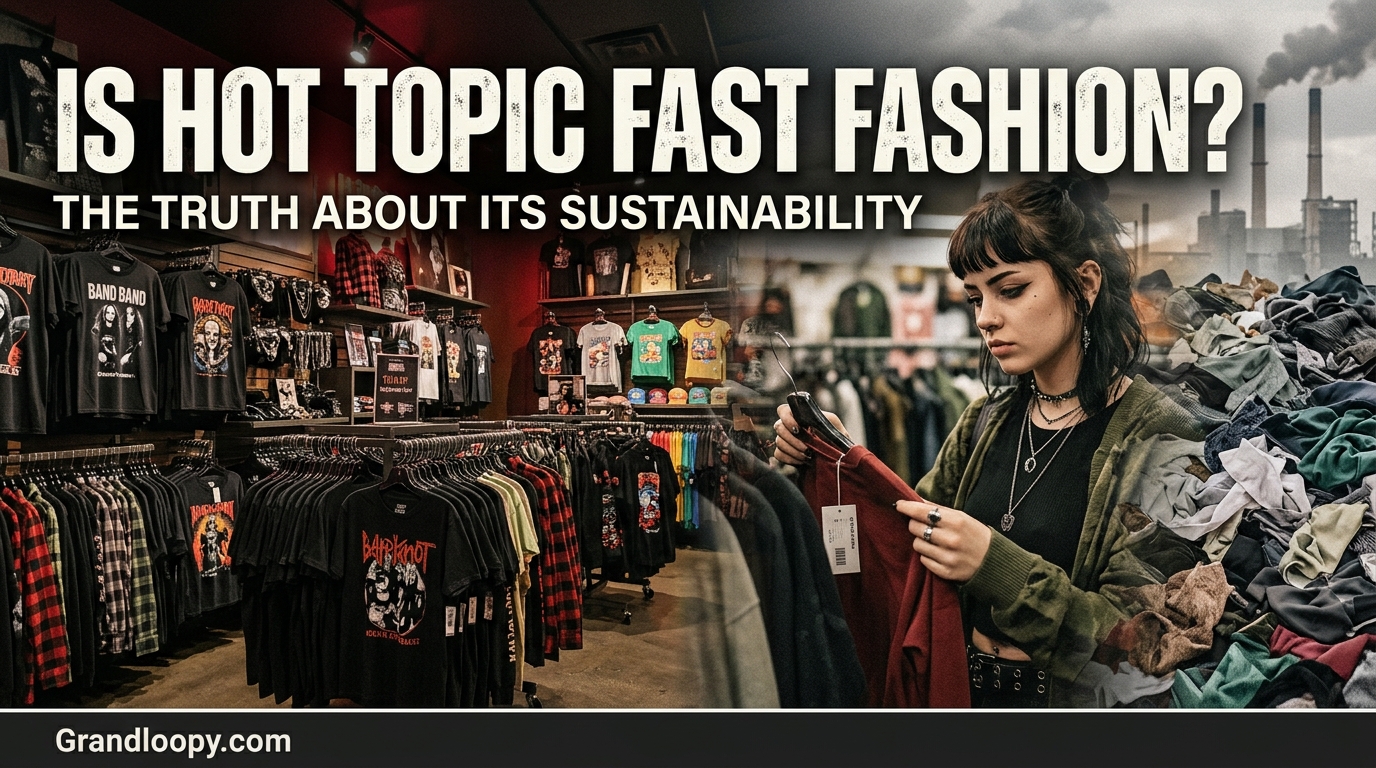
The Short Answer: Yes, Fast Fashion, but Not Ultra-Fast
Yes, Hot Topic is a fast-fashion retailer, but it is not ultra-fast fashion.
It sells cheap, trend-led, licensed pop-culture clothing with weekly drops and no restocking.
Good On You rates it “Not Good Enough”, with 1 out of 5 for Planet, 2 out of 5 for People, and 2 out of 5 for Animals.
That is the verdict in one sentence. The sections below prove it with evidence, because a verdict without evidence is just an opinion.
You will see the five fast-fashion markers checked one by one, the full Good On You rating with pillar scores, a comparison table against SHEIN, Zara, and CIDER, and a list of better-rated alternatives.
Hot Topic is the mall store that sold band tees and goth chokers to teenagers for decades, then became the place to buy anime merch, Disney shirts, and Funko Pops.
It looks different from SHEIN, and it is different in one important way: almost everything it sells is officially licensed. That difference changes the business model, but it does not change the impact.
The verdict is a grey zone, not a flat yes or no. Hot Topic is fast fashion by every standard test, and it is not ultra-fast fashion by any standard test.
The licensed-merch model makes it different from SHEIN and Zara, not better.
| Question | Short answer |
|---|---|
| Is Hot Topic fast fashion? | Yes. Cheap prices, weekly drops, no restocking, synthetic materials, and almost no sustainability reporting. |
| What is Hot Topic’s Good On You rating? | “Not Good Enough” overall, with 1 out of 5 for Planet, 2 out of 5 for People, and 2 out of 5 for Animals. |
| Is Hot Topic ultra-fast fashion? | It is not. Ultra-fast fashion means SHEIN and Temu: thousands of new items a day, app-only, prices under a dollar. Hot Topic is mall-based and licensed. |
| Who owns Hot Topic in 2026? | Spencer Spirit Holdings announced it would acquire Hot Topic from Sycamore Partners on August 7, 2026. The sale was announced, and Hot Topic keeps operating as an independent subsidiary. |
| Is Hot Topic ethical? | By the independent ratings, it is not doing enough. Good On You rates it “Not Good Enough”, and The Commons Earth rates it “Bad”. |
Why the Verdict Is a Grey Zone, Not a Flat Yes
A flat yes would be wrong, because Hot Topic is not SHEIN.
It does not add thousands of new items a day, it does not sell clothes for under a dollar, and it does not copy other designers’ work.
Almost everything it sells is officially licensed, which means the brand, the band, or the studio approved the design and gets a share of the price.
A flat no would be wrong too, because Hot Topic passes every standard fast-fashion test.
Prices are low, new products arrive almost every week, and sold-out items are not restocked.
Materials are mostly conventional cotton and synthetics, and the company publishes almost no information about its supply chain or its environmental impact.
The honest verdict sits between the two. Hot Topic is fast fashion with a licensed-merch twist.
The twist matters for shoppers who care about authenticity, and it does not matter much for the planet, because the clothes are still cheap, still disposable, and still made with little transparency.
What Is Hot Topic? History in 60 Seconds
Hot Topic is an American fast-fashion company specializing in counterculture-related clothing and accessories, plus licensed music.
The stores aim at an audience interested in alternative music, anime, and video gaming, and most of that audience ranges from teens to young adults.
The company went public and began trading on the Nasdaq in 1996.
In 2013, it announced its sale to private equity firm Sycamore Partners for $600 million, and it stopped publishing financial data after that sale.
The last published revenue figure is $741.8 million for fiscal year 2013.
Founded 1989, Montclair Plaza, Orv Madden
The first Hot Topic store opened in November 1989 in Montclair Plaza, Montclair, California, founded by Orv Madden, a former executive at The Children’s Place.
The company moved its headquarters into the store, and later to the City of Industry, California, where it is still based.
Two corrections matter here, because other pages get them wrong. One competitor says the company was founded in 1988. That is wrong.
Wikipedia and Hot Topic’s own history page both say November 1989, and the company’s own website says “Pioneering Alt Fashion Since 1989”. Another page says the founders were “brothers Jeff and Greg Greenfield”.
That is also wrong. The founder was Orv Madden, and there is no record of Greenfield brothers founding the company.
Steve Vranes has been chief executive since 2016. Betsy McLaughlin led the company from 2000 to 2011, and Lisa Harper led it from March 2011 until Vranes took over.
What It Sells: Licensed Pop Culture, Band Tees, Anime, Gaming
Hot Topic sells t-shirts, sweatshirts, jeans, dresses, shoes, and jewelry, plus accessories, collectibles, and music.
Its own website describes it as a 100 percent legit, officially licensed merchandise and clothing store, selling band tees, pop-culture collections, accessories, collectibles and toys, anime merch, and fashion apparel.
The product mix has changed with the culture. In the early 2000s, the store was known for nu-metal merchandise, gel bracelets, and phat-pants-inspired bondage pants.
It later focused on skinny jeans and merchandise related to scene, emo, and hardcore punk music, with a much larger focus on goth, spiky chokers, and clothing.
At present, the selection is largely focused on licensed video game merchandise and internet memes, plus anime, manga, Japanese films, and the associated otaku subculture.
The store also sells Disney, Star Wars, Harry Potter, Marvel, and Sanrio merchandise, plus Funko Pops and Loungefly bags. It carries several other brands too, including Iron Fist, Funko, and Her Universe.
In 2007, approximately 40 percent of Hot Topic’s revenue came from sales of licensed band T-shirts. That figure is old, but it shows how central licensing has always been to the business.
The company also sponsored music tours, including the 2004 Ozzfest, the 2005 through 2007 Sounds of the Underground tour, and the 2008 Taste of Chaos tour.
Who Owns It Now: The Spencer Spirit Acquisition
On August 7, 2026, Spencer Spirit Holdings, the owner of rival chain Spencer’s Gifts, announced that it would acquire Hot Topic from Sycamore Partners for an undisclosed amount.
Following the completion of the sale, Hot Topic will operate as an independent subsidiary, maintaining its California headquarters and retail banners.
Combined with the Spencer’s Gifts and Spirit Halloween chains, the combined company will operate over 3,000 stores across the United States and Canada.
That makes the Halloween angle newly relevant, because Spirit Halloween is the largest Halloween retailer in the country, and Hot Topic already sells Halloween costumes and horror merch.
One warning: the Good On You directory page still says “Hot Topic is owned by Sycamore Partners”. That line is stale after the August 2026 announcement.
Check the current ownership before you repeat it, because the directory page has not been updated.
The Evidence: 5 Fast-Fashion Markers, Checked
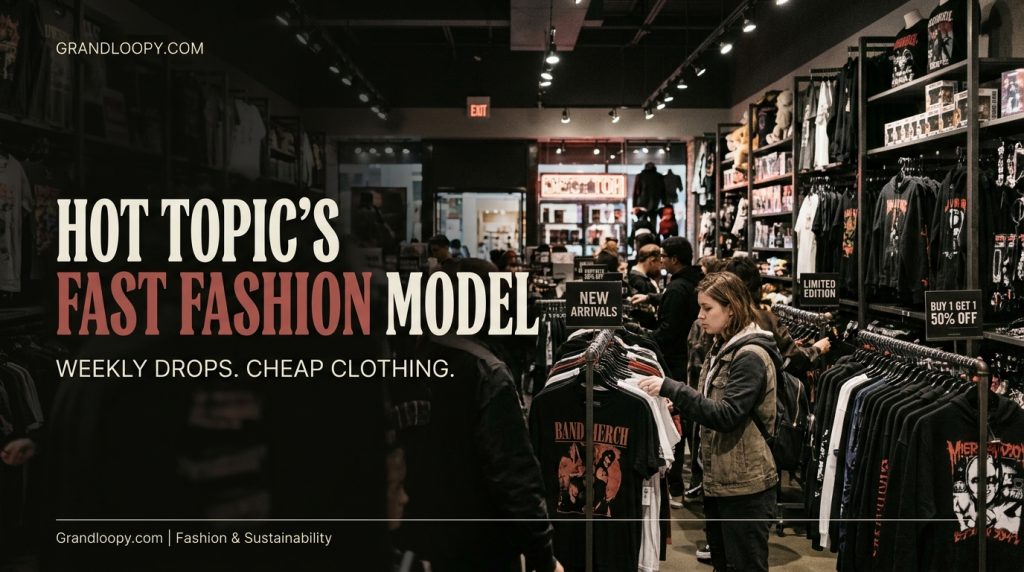
Good On You defines fast fashion as cheaply mass-producing of-the-moment items at low price points, made poorly, often using unsustainable synthetic materials like polyester.
Those items rarely last beyond a few wears and need to be replaced quickly with newer and trendier items.
Fast fashion brands also engage in frequent heavy discounting, pushy marketing tactics to pressure shoppers to buy quickly, and have thousands of items available at any one time.
Hot Topic passes all five markers. Here they are, checked one by one.
Marker 1: Cheap Prices
Hot Topic designs its clothing to appeal to young adults interested in music, pop culture, and self-expression. That lets it produce highly stylish garments that are still relatively inexpensive.
Most trendy tank tops were priced between $9.50 and $30, according to a 2023 guide.
That price range is labelled by date, because it comes from 2023, and current prices should be checked live on the Hot Topic website before they are quoted as current.
Cheap prices are the first marker of fast fashion, because low prices require low costs, and low costs come from cheap materials and cheap labor.
A $9.50 tank top cannot be made from organic cotton by a worker earning a living wage. The price itself tells you most of what you need to know about how the garment was made.
Hot Topic also runs frequent heavy discounting and promotions, including its Hot Cash program, which gives shoppers coupons to spend in a later visit.
Discounting is a fast-fashion marker, because it pressures shoppers to buy quickly and buy more than they need.
Marker 2: Weekly Drops and No Restocking
The fast-fashion industry is entirely based on the idea of filling up wardrobes with the newest fashion items regularly.
Hot Topic follows this principle and offers new products almost every week, according to a 2023 guide.
Weekly drops create a constant sense of need, because shoppers know the item they want today may be gone tomorrow.
A fast-fashion item has a short life. Hot Topic does not restock items once they are sold out. Instead, the brand refills the void with a brand new style.
That is the drop model, and it is the same model Zara uses, only slower. Zara adds new styles twice a week. Hot Topic adds them almost every week. SHEIN adds thousands a day.
The speed differs, but the model is the same.
Hot Topic also frequently collaborates with designers, artists, and celebrities to create limited-edition collections. Limited editions are a fast-fashion marker, because they create urgency and make the product feel scarce, even when it is mass-produced.
Marker 3: Synthetic Materials
Hot Topic primarily uses conventional cotton and synthetic fabrics such as polyester and acrylic for nearly all its clothing, according to a sustainable fashion guide.
The company does not provide information about the factories it collaborates with or the locations of its product manufacturing.
Polyester and acrylic are cheap, durable, and easy to produce, which is why fast-fashion brands use them.
They are also made from fossil fuels, they shed microfibres into waterways when washed, and they do not biodegrade.
Conventional cotton is also a problem, because it uses large amounts of water and pesticides, unless it is grown organically.
Good On You notes that Hot Topic appears to use wool, and that it does not appear to use fur, angora, leather, shearling, cashmere, alpaca, mohair, or down.
It uses few animal-derived materials, which is the one area where the rating is less negative. The materials problem is not about animals.
It is about synthetics and conventional cotton, and about the lack of information on what else the company uses.
Marker 4: No Sustainability Report
Hot Topic does not have a sustainability page on its website, according to a sustainable fashion guide, which shows how little it cares about the planet and its environmental impact.
As of July 2026, Hot Topic had not been shown in third-party sources to have published a public sustainability report.
Good On You rates Hot Topic “Not Good Enough” overall, and says the brand does not publish sufficient information to judge its impact properly.
The Commons Earth gives it a “Bad” rating and says its sustainability reporting is incomplete or nonexistent, while also describing it as a fast-fashion company that encourages overconsumption.
The absence of a report is itself the evidence. A brand that was reducing its impact would publish the numbers.
A brand that publishes nothing is either not measuring its impact or not willing to share the results. Either way, shoppers cannot verify any sustainability claim the brand makes, because there is nothing to check.
Marker 5: Low Transparency
Hot Topic does not provide information about the factories it collaborates with or the locations of its product manufacturing, according to a sustainable fashion guide.
Good On You says the brand discloses some supply-chain information, including that some final-stage production is located in low-risk countries or certified facilities, but that is not enough to judge its impact.
Transparency is the first step toward a more sustainable business, and Good On You only uses information that brands are prepared to make public.
Brands that continue to publish little relevant or concrete information about their supply chains receive the two lowest ratings, “We Avoid” and “Not Good Enough”. Hot Topic receives “Not Good Enough”.
The company does publish a vendor code of conduct, which sets basic rules on forced labour, harassment, discrimination, wages, health and safety, environmental compliance, and audits. That is a written standard, not proof of compliance.
Good On You also notes that Hot Topic appears to use few animal-derived materials, and that it has a code of conduct covering some International Labour Organization fundamental freedoms principles.
The code exists, but there is no public evidence of living wages, and no public audit results.
| Fast-fashion marker | Hot Topic | Verdict |
|---|---|---|
| Cheap prices | Tank tops $9.50 to $30 (2023), frequent discounts, Hot Cash program | Yes |
| Frequent drops | New products almost every week | Yes |
| No restocking | Sold-out items are not restocked, replaced with new styles | Yes |
| Synthetic materials | Mostly conventional cotton, polyester, acrylic | Yes |
| No sustainability report | No public report as of July 2026, no sustainability page | Yes |
| Low transparency | No factory disclosure, limited supply-chain information | Yes |
| Ultra-fast speed | Weekly drops, not thousands of items a day | It is not ultra-fast |
| Copycat designs | Officially licensed designs, not copies | It is not a copycat |
The Good On You Rating, Explained
Good On You is the most transparent sustainability rater for fashion, beauty, and retail.
It rates brands on key sustainability issues for people, the planet, and animals, using only information that brands are prepared to make public.
Its five tiers are Great, Good, It Is a Start, Not Good Enough, and We Avoid. Not Good Enough is the second-lowest tier.
Good On You rates Hot Topic “Not Good Enough” overall, with a very poor Planet score of 1 out of 5 and People and Animals scores of 2 out of 5 each.
The rating was checked against the Good On You directory on November 24, 2026, and it should be re-checked quarterly, because Good On You re-rates brands and this rating has already changed once.
Overall: “Not Good Enough” (Pillar Scores Table)
| Pillar | Score | What it means |
|---|---|---|
| Planet | 1 out of 5, “Very Poor” | Hot Topic does not publish sufficient information about its environmental policies, from carbon emissions and wastewater to business models and product circularity. |
| People | 2 out of 5, “Not Good Enough” | Workers’ rights are central here, from child labour to living wages and gender equality. Hot Topic does not publish enough to judge its impact. |
| Animals | 2 out of 5, “Not Good Enough” | Animal welfare policies and traceability of animal-derived products. Hot Topic uses few animal-derived materials, which limits the damage. |
| Overall | “Not Good Enough” | Based on all publicly available information Good On You has reviewed. |
Planet: “Very Poor” (1 Out of 5), Why
The Planet rating evaluates brands based on the environmental policies in their supply chains, from carbon emissions and wastewater to business models and product circularity.
Good On You rates Hot Topic “Very Poor” here, and says the brand does not publish sufficient information.
You have a right to know how the products you buy affect the issues you care about, and Hot Topic does not give you that information.
The Planet score is the worst of the three, and it is the one that most directly reflects the fast-fashion model.
Cheap synthetic materials, weekly drops, and no restocking all create waste, and the company publishes no data on how much waste it creates or what it does about it.
People: “Not Good Enough” (2 Out of 5), Why
Workers’ rights are central to the People rating, which assesses brands’ policies and practices on everything from child labour to living wages and gender equality.
Good On You rates Hot Topic “Not Good Enough” here, and notes that during the height of the Covid-19 pandemic, the company did not disclose adequate policies or safeguards.
Those safeguards would have protected workers in its supply chain from the virus.
Good On You also says there is no evidence of living wages in Hot Topic’s supply chain, and that the company’s auditing is unclear.
The vendor code of conduct covers some International Labour Organization fundamental freedoms principles, but a code is a promise, not proof. Without public audit results, shoppers cannot verify whether the code is enforced.
Animals: “Not Good Enough” (2 Out of 5), Why
Brands’ animal welfare policies and, where applicable, how well they trace their animal-derived products are the focus of the Animals rating.
Good On You rates Hot Topic “Not Good Enough” here, and notes that it appears to use wool, and that it does not appear to use fur, angora, leather, shearling, cashmere, alpaca, mohair, or down.
It uses few animal-derived materials, which is why the Animals score is higher than the Planet score. The problem is not what Hot Topic uses.
It is that the company does not publish enough information about its animal welfare policies or its traceability to earn a higher rating.
The Rating Changed: “We Avoid” in 2024, “Not Good Enough” Now
Good On You listed Hot Topic among its 10 worst-rated brands in its 2024 roundup, with a “We Avoid” rating, the lowest tier. The current directory rates it “Not Good Enough”, one tier higher.
Both ratings are presented here, labelled by date, because they conflict and must never be merged.
| Rater | Rating | Date |
|---|---|---|
| Good On You | “We Avoid” (lowest tier) | 2024 roundup |
| Good On You | “Not Good Enough” (1 out of 5 Planet, 2 out of 5 People, 2 out of 5 Animals) | November 24, 2026, directory check |
| The Commons Earth | “Bad” (1 on a 1 to 5 scale) | Checked November 24, 2026 |
| Trustpilot (United States) | 2.1 out of 5 from 450 reviews | Checked November 24, 2026 |
| Trustpilot (Australia) | 2 out of 5 from 453 reviews | Checked November 24, 2026 |
The change could mean the brand improved, or it could mean Good On You re-rated it with new information.
Good On You does not publish a detailed changelog for individual brands, so the reason is not confirmed.
What is confirmed is that the current rating is “Not Good Enough”, checked November 24, 2026, and that the 2024 rating was “We Avoid”.
Do not quote the 2024 rating as current, and do not quote the current rating as if it were always the rating.
What the Other Raters Say
Good On You is not the only rater, and the others agree with it. That matters, because a single rater can be wrong, but three raters pointing the same way is a pattern.
The Commons Earth: “Bad”
The Commons Earth rates Hot Topic “Bad” on a scale from 1 (bad) to 5 (best). Its verdict is blunt: “We avoid Hot Topic because its sustainability reporting is incomplete or nonexistent.
As a fast fashion company, Hot Topic exploits labor and natural resources while incentivizing overconsumption. To operate more sustainably, Hot Topic would have to drastically change its business model.”
The Commons Earth also gives Hot Topic low marks for Materials, Slow Consumption, and Accountability.
Its rating is harsher than Good On You’s current “Not Good Enough”, because it uses a different scale and a different methodology. Present the two ratings side by side, never merged.
Sustainability Tracker: Aggregated, Low Confidence
Sustainability Tracker aggregates Good On You, The Commons Earth, and Trustpilot in one place, and it flags its own profile as “Not verified” and “unclaimed”.
Hot Topic has not joined the tracker to verify its sustainability credentials, so the tracker gathered what it could from public sources.
It also carries a disclaimer: “Powered by Tracker AI BETA; there may be errors.”
The tracker confirms the Good On You scores (1 out of 5 Planet, 2 out of 5 People, 2 out of 5 Animals) and the Commons Earth “Bad” rating.
It also confirms the Trustpilot score (2.1 out of 5 from 450 reviews).
It also notes that Hot Topic has no verified sustainability certifications and no formal public ESG reporting in the sources it checked.
Its confidence on the absence of a sustainability report is low, because absence is hard to prove, but the available evidence points the same way.
Trustpilot: 2.1 Out of 5 (450 Reviews), What It Does and Does Not Prove
Trustpilot rates Hot Topic 2.1 out of 5 from 450 reviews on the United States profile, and 2 out of 5 from 453 reviews on the Australia profile.
Those are two different regions, so never merge them into one number.
The United States figure is 2.1 out of 5 from 450 reviews, and the Australia figure is 2 out of 5 from 453 reviews.
Trustpilot measures customer satisfaction, not sustainability. A low Trustpilot score does not prove a brand is unsustainable, and a high Trustpilot score does not prove a brand is sustainable.
What it proves is that shoppers are unhappy, and that dissatisfaction sits alongside the sustainability concerns. Treat it as a trust signal, not as a sustainability rating.
Hot Topic Versus SHEIN, Zara, and CIDER
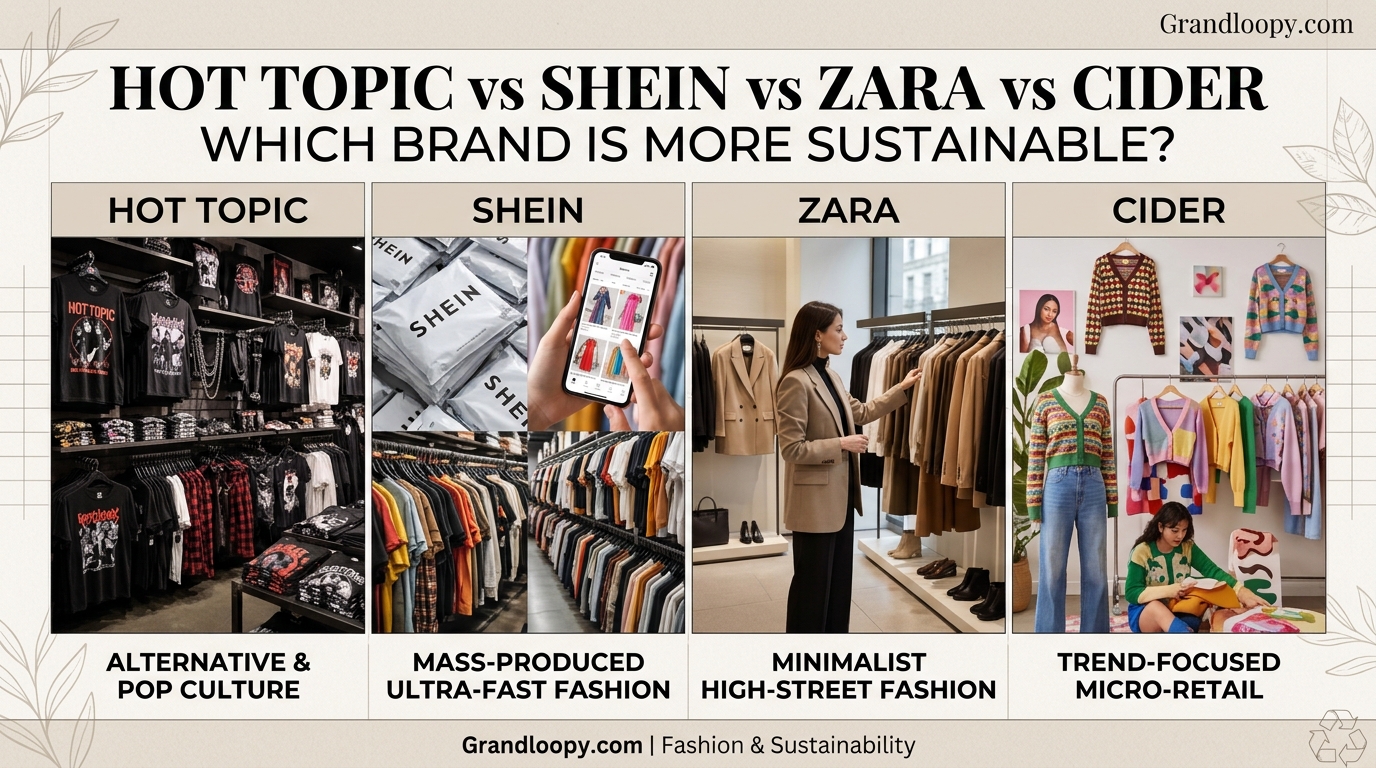
Comparison is where the verdict becomes useful, because shoppers do not choose between Hot Topic and nothing. They choose between Hot Topic and SHEIN, or Hot Topic and Zara, or Hot Topic and CIDER.
Here is the comparison, with every figure labelled by source and date.
| Factor | Hot Topic | SHEIN | Zara | CIDER |
|---|---|---|---|---|
| Good On You rating | “Not Good Enough” | “We Avoid” | “Not Good Enough” | “We Avoid” |
| Model | Licensed pop-culture merch, mall-based | Ultra-fast, app-only, copycat designs | Fast fashion, global, twice-weekly drops | Ultra-fast, online-only, social media driven |
| Speed | New products almost every week | Thousands of new items a day | New styles twice a week | New styles daily |
| Price | Tank tops $9.50 to $30 (2023) | Items under $1 in some cases | Tees around $10 to $30 | Tees around $5 to $20 |
| Licensing | 100 percent officially licensed | Mostly unlicensed, copycat designs | Own designs, some licensed | Own designs, some licensed |
| Restocking | Sold-out items not restocked | Constant new items, no restock | Limited restock, new styles replace old | No restock, new styles replace old |
| Materials | Conventional cotton, polyester, acrylic | Polyester, synthetics, toxic chemicals reported | Polyester, cotton, viscose, some recycled | Polyester, synthetics, limited disclosure |
| Transparency | No sustainability report, limited factory disclosure | Almost no public information | Publishes some supply-chain data, FTI score low | Does not communicate sufficient information |
| Stores | Over 630 across the United States and Canada | Online only, few pop-up stores | Thousands worldwide | Online only |
Read the table carefully. Hot Topic is the least bad of the four on licensing and on speed, and it is tied with Zara on the Good On You rating.
It is worse than Zara on transparency, because Zara publishes some supply-chain data and Hot Topic publishes almost none.
It is better than SHEIN and CIDER on the rating, because those two score “We Avoid”, the lowest tier.
A Zara verdict is available in the same cluster, and it gives the full Zara rating and evidence.
A CIDER verdict is also available, and it covers the same “We Avoid” rating from a different model.
An Aritzia verdict is available too, and it uses the same grey-zone framework, with a “premium fast fashion” verdict.
A Fashion Nova verdict is available as well, and Fashion Nova also scores “We Avoid” on Good On You.
What Makes Hot Topic Different From Ultra-Fast Fashion
Ultra-fast fashion is a specific thing, and Hot Topic is not it.
Ultra-fast fashion means SHEIN, Temu, and Princess Polly: thousands of new items a day, prices under a dollar, app-only shopping, copycat designs, and almost no public information about supply chains or materials.
Hot Topic does none of those things at that scale.
| Model | Speed | Price | Materials | Transparency | Examples |
|---|---|---|---|---|---|
| Fast fashion | New styles weekly | Low, $10 to $30 | Polyester, conventional cotton | Limited disclosure | Hot Topic, Zara, H and M |
| Ultra-fast fashion | Thousands of items a day | Very low, under $1 in some cases | Synthetics, toxic chemicals reported | Almost none | SHEIN, Temu, CIDER |
| Slow fashion | Seasonal collections | Higher, $50 and up | Organic, recycled, deadstock | Published supplier lists | Reformation, Kowtow, Ninety Percent |
Licensed Merch, Not Copycat Designs
Almost everything Hot Topic sells is officially licensed. The band, the studio, or the franchise approved the design and gets a share of the price.
That is the opposite of the SHEIN model, which has been accused repeatedly of copying independent designers’ work without permission or payment.
Licensing changes the business model, because Hot Topic pays for the right to use a design, which raises its costs and limits what it can copy.
It does not change the impact, because the garment is still made from cheap synthetics, still sold at a low price, and still designed to be replaced quickly.
Limited Editions and Fandom Demand, Not Microtrends
Hot Topic sells to fandoms, not to microtrends. A band tee sells because fans love the band, not because an algorithm said the design was trending this week.
An anime hoodie sells because fans love the show, not because a TikTok video made it viral for three days.
That matters for how long the garment lasts in a wardrobe. A fan keeps a band tee for years, because it means something to them.
A microtrend top gets thrown away after three wears, because the trend moved on. The fandom model is less disposable than the microtrend model, even when the garment is made the same way.
Mall-Based, Not App-Only
Hot Topic has over 630 stores across the United States and Canada, plus a website. SHEIN and CIDER are online only, with a few pop-up stores.
A mall store is slower, more expensive to run, and harder to scale than an app, which is why Hot Topic cannot match SHEIN’s speed or prices.
The mall model also means Hot Topic has employees, leases, and a physical presence in communities, which creates jobs and tax revenue that an app-only brand does not.
That is a real difference, and it is worth naming, even though it does not make the clothes sustainable.
Why Different Does Not Mean Better
Different is not the same as better.
Hot Topic is different from SHEIN in its model, its speed, and its licensing.
It scores “Not Good Enough” on Good On You, which is the same tier as Zara and only one tier above SHEIN’s “We Avoid”.
The difference is real, and it is small.
A shopper who buys a Hot Topic band tee instead of a SHEIN copy is making a better choice on licensing and on longevity.
The licensed tee is authentic, and the fan will keep it longer.
A shopper who buys ten Hot Topic tees a month is making the same choice as a SHEIN shopper, because the volume and the waste are the same. The model matters less than the behaviour.
Streetwear fashion offers a useful contrast here, because it also uses the drop model and limited editions, but it prices higher and targets a different audience.
A guide to streetwear fashion covers the history, the brands, and the drop model in detail, and it shows how the same drop mechanic can serve a premium market instead of a budget one.
| Pros | Cons |
|---|---|
| Officially licensed merch, authentic designs | Good On You rating “Not Good Enough” |
| Fandom demand, fans keep merch longer | No public sustainability report |
| Mall stores, jobs, physical presence | Cheap synthetics (polyester, acrylic, conventional cotton) |
| Cheap prices, accessible to teens | No factory disclosure, unclear auditing |
| Exclusive limited editions | 2024 data breach, 350 million customers affected |
| Wide range, band tees to anime to Disney | Trustpilot 2.1 out of 5 from 450 reviews |
Is Hot Topic Ethical? Labor, Materials, and Data
Ethics is a separate question from fast fashion, and Hot Topic has a mixed record.
The independent ratings are negative, the labor history includes a walkout, and the data record includes one of the largest retail breaches in history.
The company has also taken some steps, including a child labor pledge and a Rainforest Alliance partnership, but those steps are competitor-reported and should be labelled as such.
The 2021 Minnesota Walkout
In 2021, employees at the Hot Topic store in Rochester, Minnesota, walked out in protest of low wages and poor workplace conditions.
They said the wages were not sufficient to make their ends meet, and that they could no longer support themselves and their families.
The walkout was reported by local news and by sustainable fashion guides, and it is the most concrete labor incident in Hot Topic’s recent history.
The walkout matters because it is first-hand evidence from workers, not a rating from a third party. Workers who walk out are telling shoppers something the company’s own materials do not say.
What changed since the walkout is not confirmed in the sources checked on November 24, 2026, so do not claim the company fixed the problem.
Say what happened, when it happened, and that the outcome is not confirmed.
Critics have also accused the brand of using child labor, exploiting workers, and selling products sourced from endangered animals, according to a 2023 guide.
Those are accusations, not findings, and they should be labelled as accusations.
The guide also says the company signed a pledge to end the use of child labor in its supply chain, and partnered with the Rainforest Alliance to source sustainable materials.
Both claims are competitor-reported, and neither is verified on the company’s own website in the sources checked on November 24, 2026.
The Vendor Code of Conduct
Hot Topic publishes a vendor code of conduct that sets basic rules on forced labour, harassment, discrimination, wages, health and safety, environmental compliance, and audits.
That gives shoppers at least some written standards for suppliers, which is more than nothing, and less than proof.
Good On You notes that Hot Topic has a code of conduct covering some International Labour Organization fundamental freedoms principles, and that some final-stage production is located in low-risk countries or certified facilities.
The code exists, the facilities exist, and the auditing is unclear.
Good On You says the brand does not publish sufficient information to judge its impact, and that there is no public evidence of living wages.
A code of conduct is a promise. A public audit result is proof.
Hot Topic publishes the promise and not the proof, which is why its People score is 2 out of 5 and not higher.
Shoppers who care about labor should look for the audit results, and if they cannot find them, that absence is itself the answer.
The Rainforest Alliance Partnership and the Child Labor Pledge
A 2023 guide says Hot Topic signed a pledge to end the use of child labor in its supply chain, and partnered with the Rainforest Alliance to source sustainable materials.
Both claims are competitor-reported, and both should be labelled as such, because neither appears on the company’s own website in the sources checked on November 24, 2026.
A pledge is a commitment, not a result. A partnership is a relationship, not a certification. Neither proves that child labor has ended or that materials are sustainable.
If the company publishes details of the pledge or the partnership, those details belong in this section. Until then, present the claims as competitor-reported and move on.
The 2024 Data Breach
In 2024, Hot Topic was the subject of what cybersecurity firm Hudson Rock labeled the “largest retail data breach in history”.
The breach involved the theft of personal data belonging to 350 million customers of Hot Topic, Box Lunch, and Torrid.
The stolen data reportedly included names, emails, addresses, phone numbers, birthdates, and partial credit card numbers.
The breach came from an infostealer infection, according to Hudson Rock, and it was reported by TechRadar and other security news outlets in October 2024.
Hot Topic also suffered credential stuffing attacks that exposed customers’ personal information and partial payment data, in two waves in November, according to security news reports.
The breach matters for shoppers, because it shows the company did not protect customer data.
It also matters for the verdict, because a brand that cannot protect 350 million customers’ data is not a brand that can be trusted with supply-chain transparency.
If you shopped at Hot Topic, Box Lunch, or Torrid before October 2024, change your password, check your credit card statements, and consider a credit freeze.
The breach is a trust signal, and it belongs in any honest verdict.
Is Hot Topic Clothing Good Quality?
Quality is the question shoppers ask most after the verdict, and it is the question with the least verified data.
No independent lab has tested Hot Topic garments, and no competitor has published a first-hand quality review with a wash test.
What exists is price evidence, material evidence, and shopper reports, and all three point the same way.
What $9.50 to $30 Buys You
Most trendy tank tops were priced between $9.50 and $30 in 2023, according to a guide from that year.
That price range is labelled by date, because it comes from 2023, and current prices should be checked live on the Hot Topic website.
The homepage, checked November 24, 2026, shows no prices, because it is a landing page, not a product page.
A $9.50 tank top is made from cheap materials by cheap labor, because there is no other way to sell a garment for $9.50 and make a profit.
A $30 hoodie is made the same way, with a higher margin. The price tells you the quality ceiling, even if it does not tell you the exact quality.
Expect a garment that looks good on the first wear, fades after a few washes, and does not last as long as a garment that costs twice as much.
What Shoppers Report
Trustpilot rates Hot Topic 2.1 out of 5 from 450 reviews, and the reviews mention customer service, shipping, and quality.
Reddit threads about Hot Topic quality report shrinkage after washing, sizing inconsistency, and print fading, which are the standard complaints for cheap synthetic garments.
Those reports are shopper-reported, not lab-tested, and they should be labelled as such.
The licensed merch is the exception.
A licensed band tee is printed on the same cheap blank as an unlicensed tee, but the design is authentic, and fans keep licensed merch longer because it means something to them.
Longevity comes from attachment, not from fabric, and a fan who keeps a tee for five years has made it sustainable by wearing it, even if the fabric was not.
How Long It Lasts
There is no verified data on how long Hot Topic clothing lasts.
Good On You says fast-fashion items “rarely last beyond a few wears and need to be replaced quickly with newer and trendier items”, and Hot Topic’s materials and prices fit that description.
No competitor has published a wash test, a wear test, or a durability study for Hot Topic specifically.
Say so plainly. Do not invent a lifespan.
If a first-hand test is done for a future update, buy a band tee, wash it five times, photograph the result, and report shrinkage, fading, and seam quality.
Until then, the honest answer is that the materials and the price point predict a short life, and shopper reports agree, but no lab has confirmed it.
How Many Hot Topic Stores Are There?
Store counts conflict by source and date, so here they are, labelled by date, never merged.
| Date | Store count | Source |
|---|---|---|
| April 2020 | 675 | Wikipedia |
| 2023 | Over 850 | Ethicallyengineered (stale, do not use as current) |
| 2024 | Over 630, with 10,000+ employees and two distribution centers | Security Affairs |
| Undated, before 2026 | About 700 | Sustainably Chic |
| November 24, 2026 | Over 630 across the United States and Canada | Hot Topic official website, checked live |
The current figure is over 630 stores, from the company’s own website, checked November 24, 2026. The 850-plus figure from 2023 is stale and should not be quoted as current.
The count fell from 675 in April 2020 to over 630 in 2024 and 2026, which suggests the company closed stores.
The exact closure history is not confirmed in the sources checked on November 24, 2026.
The majority of the stores are located in regional shopping malls. The company also has stores in Canada, first opened in August 2010 in Mississauga and Toronto, and in Puerto Rico.
After the Spencer Spirit acquisition completes, the combined company will operate over 3,000 stores across the United States and Canada, including Spencer’s Gifts and Spirit Halloween.
Sister Brands: Torrid, BoxLunch, and Blackheart
Hot Topic is not one brand. It is a family of brands, and each one has its own verdict.
Wikipedia lists the divisions as Blackheart Lingerie and BoxLunch, and the history includes Torrid as a former division that branched off in 2015.
| Brand | What it sells | Relationship to Hot Topic | Fast fashion? |
|---|---|---|---|
| Torrid | Plus-size women’s clothing | Launched by Hot Topic in 2001, branched off in 2015 as Torrid, LLC | Not covered here; needs its own verdict |
| BoxLunch | Gifts and novelty items, pop culture merch | Launched by Hot Topic on October 14, 2015; for every $10 spent, a meal is donated to a person in need | Not covered here; needs its own verdict |
| Blackheart Lingerie | Lingerie and clothing for women | Launched in 2012; products now sold in Hot Topic stores under the same branding | Not covered here; needs its own verdict |
| ShockHound | Online music retailer and social network | Launched 2008, shut down March 2011; merchandise moved to HotTopic.com | Defunct |
| ThinkGeek | Geek merchandise, online retailer | Hot Topic bid $122 million in May 2015; GameStop counter-offered $140 million and won | Never acquired |
Torrid and BoxLunch are the two sister brands shoppers ask about most. Torrid is a plus-size clothing brand, and BoxLunch is a gift and novelty store with a meal-donation program.
Neither has a Good On You rating in the sources checked on November 24, 2026, and neither should be called fast fashion on the basis of Hot Topic’s rating alone.
Each brand needs its own verdict, with its own rating check, its own evidence, and its own comparison table.
Gothic fashion is the style most associated with Hot Topic, and a guide to gothic fashion covers the history, the brands, and the prices in detail.
Hot Topic sells goth clothing, but it is not a goth brand. It is a pop-culture retailer that sells goth clothing alongside anime merch, Disney shirts, and band tees.
How to Shop Hot Topic More Ethically
If you still want the merch, there are ways to buy it with less harm. None of them make Hot Topic sustainable, but all of them reduce the impact of your own purchase.
Buy secondhand first. Hot Topic band tees, anime hoodies, and Funko Pops are everywhere on Depop, Poshmark, and thrift stores, often for less than the original price.
Secondhand shopping diverts used clothing from landfills, extends its life, and costs less than new.
It is Good On You’s top suggestion, and it works especially well for licensed merch, because the design is what matters, not whether it is new.
Buy licensed merch you will keep. A band tee you wear for five years is sustainable by use, even if the fabric was not sustainable by production.
A microtrend top you wear three times is not. Choose designs that mean something to you, not designs that are trending this week.
Avoid impulse drops. Weekly drops are designed to make you buy quickly, before the item sells out. Wait 48 hours before you buy. If you still want it, buy it.
If you forgot about it, you did not need it. That one habit cuts fast-fashion waste more than any brand switch.
Check the vendor code of conduct before you buy. It is published on the Hot Topic website, and it sets basic rules on forced labour, harassment, discrimination, wages, health and safety, environmental compliance, and audits.
A code is not proof, but a brand with no code at all is worse. Read it, and ask the company for its audit results if you want more.
Wash less, wash cold, and repair. Polyester and acrylic shed microfibres into waterways when washed, so wash less often, wash in cold water, and use a microfibre filter bag.
Repair a torn seam instead of throwing the garment away. The most sustainable garment is the one you already own.
Better Alternatives to Hot Topic
Good On You lists seven brands as more sustainable alternatives to fast fashion, with a range of pricing levels.
None of them sells exactly what Hot Topic sells, because Hot Topic’s licensed pop-culture merch is hard to replace.
The alternatives below are the best available, and the table says what each one sells, so shoppers can see the trade-off.
| Brand | Good On You rating | Price level | What it sells |
|---|---|---|---|
| OMNES | Rated highly | Affordable | Responsible womenswear, sizes 6 to 20 |
| CHNGE | Rated highly | Mid-range | United States brand, 100 percent organic material, sizes 2XS to 4XL |
| Ninety Percent | Rated highly | Mid-range | British womenswear, shares 90 percent of profits, publishes supplier details |
| SeamsFriendly | Rated highly | Mid-range | Custom-made clothing for women, men, and kids, all body types and heights |
| Subset (Knickey) | Rated highly | Mid-range | Organic cotton underwear, Fairtrade certified factory, sizes 2XS to 4XL |
| Kowtow | Rated highly | Premium | New Zealand womenswear, organic fair trade cotton, non-toxic dyes, sizes XS to L |
| Reformation | Rated highly | Premium | Los Angeles womenswear, deadstock materials, sizes XS to 3XL |
For band merch specifically, buy directly from the band.
Most bands sell merch on their own websites, at concerts, and through Bandcamp, and the band gets a larger share of the price than it does from a Hot Topic sale.
For anime merch, buy from the studio or the licensor directly, or from a licensed retailer that publishes its supply-chain data.
For pop-culture merch, buy secondhand first, because the design is what matters, not whether it is new.
Frequently Asked Questions
Is Hot Topic fast fashion?
Yes. Hot Topic is a fast-fashion retailer, but it is not ultra-fast fashion. It sells cheap, trend-led, licensed pop-culture clothing with weekly drops and no restocking, and Good On You rates it “Not Good Enough”.
Is Hot Topic fast fashion or ultra-fast fashion?
Hot Topic is fast fashion, not ultra-fast fashion. Ultra-fast fashion means SHEIN and Temu: thousands of new items a day, prices under a dollar, app-only shopping.
Hot Topic adds new products almost every week, sells in malls, and licenses its designs.
Is Hot Topic an ethical brand?
By the independent ratings, it is not doing enough.
Good On You rates it “Not Good Enough”, with 1 out of 5 for Planet, 2 out of 5 for People, and 2 out of 5 for Animals. The Commons Earth rates it “Bad”.
Is Hot Topic sustainable?
It is not, by the available evidence. Hot Topic has no public sustainability report as of July 2026, no sustainability page on its website, and no factory disclosure.
Good On You says it does not publish sufficient information to judge its impact.
What is Hot Topic’s Good On You rating?
“Not Good Enough” overall, with 1 out of 5 for Planet (“Very Poor”), 2 out of 5 for People, and 2 out of 5 for Animals. The rating was checked November 24, 2026.
Why did Good On You rate Hot Topic “We Avoid” in 2024 and “Not Good Enough” now?
Good On You listed Hot Topic among its 10 worst-rated brands in 2024 with a “We Avoid” rating, the lowest tier. The current directory rates it “Not Good Enough”, one tier higher.
The reason for the change is not confirmed, because Good On You does not publish a detailed changelog for individual brands.
Who owns Hot Topic in 2026?
Spencer Spirit Holdings announced on August 7, 2026 that it would acquire Hot Topic from Sycamore Partners for an undisclosed amount.
Hot Topic will operate as an independent subsidiary, keeping its California headquarters and retail banners. The Good On You directory still says “owned by Sycamore Partners”, which is stale.
Is Hot Topic owned by Spencer’s?
It will be, once the acquisition completes. Spencer Spirit Holdings owns Spencer’s Gifts and Spirit Halloween, and it announced the Hot Topic acquisition on August 7, 2026.
The combined company will operate over 3,000 stores across the United States and Canada.
When was Hot Topic founded?
October 1989. The first store opened in November 1989 in Montclair Plaza, Montclair, California. One competitor says 1988, which is wrong. Hot Topic’s own website says “Pioneering Alt Fashion Since 1989”.
Who founded Hot Topic?
Orv Madden, a former executive at The Children’s Place. One page says “brothers Jeff and Greg Greenfield” founded it, which is wrong. There is no record of Greenfield brothers founding the company.
How many Hot Topic stores are there?
Over 630 across the United States and Canada, according to the company’s own website, checked November 24, 2026.
Older figures (675 in April 2020, about 700, over 850 in 2023) are labelled by date and should not be quoted as current.
Where is Hot Topic clothing made?
Hot Topic does not publish information about the factories it collaborates with or the locations of its product manufacturing.
Good On You says some final-stage production is located in low-risk countries or certified facilities, but that is not enough to judge its impact.
Does Hot Topic use child labor?
There is no confirmed finding of child labor in Hot Topic’s supply chain in the sources checked on November 24, 2026.
Critics have accused the brand of using child labor, and the company has signed a pledge to end the use of child labor, according to a 2023 guide.
Both claims are competitor-reported and should be labelled as such.
Does Hot Topic use sweatshops?
There is no confirmed finding of sweatshop labor in Hot Topic’s supply chain in the sources checked on November 24, 2026.
Good On You says there is no public evidence of living wages, and that the company’s auditing is unclear.
The vendor code of conduct covers forced labour, harassment, discrimination, wages, health and safety, environmental compliance, and audits.
What is Hot Topic’s vendor code of conduct?
It is a published set of rules for suppliers and factories, covering forced labour, harassment, discrimination, wages, health and safety, environmental compliance, and audits. It also covers some International Labour Organization fundamental freedoms principles.
A code is a promise, not proof, and Hot Topic publishes no public audit results.
Does Hot Topic have a sustainability report?
It does not, as far as third-party sources can show.
As of July 2026, Hot Topic had not been shown to have published a public sustainability report, and it has no sustainability page on its website, according to a sustainable fashion guide.
Is Hot Topic a B Corp?
It is not. Sustainability Tracker lists Hot Topic as “B Corp: No”, and the company does not appear in the B Corp directory.
B Corp certification requires verified social and environmental performance, and Hot Topic has not achieved it.
Is Hot Topic clothing good quality?
There is no lab-tested quality data for Hot Topic.
Prices are low ($9.50 to $30 for tank tops in 2023), materials are mostly conventional cotton and synthetics, and shoppers report shrinkage, sizing inconsistency, and print fading.
Expect a garment that looks good on the first wear and does not last as long as a garment that costs twice as much.
Is Hot Topic expensive?
It is not. Most trendy tank tops were priced between $9.50 and $30 in 2023, and the store runs frequent discounts and a Hot Cash program.
Cheap prices are the first marker of fast fashion, because low prices require low costs.
Does Hot Topic restock items?
It does not. Sold-out items are not restocked. Instead, the brand refills the void with a brand new style.
That is the drop model, and it creates urgency by making shoppers buy quickly before an item disappears.
What is Hot Topic known for?
Licensed pop-culture merchandise, band t-shirts, anime merch, and alternative fashion.
It was the first retailer to bring alternative apparel to malls across the country, and it is now a cultural icon and fandom haven for shoppers obsessed with music, movies, TV shows, and pop culture.
Is Torrid fast fashion?
Torrid has no Good On You rating in the sources checked on November 24, 2026, and it should not be called fast fashion on the basis of Hot Topic’s rating alone.
Torrid was launched by Hot Topic in 2001 and branched off in 2015 as Torrid, LLC. It needs its own verdict.
Is BoxLunch fast fashion?
BoxLunch has no Good On You rating in the sources checked on November 24, 2026, and it should not be called fast fashion on the basis of Hot Topic’s rating alone.
BoxLunch was launched by Hot Topic in 2015, and for every $10 spent, a meal is donated to a person in need. It needs its own verdict.
What happened in the 2024 Hot Topic data breach?
Cybersecurity firm Hudson Rock labeled it the “largest retail data breach in history”, involving the theft of personal data belonging to 350 million customers of Hot Topic, Box Lunch, and Torrid.
The stolen data reportedly included names, emails, addresses, phone numbers, birthdates, and partial credit card numbers.
What happened in the 2021 Hot Topic walkout?
Employees at the Hot Topic store in Rochester, Minnesota, walked out in protest of low wages and poor workplace conditions. They said the wages were not sufficient to make their ends meet.
What changed since the walkout is not confirmed in the sources checked on November 24, 2026.
Conclusion
Is Hot Topic fast fashion? Yes, but not ultra-fast.
It sells cheap, trend-led, licensed pop-culture clothing with weekly drops and no restocking.
Good On You rates it “Not Good Enough”, with 1 out of 5 for Planet, 2 out of 5 for People, and 2 out of 5 for Animals.
The licensed-merch model makes Hot Topic different from SHEIN and Zara, not better.
Licensing means the designs are authentic and the bands get paid, and fandom demand means fans keep the merch longer than microtrend shoppers keep theirs.
The clothes are still cheap, still synthetic, and still made with almost no transparency, and the company still publishes no sustainability report.
Buy secondhand first, buy licensed merch you will keep, and wait 48 hours before you buy a drop. If you want new clothes from a brand that publishes its impact, check the alternatives table above.
Good On You lists OMNES, CHNGE, Ninety Percent, SeamsFriendly, Subset, Kowtow, and Reformation as better-rated options, and none of them sells exactly what Hot Topic sells, because licensed pop-culture merch is hard to replace.
Check the Good On You rating before you buy, because it changed between 2024 and 2026, and it will change again. A rating is a snapshot, not a verdict for all time.
The verdict today is “Not Good Enough”. The evidence is in the tables above, and the decision is yours.