What Is High Fashion? Meaning, Types, History & Style Guide
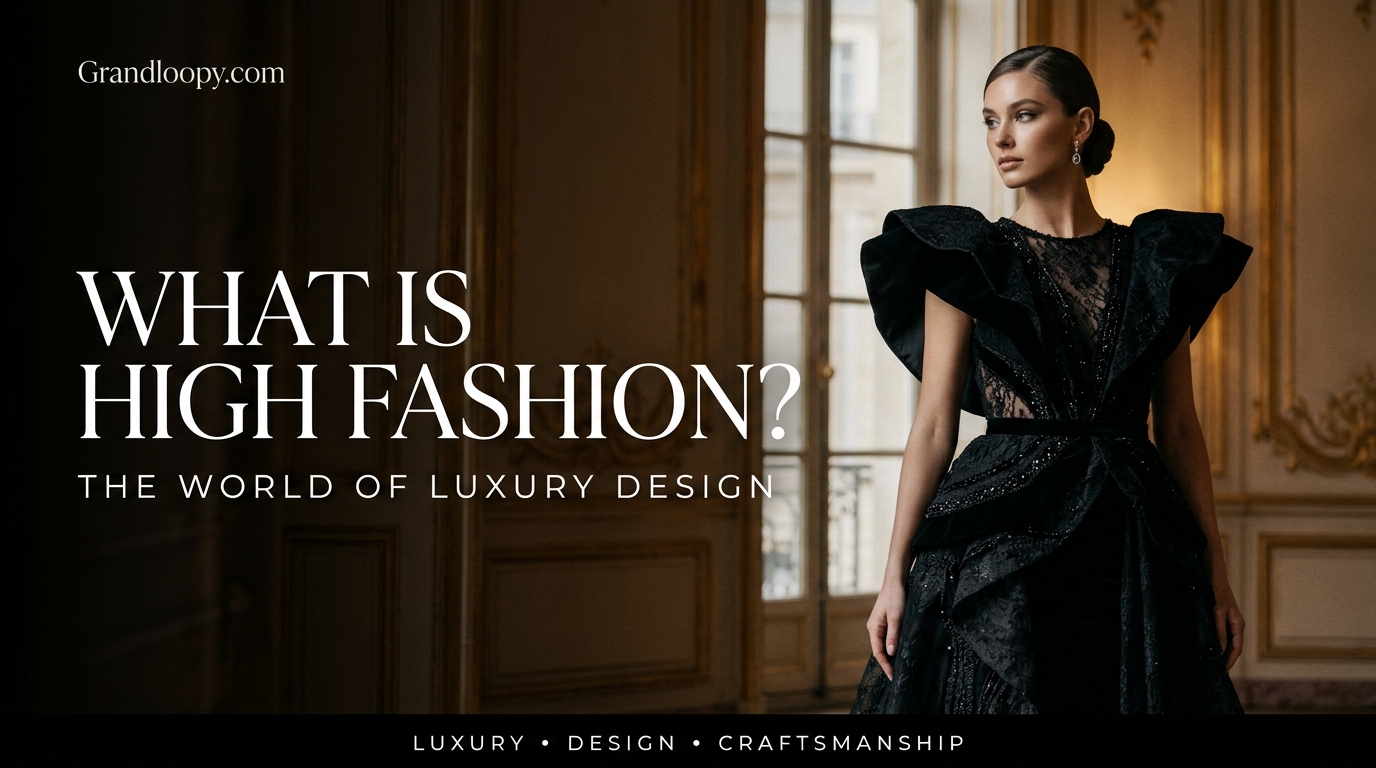
High fashion is exclusive designer led luxury clothing made with exceptional materials, skilled handwork, and strong creative vision for discerning clients around the world for every thoughtful wardrobe.
High fashion is not only about a high price or a famous logo, because many expensive items lack the design authorship, material quality, and careful construction that define the category.
High fashion covers clothing, shoes, handbags, jewelry, and accessories, and it includes both made to order couture and limited designer ready to wear collections for work, events, and travel.
High fashion matters because it influences what people wear far beyond the runway, as designers test new shapes, colours, and techniques that later appear in shops at lower prices.
High fashion can feel distant, yet its ideas are useful for any wardrobe, because the same principles of fit, fabric, proportion, and restraint improve everyday outfits.
High fashion rewards slow looking, because a quick glance at a label misses the details that separate a well made garment from a costly imitation.
What Is High Fashion in Simple Words
High fashion means clothing designed by a leading fashion house and made to a very high standard, with limited availability and a clear creative point of view.
High fashion is often called designer fashion or luxury fashion, although those terms overlap rather than match exactly, and the differences matter when shopping or judging quality.
High fashion pieces are usually produced in small numbers, shown at fashion week, and sold through flagship stores, select boutiques, and trusted luxury retailers across Paris, Milan, and New York.
High fashion is made for people who value design and craft, including collectors, celebrities, editors, stylists, and thoughtful buyers who prefer fewer better pieces and value lasting quality.
High fashion includes evening gowns, tailored suits, coats, dresses, shoes, and handbags, and each category follows the same test of design authorship, material quality, and careful finishing.
High fashion is easy to recognise once the five traits below are clear, because a piece either shows them together or it does not in design, material, and making.
High fashion changes with time, yet its core stays stable, as new designers bring fresh ideas while houses protect their archives, codes, and craft traditions.
High fashion is also a business, with ready to wear, leather goods, fragrance, and accessories funding the costly couture work that builds prestige and cultural influence worldwide.
The Five Traits That Define High Fashion
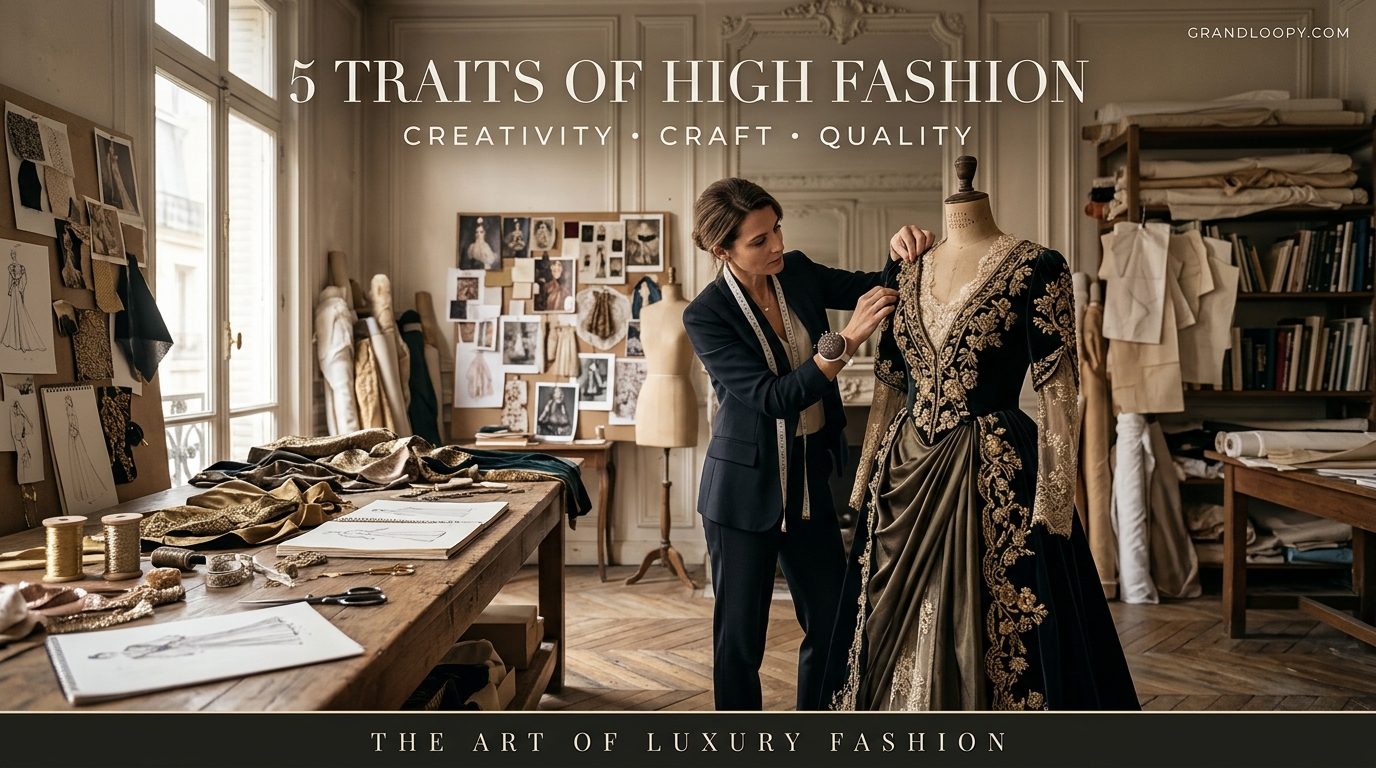
Creativity is the first trait, because high fashion begins with an original idea about shape, colour, texture, or culture, rather than a copy of a current best seller.
Exclusivity is the second trait, because limited runs, made to order work, and selective distribution keep a design rare and desirable. Scarcity also allows closer quality control.
Craftsmanship is the third trait, because skilled artisans use handwork, careful pattern making, and precise finishing to create garments that machines alone cannot match in every couture atelier.
Material quality is the fourth trait, because fine silk, wool, cashmere, lace, and leather behave differently from cheap synthetics in drape, comfort, and longevity. Good fabric holds shape and ages gracefully with care.
Cultural impact is the fifth trait, because high fashion reflects art, music, film, politics, and social change, and its best looks are quoted, copied, and remembered.
These five traits work together, and a piece that lacks one trait can still be good, yet it is less likely to count as high fashion.
A useful test is to ask whether the design, material, making, rarity, and cultural meaning all point in the same direction for design, fabric, and fit.
What High Fashion Is Not
High fashion is not the same as expensive clothing, because price can reflect marketing, rent, distribution, and brand fees as well as quality and brand prestige worldwide.
High fashion is not the same as a famous logo, because logos can be printed, copied, or applied to products far from a house core craft.
High fashion is not the same as fast fashion, because fast fashion copies runway ideas quickly, produces them in large volumes, and sells them at low prices with short lifespans.
High fashion is not the same as premium fashion, because premium is an informal market label for brands priced between luxury and the high street, with no fixed definition.
High fashion is not only for the runway, because many runway looks are experiments, statements, or art pieces that never reach shops in the same form.
High fashion is not always handmade, because some luxury products involve extensive hand finishing while others are largely machine made with careful quality control in luxury ready to wear.
High fashion is not a guarantee of good taste, because a costly piece can still clash with body shape, occasion, or personal style when chosen without thought.
The Legal Test for Haute Couture
Haute couture is French for high sewing, and it is a legally protected term in France, not simply a fancy label for expensive clothes in the fashion world.
To use the term haute couture in France, a house must design made to order garments for private clients, with one or more fittings for each client.
A house must also have a workshop, called an atelier, in Paris that employs at least fifteen full time staff members with skilled technical workers.
A house must present a collection of at least fifty original designs to the public every fashion season, twice a year, in January and July, with both day and evening garments.
Conflicts exist in published sources, so the look count needs careful labelling rather than a single settled figure for couture look counts in France today.
Official membership also varies by date and source, so readers should check the current directory before quoting a number in the current official Federation directory.
The thirteen houses listed in November 2026 were Adeline Andre, Alexis Mabille, Chanel, Christian Dior, Franck Sorbier, Giambattista Valli, Givenchy, Jean Paul Gaultier, Julien Fournie, Maison Margiela, Maison Rabih Kayrouz, Schiaparelli, and Stephane Rolland.
A custom dress from a local tailor is not haute couture, even when it is beautiful, well fitted, and made by hand.
The legal term requires an accredited Paris house meeting the rules above.
Many brands use the word couture loosely in marketing, especially outside France, where the term is not protected in the same way and in online luxury marketing.
The Six Tiers of Fashion
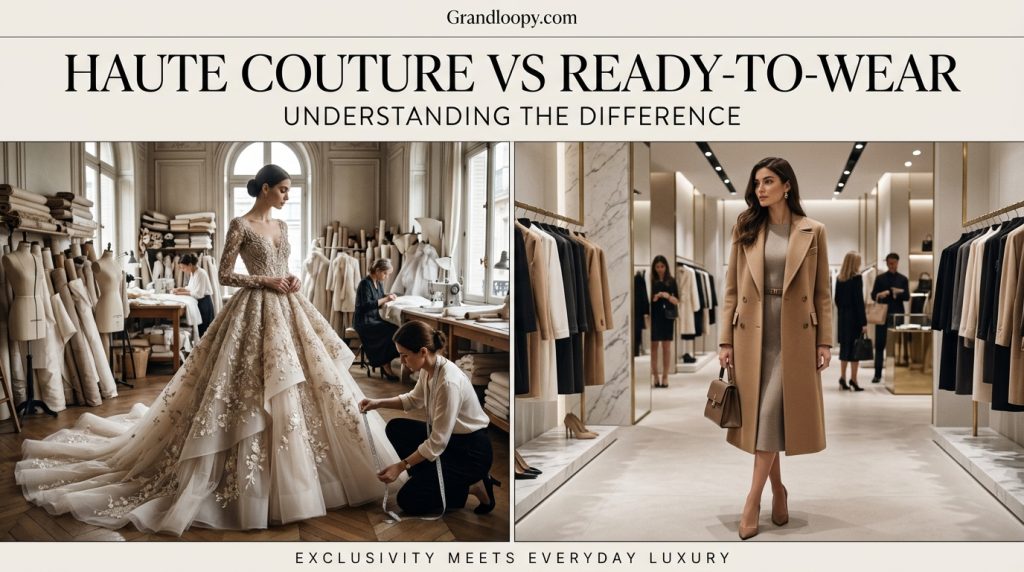
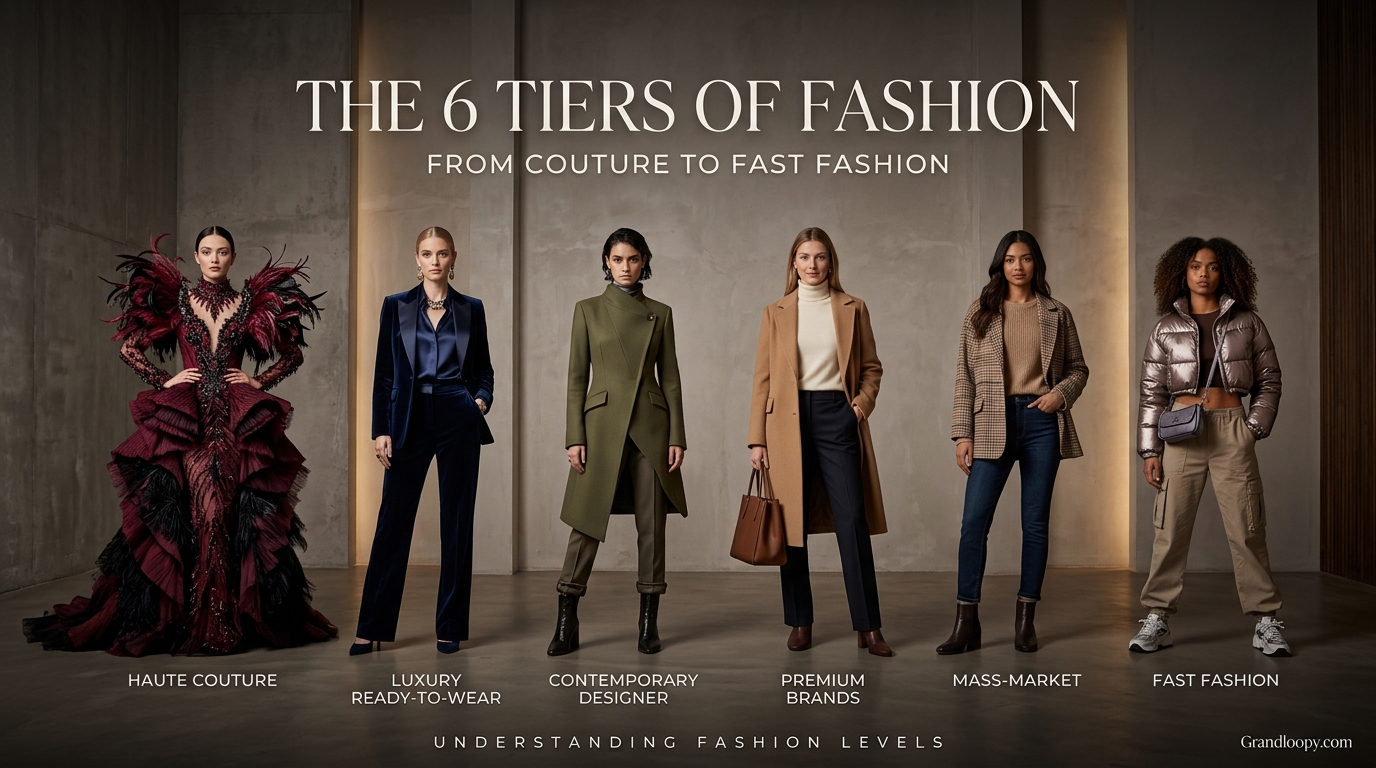
Fashion is best understood as a ladder, with haute couture at the top and fast fashion at the bottom, and each tier differs in fit, production, price, and purpose.
Haute couture sits at the top, with made to measure fit, individual patterns, hand construction, multiple private fittings, and extreme exclusivity. It is for private clients, red carpet moments, and collectors.
Luxury ready to wear sits below couture, with standard sizes, limited production runs, designer led collections, premium fabrics, and seasonal releases. Most buyers meet high fashion through trusted luxury retailers.
Contemporary designer fashion sits in the middle, with standard sizes, mid scale production, trend driven design, and more accessible designer pricing. It offers designer ideas at lower prices with less handwork.
Premium fashion sits below contemporary designer, with standard sizes, varied production methods, and prices between luxury and the high street. Quality varies widely by brand, so each piece needs judging.
Mass market fashion sits below premium, with standard sizes, high volume manufacturing, low cost production, fast turnaround, and wide availability. It gives trend access at low prices, yet rarely matches higher tier quality.
Fast fashion sits at the bottom of the ladder, with very high volume, very fast copying, cheap synthetic materials, and short product life and short product life.
| Tier | Fit and production | Defining traits | Best for |
|---|---|---|---|
| Haute couture | Made to measure, one client | Hand construction, private fittings, extreme rarity | Private clients, red carpet, collectors |
| Luxury ready to wear | Standard sizes, limited runs | Designer collections, premium fabrics, seasonal shows | Thoughtful buyers, investment pieces |
| Contemporary designer | Standard sizes, mid scale runs | Trend driven, accessible designer prices | Style led buyers, first designer pieces |
| Premium | Standard sizes, varied methods | Mid prices, quality varies by brand | Everyday quality, careful shoppers |
| Mass market | Standard sizes, high volume | Low cost, fast turnaround, wide access | Basic needs, trend testing |
| Fast fashion | Standard sizes, very high volume | Cheap materials, short life, rapid copying | Short term trends, low budgets |
The ladder is not a judgment of people, because a thoughtful wardrobe can mix tiers, using a luxury coat with mass market basics and a vintage accessory.
A common mistake is to assume that moving up the ladder always improves value, yet a premium piece with excellent fabric can beat a luxury piece with weak construction.
streetwear fashion now crosses the ladder, because designer houses adopt its silhouettes, limited drops, and cultural credibility, while streetwear brands adopt luxury materials and tailoring in modern luxury collections.
gothic fashion also shows how a subculture can influence high fashion, with dark palettes, lace, velvet, and dramatic silhouettes appearing on runways and in designer collections.
A Short History of High Fashion
High fashion began in Paris in the mid nineteenth century, when skilled artisans made custom garments for elite clients with great care and detail for elite European clients.
Charles Frederick Worth changed dressmaking into a design profession, and his story is told in the Charles Frederick Worth and the House of Worth essay from the Metropolitan Museum of Art.
Worth opened his firm in Paris in 1858, and he is widely called the father of haute couture, although the Metropolitan Museum notes others worked similarly.
Rose Bertin had earlier served Queen Marie Antoinette, and her work helped bring fashion to French culture, yet Worth created the modern house system with seasonal collections and named designers.
The Chambre Syndicale de la Couture Parisienne was founded in 1868, and it regulated members on copying, show dates, model numbers, press relations, law, and taxes.
The early twentieth century brought new houses, including Chanel, Lanvin, Schiaparelli, Balenciaga, and Dior, each with a distinct vision of elegance, structure, and modern life.
Christian Dior presented his first collection on February 12, 1947, at 30 Avenue Montaigne, and the Bar jacket became the emblem of the New Look.
Chanel introduced the simple black dress in 1926, and the design showed how restraint, proportion, and one colour could create lasting elegance and timeless Parisian elegance.
Yves Saint Laurent showed a tuxedo for women in 1966, and the couture version sold only one example while the ready to wear version succeeded.
The 1960s also saw young designers leave established houses to found their own labels, including Yves Saint Laurent, Pierre Cardin, Andre Courreges, and Emanuel Ungaro.
Ready to wear grew rapidly after the Second World War, as houses realised that a few dozen private clients could not sustain a large business.
The late twentieth century brought luxury conglomerates, global flagships, licensing, fragrance, and accessories, so couture became a prestige engine rather than the main income source.
The twenty first century brought technology, sustainability, and diversity to high fashion, with 3D printed dresses, AI assisted design, upcycled fabrics, and more varied models and designers.
High fashion today still follows the Paris calendar, yet it also lives on social media, resale platforms, and rental services, where runway looks reach new audiences in hours.
| Year | Event | Why it matters |
|---|---|---|
| 1858 | Worth opens his Paris firm | First modern couture house, designer as author |
| 1868 | Chambre Syndicale founded | Regulation of couture houses, shows, and copying |
| 1910 | Chanel opens a hat shop in Paris | Start of a house built on movement and restraint |
| 1926 | Chanel little black dress | Simple black dress becomes a lasting classic |
| 1945 | Stricter haute couture criteria set | Legal rules for atelier, staff, and designs |
| 1947 | Dior New Look, February 12 | Bar jacket defines post war luxury and shape |
| 1955 | Chanel 2.55 bag | Shoulder bag frees hands, becomes a house code |
| 1966 | Saint Laurent women’s tuxedo | Couture idea succeeds in ready to wear |
| 1975 | Chambre joins the Federation | Modern Federation structure for couture and fashion |
| 2027 | Hermes couture debut as guest | A leather house enters couture in January |
The timeline shows a pattern, where each generation redefines luxury while keeping craft, authorship, and Paris at the centre. Knowing dates helps spot true brand claims.
How a High Fashion Garment Is Made
A high fashion garment begins as an idea, when a creative director sketches a concept, researches fabrics, and builds a collection narrative. Mood boards shape the story before cutting fabric.
Pattern makers and designers then turn sketches into technical plans, using draping on a dress form to see how fabric moves before committing to final materials.
A toile is made next, which is a test garment in cheap cotton muslin that checks the architecture of the design. The toile fitting reveals balance problems and saves costly fabric.
Fabric selection follows, with silk, satin, brocade, jacquard, chiffon, organza, tulle, lace, velvet, wool, and cashmere chosen for drape, weight, and behaviour in the Paris atelier.
Hand construction begins after the pattern is locked, with hand embroidery, embellishment, and bespoke tailoring done by skilled artisans in the atelier in the Paris atelier.
Inside a genuine Paris couture house, work is divided into two workshops, the atelier tailleur and the atelier flou for structured and fluid garments alike.
The petites mains, literally little hands, are the highly skilled seamstresses and artisans who execute the designer vision with great care with great skill and patience.
Private fittings follow, sometimes several, as the garment is adjusted directly on the client body. Each fitting refines shape, balance, and comfort for the client.
A finished collection debuts on the runway, usually in Paris in January or July for couture, and selected designs are then ordered, adapted, or commissioned from scratch.
| Step | Action | Detail |
|---|---|---|
| 1 | Concept and mood board | Sketch, research, colour, story, silhouette |
| 2 | Draping and pattern | Test shape on a dress form, refine proportion |
| 3 | Toile fitting | Cheap muslin prototype, check architecture |
| 4 | Fabric selection | Silk, lace, wool, cashmere, drape and weight |
| 5 | Hand construction | Embroidery, tailoring, beadwork, hand finishing |
| 6 | Private fittings | Multiple fittings on the client body |
| 7 | Runway presentation | January or July show in Paris for couture |
| 8 | Order and delivery | Adapt or commission, quality control, delivery |
The process explains the price, because time, skill, fittings, and rare materials cannot be rushed without losing quality. A machine copy rarely matches the fit, lining, and movement.
Readers can use the process as a buying lens, by asking how a garment was made, how many fittings it had, and what handwork it contains.
The Houses That Define High Fashion
Chanel defines timeless restraint, with tweed jackets, quilted handbags, classic slingbacks, and refined costume jewellery that have lasted for decades with timeless Parisian style and elegance.
Dior defines romantic structure, with feminine tailoring, the Bar jacket heritage, modern romantic dresses, and elevated accessories that balance softness and shape for modern romantic elegance.
Hermes defines exceptional leathercraft, with timeless handbags, silk scarves, and equestrian inspired details built on a harness making history in Paris, France, since eighteen thirty seven.
Louis Vuitton defines travel and leather goods, with trunks, monogram canvas, and refined accessories that began as practical luggage from its early trunk making days.
Gucci defines Italian glamour and eclectic maximalism, with bold prints, leather goods, and equestrian hardware that have attracted younger buyers in recent years in recent fashion seasons.
Prada defines intellectual luxury, with minimalist sophistication, innovative materials, and a nylon backpack first produced for Fall Winter 1984 to 1985 with intellectual Parisian style.
Saint Laurent defines sharp modern elegance, with the women’s tuxedo, sleek tailoring, and bold evening looks that mix masculine and feminine codes for modern evening elegance.
Valentino defines romantic Italian couture, with red dresses, delicate lace, and dramatic evening gowns that suit red carpet moments and formal events. The house remains known for glamour and its signature red.
Balenciaga defines sculptural innovation, with oversized shapes, streetwear influence, and bold trainers that challenge traditional ideas of luxury and bold Parisian runway style for today.
Alexander McQueen defines dramatic artistry, with theatrical runway shows, sharp tailoring, and dark romantic themes that turn clothing into storytelling with dark romantic drama and craft.
The Victoria and Albert Museum fashion collections show how these houses developed, and its galleries help readers see construction, fabric, and silhouette up close for fashion history lovers.
New houses also matter, including Schiaparelli, known for surrealist detail and bold jewellery, and Maison Margiela, known for deconstruction, anonymity, and conceptual design in contemporary Paris fashion.
How Much Does High Fashion Cost and Why
High fashion costs more because it uses rare materials, skilled labour, small production runs, private fittings, and long design time, and those costs cannot be removed without changing the product.
Houses do not publish price lists, so every price below is competitor reported, not verified from a house, and readers should treat each figure as a range rather than a fixed quote.
Entry level designer pieces are reported at about three hundred to eight hundred dollars, for contemporary lines and simple accessories, according to a buying guide.
Premium collections are reported at about three thousand to ten thousand dollars or more, for Valentino gowns and Loro Piana outerwear, according to the same guide.
A simple couture day look is reported at about forty thousand dollars by one guide, while a suit is reported at sixty thousand to one hundred thousand dollars by the same guide.
Another guide reports a couture day suit starting at thirty thousand dollars, while a heavily embroidered ballgown can exceed two hundred thousand dollars in a detailed buying guide.
Luxury ready to wear gowns are reported at about one thousand to ten thousand dollars, which is far below couture yet far above mass market prices.
Hours explain much of the gap, because a day dress can take about one hundred fifty hours, while an embroidered gown can take over one thousand hours of handwork.
| Piece type | Reported price range | Reported hours | Source label |
|---|---|---|---|
| Entry designer piece | 300 to 800 dollars | Not reported | Buying guide, competitor reported |
| Mainline luxury dress | 800 to 3,000 dollars | Not reported | Buying guide, competitor reported |
| Premium collection gown | 3,000 to 10,000 dollars or more | Not reported | Buying guide, competitor reported |
| Couture day suit | 30,000 dollars start, 60,000 to 100,000 dollars in another guide | 150 hours or more | Jovani and Gavalia, conflict, both shown |
| Couture evening gown | 60,000 to 120,000 dollars, up to 300,000 dollars or more | 800 to 1,000 hours or more | Jovani and CoutureNotebook, conflict, both shown |
| Highly elaborate gown | 500,000 dollars or more | Over 1,000 hours | CoutureNotebook, competitor reported |
Cost per wear helps judge value, because a costly piece worn often can cost less per use than a cheap piece worn rarely for thoughtful luxury buyers.
| Item | Price | Wears | Cost per wear |
|---|---|---|---|
| Luxury coat | 2,000 dollars | 50 wears | 40 dollars |
| Cheap coat | 200 dollars | 5 wears | 40 dollars |
| Designer blazer | 1,500 dollars | 75 wears | 20 dollars |
| Trend dress | 120 dollars | 3 wears | 40 dollars |
| Quality handbag | 3,000 dollars | 300 wears | 10 dollars |
The table shows that durability and frequency, not price alone, decide value, and a timeless piece worn for years can be the cheaper choice. Buyers should count likely wears and resale value.
Market size also puts the industry in context, with figures that differ by scope and should not be merged. The global personal luxury goods market generated three hundred fifty eight billion euros in 2025.
Bain forecasts luxury to reach three hundred sixty five to three hundred seventy three billion euros in 2026, up two to four percent, in the Bain-Altagamma Luxury Goods Worldwide Market Study dated June 25, 2026.
About half of luxury shoppers check secondhand before buying new, according to Bain in 2026, which shows that resale is now part of mainstream luxury behaviour rather than a niche.
How to Spot Real High Fashion in Ten Checks
Spotting real high fashion starts with the silhouette, because a strong design reads clearly from a distance through shoulder line, waist position, and balance of volumes.
Material is the second check, because luxury fabrics drape smoothly, feel substantial yet soft, and show consistent grain and colour across panels across panels and seams.
Construction is the third check, and it often shows most clearly where buyers rarely look, inside the garment where stitching and seams show and in the lining.
Lining is the fourth check, because a good lining lies flat, is attached cleanly, and does not pull or bunch when the garment moves when the garment moves.
Hardware is the fifth check, because zips, buckles, buttons, and clasps should feel solid, work smoothly, and show how they are fixed, whether riveted, stitched, or screwed.
Fit is the sixth check, because a garment should move with the body without dragging or riding up more than its style explains without dragging or riding up.
Provenance is the seventh check, because the country of manufacture, serial numbers, holograms, and brand records help confirm authenticity and help confirm authenticity for every careful buyer.
Pattern matching is the eighth check, because stripes, checks, and prints should align across pockets, closures, and seams when the design calls for it when the design calls for it.
Repairability is the ninth check, because a piece designed for years of use will have generous seam allowances, replaceable zips, handles, heels, and linings, and a brand repair service.
Price logic is the tenth check, because deep discounts on new designer items, inconsistent branding, or sellers who refuse returns are red flags for any careful buyer.
| Check number | Check | What good looks like | Red flag |
|---|---|---|---|
| 1 | Silhouette | Clear shape, balanced volumes | Unclear shape, poor proportion |
| 2 | Material | Consistent grain, good drape | Thin, stiff, uneven colour |
| 3 | Construction | Even stitching, clean seams | Loose threads, glue spots |
| 4 | Lining | Flat, clean, no pulling | Bunching, loose, cheap lining |
| 5 | Hardware | Solid, smooth, well fixed | Hollow, loose, poorly finished |
| 6 | Fit | Moves with the body | Drags, rides up, pulls |
| 7 | Provenance | Clear label, serial, records | Missing serial, vague origin |
| 8 | Pattern matching | Aligned across seams | Misaligned at visible seams |
| 9 | Repairability | Repair service, spare parts | No repair, no seam allowance |
| 10 | Price logic | Price matches market and condition | Deep discount, no returns |
Use the checklist in order, and do not buy when several checks fail, even when the label looks right even when the label looks right.
Authentication services are useful for high value secondhand purchases, especially for handbags, watches, and limited pieces where fakes are common. Keep receipts and cards, because provenance supports resale value.
How to Wear High Fashion Without Buying Couture
Wearing high fashion without buying couture starts with one strong piece, rather than a head to toe designer outfit that can feel like a costume.
Tailoring is the cheapest luxury, because a well fitted mass market garment often looks better than an expensive ill fitting one for a polished everyday look.
Accessories carry the high fashion signal, because a statement bag, quality shoes, or refined jewellery can change an outfit without a large wardrobe overhaul. Choose one or two statement pieces, and keep the rest simple.
chic fashion offers a useful model for everyday high fashion, because it stresses clean lines, good fit, and intentional choices rather than logos or excess.
Workwear can also borrow high fashion ideas, through structured tailoring, quality fabrics, and restrained accessories that suit an office setting, as in business casual for women.
A related guide uses the shorter phrase business casual woman for a catalogue of pieces and formulas, and it complements the decision first guide linked above.
Rental is a practical route to high fashion, because it allows a couture inspired look for a wedding, gala, or photoshoot without long term ownership costs.
Resale is another route, because vintage and secondhand platforms offer authenticated designer pieces at lower prices, with unique finds that are no longer in shops.
A capsule wardrobe helps, because a small set of versatile staples can be elevated with one or two high fashion pieces each season with one or two high fashion pieces.
Seasonal adaptation matters, because spring and summer favour vibrant colours and flowy fabrics, while fall and winter favour bold jackets, luxurious layers, scarves, and gloves.
Fit and proportion deserve daily attention, because layering should not overwhelm the frame, and accessories should enhance rather than crowd an outfit. Less is often more, and one clear focal point looks stronger.
High Fashion for Men
Men’s high fashion includes tailored suits, coats, shoes, leather goods, and accessories, with the same tests of design, material, and construction as womenswear. A well cut suit and quality shoes can define a wardrobe.
Thom Browne is known for grey wool suits cut short and close, with a knitted polo and a four bar stripe that signal the house without a large logo.
Loewe is known first as a leather house, so men should look at bags, wallets, and shoes before clothes, because leather craft is the house strength.
Valentino offers Italian tailoring, sneakers, and studded Rockstud accessories for men, with a Roman couture heritage and a full men’s line with a Roman couture heritage.
Louis Vuitton is travel first for men, from the Keepall bag to monogram leather goods, and the house history in trunks still shapes its accessories.
Men should start with versatile staples, including a tailored blazer, dark tailored trousers, a white shirt, quality leather shoes, and a simple leather belt for work, events, and travel.
Fit matters more for men than brand, because a suit that pulls at the chest, bunches at the waist, or pools at the ankle looks careless at any price.
Men can also use rental and resale for formal events, where a tuxedo, dinner jacket, or statement coat is needed only once or twice a year.
Streetwear has changed men’s high fashion, with oversized shapes, trainers, and logo pieces now appearing in luxury collections and on runways in luxury collections and on runways.
Men should avoid overaccessorising, because one watch, one belt, and one bag suffice.
Extra jewellery, logos, or patterns can crowd the look, while restraint and good shoes often say more than a full designer outfit.
High Fashion for Women
Women’s high fashion includes dresses, suits, coats, shoes, handbags, and jewellery, with a wide range of silhouettes from structured tailoring to fluid draping from structured tailoring to fluid draping.
Chanel is known for tweed jackets, quilted handbags, classic slingbacks, and refined costume jewellery, with a timeless elegance that suits many ages and occasions. Dior is known for feminine tailoring and modern romantic dresses.
Hermes is known for exceptional leathercraft, timeless handbags, silk scarves, and equestrian inspired details, with the Birkin and Kelly bags as lasting icons. Louis Vuitton is known for travel goods and refined accessories.
Gucci is known for eclectic maximalist designs, bold prints, and leather goods that have attracted younger buyers, while Prada is known for minimalist sophistication and intellectual design.
Women should build around a classic white shirt, tailored trousers, a little black dress, a statement coat, and quality footwear, because those pieces adapt to work, events, and travel.
Fit is essential for women, because a garment that pulls, gaps, or rides up will undermine even the finest fabric and design and undermine even the finest design.
Accessories should be chosen with restraint, using one or two statement pieces to enhance a look without overwhelming it. A quality handbag or unique scarf can introduce colour and texture, while too many pieces compete.
Evening wear deserves special care, because a couture inspired gown needs the right undergarments, shoes, and hair to hold its shape and movement to hold its shape and movement.
Women can also use vintage and secondhand luxury to find unique pieces, including archival designs that are no longer in production and often hold or gain value.
Women should stay true to personal style, rather than following every trend blindly, because a trend that clashes with body shape, colouring, or lifestyle will rarely feel comfortable.
Sustainable High Fashion
Sustainable high fashion starts with longevity, because a well made garment worn for years has a lower impact per wear than many cheap garments worn a few times.
Stella McCartney leads on sustainable materials and ethical practices, with a clear stance against fur and leather and a focus on innovative fabrics. Gabriela Hearst also leads with sustainable materials and ethical production.
Houses are rethinking approaches as eco consciousness grows, with organic materials, ethical labour practices, and eco friendly processes becoming part of luxury conversations in luxury conversations today.
Slow fashion is a useful frame, because it values fewer higher quality garments that last longer and reduce environmental impact compared with fast fashion cycles.
Rental and secondhand support sustainability, because they extend the life of existing garments.
They reduce demand for new production, and renting for special occasions plus buying authenticated vintage pieces keeps quality clothing in use longer.
Care extends life, so follow washing and care instructions, use appropriate hangers, avoid overcrowding, use garment bags for delicate pieces, and choose professional cleaning for high value items.
Repair is a sustainability test, because a house that offers repairs, spare parts, and restoration shows a commitment to longevity rather than replacement. Ask about repair before buying, and keep a trusted tailor.
Diversity and inclusivity are also part of modern sustainability, because high fashion is becoming more reflective of global cultures, identities, and body types. Models and designers from varied backgrounds are redefining beauty norms.
Greenwashing is a risk, because a single organic fabric or a capsule collection does not make a whole house sustainable when most products use conventional methods.
The most sustainable high fashion choice is often the piece already owned, worn well, repaired, and styled in new ways worn well, repaired, and styled in new ways.
High Fashion in 2026 and 2027
Fashion weeks follow a seasonal calendar, with ready to wear shows in February, March, June, September, and October, and couture shows in January and July.
Paris is the centre for haute couture, with Milan, London, and New York as the other major fashion capitals, each with a distinct character and strength.
The latest Haute Couture Week for Fall Winter 2026 to 2027 ran from July 6 to 9, 2026, with thirty houses on the final calendar, including eight members, four corresponding members, and eighteen guests.
The next edition, Spring Summer 2027, runs from January 25 to 28, 2027, according to the Federation calendar, and AFP reports that Hermes will make its couture debut there as a guest.
Fall Winter 2027 to 2028 Haute Couture Week is scheduled for July 5 to 8, 2027, according to the Federation de la Haute Couture et de la Mode according to the Federation calendar.
| Event | Dates in 2027 | Notes |
|---|---|---|
| Menswear Fall Winter 2027 to 2028 | January 19 to 24, 2027 | Paris, official calendar |
| Haute Couture Spring Summer 2027 | January 25 to 28, 2027 | Hermes debut as guest |
| Womenswear Fall Winter 2027 to 2028 | March 1 to 9, 2027 | Paris, official calendar |
| Menswear Spring Summer 2028 | June 22 to 27, 2027 | Paris, official calendar |
| Haute Couture Fall Winter 2027 to 2028 | July 5 to 8, 2027 | Paris, official calendar |
| Womenswear Spring Summer 2028 | September 27 to October 5, 2027 | Paris, official calendar |
Shows are by invitation only, and the public cannot simply buy a ticket to a couture show, although some houses stream shows online and share looks on social media.
The Met Gala remains the largest haute couture night of the year, held at the Metropolitan Museum of Art in New York and organised by Vogue.
Trends for 2026 and 2027 include quiet luxury, with restrained colours, quality fabrics, and minimal logos, alongside bold statement pieces for evening and events for evening and events.
Buyers should refresh this calendar before planning travel, because dates can change, house lists can change, and guest invitations are decided each season. The Federation site is the official source for dates.
Mistakes to Avoid
Overaccessorising is a common mistake, because too many statement pieces compete and overwhelm an outfit that could have looked clean and intentional. Choose one focal point, and let the rest support it quietly.
Ignoring fit is another mistake, because an ill fitting garment undermines even the finest fabric, design, and brand, and it draws attention to the wrong details.
Following trends blindly is a third mistake, because a trend that suits a runway model may not suit a different body, lifestyle, or occasion, and the result can feel uncomfortable and short lived.
Buying for a logo is a fourth mistake, because a logo without quality, fit, or design coherence is an expensive label rather than a good garment.
Buying fast fashion copies is a fifth mistake for people who want high fashion quality, because copies often use cheap synthetics, weak stitching, and poor fit, and they rarely last beyond a few wears.
Neglecting care is a sixth mistake, because high fashion items need proper cleaning, storage, and repair, and neglect can ruin fabric, shape, and hardware. Follow care labels, use padded hangers, and store knits folded.
Buying without authentication is a seventh mistake in resale, because counterfeits are common for popular bags, shoes, and accessories, and a fake can cost thousands.
is Zara fast fashion is a useful check for readers who wonder where a popular high street brand sits on the ladder, because the answer separates fast fashion from high fashion clearly.
Fabric Guide and Pros and Cons
Fabric choice decides how a high fashion garment drapes, feels, and lasts, so readers should know the main materials and their strengths and their strengths for readers.
Cashmere is soft, warm, and light, and it suits knitwear, coats, and scarves, yet it needs gentle washing, proper storage, and protection from moths and protection from moths.
Brocade is a rich patterned fabric, often with raised designs, and it suits evening wear, jackets, and statement pieces that need structure and visual impact.
Chiffon is a light sheer fabric, often in silk, and it suits draping, layers, and flowing dresses because it moves easily and creates soft volume.
Tulle is a fine net fabric, and it suits veils, skirts, and layered volume, while French lace offers delicate openwork patterns for dresses, veils, and trims.
| Fabric | Feel and drape | Best use | Care note |
|---|---|---|---|
| Silk | Smooth, fluid, lustrous | Evening gowns, scarves, draping | Dry clean, protect from sun |
| Cashmere | Soft, warm, light | Knitwear, coats, scarves | Gentle wash, moth protection |
| Wool | Resilient, warm, structured | Tailoring, suits, coats | Dry clean, brush, air out |
| Brocade | Rich, patterned, structured | Evening jackets, statement pieces | Dry clean, avoid crushing |
| Jacquard | Woven pattern, firm | Dresses, jackets, upholstery style | Dry clean, check label |
| Chiffon | Light, sheer, flowing | Layered dresses, draping | Hand wash or dry clean |
| Organza | Crisp, sheer, structured | Volume, overlays, bridal | Dry clean, handle gently |
| Tulle | Fine net, light volume | Veils, skirts, layers | Store flat, avoid snags |
| French lace | Delicate, openwork | Dresses, veils, trims | Hand wash, dry flat |
| Velvet | Soft pile, rich surface | Evening wear, jackets | Brush, dry clean, avoid water |
High fashion has clear advantages, including superior durability, timeless design, unique pieces, and support for artisanal craftsmanship and creative industries. It also offers potential value retention for rare pieces.
High fashion also has clear disadvantages, including very high upfront cost, limited accessibility, and styles that can be impractical for daily wear. Some pieces need specialised care, and some buyers face ethical concerns.
| Side | Points |
|---|---|
| Pros | Timeless elegance, superior durability, unique design, potential value retention, support for artisans |
| Pros | Better materials, careful construction, cultural relevance, lasting style beyond one season |
| Cons | Very high cost, limited access, impractical for daily wear, specialised care needed |
| Cons | Risk of counterfeits in resale, fast fashion offers quicker trends at lower prices, ethical concerns for some buyers |
A balanced view helps buyers decide, because high fashion is worth it for timeless pieces worn often, yet it is not worth it for a trend piece worn once.
FAQs
What is high fashion?
High fashion is exclusive designer led luxury clothing made with exceptional materials, skilled handwork, and strong creative vision. It sets trends, uses limited production, and values originality and craftsmanship above speed and volume.
What is high fashion in simple words?
High fashion means quality designer clothing made to a very high standard, with limited availability and a clear creative point of view. It is the exclusive end of fashion, where design and craft matter most.
Is high fashion the same as haute couture?
No, high fashion is the broad umbrella, while haute couture is its narrowest tier. Haute couture is made to order in Paris, legally protected in France, and shown in January and July.
What is the difference between high fashion and luxury fashion?
Luxury fashion is broader, covering ready to wear, leather goods, and accessories from established houses. High fashion stresses trend leadership, artistic vision, and exclusivity in addition to fine materials and construction.
What is considered high fashion?
A piece counts as high fashion when it shows design authorship, premium materials, careful construction, limited availability, and cultural impact together. Price or a logo alone does not make a piece high fashion.
What are the top high fashion brands?
Leading houses include Chanel, Dior, Louis Vuitton, Gucci, Prada, Hermes, Saint Laurent, Valentino, Balenciaga, and Givenchy. Each house has a distinct code, history, and strength in tailoring, leather, or evening wear.
Why is high fashion so expensive?
High fashion is expensive because it uses rare materials, skilled labour, small production runs, private fittings, and long design time. A single embroidered gown can take upwards of eight hundred hours of handwork.
How much does a haute couture dress cost?
Houses publish no price list, so figures are competitor reported ranges. A simple day look is reported from about forty thousand dollars, while an embroidered evening gown can reach one hundred thousand dollars or more.
How long does it take to make a couture dress?
A simple couture day dress can take about one hundred fifty hours, while an embroidered gown can take over one thousand hours. Time depends on fabric, beading, fittings, and the complexity of the design.
When did high fashion start?
High fashion began in Paris in the nineteenth century, with Charles Frederick Worth opening his firm in 1858. He showed finished designs on live models, and clients chose colours and fabrics before making.
Who is the father of haute couture?
Charles Frederick Worth is widely called the father of haute couture, although the Metropolitan Museum notes that he was not the first or only person to work in that way.
What are the rules to be called haute couture?
A house must make made to order garments for private clients, have a Paris atelier with at least fifteen full time staff, employ twenty technical staff, and present fifty original designs twice a year.
How many haute couture houses are there?
As of November 16, 2026, thirteen houses held the legally protected haute couture appellation in the Federation directory. An older Wikipedia list names about seventeen official members, so the count depends on date and source.
When is Paris Haute Couture Week in 2027?
Spring Summer 2027 Haute Couture Week runs from January 25 to 28, 2027, and Fall Winter 2027 to 2028 runs from July 5 to 8, 2027.
Can anyone buy haute couture?
In theory anyone who can pay and attend fittings can commission couture, yet in practice access is limited by price, travel to Paris, waiting time, and house selection.
What is demi-couture?
Demi-couture is a middle ground between full couture and ready to wear, where a designer presents a collection and makes a dress only when a customer orders it.
What is alta moda?
Alta moda is the Italian term for high fashion, often treated as the Italian counterpart to French haute couture. It is not protected in Italy, and it refers to the Italian made to order system.
What is the difference between couture and ready to wear?
Couture is custom made for one client, with extensive handwork and multiple fittings, while ready to wear is made in standard sizes and produced in multiples for retail sale.
Is streetwear high fashion?
Streetwear is high fashion when designer houses adopt its silhouettes, limited drop culture, and cultural credibility, and when craftsmanship and brand positioning lift it into luxury.
Is Zara high fashion?
No, Zara is fast fashion, not high fashion, because it copies runway ideas quickly, produces them in large volumes, and sells them at low prices.
Is high fashion worth the money?
High fashion is worth the money for timeless pieces worn, with good fit, quality materials, and lasting design. It is less worth it for a trend piece worn once, where cost per wear stays high.
How can you tell if high fashion is real?
Check silhouette, material, stitching, lining, hardware, fit, provenance, pattern matching, repairability, and price logic together. A genuine piece passes most checks, while a fake or low tier copy usually fails several at once.
How do you wear high fashion on a budget?
Start with one strong piece, use tailoring, choose quality accessories, and mix luxury with simple basics. Rental, resale, vintage, and a capsule wardrobe also give access without buying couture at full price.
Is high fashion sustainable?
High fashion can be more sustainable when pieces last for years, use quality materials, and are repaired, rented, or resold. It is not automatically sustainable, because production and transport still have impacts.
Is high fashion only for women?
No, high fashion includes menswear, with tailored suits, coats, shoes, leather goods, and accessories judged by the same tests. Houses like Thom Browne, Loewe, Armani, and Louis Vuitton offer strong men’s collections and accessories.
Conclusion
High fashion is exclusive designer led luxury clothing that combines original design, fine materials, skilled handwork, limited availability, and cultural impact in one coherent vision.
The tier ladder, history, atelier process, and price tables here give readers a practical way to judge any piece, from a couture gown to a ready to wear coat.
High fashion is most useful when it improves everyday style, through better fit, better fabric, and more intentional choices, rather than through logos or excess.
Start with the definition, check the tier, and verify the making before you choose.
Choose pieces that suit body, occasion, and personal style, because that approach is the real lesson of high fashion at any budget.