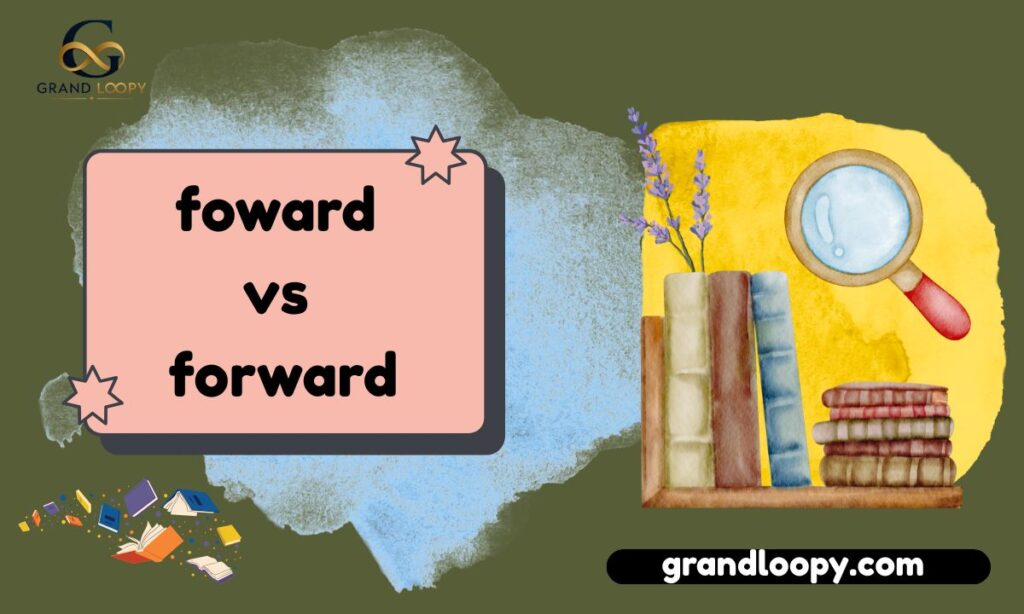

You typed a text, hit send, and then it hit you. Did you just write “foward” instead of “forward”? Your brain freezes for a second, your thumb hovers over the delete button, and now you’re questioning a word you’ve used a thousand times.
Here’s the short answer: “forward” is the correct spelling. “Foward” is not a real English word. It’s simply a common misspelling, usually caused by typing fast or skipping the letter “r.” Once you know this, you’ll never second guess it again.
Is “Foward” a Real Word?
No, “foward” is not a word in the English language. You won’t find it in Merriam Webster, Oxford, or Cambridge dictionaries.
It shows up so often because of how our fingers move on a keyboard. The “r” in “forward” gets skipped, and “foward” slips out instead.
Think of it like ordering a “expresso” instead of an “espresso.” It sounds close enough that your brain doesn’t catch the mistake until later.
What Does “Forward” Actually Mean?
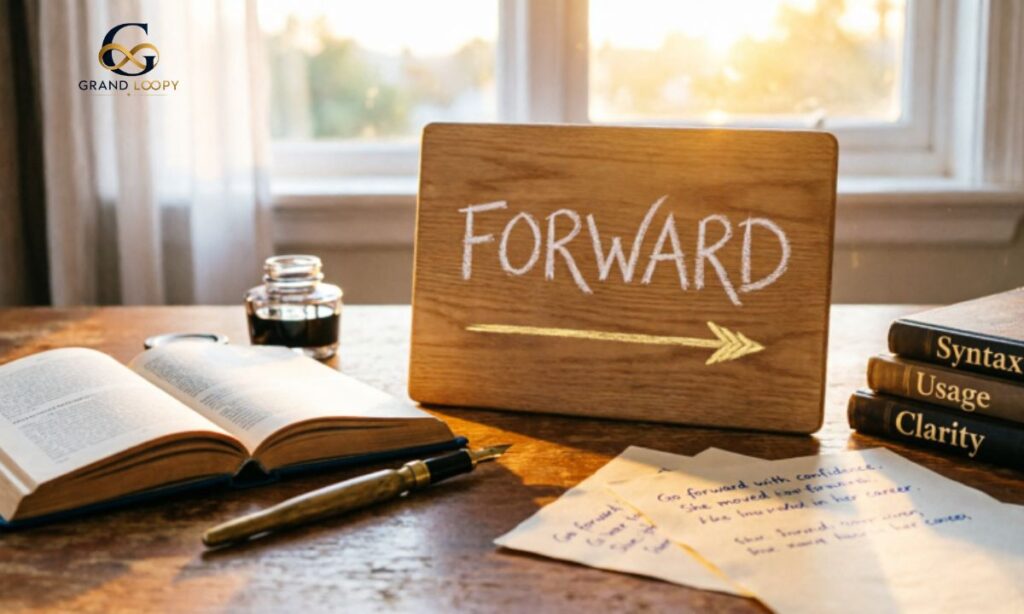
“Forward” is a versatile word, and that’s part of why people misspell it so often. It shows up as an adjective, adverb, verb, and even a noun.
Here’s what it means in everyday use:
- Movement: Moving toward the front (Walk forward, please.)
- Time: Moving ahead in time (Let’s move the meeting forward.)
- Communication: Sending something along (I’ll forward you the email.)
- Sports: A player position (He plays forward on the soccer team.)
- Attitude: Bold or confident (She’s quite forward in interviews.)
One word, five different jobs. No wonder it gets typed in a hurry.
Click Here To Read More Knowledgeable Articles
Where Did the Word “Forward” Come From?
“Forward” has deep roots in Old English. It comes from “foreweard,” a combination of “fore” (meaning before or front) and “weard” (meaning direction, as in toward).
Over hundreds of years, “foreweard” slowly smoothed out into “forward” through natural pronunciation shifts. This is the same pattern you see in words like “toward” and “backward.”
So technically, “foward” isn’t even a shortcut version of an older spelling. It’s just a modern typing slip, not a forgotten historical form.
Biblical and Historical Use of “Forward”
The word “forward” appears frequently throughout classic English literature and religious texts. In the King James Bible, phrases like “go forward” and “press forward” are used to express faith, progress, and obedience.
Exodus 14:15 famously reads, “speak unto the children of Israel, that they go forward.” The word carries a sense of moving with purpose, not just physically, but spiritually and emotionally.
This shows “forward” has always meant more than direction. It represents progress, courage, and momentum, and that meaning has stayed remarkably consistent for centuries.
Foward vs Forward: Quick Comparison Table
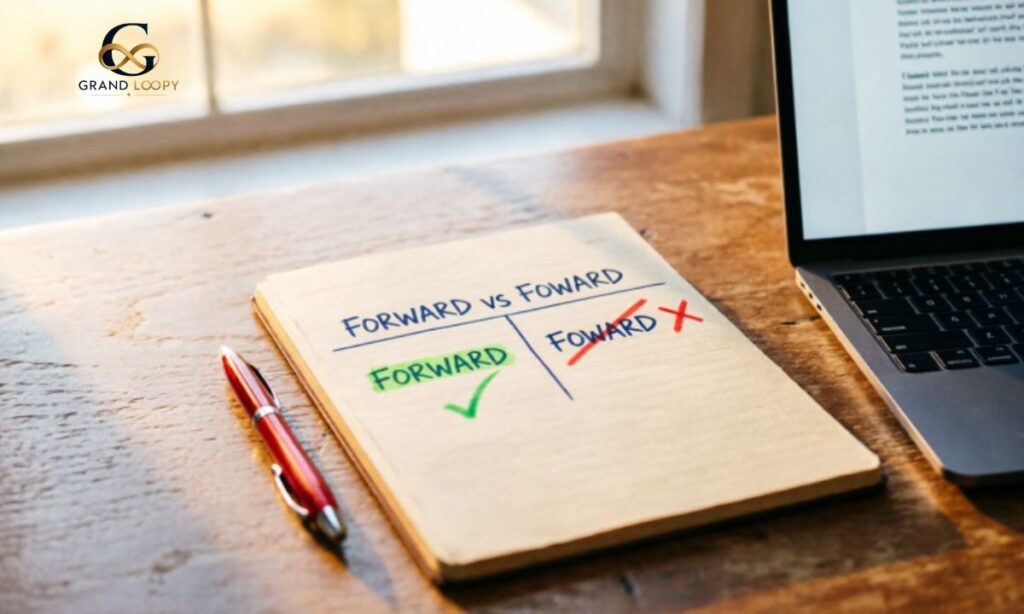
| Foward | Forward |
| Misspelling | Correct spelling |
| Not in any dictionary | Found in every major dictionary |
| Caused by typing error | Standard English word since Old English |
| Never grammatically correct | Used as adjective, verb, adverb, and noun |
| Should always be corrected | Safe to use in any context |
How to Use “Forward” Correctly in a Sentence
Using “forward” correctly is simple once you know its different roles. Here’s a quick guide.
As a verb (to send something along): “Please forward this document to the manager.”
As an adverb (describing movement): “The car moved forward slowly.”
As an adjective (describing something bold or ahead): “She has a forward thinking approach.”
As a noun (in sports): “He was named the team’s starting forward.”
Once you match the sentence structure, the correct spelling becomes second nature.
Real-Life Examples of “Forward” in Action
Seeing “forward” used in real situations helps lock in the correct spelling for good.
- Email: “I’m forwarding this message to the whole team.”
- Business: “Let’s fast forward to the results section of the report.”
- Sports commentary: “The forward scored in the final minute.”
- Everyday speech: “I’m really looking forward to the weekend.”
- Motivation: “Keep moving forward, no matter what.”
Notice how “forward” never changes shape, even when its job in the sentence changes. That consistency is exactly why the correct spelling matters.
Common Mistakes People Make With “Foward”
Beyond the classic typo, a few other mistakes tend to show up alongside “foward.”
- Writing “forword” instead of “forward”
- Confusing “forward” with “foreword” (the introduction section of a book)
- Dropping the “r” when typing quickly on mobile keyboards
- Assuming autocorrect will always catch it (it often won’t, since “foward” can sometimes get accepted as a rushed variant by weak spell checkers)
If you remember one rule, remember this: forward always has the letter combination f o r w a r d, in that exact order, with no letters missing.
Why Do People Keep Typing “Foward”?
This mistake isn’t about intelligence or education. It’s almost entirely mechanical.
When typing fast, especially on phones, your brain sends the instruction “forward” but your fingers sometimes skip the “r” because it’s a quick, easy letter to miss between “fo” and “ward.” Add autocorrect delays, and the error slips through unnoticed.
It’s similar to how people write “definately” instead of “definitely.” The mistake is common precisely because the correct version sounds almost the same when spoken quickly.
Which One Should You Use, Forward or Foward?
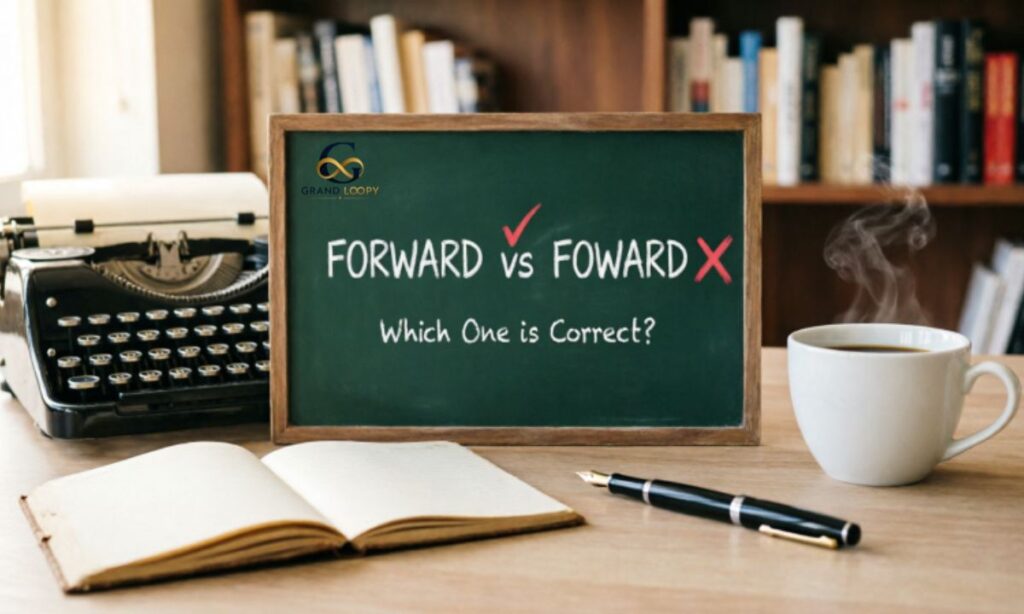
Always use “forward.” There is no situation, formal or casual, where “foward” is acceptable.
Whether you’re writing a résumé, a text message, a school essay, or a business email, “forward” is the only correct choice. Treat “foward” the same way you’d treat any other typo: fix it and move on.
Related Words People Often Mix Up
While we’re clearing up spelling confusion, a few related word pairs trip people up just as often.
Forward vs foreword: “Forward” means ahead or ongoing. A “foreword” is the introduction section written at the start of a book, usually by someone other than the author.
Affect vs effect: “Affect” is usually a verb meaning to influence something (The rain affected our plans). “Effect” is usually a noun meaning the result (The effect of the rain was a canceled game). A simple trick, “A” for Action, “E” for End result.
Take effect vs take affect: The correct phrase is always “take effect,” never “take affect.” “Take effect” means a rule, law, or change officially begins working (The new policy will take effect on Monday). “Take affect” is grammatically incorrect and should never be used, since “affect” is a verb, not a noun that can be “taken.”
Keeping these pairs straight instantly boosts the clarity of your writing.
FAQs About Foward vs Forward
Is “foward” ever correct in any dialect of English?
No. “Foward” is not recognized as correct in American English, British English, or any other regional variation. It is always treated as a spelling error.
What’s an easy trick to remember the correct spelling?
Break it into two parts: “for” and “ward.” If you can spell “for” and “ward” separately, you’ll always spell “forward” correctly.
Does autocorrect always fix “foward” automatically?
Not always. Some keyboards accept it as a close match rather than flagging it, especially on mobile devices. It’s safer to proofread manually rather than relying fully on autocorrect.
Final Thoughts
“Forward” is the only correct spelling, and “foward” is simply a fast typing slip that doesn’t belong in any dictionary. Once you connect the word to its two parts, “for” and “ward,” the mistake becomes easy to catch and even easier to avoid.
Language moves forward, and now, so does your spelling.