What Is Business Casual? The Complete Guide for Men and Women (2026)
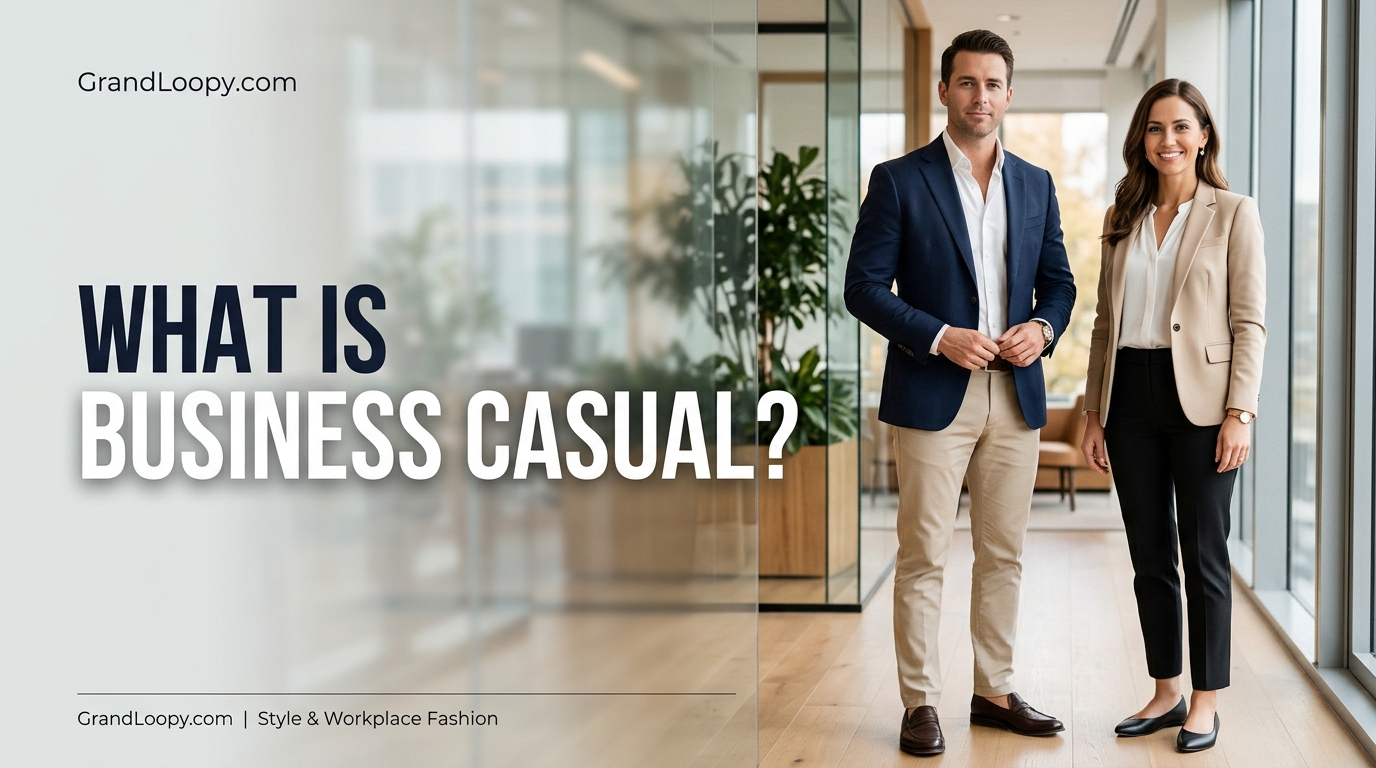
What is business casual? It is a dress code that combines professional pieces with comfortable, everyday pieces, without a full suit or tie.
Business casual means slacks, khakis, or a skirt with a dress shirt, blouse, or polo, with closed-toe shoes and the tie optional.
That is the Emily Post Institute’s definition, and it is the clearest one in use.
The code sits between business professional and casual. It is more polished than jeans and a T-shirt, and less formal than a matching suit, and most American offices now use it as the default.
A Gallup poll from 2023 found that 41% of U.S. workers reported wearing business casual, as reported by Salary.com. That makes it the most common office dress code in the country.
This guide defines the code, places it on the dress code ladder, and walks through what men and women wear, what to avoid, and how to build a wardrobe that works every day.
What Is Business Casual?
Business casual is a Western dress code that merges traditional, professional clothing with more comfortable, everyday pieces. The goal is a look that is polished, well-groomed, and appropriate for a white-collar office.
At its core, business casual excludes ultra-formal items like matching three-piece suits and evening wear, and ultra-casual items like athletic wear, ripped jeans, flip-flops, or T-shirts with large graphics.
The Emily Post Institute admits the problem up front: casual business attire is pretty ambiguous. Its working rule is what is acceptable is about one notch down the formality chain from the usual expectations.
That rule has two versions. Where people usually wear suits, business casual means a jacket, a button-down dress shirt with the tie optional, slacks, and loafers.
Where people do not usually wear suits, it means an optional sweater, a button-down, chinos or khakis, and casual leather shoes or well-kept sneakers.
The code is defined more by its don’ts than its dos.
Business casual dressing is more about avoiding a list of don’ts than following a list of dos, and the don’ts are the same in most offices.
When the dress code is unclear, research the employer and dress one level more formal than the everyday norm.
Check the written policy, look at recent company photos, and ask HR about jeans, sneakers, or visible logos.
The Dress Code Ladder: Where Business Casual Sits
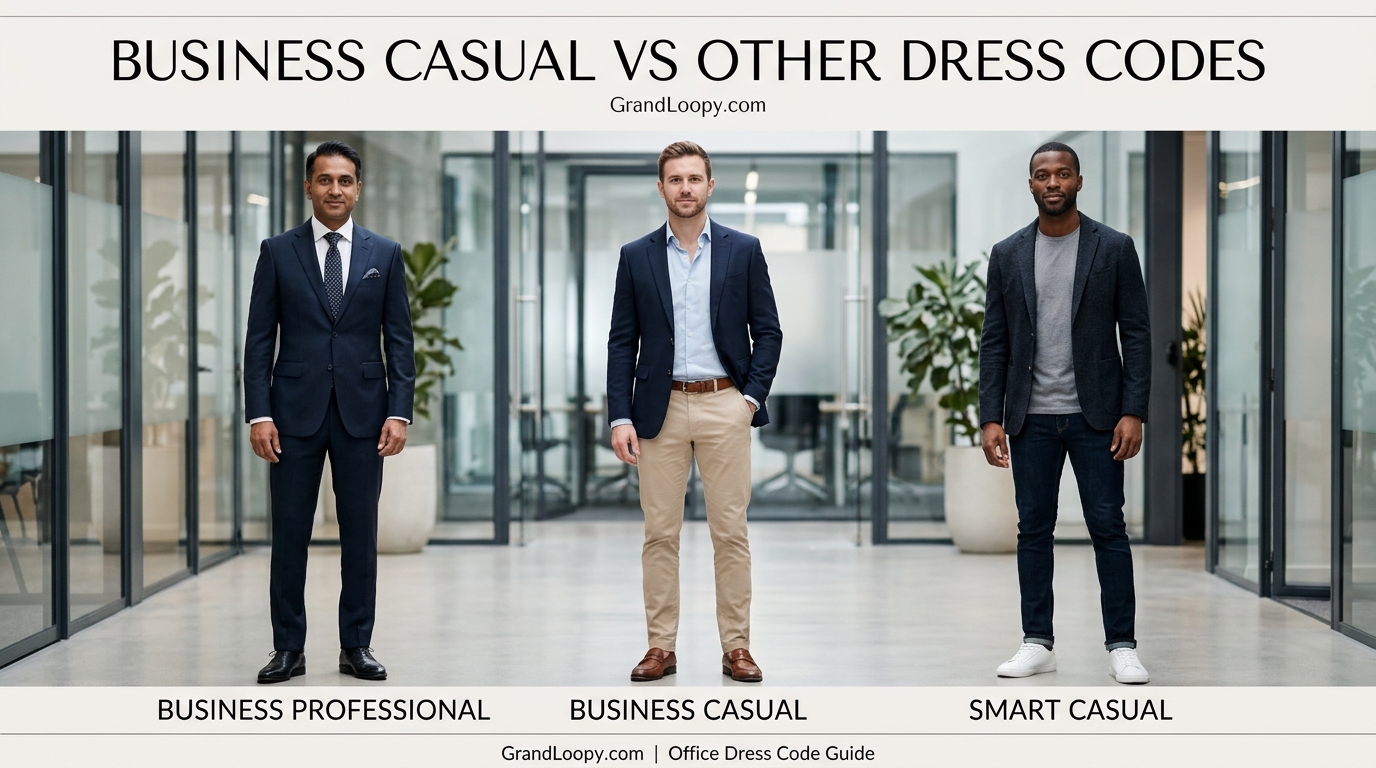
Business casual sits in the middle of the formality ladder, between business professional above it and smart casual below it. The ladder runs from business formal at the top to casual at the bottom.
Business formal is the highest level: a matched suit, a conservative tie for men, and a tailored suit or dress for women. It belongs in boardrooms, law firms, and formal events.
Business professional is one step down: a suit is still expected, but separates and a wider color range are allowed. It is the standard in banking, consulting, and corporate offices.
Business casual drops the matched suit and makes the tie optional. It is the standard in most modern workplaces, and it is the level this guide covers.
Smart casual is one step below business casual: dark jeans, a blazer, and clean sneakers can all appear, and the emphasis shifts from work-appropriate to personal style.
| Dress code | Formality | Typical clothing | Common workplaces |
|---|---|---|---|
| Business formal | Highest | Matched suit, tie, formal dress | Law firms, boardrooms, executive leadership |
| Business professional | High | Suits, tailored separates, dress shoes | Banking, consulting, corporate offices |
| Business casual | Medium | Blazers, chinos, blouses, loafers | Most modern workplaces |
| Smart casual | Relaxed | Dark jeans, blazer, clean sneakers | Tech, marketing, creative industries |
| Casual | Lowest | T-shirts, jeans, comfortable shoes | Informal offices, weekends |
The ladder is a guide, not a law. A tech company and a financial firm draw the line in different places, and Indeed’s guide, updated in June 2026, makes that point clearly.
The Emily Post attire guide lists ten dress codes from casual to white tie, and business casual sits fourth from the bottom. That guide is the authority most offices borrow from.
Your company’s own code always overrides the general rule. The Emily Post Institute says the same thing on every page: always check and abide by your company’s dress code.
Business Casual vs Business Professional
Business professional is the more formal code, and the difference is the suit. Business professional requires a matching suit, while business casual allows coordinated separates that do not match.
For men, business professional means a dark, matching suit in navy, charcoal, or black, a collared dress shirt, a tie, and polished leather dress shoes.
Business casual drops the tie and lets the jacket and trousers differ.
For women, business professional means a tailored pantsuit or skirt suit in a neutral color, worn with a conservative blouse.
Business casual allows a blouse with tailored trousers, or a dress with a cardigan, and no suit is required.
Ties are required for business professional and optional for business casual. That single difference is the line most offices use to tell the two codes apart.
Choose business professional for formal presentations, board meetings, and traditional corporate environments where credibility demands maximum polish. Choose business casual for regular office days, internal meetings, and most modern workplaces.
When in doubt, dress one level up. A business casual outfit at a business professional event looks underdressed, while a business professional outfit at a business casual office just looks sharp.
Business Casual vs Smart Casual
Smart casual is more relaxed than business casual, and the difference is intent. Business casual is a workplace code, while smart casual is mainly a social code that some offices borrow.
Business casual leans conservative and workplace-focused. It usually includes dress pants, button-down shirts, blouses, skirts, cardigans, loafers, and closed-toe shoes.
Smart casual allows more personal style and modern pieces. It may include fashionable jackets, clean sneakers, dark jeans, elevated knitwear, stylish accessories, or more creative combinations.
The Emily Post Institute’s attire guide has an entry for business casual and none for smart casual. American usage took smart casual’s meaning from the office, not from etiquette books.
Indeed’s 2026 career guide treats smart casual as business casual plus trendy pieces such as leather sneakers, bold prints, and statement accessories. That is a useful shorthand for the difference.
Side-by-side example. Business casual: dress pants, a button-down shirt, and loafers. Smart casual: dark jeans, a blazer, a clean T-shirt, and loafers. The blazer is the same, and everything else relaxes.
Choose business casual for the workplace and smart casual for social or informal events. If your office says business casual, do not dress smart casual and hope nobody notices.
| Business professional | Business casual | Smart casual | |
|---|---|---|---|
| Suit | Matching suit required | Separates, no matching suit | No suit needed |
| Tie | Required | Optional | Not worn |
| Bottoms | Dress slacks | Dress pants, chinos, khakis | Dark jeans, chinos |
| Shoes | Polished leather dress shoes | Loafers, oxfords, flats | Clean sneakers, loafers |
| Where | Banking, law, board meetings | Most modern workplaces | Social events, creative offices |
Business Casual for Men
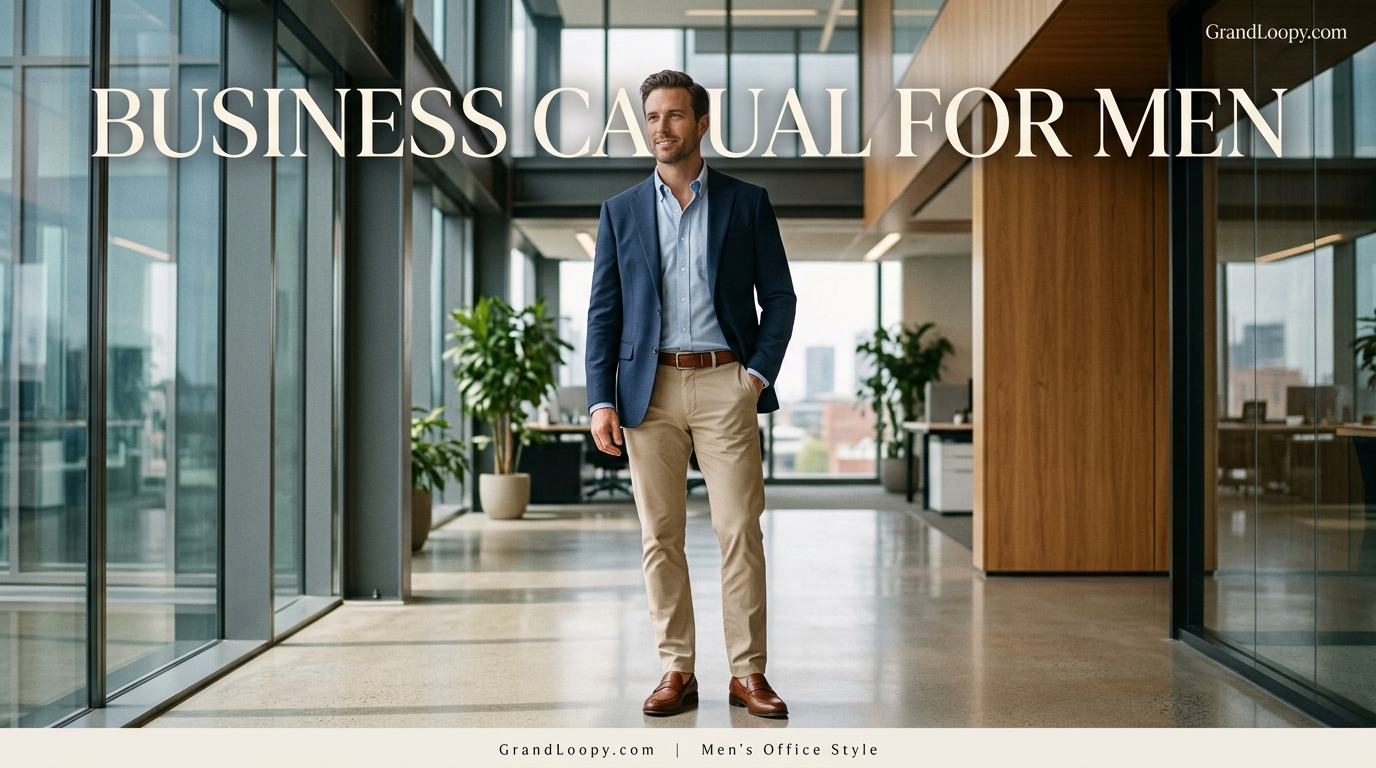
For men, business casual is about subtracting formality from a traditional suit while keeping the sharp silhouette. The defining feature is the collar, and the goal is clean lines, thoughtful colors, and a tailored fit.
Start with the shirt. A long-sleeved button-down is the cornerstone, and an oxford cloth button-down is the standard. Polos are a second choice, and they work best in warmer weather or more relaxed offices.
Stick to dress slacks or chino pants, commonly known as khakis. Chinos are the most versatile piece in the male business casual wardrobe, and tan, navy, olive, and grey cover most offices.
Add a blazer or sport coat to sharpen the look instantly. A seasonal sport coat with slacks or khakis is Emily Post’s men’s list, and it works in suit offices and casual ones alike.
Wear loafers, oxfords, or brogues, and add clean leather sneakers only where the office clearly allows them. Avoid athletic shoes, worn footwear, flip-flops, and casual sandals.
Ties are generally not required for business casual. If you wear one, choose a knit tie or a fun pattern to distinguish it from formal corporate wear.
Outfit example one: a pressed white button-down, navy dress slacks, a navy blazer, and brown loafers. That is Indeed’s 2026 interview example, and it works for a first day too.
Outfit example two: a light blue oxford shirt, tan chinos, a grey sweater, and clean leather shoes. That is the less dressy version, and it fits a relaxed office.
Outfit example three: a navy polo, charcoal chinos, and loafers with socks. That is the warm-weather version, and it needs a belt and a clean, pressed shirt to stay professional.
Business Casual for Women
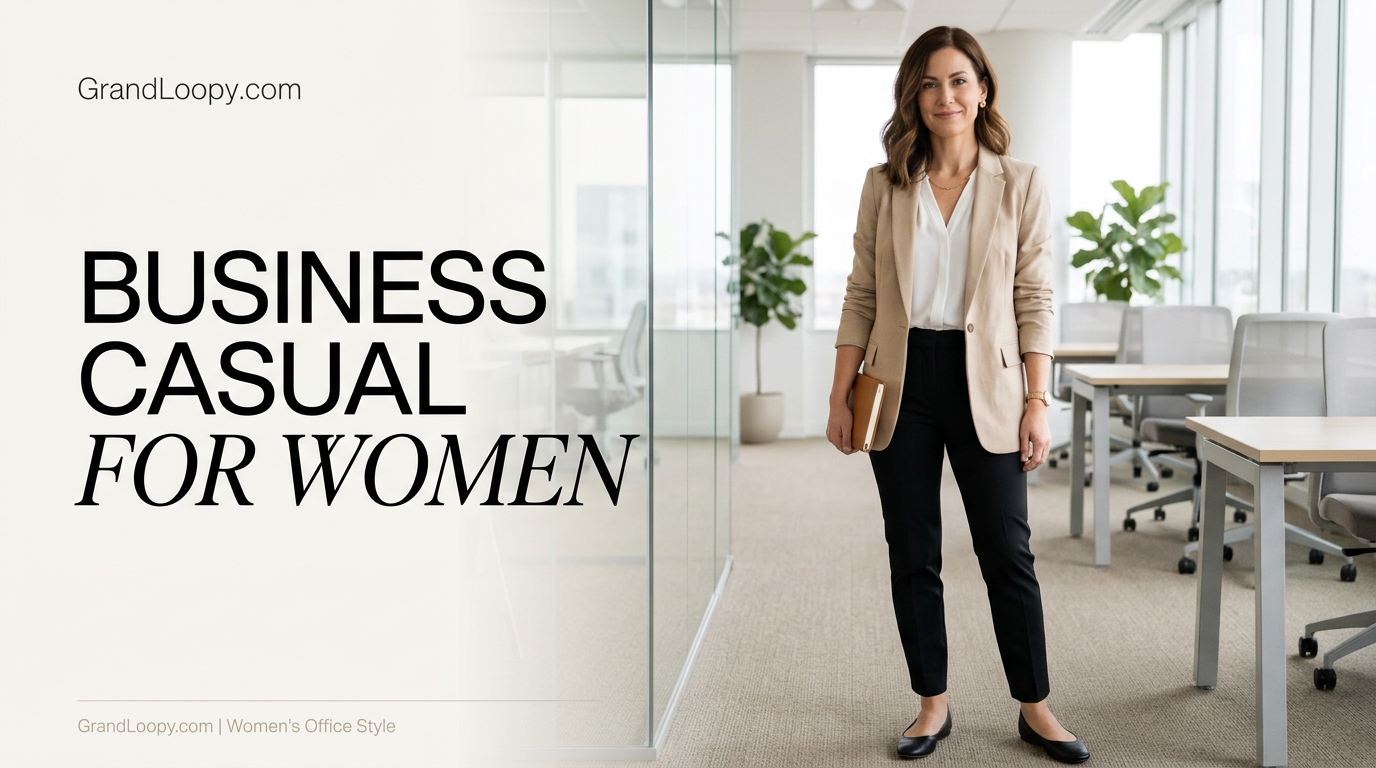
For women, business casual offers more choice, which makes it trickier to interpret. The goal is the same: professional, comfortable, and modest, so you can feel confident in any workplace setting.
Start with the top. Blouses, silk shirts, and high-quality knit sweaters are timeless choices. Sleeveless tops with wide straps may be fine in many workplaces, especially when paired with a blazer or cardigan.
For bottoms, tailored dress pants, chinos, and tailored trousers are the go-to options. Knee-length or midi skirts and dresses are always a safe bet, and the length and tightness should suit the office.
A sheath dress paired with another layer is Indeed’s 2026 starter recommendation. A dress is business casual when it is knee-length, modest, and paired with a cardigan or blazer.
Wear closed-toe heels, flats, or loafers. Closed-toe shoes are the rule as long as the word business is in the dress code, and Emily Post’s guide is explicit about that.
Avoid spaghetti straps, low necklines, and strapless dresses. Emily Post’s women’s list rules out spaghetti straps and a low neckline, and her summer guide adds strapless dresses.
Outfit example one: a white blouse, black tailored trousers, a black blazer, and black flats. That is the most versatile business casual outfit a woman can own.
Outfit example two: a navy sheath dress, a grey cardigan, and nude closed-toe heels. That is the dress-first version, and it needs no separate top or bottom.
Outfit example three: a striped knit sweater, wide-leg grey trousers, and loafers. That is the relaxed version, and it fits a creative or tech office.
Gender-Neutral Business Casual
A polished business casual outfit can combine any of the pieces above, and the men’s and women’s guides are starting points, not rules.
Trousers, a skirt, a dress, a blouse, a button-down, a sweater, a blazer, or office-appropriate shoes all belong in the same wardrobe.
Prioritize the written policy, the workplace culture, fit, cleanliness, and comfort over trying to match a gendered template. Those five things matter more than which section of the store the clothes came from.
Gender-neutral business casual prioritizes comfort and flexibility over strict gender norms. The pieces are the same, and the fit is what makes them yours.
When a dress code is written in gendered language, read it for the formality level, not the garment list. A collared shirt, tailored trousers, and closed-toe shoes meet the standard regardless of who wears them.
Ask HR when the policy is unclear. A short question about jeans, sneakers, or visible logos saves a week of guessing, and HR expects the question from new hires.
What NOT to Wear: Business Casual Don’ts
Knowing what not to wear is as important as knowing what to wear. The don’ts are the same in most offices, and they are the fastest way to look out of place.
Do not wear athletic wear: no leggings, yoga pants, tracksuits, or hoodies. If you would wear it to the gym, it does not belong in the office.
Do not wear beachwear: no flip-flops, shorts, or tank tops. Flip-flops are rarely acceptable, and Emily Post notes they are distracting for the sound they make.
Do not wear distressed clothing: ripped jeans or frayed hems look sloppy. A step down in formality does not change any expectations about the care and cleanliness of your clothes.
Do not wear excessive branding: shirts with giant logos or slogans belong off duty. A small logo is fine, and a slogan across the chest is not.
Do not wear wrinkled clothes: even an expensive shirt looks bad if it is wrinkled. Invest in an iron or a steamer, because neat and clean still counts.
Do not wear baggy, old, or logo-ridden shirts or pants. Keep your ensemble looking fresh and clean, and replace the pieces that have faded or stretched out.
A good rule of thumb is simple.
If you would wear it to the gym, the beach, or a nightclub, it is not business casual, and that test catches most mistakes before you leave the house.
| Category | Acceptable | Generally excluded |
|---|---|---|
| Tops | Collared shirts, blouses, sweaters, cardigans, blazers | T-shirts with large graphics, hoodies, low-cut or spaghetti-strap tops |
| Bottoms | Dress pants, slacks, chinos, khakis, knee-length skirts | Shorts, miniskirts, cargo pants, sweatpants, leggings as pants, ripped jeans |
| Footwear | Loafers, oxfords, flats, dressy boots, closed-toe low heels | Flip-flops, athletic sneakers, overly flashy or sequined shoes |
| Accessories | Leather belt, watch, modest jewelry, leather bag | Baseball caps, oversized logos, distracting jewelry |
The Jeans Question
Are jeans business casual? Usually no, and sometimes yes. The answer depends on the office, the jeans, and the day, and the safest default is no.
Emily Post’s answer is direct: jeans are usually a no. Clean and neat, well fitted, in an atmosphere that is on the more casual end of the spectrum, you could maybe do it.
Dark-wash, hole-free denim is the only version that ever qualifies. Pair it with a blazer and closed-toe shoes to elevate the look, and never wear ripped, faded, or baggy jeans to work.
Many modern offices allow dark jeans on Fridays or in relaxed environments. Friday is usually the day for jeans, and the rule is still dark wash and a good fit.
Check your office’s dress code policy before you wear jeans. Some progressive offices allow them, and some do not, and the written policy is the only answer that counts.
Decision test for jeans. Are they dark wash, with no holes, no fading, and a tailored fit? Is the office relaxed, and is it Friday or a casual day?
If every answer is yes, pair them with a blazer.
Jeans stretch out after wearing them, and that is why a good fit disappears over time. Baggy jeans are never business casual, and stretched-out jeans are baggy jeans.
The Sneakers Question
Are sneakers business casual? Usually no, with one exception. Clean, minimal leather sneakers in a neutral color can work in relaxed offices, and athletic sneakers cannot.
Emily Post’s answer is direct: leather shoes are probably the safest bet for business casual, and sneakers are usually a no-go. That is the default rule.
The exception is the less dressy version of the code, where Emily Post allows casual leather shoes or well-kept sneakers. The key words are leather and well-kept, and both must be true.
White sneakers are the hardest to keep clean, and a stained sneaker breaks the rule even if the style is right.
Our guide to why white sneakers turn yellow after washing covers the nine causes and the fixes.
Never wear running shoes, gym shoes, or brightly colored athletic sneakers to the office. They read as sportswear, and sportswear is the clearest business casual don’t.
Decision test for sneakers. Are they leather, in a neutral color, clean, and free of logos? Does the office allow them? If every answer is yes, they can work with chinos and a blazer.
Business Casual by Industry
Business casual means different things in different industries. A tech company and a financial firm draw the line in different places, and the industry table below shows where.
In finance and law, business casual is the dressier version: a blazer is often required, a collared button-down is standard, and leather dress shoes are expected. Jeans and sneakers are almost never allowed.
In tech and startups, business casual is the relaxed version: a sweater and chinos, a polo, and clean leather shoes are normal. Dark jeans and minimal sneakers appear in many tech offices.
In creative agencies and marketing, business casual allows more personal style. Bold prints, statement accessories, and trendy pieces are part of the code, and the line sits closer to smart casual.
In government and healthcare, business casual is conservative and practical. Closed-toe shoes are required for safety, and modest, neat clothing is the standard.
| Industry | Men’s interpretation | Women’s interpretation |
|---|---|---|
| Finance and law | Blazer often required, collared button-down, dress slacks, leather dress shoes | Tailored pieces, blazers, knee-length skirts, high-quality blouses, modest heels |
| Tech and startups | Polo or button-down, chinos, clean leather shoes or minimal sneakers | Knit tops, tailored trousers, flats or loafers, cardigans |
| Creative and marketing | Blazer with chinos, patterned shirt, loafers, personal style allowed | Bold prints, statement accessories, dresses with blazers, stylish flats |
| Government and healthcare | Button-down, dress slacks, closed-toe leather shoes, neat grooming | Blouses, tailored trousers or knee-length skirts, closed-toe flats or low heels |
| General office | Button-down or polo, chinos, optional sport coat, loafers | Blouses, cardigans, dress pants or midi skirts, flats or low heels |
When you change industries, change your default. The same outfit that is perfect in a startup can look underdressed in a bank, and the industry table is the fastest way to recalibrate.
Business Casual by Season
Business casual changes with the weather, and the rules change with it. Summer allows lighter fabrics and shorter sleeves, while winter demands layering, and both seasons keep the same formality level.
In summer, choose breathable fabrics: cotton, linen, and lightweight wool. A polo with khakis is the warm-weather default for men, and a sleeveless top with wide straps, layered under a blazer, works for women.
Summer does not mean shorts. In the majority of offices, nothing says you do not take your job seriously more than wearing shorts, and Emily Post’s summer guidance is blunt about that.
Keep a thin sweater or lightweight jacket with you to ward off chills during morning meetings. Air conditioning is the real summer challenge, and a layer solves it.
In winter, layer with sweaters, cardigans, and blazers over a collared shirt. Darker colors and heavier fabrics like wool and corduroy fit the season, and dressy boots replace loafers on wet days.
Wrinkles are harder to fight in humid summer months, but neat and clean still counts.
Wrinkled khakis and a stained or faded polo shirt are as bad as showing up in gym shorts and a T-shirt.
| Season | Fabrics | Men | Women | Watch out for |
|---|---|---|---|---|
| Summer | Cotton, linen, lightweight wool | Polo, khakis, loafers, light blazer | Wide-strap top with blazer, knee-length dress, flats | Shorts, tank tops, flip-flops, wrinkles |
| Winter | Wool, corduroy, knit, cashmere | Sweater over button-down, dress slacks, dressy boots | Cardigan over blouse, tailored trousers, dressy boots | Bulky coats indoors, wet shoes, heavy scarves |
| Spring and fall | Cotton, twill, light wool | Button-down, chinos, blazer, loafers | Blouse, midi skirt, blazer, flats or low heels | Rain, mud, sudden temperature swings |
Black clothes fade faster in the sun, and faded black reads as sloppy.
Our guide to why black clothes fade so quickly covers the ten causes and the fixes, and it matters for a wardrobe built on black trousers.
What to Wear to a Business Casual Interview
Dress one level more formal than the office norm for an interview. The interview is the one day where overdressing is safer than underdressing, and the rule is the same across industries.
For men, wear a pressed button-down, dress slacks, a blazer, and leather shoes.
Indeed’s 2026 interview example is loafers, slacks, and a pressed white button-down, and it works because it is polished without being a full suit.
For women, wear a tailored blouse, tailored trousers or a knee-length skirt, a blazer, and closed-toe flats or low heels.
A sheath dress with a blazer is the dress-first version, and it works just as well.
Never wear jeans to a business casual interview, even if the office allows them on Fridays. The interview is not Friday, and the hiring manager is judging the whole package.
Never wear sneakers to an interview, even clean leather ones. Leather dress shoes are the safest choice, and they signal that you took the meeting seriously.
Check the company’s photos before the interview. Look at recent company photos or social posts to see what employees actually wear, and then dress one step above that.
PennWest University’s career center guide covers professional attire for interviews and meetings, with examples for each dress code level. It is a useful second opinion before a big day.
What to Wear on Your First Day
Your first day is a dress rehearsal for the office. Wear the interview outfit again, or one step below it, and watch what your colleagues wear before you relax.
Start with the safest version of the code: a collared shirt, tailored trousers or a knee-length skirt, a blazer, and closed-toe shoes.
You can always remove the blazer, but you cannot add one you left at home.
Bring a blazer even if you do not plan to wear it. Keep it at your desk for client meetings, and it becomes your third piece on the days you need one.
Observe your colleagues on day one, and ask your manager about specifics. A short question about jeans, sneakers, or open-toe shoes saves a week of guessing.
First-day checklist. Pressed shirt, tailored trousers or skirt, blazer, closed-toe shoes, leather belt, watch, and a bag that fits a laptop. That is the whole list.
Business Casual for Video Calls and Hybrid Work
Video calls have their own version of business casual. The camera shows your top half, and the top half is what matters, but the bottom half still counts when you stand up.
Wear a collared shirt, a blouse, or a knit top on camera. Solid colors and subtle patterns read best on video, and busy patterns, stripes, and bright white can shimmer or glare.
Add a blazer or cardigan for client calls and interviews. The third piece is the fastest way to look polished on a small screen, and it needs no ironing to read well.
Wear real trousers, not shorts or sweatpants, even if the camera never shows them. You will stand up at some point, and the person who stands up in shorts is the story of the meeting.
Keep your background tidy and your lighting in front of you. A neat background and good light do more for your professional image than any shirt.
Hybrid rule: dress for the office you are in. Office days follow the office code, and home days follow the video-call code, and the blazer is the bridge between them.
How to Build a Business Casual Capsule Wardrobe
A capsule wardrobe is a small set of pieces that mix and match. Ten pieces, chosen well, can make thirty outfits, and the cost per wear falls every time you wear them.
Build around neutrals first: black, navy, grey, white, and camel. Neutrals pair with everything, and they make a small wardrobe feel large.
Buy quality over quantity. A well-made blazer that fits beats three cheap ones that do not, and tailoring is the cheapest upgrade in the wardrobe.
Our guide to how to build a capsule wardrobe without buying more clothes shows how to start from the pieces you already own. That is the cheapest way to begin.
| Piece | Example price | Wears per year | Cost per wear |
|---|---|---|---|
| Navy blazer | $120 | 60 | $2.00 |
| White button-down shirt | $40 | 50 | $0.80 |
| Light blue button-down shirt | $40 | 50 | $0.80 |
| Black tailored trousers | $60 | 60 | $1.00 |
| Navy chinos | $50 | 50 | $1.00 |
| Grey cardigan | $50 | 40 | $1.25 |
| White blouse | $40 | 40 | $1.00 |
| Black knee-length skirt | $50 | 30 | $1.67 |
| Brown loafers | $90 | 80 | $1.13 |
| Black flats | $70 | 80 | $0.88 |
| Total | $610 | 540 | $1.13 average |
The prices above are example prices, not quotes. Check current retail prices before you buy, and use the table for the method, not the numbers.
Cost per wear is the price divided by the number of times you wear the piece.
A $120 blazer worn 60 times costs $2.00 per wear, and a $20 shirt worn twice costs $10.00 per wear.
Business Casual on a Budget
You can build a business casual wardrobe on a budget.
The trick is to buy neutrals first, buy quality second, and buy the blazer last, because the blazer is the most expensive piece and the easiest to add later.
Start with two shirts, two trousers, and one pair of shoes. That is five pieces, and it makes ten outfits with a cardigan or a blazer added.
Buy the trousers first, because they wear out fastest and fit matters most. A well-fitting pair of black trousers is the foundation of the whole wardrobe.
Thrift stores and outlet sales are the best places to find a blazer.
A $30 blazer that fits beats a $120 blazer that does not, and a tailor can fix the rest for a small fee.
| Budget tier | Total spend | What it buys | Best for |
|---|---|---|---|
| Starter | Under $300 | 2 shirts, 2 trousers, 1 pair of shoes, 1 cardigan | First job, tight budget |
| Standard | $300 to $600 | 4 shirts, 3 trousers, 1 blazer, 2 pairs of shoes | Most office workers |
| Full wardrobe | $600 to $1,000 | 10-piece capsule, 2 blazers, 3 pairs of shoes, accessories | Client-facing roles |
Clothes look better in stores than at home for a reason.
Our guide to why clothes look better in stores than at home explains the lighting, the fit, and the styling, and it helps you shop smarter.
The Third Piece Rule and Color Palette
The third piece rule is the fastest styling trick in business casual. Your top is the first piece, your pants are the second, and the third piece pulls the look together.
The third piece can be a blazer, a structured cardigan, or a statement belt. It adds structure, and structure is what separates business casual from plain casual.
Keep a blazer at your desk. It is the third piece on demand, and it turns a polo and chinos into an outfit that survives a surprise client meeting.
Build your color palette around neutrals: black, navy, grey, white, and camel. Neutrals pair with everything, and they make a small wardrobe feel large.
Add one or two accent colors that suit you: burgundy, forest green, or dusty blue. Accents belong in the shirt or the sweater, and neutrals belong in the trousers and the blazer.
Avoid loud patterns and bright neons at work. Subtle patterns like thin stripes, small checks, and fine dots are fine, and anything that distracts from your face is not.
Fit, Grooming, and the Details That Matter
Fit matters more than price. A $40 shirt that fits beats a $140 shirt that does not, and tailoring is the cheapest upgrade in the wardrobe.
Shirts should sit on the shoulder seam, and sleeves should end at the wrist bone. Trousers should break once at the shoe, and a jacket should button without pulling.
Wear a belt with any tucked shirt. Emily Post says you can only tuck a shirt properly with a belt, and a missing belt is the detail people notice.
Keep your shoes clean and polished. Worn footwear is the fastest way to look sloppy, and clean leather shoes are the fastest way to look polished.
Grooming is part of the dress code. Clean hair, trimmed nails, and a light touch with fragrance are the baseline, and they cost nothing.
Tattoos and piercings depend on the office. Check the written policy, and cover tattoos for client meetings and interviews when the policy is unclear.
What to Do When the Dress Code Is Unclear
Most dress code confusion comes from a policy nobody read. The fix is a short checklist, and it takes less than an hour.
Step one: read the employee handbook. The dress code is usually in the first ten pages, and it answers the jeans and sneakers questions directly.
Step two: look at recent company photos or social posts. They show what employees actually wear, and that is more honest than the handbook.
Step three: ask HR or your manager about specifics. Ask about jeans, sneakers, open-toe shoes, and visible logos, and write down the answers.
Step four: observe your colleagues for a week. Watch what the people at your level wear, and match the median, not the most casual person in the room.
Step five: dress one level more formal than the everyday norm until you are sure. A blazer on day one is easy to remove, and a T-shirt on day one is hard to forget.
When in doubt, dress slightly more formally than you think you need to. That rule appears in almost every guide, and it appears here because it works.
Keep Reading on GrandLoopy
Business casual sits inside a bigger professional life, and the guides below cover the pieces around it. Each one is live on GrandLoopy and verified at writing time.
Start with the wardrobe itself in how to build a capsule wardrobe without buying more clothes.
That guide shows how to start from the pieces you already own, and it pairs with the capsule wardrobe table above.
A business casual wardrobe is also a career investment, and our guide to how to write a business plan in 9 steps covers the document that turns a good job into your own business.
The plan is step three of the launch, and the wardrobe is the part people see first.
GrandLoopy has no dedicated men’s office outfits page yet, and no women’s work outfits page, no business casual shoes page, and no interview outfits page.
Those are the natural follow-ups to this guide, and they would close the cluster this article opens.
Key Takeaways
Business casual means slacks, khakis, or a skirt with a dress shirt, blouse, or polo, closed-toe shoes, and the tie optional. That is Emily Post’s definition, and it is the clearest one in use.
It is one notch down from your office’s usual. Where people wear suits, add a jacket and drop the tie. Where they do not, a sweater, a button-down, and chinos are enough.
Business casual sits between business professional and smart casual. Business professional keeps the matched suit and the tie, and smart casual allows dark jeans and clean sneakers.
Jeans and sneakers are usually no. Dark-wash, hole-free jeans and clean leather sneakers can work in relaxed offices, and athletic sneakers and ripped jeans never do.
Build a capsule wardrobe of ten pieces in neutrals. Ten pieces make thirty outfits, and the cost per wear falls every time you wear them.
When in doubt, dress one level up. A blazer on day one is easy to remove, and a T-shirt on day one is hard to forget.
Frequently Asked Questions
What is business casual?
Business casual is a dress code that combines professional pieces with comfortable, everyday pieces, without a full suit or tie.
It means slacks, khakis, or a skirt with a dress shirt, blouse, or polo, and closed-toe shoes.
What does business casual mean?
It means polished but comfortable at work. The code falls between professional and casual, and the goal is to look professional yet approachable and comfortable.
Are jeans business casual?
Usually no, and sometimes yes. Dark-wash, hole-free jeans can work in relaxed offices, especially on Fridays, but Emily Post says jeans are usually a no, and the written policy is the only answer that counts.
Are sneakers business casual?
Usually no, with one exception. Clean, minimal leather sneakers in a neutral color can work in relaxed offices, while athletic sneakers cannot, and leather dress shoes are always the safest choice.
Is a polo shirt business casual?
Yes, in most offices. A polo is a second choice after a button-down, and it works best in warmer weather or more relaxed offices, paired with chinos and a belt.
Are leggings business casual?
No, not as pants. Leggings are athletic wear, and business casual excludes athletic wear. They can work under a long tunic or dress in some offices, but never as trousers on their own.
What shoes are business casual?
Loafers, oxfords, brogues, flats, and closed-toe low heels are the standard. Dressy boots work in winter, and clean leather sneakers work only where the office clearly allows them.
Do you need a tie for business casual?
No, ties are optional for business casual. That is the key difference from business professional, where a tie is required. If you wear one, choose a knit tie or a fun pattern.
What is the difference between business casual and smart casual?
Smart casual is more relaxed than business casual. Business casual is a workplace code with dress pants and button-downs, while smart casual allows dark jeans, clean sneakers, and more personal style.
What is the difference between business casual and business professional?
Business professional requires a matching suit and a tie. Business casual drops the matched suit, makes the tie optional, and allows coordinated separates that do not match.
What should a woman wear for business casual?
A blouse or knit sweater with tailored trousers, a knee-length skirt, or a sheath dress, plus a blazer or cardigan and closed-toe flats or low heels. Avoid spaghetti straps and low necklines.
What should a man wear for business casual?
A button-down shirt with dress slacks or chinos, plus a blazer or sport coat and loafers or oxfords. A polo is a second choice, and a tie is optional.
Can you wear a dress for business casual?
Yes, when it is knee-length and modest. A sheath dress paired with a cardigan or blazer is a classic business casual outfit, and strapless or very short dresses are not.
What is business casual for a job interview?
Dress one level more formal than the office norm. Wear a pressed button-down, dress slacks, a blazer, and leather shoes, and never wear jeans or sneakers to an interview.
What should I wear on my first day at a business casual office?
Wear the interview outfit again, or one step below it. Start with a collared shirt, tailored trousers or a knee-length skirt, a blazer, and closed-toe shoes, and watch what colleagues wear.
What is business casual in summer?
Lighter fabrics and shorter sleeves, with the same formality. Choose cotton and linen, a polo with khakis for men, and a wide-strap top with a blazer for women, and never wear shorts.
What is business casual in winter?
Layer with sweaters, cardigans, and blazers over a collared shirt. Darker colors and heavier fabrics like wool fit the season, and dressy boots replace loafers on wet days.
Can you wear open-toe shoes for business casual?
Usually no. Emily Post’s rule is to stick to closed-toe shoes as long as the word business is in the dress code, and sandals are iffy even in summer.
Are sandals business casual?
No, sandals are not business casual. Closed-toe shoes are the rule, and flip-flops are rarely acceptable and distracting for the sound they make.
What is business casual for a client meeting?
Dress one level up from your everyday office outfit. Add a blazer, wear leather dress shoes, and keep the look polished, because the client is judging the whole company by you.
What is business casual for a startup?
The relaxed version: a sweater and chinos, a polo, and clean leather shoes. Dark jeans and minimal sneakers appear in many tech offices, but check the policy first.
What is business casual for a law firm?
The dressy version: a blazer is often required, with a collared button-down and leather dress shoes. Jeans and sneakers are almost never allowed, and the line sits close to business professional.
What is business casual for a video call?
A collared shirt, blouse, or knit top, plus a blazer or cardigan for client calls. Solid colors read best on camera, and wear real trousers even if the camera never shows them.
How do I build a business casual wardrobe on a budget?
Buy neutrals first, buy quality second, and buy the blazer last. Start with two shirts, two trousers, and one pair of shoes, and add a blazer from a thrift store or outlet sale.
What is a business casual capsule wardrobe?
A small set of pieces that mix and match. Ten pieces in neutrals can make thirty outfits, and the cost per wear falls every time you wear them.
Conclusion
What is business casual comes down to one rule. Dress one notch down from your office’s usual, keep it clean and tailored, and let the don’ts do the work.
Start with the Emily Post definition: slacks, khakis, or a skirt with a dress shirt, blouse, or polo, closed-toe shoes, and the tie optional. Then adjust for your industry, your season, and your office.
Build the ten-piece capsule wardrobe, keep a blazer at your desk, and dress one level up for interviews and client meetings. That is the whole system, and it works in every office.
When in doubt, dress slightly more formally than you think you need to. A blazer on day one is easy to remove, and a T-shirt on day one is hard to forget.