What Is Gothic Fashion? Styles, History, and How to Wear It
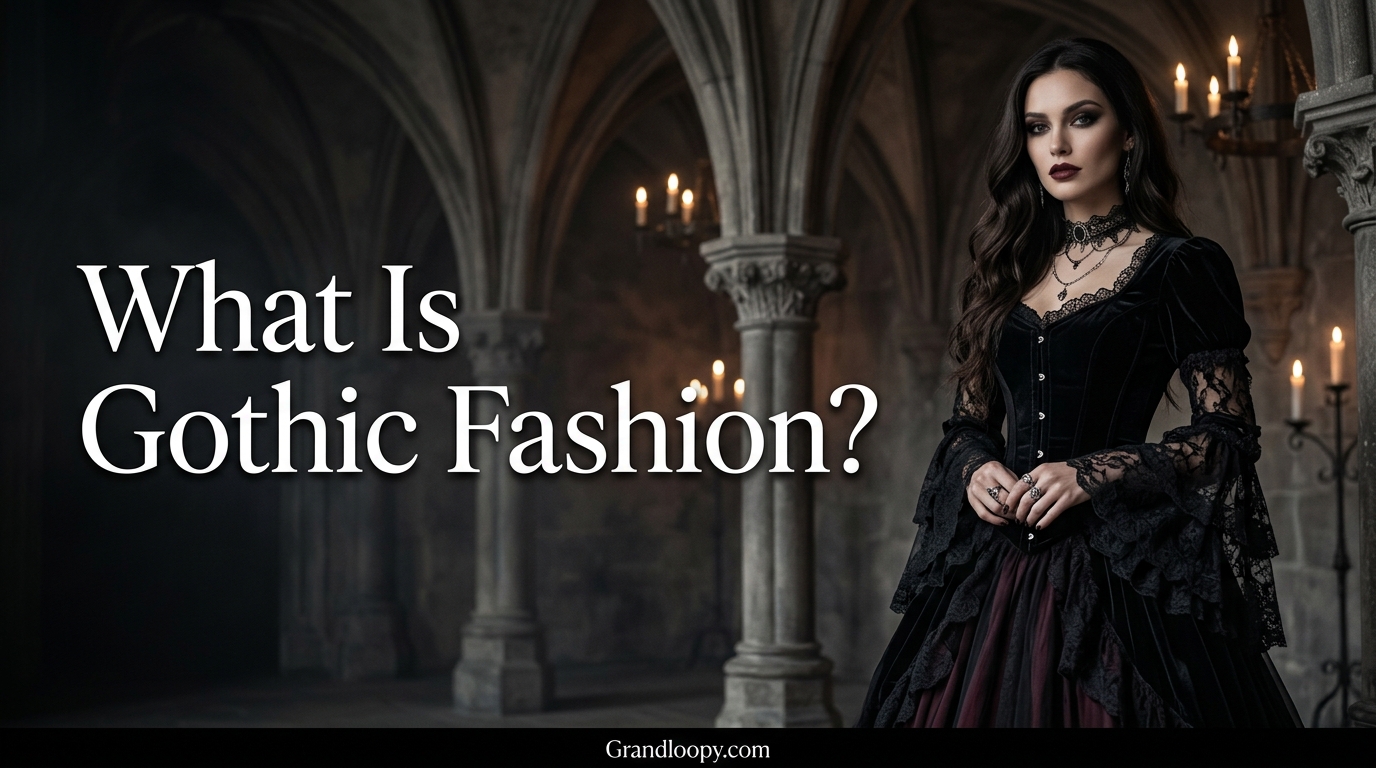
Gothic fashion is a dark, romantic clothing style worn by members of the goth subculture.
It centres on black, velvet, lace, and leather, with dramatic silhouettes drawn from Victorian mourning dress, medieval art, and Romantic literature.
The style began in London post-punk in the late 1970s and grew into a global subculture with more than a dozen distinct substyles.
Some goths dress like Victorian mourners, others like cyberpunk ravers, and many mix both.
Readers who want the short version can stop at the definition and the substyle table.
Readers who want to dress the part will find a full wardrobe plan, brand prices, fabric care, and a 2026 trend update further down.
The Short Answer: Dark, Romantic, and Older Than You Think
Gothic fashion is clothing that expresses a love of darkness, romance, and history through dress.
The look is defined by a mostly black palette, rich textures, and symbolic accessories such as crosses, skulls, bats, and moons.
It is not a costume, and it is not a single outfit.
Gothic fashion is a visual language with many dialects, from the backcombed hair and ripped fishnets of traditional goth to the clean black lines of nu-goth and the pastel colours of pastel goth.
The fashion belongs to the goth subculture, which grew out of post-punk music in Britain.
Bands such as Bauhaus, Siouxsie and the Banshees, and The Cure gave the scene its sound, and the audience gave it its look.
Outsiders often confuse goth with emo, punk, metal, and grunge. The styles share dark colours, but each has its own history, music, and rules. The comparison section below separates them clearly.
What Gothic Fashion Is (And What It Is Not)
Gothic fashion is a long-term style built on black clothing, layered textures, and historical references. It values drama, elegance, and personal meaning over trends, and it rewards knowledge of the subculture behind it.
It is not Halloween dress-up. A goth outfit is worn every day, not only in October, and it is assembled with the same care any other style receives.
It is not a uniform. Two goths can look completely different and both be authentic, because the style has many substyles and no single correct outfit exists.
It is not a religion, and it is not satanic. Gothic fashion borrows religious and occult symbols as art and history, not as worship. Many goths are not religious at all.
It is not only for women or only for men. Gothic fashion is worn by every gender, and many of its core pieces, such as leather jackets, velvet coats, and platform boots, are gender neutral.
Gothic vs Goth: The Word Difference
Gothic describes the style, the art, and the history. Gothic architecture, Gothic literature, and Gothic fashion all use the word to mean dark, medieval, and romantic.
Goth describes the people and the subculture. A goth is someone who belongs to the scene, listens to the music, and dresses in the style.
The two words are often used as synonyms, and most readers will not mind. Using gothic for the style and goth for the people keeps the writing precise.
A Brief History of Gothic Fashion
Gothic fashion has two histories. One is the long history of the word gothic, which runs from medieval cathedrals to Victorian novels.
The other is the short history of the subculture, which runs from London post-punk in 1979 to the runways and streaming shows of 2026.
Both histories matter, because the subculture borrowed its look from the older one. A Victorian mourning dress, a Gothic cathedral, and a Bauhaus concert all feed into the same wardrobe.
Gothic Architecture and Literature (12th to 19th Century)
The word gothic began as an insult. Renaissance Italians used it for medieval architecture they considered barbaric, naming it after the Goths who sacked Rome.
The pointed arches, ribbed vaults, and stained glass of Gothic cathedrals later became symbols of beauty and mystery.
In the 18th century, Romantic writers reclaimed the word. Horace Walpole published The Castle of Otranto in 1764, and a wave of Gothic novels followed from Ann Radcliffe, Matthew Lewis, Mary Shelley, and Bram Stoker.
Their stories used castles, ghosts, and the supernatural to explore fear and desire.
This literary tradition gave gothic fashion its themes: darkness, romance, death, and the supernatural.
A black velvet dress and a lace veil carry the same mood as a Gothic novel, and that is not an accident.
One common error in weaker guides claims gothic fashion itself began in the 12th century. That is wrong. Gothic architecture began in the 12th century, and Gothic literature began in the 18th.
Gothic fashion, as a subculture style, began in the late 1970s.
Victorian Mourning Dress
The most direct ancestor of gothic fashion is Victorian mourning dress.
In the Victorian era, which ran from 1837 to 1901, widows wore black crepe, veils, and high collars for months or years after a death. The look was strict, formal, and deeply symbolic.
Gothic fashion borrows the silhouette and the mood of mourning dress without the grief.
High collars, long skirts, corsets, lace, and veils all appear in Victorian goth and romantic goth outfits, worn as romance rather than sorrow.
Cintra Wilson, writing in the New York Times in 2008, declared that the origins of contemporary goth style are found in the Victorian cult of mourning.
Fashion historian Valerie Steele, author of Gothic: Dark Glamour, is the leading expert on this history, and her book is the best source for readers who want the full story.
The Victoria and Albert Museum holds one of the best Victorian fashion collections in the world, and its mourning dress pieces show exactly where the goth look comes from.
Post-Punk London, 1979 to 1983
The goth subculture began in London post-punk between 1979 and 1983. Punk had burned fast and loud, and a darker, slower, more romantic sound grew out of it.
The bands were Bauhaus, Siouxsie and the Banshees, The Cure, Joy Division, and the Sisters of Mercy.
Bauhaus released Bela Lugosi’s Dead in August 1979, and the single is often cited as the originating moment of goth music.
The song named the horror actor Bela Lugosi, and its slow, echoing sound set the tone for the scene that followed.
The fashion followed the music. Early goths wore ripped fishnets, leather jackets, black clothes, and heavy makeup.
The look was punk with the anger removed and the romance turned up, and it spread quickly through London clubs.
By the mid-1980s, the subculture had spread from London to continental Europe, North America, and beyond. The style was no longer a London scene, and it was no longer a passing trend.
The Batcave and the 1980s
The Batcave nightclub opened at 69 Dean Street in Soho in July 1982, and it became the physical centre of the emerging scene.
It was run by Ollie Wisdom of the band Specimen, and it ran from 1982 to 1986.
The club set the visual vocabulary of gothic fashion for decades. Black clothing was the default, white face makeup drew on kabuki theatre and horror film, and hair was styled upward or in asymmetric shapes.
The room itself had cobwebbed ceilings and a real coffin at the entrance.
Style icons of the decade included Siouxsie Sioux, whose dramatic makeup and black outfits shaped how a generation of goth women dressed.
Paul Morley of NME wrote that about half the girls at a 1980 Siouxsie and the Banshees gig in Leeds had used Sioux as the basis for their appearance, from hair to ankle.
Other icons included Robert Smith of The Cure, Dave Vanian of The Damned, and the film stars Theda Bara, Bela Lugosi, and Vampira.
The 1980s also produced the first goth designers, such as Drew Bernstein of Lip Service, whose label became a staple of the scene.
The 1990s: Cyber, Industrial, and Mainstream
In the 1990s, goth split into new substyles. Cyber goths took the classic look and gave it a neon, futuristic twist with PVC, latex, and circuit board accessories.
Industrial goths took a militaristic, dystopian direction with gas masks, combat boots, and heavy hardware.
Marilyn Manson brought goth imagery to the mainstream in the 1990s, wearing heavy dark eyeliner and black clothes on stage and in videos.
The look reached audiences who had never heard of the Batcave, and it brought a new wave of young fans into the scene.
The 1990s also saw a surge of US-based gothic fashion designers, many of whom still shape the style today.
Labels such as Kambriel, Rose Mortem, and Heavy Red, run by Tyler Ondine, built their names in this decade and were featured repeatedly in Gothic Beauty magazine.
Japanese goth grew in the same decade. Gothic Lolita fashion began in Harajuku in the late 1990s, mixing dark makeup and clothing with the modest, doll-like silhouette of lolita fashion.
Brands such as Atelier-Pierrot, Atelier Boz, Black Peace Now, H. Naoto Blood, and Moi-même-Moitié defined the look.
The 2000s Revival and Haute Goth
The first decade of the 2000s brought a gothic revival in mainstream fashion.
High street shops carried gothic-inspired clothing, and design houses including Gucci, Jean Paul Gaultier, and Yves Saint Laurent presented gothic collections on the runway, as noted in EBSCO’s research starter on gothic fashion.
Cintra Wilson called the runway version haute goth in the New York Times.
Designers such as Alexander McQueen, Anna Sui, Rick Owens, Gareth Pugh, Ann Demeulemeester, Philipp Plein, Hedi Slimane, John Richmond, John Galliano, Olivier Theyskens, and Yohji Yamamoto all brought elements of goth to their shows.
Film and television carried the look further. The Girl with the Dragon Tattoo, released in 2011, gave the world Lisbeth Salander, a goth-punk heroine in black leather, black skinny jeans, and moto boots.
Her outfit became a reference point for punk goth style.
Vogue traced Alexander Wang’s gothic inspiration from Siouxsie Sioux to The Cure in a 2015 feature, showing how deeply the subculture had entered high fashion by the middle of the decade.
Gothic Fashion in 2026
Gothic fashion is having another revival in 2026, and this one has clear triggers. Netflix’s Wednesday premiered in 2022, and Jenna Ortega became a gothic fashion icon on the red carpet.
The second season premiered on August 6, 2025, with the second half released on September 3, 2025, and a third season is now filming.
The Guardian covered the Wednesday effect in December 2022, writing that Tim Burton’s show sparked a gothic fashion revival.
Four years later, the show remains the most viewed English-language Netflix series ever, according to a 2026 trend report, and its black pinafore dress and white collar are still copied.
Practical Magic 2, released in September 2026, sent the whimsigoth conversation into a second peak.
The film’s velvet, lace, and layered dark romance is exactly the register whimsigoth occupies, and searches for the style spiked through the autumn.
Purchase data backs the revival, and the runway and shopping figures behind it are covered in the 2026 trends section.
The 12 Gothic Substyles, Compared
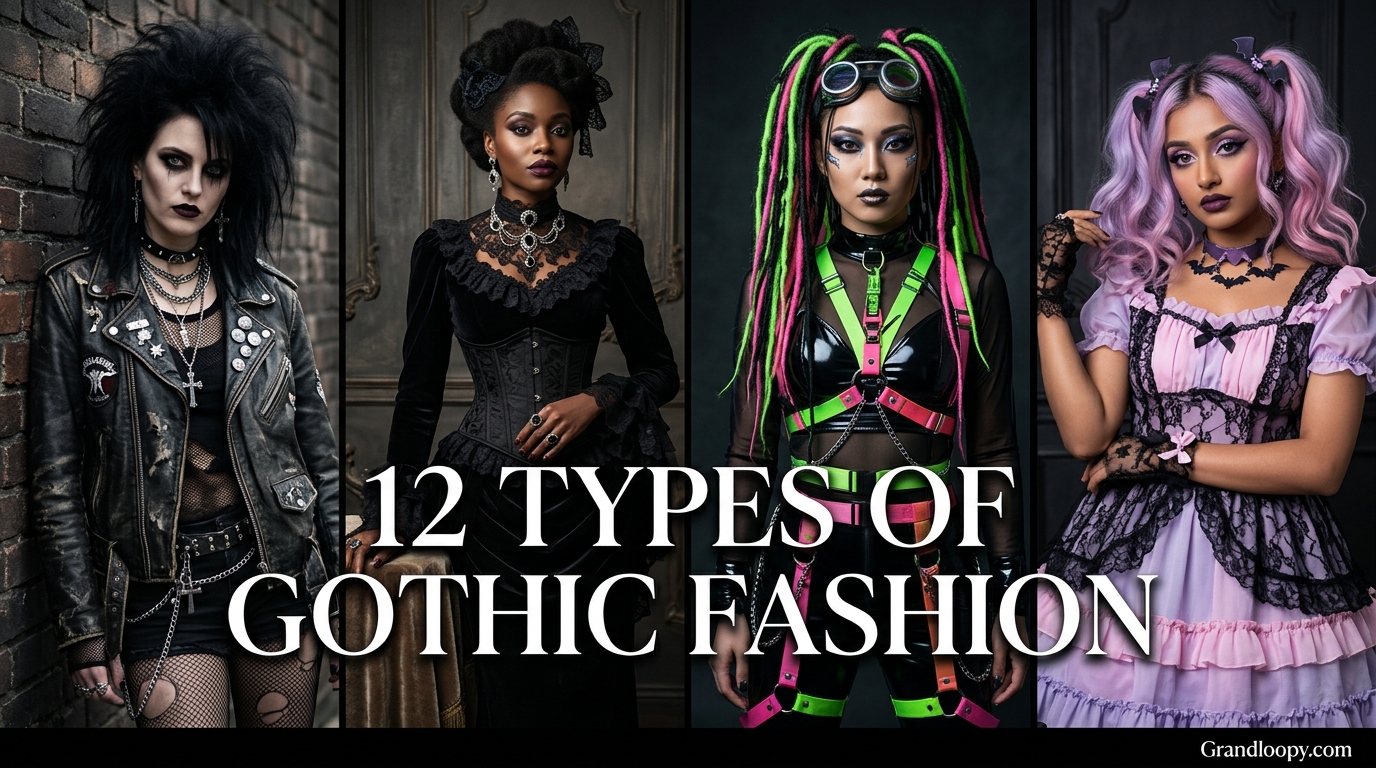
The most common misunderstanding about gothic fashion is that it is one uniform style. In practice, the goth aesthetic contains many distinct substyles, each with its own history, music, and community norms.
The table below compares the twelve most established substyles. Use it to find the one that fits your taste, your budget, and your life, then read the detailed sections that follow.
| Substyle | Era and Origin | Key Aesthetic Features | Musical Associations | Price Level |
|---|---|---|---|---|
| Traditional Goth | 1979 to 1985, London | Black with silver, dramatic makeup, backcombed hair, band shirts, pointed boots | Bauhaus, Siouxsie, Sisters of Mercy | Low to medium |
| Romantic Goth | 1980s to present | Velvet, lace, flowing silhouettes, corsets, deep jewel tones | Dead Can Dance, Cocteau Twins | Medium to high |
| Victorian Goth | 1980s to present | Historically accurate Victorian silhouettes, mourning dress, top hats, pocket watches | Emilie Autumn, Abney Park | Medium to high |
| Deathrock | 1979 to 1985, California | Torn and reassembled garments, horror imagery, DIY patches, mohawks | Christian Death, 45 Grave, TSOL | Low |
| Cybergoth | 1990s to present | Neon accents, industrial materials, goggles, gas masks, platform boots, synthetic dreads | Combichrist, Psyclon Nine | Medium to high |
| Industrial Goth | 1990s to present | Black denim, combat boots, cargo pants, tactical vests, gas masks | Nine Inch Nails, Ministry, KMFDM | Low to medium |
| Nu-Goth | 2010s to present | Minimalist black, occult symbols, modern cuts, witchy aesthetic, less theatrical | Chelsea Wolfe, Zola Jesus | Low to medium |
| Pastel Goth | 2010s to present | Pastel colours with gothic iconography, crosses, bats, skulls, kawaii fusion | Grimes, Crystal Castles | Low to medium |
| Soft Goth | 2010s to present | Simple black pieces, clean lines, subtle gothic details, hint of lace or skull | The Cure, The Smiths | Low |
| Gothic Lolita | Late 1990s, Harajuku | Dark makeup, bell-shaped skirts, petticoats, lace, modest silhouette | Mana, Moi-même-Moitié | Medium to high |
| Aristocrat | 1990s to present, Japan | Tight pants, velvet coats, top hats, cravats, corsets, ankle-length skirts | Visual kei, Mana | Medium to high |
| Corporate Goth | 1990s to present | Professional black attire, subtle gothic elements, silver jewellery, dark nails, quality tailoring | Scene identity outside work hours | Medium |
These substyles are not rigid categories. Most goths borrow elements from several of them and move between them over time.
The taxonomy helps newcomers find their direction, but the culture values authenticity and personal expression above following any single template.
Traditional Goth
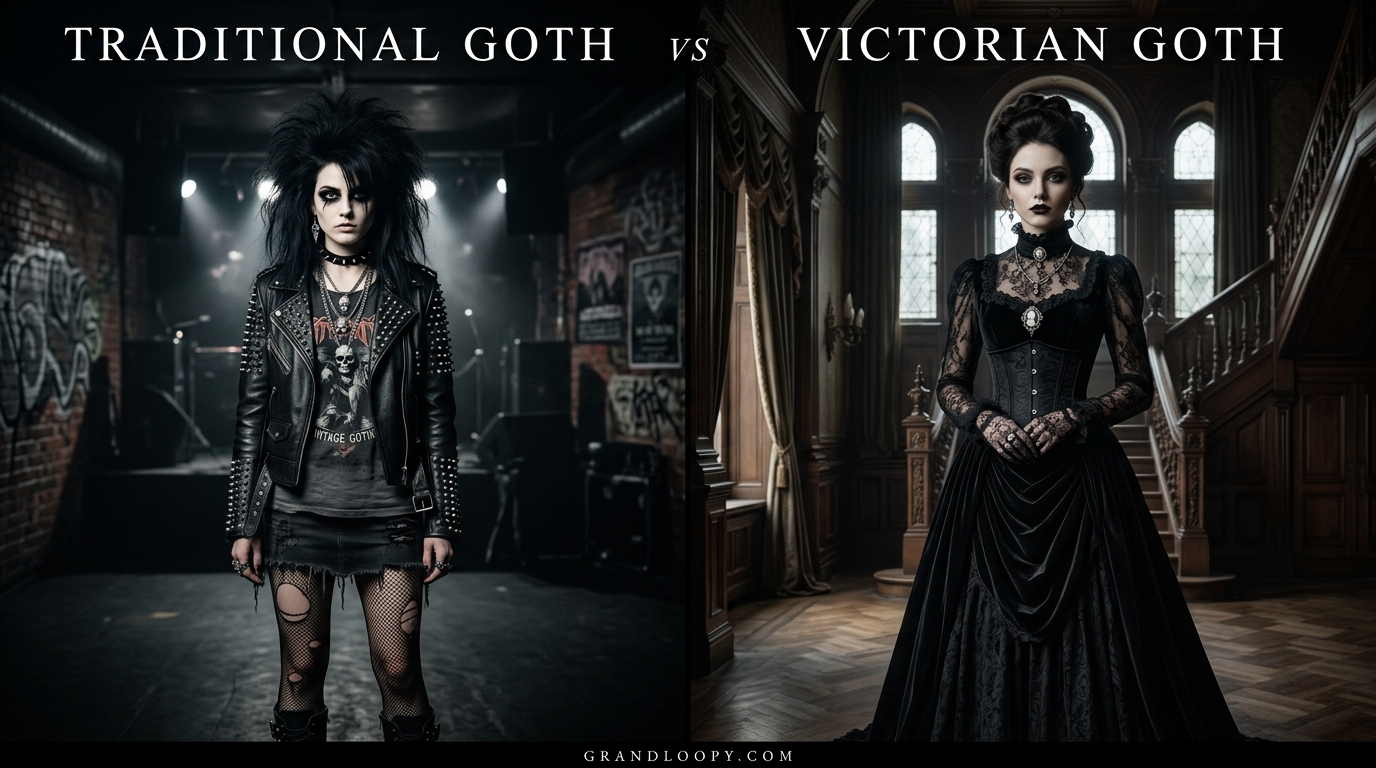
Traditional goth, often called trad goth, is the original 1980s look. It means ripped fishnets, black leather jackets, band shirts, and plenty of silver jewellery with bats, spiderwebs, and other macabre motifs.
The hair is backcombed and teased into volume, and the makeup is dramatic, with dark eyeliner and pale foundation. The boots are pointed, often winklepickers or creepers, and the overall effect is theatrical and proud.
Trad goth is the cheapest substyle to start, because its core pieces are black basics, band shirts, and thrifted leather.
It is also the most recognised, so it reads as goth immediately to anyone who knows the scene.
Romantic Goth
Romantic goth takes the lush, poetic side of Victorian fashion and gives it a softer, more flowing form.
Velvet, lace, and long skirts replace the sharp edges of trad goth, and the palette opens to burgundy, forest green, and deep purple.
The look suits readers who love Gothic literature and want to channel a tragic hero or heroine.
Flowing fabrics, delicate lace, and deep jewel tones do the work, and the makeup stays dark but softer than the trad goth face.
Romantic goth costs more than trad goth, because velvet and lace in good quality are not cheap.
Thrift shops are the best source, since vintage velvet and lace often beat new mass-market fabric at a fraction of the price.
Victorian Goth
Victorian goth is the most historically faithful substyle. It interprets Victorian fashion directly, with high collars, corsets, long sweeping skirts, waistcoats, top hats, and pocket watches in rich fabrics such as velvet and brocade.
The difference between Victorian goth and romantic goth is accuracy. Victorian goth aims for period-correct silhouettes and fabrics, while romantic goth borrows the mood and softens it.
A Victorian goth who hand-sews a historically accurate bodice from a period pattern earns real respect in the community.
This substyle is the most formal and the most expensive, because period-accurate pieces are either handmade or bought from specialist makers. It is also the substyle most often seen at goth festivals and formal events.
Deathrock
Deathrock was born in the early Los Angeles punk scene and mixed glam rock, punk, horror literature, and classic horror films.
Its common theme is dominantly black clothing with horror imagery, torn fishnets, pale foundation, and black or dark eye makeup.
Deathrock is the most explicitly DIY substyle. Garments are torn and reassembled, patches are sewn on by hand, and the expectation is that the outfit looks handmade.
Combat boots or Doc Martens finish the look, with skirts, leggings, or slim fit pants.
The iconic deathrock hairstyle is the deathhawk, an extreme mohawk with shaved sides and the remaining hair teased into a towering spiky mane.
It is bold, it is not for the faint of heart, and it turns heads everywhere.
Cybergoth
Cybergoth emerged in the late 1990s in America, mixing classic gothic fashion with industrial metal and rave culture.
The result is a dystopian, futuristic science fiction look built on leather duster coats, platform boots, and neon.
Key pieces include shiny PVC clothing, corsets or floor-length coats, goggles, gas masks, synthetic neon dreadlocks, chains, and black trench coats decorated with metal studs.
Brightly coloured fluorescent hair was inspired by the UV backdrops at dance clubs in the United Kingdom.
Cybergoth is the most expensive substyle to build from scratch, because platform boots, PVC, and accessories add up fast.
It is also the most at home in clubs and festivals, where the neon and the platforms make sense.
Industrial Goth
Industrial goth takes the gritty, dystopian feel of industrial music and turns it into clothing. The look is functional and military, with black denim, combat boots, cargo pants, and tactical vests.
Unlike cybergoth, industrial goth avoids neon and flash. The palette stays black, the lines stay practical, and the hardware is real rather than decorative.
Gas masks and metal accessories appear, but they are worn as part of a tough, no-nonsense outfit.
This substyle is one of the cheapest to start, because black denim, combat boots, and cargo pants are easy to find and easy to thrift.
It also layers well in cold weather, which makes it practical for everyday wear.
Nu-Goth (Modern Goth)
Nu-goth, sometimes called modern goth, emerged in the 2010s and blends traditional gothic elements with contemporary fashion. The silhouettes are simpler, the lines are cleaner, and the look is less theatrical than trad goth.
Nu-goth favours minimalist black clothing with strategic pops of colour or pattern, occult symbols such as pentacles and moon phases, and modern cuts.
A black skinny jean with a sheer flowing blouse, or a leather jacket with an asymmetrical hem, is a typical nu-goth outfit.
This is the easiest substyle for a beginner, because it starts from clothes many people already own.
Add silver jewellery with occult motifs and a pair of platform boots, and a plain black outfit becomes recognisably goth.
Pastel Goth
Pastel goth takes the classic elements of goth fashion, the lace, the velvet, and the spooky motifs, and gives them a candy-coloured twist.
Soft shades of pink, blue, and lavender sit next to crosses, bats, and skulls.
The style is a fusion of goth and kawaii culture, and it is playful where trad goth is severe.
It suits readers who want to express a dark side without taking themselves too seriously, and it photographs well on social media.
Pastel goth is the most misunderstood substyle in the scene, because some trad goths dismiss it as not real goth.
The style has its own history, its own music, and its own community, and it is as valid as any other substyle.
Soft Goth
Soft goth is the pared-down take on the goth aesthetic.
It focuses on simple, understated pieces in black and other dark shades, with clean lines and subtle gothic details such as a hint of lace or a discreet skull motif.
This is the most versatile substyle for everyday life. A soft goth outfit works for errands, for a low-key gathering, and for work, because the gothic elements are present but not loud.
Soft goth is also the best starting point for readers who are unsure about the style. It asks for the least commitment, costs the least, and lets the wearer add drama gradually as confidence grows.
Gothic Lolita
Gothic Lolita, sometimes shortened to gosu rori in Japanese, combines gothic and lolita fashions.
The fashion began in the late 1990s in Harajuku, and it is characterised by darker makeup and clothing than other lolita styles.
Red lipstick and smoky or neatly defined eyes, made with black eyeliner, are typical. The silhouette is bell-shaped, with petticoats, lace, and modest cuts.
Although gothic makeup is often associated with a white-powdered face, that is usually considered poor taste within the Japanese lolita scene.
Brands that define the style include Atelier-Pierrot, Atelier Boz, Black Peace Now, H. Naoto Blood, and Moi-même-Moitié. Author and television host La Carmina is a well-known model of Gothic Lolita fashion.
Gothic Lolita is often misunderstood by outsiders, so the fact matters: the style is modest and usually nonsexual, and it is about elegance and craft, not provocation.
Aristocrat
Aristocrat is a Japanese street fashion championed by the visual kei musician Mana, through his fashion label Moi-même-Moitié.
It is influenced by gothic and neo-Victorian fashion, and it is the most formal of the Japanese substyles.
A typical outfit combines fetish wear with Victorian and sometimes steampunk elements.
Tight pants, velvet sport coats, top hats, cravats, and corsets sit alongside ankle-length skirts, lace petticoats, and frilly pirate shirts from the New Romantics of the 1980s.
Aristocrat is a high-cost substyle, because the pieces are detailed and often made by specialist labels.
It is also the substyle most associated with visual kei, the Japanese rock movement whose musicians made the look famous.
Corporate Goth
Corporate goth is gothic fashion adapted for the workplace. It uses professional black attire with subtle gothic elements: silver jewellery, dark nails, quality tailoring, and a hint of lace or velvet.
The rule is simple. The outfit must pass a dress code, and the goth must be visible only to those who know what to look for.
A black suit with a silver skull ring, or a black blouse with a lace collar, is corporate goth done right.
This substyle has no music of its own, because it is a practical adaptation rather than a scene.
Its members are goths who express their identity outside work hours and keep a quiet version of it at the office.
Which Substyle Fits You?
Choosing a substyle is easier than it looks. The decision comes down to four questions, and the answers point to a starting style.
First, how much drama do you want. If the answer is maximum drama, start with traditional goth or Victorian goth. If the answer is quiet drama, start with soft goth or nu-goth.
Second, what is your budget. Deathrock, industrial goth, and soft goth are the cheapest to start, because they use black basics and thrifted pieces.
Victorian goth, aristocrat, and cybergoth cost the most, because their pieces are detailed or specialist.
Third, what music do you love.
Trad goth pairs with Bauhaus and Siouxsie, romantic goth with Dead Can Dance and Cocteau Twins, deathrock with Christian Death and 45 Grave, and cybergoth with Combichrist and Psyclon Nine.
The music and the fashion belong together, and starting from the music makes the choice feel natural.
Fourth, where will you wear it. If you need a work-friendly look, start with corporate goth. If you live in clubs and festivals, cybergoth and deathrock make sense.
If you want an everyday style, nu-goth and soft goth are the practical choices.
Readers who want a guided version can try the fashion style quiz on Grandloopy, which walks through the same questions in a lighter format.
Gothic Fashion vs Emo vs Punk vs Metal vs Grunge
Gothic fashion is confused with other dark styles more than any other fashion. The confusion is understandable, because the styles share black clothes and a rejection of the mainstream.
The histories, however, are different, and the table below makes the differences visible.
| Feature | Goth | Emo | Punk | Metal | Grunge |
|---|---|---|---|---|---|
| Origin | London post-punk, late 1970s | Washington DC hardcore punk, mid 1980s | New York and London, 1970s | Birmingham, late 1960s | Seattle, late 1980s |
| Core mood | Dark romance, melancholy | Emotional confession | Anger, rebellion | Power, aggression | Alienation, apathy |
| Key clothes | Velvet, lace, corsets, leather | Skinny jeans, band tees, hoodies | Ripped jeans, plaid, leather jackets | Band tees, denim, leather | Flannel, baggy jeans, sweaters |
| Key footwear | Platform boots, creepers | Converse, Vans | Doc Martens | Boots, high tops | Boots, Birkenstocks |
| Hair | Backcombed, deathhawk, long black | Side-swept bangs, straightened | Mohawk, liberty spikes | Long hair | Unkempt, long |
| Makeup | Dramatic, pale foundation, black eyeliner | Heavy eyeliner, less theatrical | Minimal or none | Minimal or none | None |
| Key bands | Bauhaus, The Cure, Siouxsie | My Chemical Romance, Fall Out Boy | Sex Pistols, Ramones | Black Sabbath, Metallica | Nirvana, Pearl Jam |
| Attitude | Beauty in darkness | Vulnerability, feelings | Anti-establishment | Power, volume | Care-free, casual |
Goth vs Emo (The Most Common Confusion)
Goth and emo are the pair most often confused, and the confusion comes from mainstream media collapsing all dark styles into one category. The two subcultures have different origins, different music, and different aesthetics.
Emo, short for emotional hardcore, emerged from the Washington DC hardcore punk scene in the mid 1980s, around bands such as Rites of Spring and Embrace.
It reached mainstream visibility in the early 2000s with My Chemical Romance and Fall Out Boy.
Emo fashion centres on fitted jeans, band t-shirts, Converse or Vans, and side-swept hair that covers part of the face. Gothic fashion centres on dramatic silhouettes, velvet, lace, and Victorian references.
The palettes overlap, but the histories and the reference points do not.
One claim to ignore is that emo originated within the goth subculture. It did not. Emo came from hardcore punk, and the two scenes developed separately before the mainstream mixed them up.
Goth vs Punk
Goth emerged from punk and keeps punk’s DIY ethos and anti-mainstream position, but the two styles diverged in look and feeling. Punk aesthetics tend toward aggressive simplicity: torn, safety-pinned, deliberately ugly clothes.
Gothic aesthetics tend toward elaborate beauty: draped, layered, deliberately beautiful in a non-mainstream way.
Punk’s political anger and goth’s aesthetic melancholy are different emotional registers. A punk outfit says the system is broken, and a goth outfit says beauty lives in darkness.
Both reject the mainstream, but they reject it for different reasons.
Goth vs Metal
Heavy metal fashion overlaps with goth in colour palette and some materials, but it has different origins and different rules.
Metal began in Birmingham in the late 1960s, via Black Sabbath, and its core uniform is black band t-shirts, denim, leather, and long hair.
Metal fashion is typically less theatrically elaborate than gothic fashion. Crossover exists, especially in black metal and doom metal communities, which share significant aesthetic territory with goth culture.
The overlap is real, but the two styles are not the same.
Goth vs Grunge
Grunge began in Seattle in the late 1980s and early 1990s, with bands such as Nirvana, Soundgarden, and Pearl Jam.
Its fashion is baggy t-shirts and jeans, oversized knit sweaters, flannel, and long skirts, worn with a care-free, almost bummy attitude.
Grunge is about not caring how you look, while goth is about caring deeply how you look. That difference in intention is the fastest way to tell them apart, even when both outfits are dark.
Goth vs Dark Academia
Dark academia is a newer aesthetic built on tweed, blazers, books, and classical learning.
It shares goth’s love of history and dark colours, but it has no music scene, no subculture history, and no connection to post-punk.
The practical difference is the reference point. Dark academia references universities, libraries, and classical art. Goth references Victorian mourning, Gothic literature, and post-punk music.
A tweed blazer with a book is dark academia, and a velvet corset with a pentagram is goth.
Goth vs Witchy Fashion
Witchy fashion, sometimes called dark feminine or whimsigoth, overlaps heavily with goth and is often worn by the same people.
The difference is emphasis: witchy fashion centres on celestial symbols, moons, stars, and natural magic, while goth centres on death, romance, and history.
Many goths wear witchy pieces, and many witchy dressers wear goth pieces. The two styles are neighbours, not rivals, and the boundary between them is the softest in this whole section.
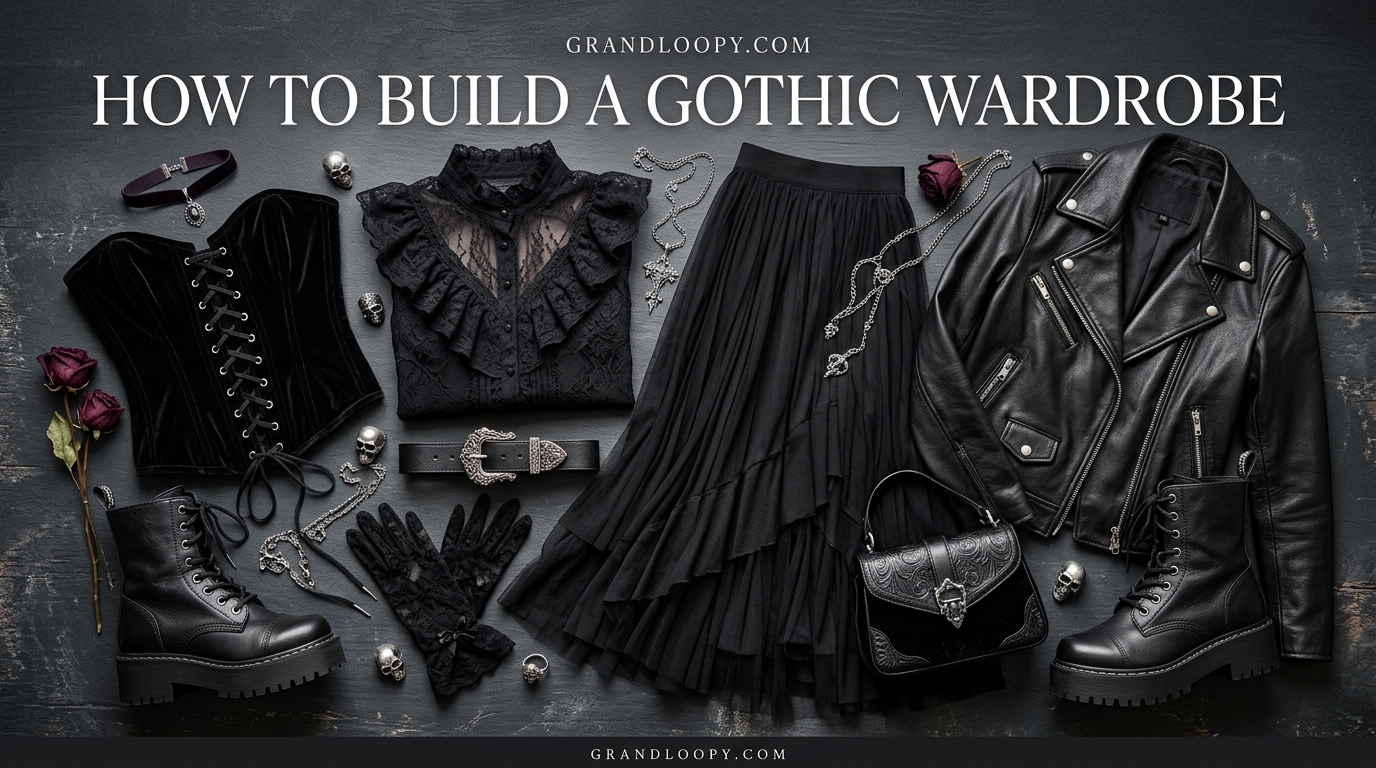
Key Pieces: Building a Gothic Wardrobe
Building a gothic wardrobe works best as a layered process. Start with functional black foundations, add substyle character over time, and finish with accessories that carry the most visual impact for the least money.
The three layers below are the method used by experienced goths, and they keep the wardrobe flexible. A good foundation works for corporate goth immediately and provides the canvas for every other substyle.
The Foundation Layer (Black Basics)
Begin with quality black basics that work both inside and outside gothic contexts.
Well-fitted black trousers or a long black skirt, a quality black shirt or blouse in cotton or a silk blend, and sturdy black boots at ankle height or higher.
Add a long black cardigan or coat for layering. These pieces form a base that looks good on their own and takes accessories well.
The rule is to buy quality here, because the foundation is worn the most and seen the most.
A black turtleneck or high-neck top is the best layering piece in the whole wardrobe.
It sits under corsets, waistcoats, and jackets, and it turns a summer outfit into a winter outfit without a new purchase.
The Character Layer (Substyle Pieces)
Once the foundation is set, add the pieces that show your substyle. For romantic goth, that means a velvet jacket, lace accessories, and a corset or corseted belt.
For traditional goth, it means pointed-toe boots, band shirts, and a leather jacket.
For Victorian goth, add a waistcoat, a pocket watch chain, and period-accurate accessories. For nu-goth, add occult-symbol jewellery, pentacle or moon-phase necklaces, and modern minimalist cuts in all black.
Buy one character piece at a time and wear it with the foundation before buying the next.
This stops the wardrobe from becoming a costume collection, and it shows which substyle you actually wear rather than the one you imagined.
The Accessory Layer (Jewellery, Bags, Hats)
Silver jewellery with gothic motifs has the highest impact-to-cost ratio in gothic fashion. A quality choker, several rings, and a statement necklace or brooch transform a basic black outfit into a recognisably gothic ensemble.
Accessories are also the most portable substyle indicators. Changing jewellery and adding lace can shift an outfit from corporate goth to romantic goth in minutes, without changing the clothes underneath.
Other high-impact accessories include coffin bags, parasols, top hats, body harnesses, and leather or lace gloves. Choose one or two per outfit, because too many accessories at once turns a look into a costume.
Footwear: Boots, Creepers, and Platforms
Footwear anchors a gothic outfit, and the choice of shoe sets the tone.
Platform boots give height and drama, combat boots give toughness, creepers give a 1980s trad goth feel, and winklepickers give a sharp, pointed silhouette.
Demonia is the platform boot most alternative wardrobes end up owning, and its prices were reported by apartstyle in August 2026 at 77.95 to 130.95 dollars.
Dr. Martens and New Rock are the other two names that appear most often in goth wardrobes, and both are bought for durability as much as style.
Buy boots that fit properly and break them in at home before wearing them out.
Platform boots with poor fit cause blisters fast, and a goth who cannot walk comfortably will not wear the outfit again.
The 10-Piece Starter Wardrobe
The starter wardrobe below is the fastest way from zero to a working gothic wardrobe. It covers foundation, character, and accessories in ten pieces, and it works for every substyle with small changes.
- Black trousers, well fitted, quality fabric
- Long black skirt, A-line or flowing, below the knee
- Black button-up shirt or blouse, cotton or silk blend
- Black turtleneck or high-neck top, for layering
- Velvet jacket or blazer, black, deep red, or deep purple
- Sturdy black boots, Doc Martens, New Rock, or similar
- Long black coat or cloak, wool or heavy cotton for cold weather
- Silver jewellery set, a choker, two or three rings, and one statement piece
- Black leather or faux leather belt with a silver buckle
- One substyle-specific accent piece, a lace shawl, a band patch jacket, or a corset belt
Starter Wardrobe Cost Tiers
The cost of a gothic wardrobe depends on where the pieces come from. The table below shows three tiers for the same ten-piece starter wardrobe, so readers can choose honestly rather than guess.
| Tier | Where the Pieces Come From | Estimated Total | Best For |
|---|---|---|---|
| Budget | Thrift shops, charity shops, sales, DIY | 100 to 200 dollars | Beginners, students, anyone testing the style |
| Mid-range | Mass-market goth brands, online retailers, some independent labels | 300 to 600 dollars | Readers building a durable everyday wardrobe |
| Investment | Independent designers, handmade pieces, quality leather and velvet | 800 to 1,500 dollars or more | Collectors, formal wear, long-term pieces |
These totals are estimates based on brand price ranges reported by apartstyle in August 2026 and on typical thrift prices.
They are not verified on any retailer’s own site, so use them as planning figures and check current prices before buying.
The budget tier is the honest starting point for most readers. Early goths built their wardrobes from charity shop finds, and the practice remains valued in the community today.
Fabrics and Materials
Fabric choice is one of the main markers of quality and intention in gothic clothing.
The difference between genuine velvet and polyester printed to look like it is visible and tactile, and anyone familiar with the style can spot it.
| Fabric | Look and Feel | Best For | Care | Cost |
|---|---|---|---|---|
| Velvet | Deep colour, soft pile, rich drape | Romantic and Victorian goth | Dry clean or gentle hand wash | Medium to high |
| Lace | Fine detail, sheer, delicate | Overlay, accents, blouses | Hand wash, air dry | Medium to high |
| Leather | Durable, develops patina | Jackets, boots, belts | Condition, keep dry | High |
| Faux leather | Similar look, lighter, cheaper | Jackets, skirts, accessories | Wipe clean, avoid heat | Low to medium |
| Brocade and damask | Raised or reversible patterns | Victorian and aristocrat goth | Dry clean | Medium to high |
| Mesh and fishnet | Sheer, layered, textured | Layering, hosiery, tops | Hand wash, air dry | Low |
| PVC and vinyl | Shiny, futuristic, stiff | Cybergoth, fetish-influenced styles | Wipe clean, avoid heat | Low to medium |
| Cotton jersey | Soft, stretchy, everyday | Everyday and casual goth | Machine wash | Low |
Velvet
Velvet is the signature fabric of gothic fashion, associated especially with the romantic and Victorian substyles. Silk velvet is the historical standard, with unmatched depth of colour and drape, but it is expensive and fragile.
Cotton velvet is more affordable and durable, with a slightly stiffer hand. Stretch velvet, a polyester and spandex blend, is widely used in commercial gothic fashion for its low price and easy care.
For quality investment pieces, cotton or silk-cotton blend velvet gives the richest visual effect.
Lace
Lace works as both a structural and an accent fabric in gothic fashion. French lace, such as Chantilly and Calais, is the historical standard: fine, detailed, and expensive.
Machine lace is more affordable and ranges from poor to excellent depending on the maker.
Black lace over a contrasting fabric, deep red, purple, or white, is one of the most recognisable gothic design elements.
A lace overlay on a dress or a lace-trimmed blouse reads as goth instantly, even when the rest of the outfit is plain.
Leather and Faux Leather
Leather appears across all gothic substyles. Full-grain leather has the best quality and develops character over time. Chrome-tanned leather is softer immediately, while vegetable-tanned leather is stiffer at first but develops a richer patina.
Faux leather has improved greatly in recent years.
Quality PU leather now approximates the look and drape of genuine leather for a fraction of the cost and without the animal ethics concerns, which matters to many goths.
Brocade and Damask
Brocade and damask appear in Victorian and aristocratic substyles. These woven fabrics feature raised patterns in brocade or reversible patterns in damask, and they add visual complexity to a garment.
Historically made from silk, modern versions in cotton-polyester blends are more accessible. Quality varies enormously, so feeling the fabric before buying is advisable when possible.
Mesh, Fishnet, and Sheer Fabrics
Mesh and fishnet are layering fabrics, and they are among the cheapest ways to add goth character to an outfit.
Torn fishnets as a shirt or as hosiery are a trad goth and deathrock staple, and sheer panels soften a heavy velvet or leather outfit.
The risk with mesh is overuse. One fishnet layer adds texture, but three fishnet layers turn an outfit into a costume. Use mesh as an accent, not as the whole look.
PVC and Vinyl
PVC and vinyl belong to cybergoth and fetish-influenced styles.
The fabrics are shiny, stiff, and futuristic, and they work best in small amounts: a PVC corset, a vinyl skirt, or PVC boots rather than a full PVC outfit.
PVC does not breathe, so it is uncomfortable in hot weather and in long wear. It also needs care, because heat damages it and creases are hard to remove.
How to Care for Gothic Fabrics
| Fabric | Wash | Dry | Store |
|---|---|---|---|
| Velvet | Dry clean or gentle hand wash | Air dry, never tumble dry | Hang, never fold under weight |
| Lace | Hand wash in cold water | Air dry flat | Fold with tissue paper |
| Leather | Do not wash, spot clean | Air dry away from heat | Hang, condition twice a year |
| Faux leather | Wipe clean with damp cloth | Air dry | Hang, keep away from heat |
| Brocade and damask | Dry clean | Air dry | Hang or roll, avoid creases |
| Mesh and fishnet | Hand wash in cold water | Air dry | Fold loosely, avoid snags |
| PVC and vinyl | Wipe clean with damp cloth | Air dry | Hang, keep away from heat |
Good fabric care is what separates a wardrobe that lasts years from one that falls apart in a season.
Velvet crushes if it is folded under weight, leather cracks if it is never conditioned, and lace tears if it is machine washed.
A few minutes of care after each wear saves the cost of replacing the piece.
Gothic Makeup and Hair
Fashion is only one part of the goth equation. The hair and makeup complete the look, and they are what make a black outfit read as goth rather than simply dark.
| Look | Products | Difficulty | Best For |
|---|---|---|---|
| Classic goth face | Pale foundation, black eyeliner, dark lipstick | Easy | Everyday, beginners |
| Dramatic goth face | White foundation, smoky eyes, black lips | Medium | Clubs, events, photos |
| Soft goth face | Light foundation, smudged eyeliner, berry lipstick | Easy | Work, daytime, beginners |
| Backcombed hair | Teasing comb, hairspray, volumising powder | Medium | Trad goth, clubs |
| Deathhawk | Clippers, strong hold gel, hairspray | Hard | Deathrock, festivals |
| Long and layered | Texturising spray, straightener or wand | Easy | Everyday, romantic goth |
| Coloured hair | Semi-permanent dye, colour-safe shampoo | Medium | Pastel goth, cybergoth |
The Classic Goth Face
The classic goth face uses pale foundation, black eyeliner, and dark lipstick. The eyeliner often extends toward the temple, and the lips are usually black, deep red, or dark purple.
The effect is dramatic without being complicated.
Start with the eyeliner, because it is the single most recognisable part of goth makeup.
A simple smudge of black eyeliner is enough for a soft goth day look, while a full face of pale foundation and deep berry lipstick suits a night out.
Hair: Backcombed, Deathhawk, Long and Layered
Goth hair is big and dramatic. The classic trad goth style is backcombed, with the hair teased into volume and held with hairspray.
The long and layered look grows the hair past the shoulders and adds choppy, textured layers for a wild, untamed effect.
The deathhawk is the extreme version: shave the sides of the head and tease the remaining hair into a towering spiky mane.
It is bold and it is not for the faint of heart, but it is the most recognisable goth hairstyle in the scene.
Hair Colour: Black, Purple, Blue, Green
Black is the default goth hair colour, and it suits every substyle. Deep purple, midnight blue, and dark green are the common accents, and they add mystery without breaking the palette.
Pastel goth uses soft pink, lavender, and baby blue, while cybergoth uses neon shades.
Use a high-quality dye and take good care of the hair, because coloured hair fades fast without colour-safe shampoo and regular conditioning.
Makeup for Beginners
Beginners should start with three products: black eyeliner, dark lipstick, and a foundation one shade lighter than their skin.
That is enough for a recognisable goth face, and it costs less than a full makeup kit.
Practice the eyeliner first, because it is the skill that takes the longest to learn.
A steady hand and a good mirror matter more than an expensive product, and a smudged line can be fixed with a cotton swab.
Gothic Fashion for Women
Gothic fashion for women is the most documented part of the style, and it offers the widest range of pieces.
Long skirts, velvet dresses, corsets, lace blouses, and platform boots are the core, and the substyle determines which pieces matter most.
Romantic and Victorian goth suit readers who want flowing silhouettes and historical detail. Nu-goth and soft goth suit readers who want a modern, everyday look with gothic details.
Pastel goth suits readers who want colour with their darkness.
Fit matters more than brand.
A well-fitted black dress in good fabric beats an expensive label in the wrong size, and a corset that fits properly is comfortable while one that does not is a punishment.
Try pieces on, or check the size chart and the return policy before ordering online.
Plus-size goth fashion is growing, but it is still uneven. Some goth brands carry extended sizes, and many do not.
Thrift shops, independent designers, and made-to-measure makers are often the best source for plus-size pieces, because they are not limited to a brand’s size range.
Gothic Fashion for Men
Gothic fashion for men is less documented than the women’s side, and the best guide in the top ten search results is written for men only.
The men’s and women’s sections below close that gap.
The core men’s pieces are black jeans, black t-shirts, black button-downs, leather jackets, long coats, and boots. A good leather jacket is essential, whether the preference is a classic biker style or something more avant-garde.
Victorian-inspired pieces add romance: a ruffled shirt, a velvet waistcoat, or a pair of lace-up boots. Rich fabrics such as silk and brocade work well, and mixing patterns and textures creates a decadent effect.
Band merchandise is part of the men’s goth wardrobe. A vintage Bauhaus t-shirt or a patch from a favourite local goth band shows allegiance to the scene and connects the wearer with other fans.
Facial hair in goth splits into two camps: clean-shaven and heavily bearded.
A beard should be well groomed and styled, whether that means a neatly trimmed goatee or a bushy mass, and a little asymmetry or a few braided sections can make it stand out.
Gothic Fashion for Work (Corporate Goth)
Corporate goth is the answer to the most practical question in gothic fashion: how do I keep the style at work. The answer is to keep the goth subtle and the tailoring excellent.
A black suit with a silver skull ring, a black blouse with a lace collar, or a black dress with dark nails and silver jewellery all pass most dress codes.
The goth is visible to those who know what to look for and invisible to those who do not.
The rules are simple. Keep the makeup soft, keep the jewellery to a few pieces, keep the boots out of sight under trousers, and keep the hair neat.
One dramatic piece is fine, but a full goth outfit in a formal office reads as a costume.
Some workplaces have strict dress codes, and in those cases the goth lives in the details: a black pen with a skull, a silver ring, a dark nail polish on the toes.
The style survives in small doses, and it is still the wearer’s own.
Where to Buy Gothic Clothing
Knowing where to buy matters as much as knowing what to buy.
Gothic fashion comes from three sources: mass-market goth brands, independent designers, and thrift shops, plus a fourth that the subculture values most, which is making it yourself.
| Retailer | Price Level | Best For | Notes |
|---|---|---|---|
| Killstar | 20 to 150 dollars | Contemporary and nu-goth, occult motifs | Price range per apartstyle, Aug 2026 |
| Dolls Kill | 20 to 200 dollars | Many brands in one order, platform boots | Price range per apartstyle, Aug 2026 |
| Demonia | 77.95 to 130.95 dollars | Platform boots, creepers, combat boots | Price range per apartstyle, Aug 2026 |
| Punk Rave | 27.93 to 88.53 dollars | Elaborate gothic, punk, and lolita designs | Price range per apartstyle, Aug 2026 |
| Disturbia | 10 to 58 pounds | Everyday alternative pieces, first goth item | Price range per apartstyle, Aug 2026 |
| Restyle | 10 to 80 dollars | Handcrafted gothic and punk details | Price range per apartstyle, Aug 2026 |
| Foxblood | Mid-range | Australian independent goth | No price range stated |
| Gallery Serpentine | Mid to high | Victorian and historical accuracy | No price range stated |
| Etsy shops | Varies widely | Handmade, one of a kind, plus size | Check reviews and fabric composition |
| Thrift and vintage | Low | Velvet, lace, leather, unique finds | Best value, best sustainability |
All prices in this table are reported by apartstyle in August 2026 and are competitor-reported.
They were not verified on the brands’ own sites at writing time, so check the current price on the brand’s own page before buying.
Thrift and Vintage
Thrift and vintage shopping is the most sustainable way to build a gothic wardrobe, and it has been part of the style since the beginning.
Early goths built their wardrobes from charity shop finds, and the practice remains valued today.
Vintage velvet, lace, and leather often exceed the quality of new mass-market equivalents at a fraction of the price.
A vintage velvet jacket found in a charity shop can outlast three new polyester ones, and it will look better doing it.
The best thrift strategy is to shop without a fixed list. Look for black basics, velvet, lace, leather, and interesting textures, and let the finds shape the wardrobe.
The pieces that surprise you are often the ones you wear most.
Independent Designers and Etsy
Independent and small-batch designers are the next tier after thrift.
Many gothic designers run small businesses producing limited runs in higher-quality materials, and the higher price per piece is offset by longer garment life and unique design.
Etsy and independent web stores are the main marketplaces for these makers. Always check fabric composition and read community reviews before buying, because quality varies and a handmade label does not guarantee good fabric.
Independent designers are also the best source for plus-size gothic clothing and for made-to-measure pieces. A maker who cuts to your measurements solves the fit problem that mass-market brands leave open.
DIY and Customisation
DIY is not incidental to gothic fashion, and it is foundational. The ability to create, modify, and customise is valued more highly in gothic culture than the ability to purchase expensive items.
Common DIY practices include fabric dyeing, garment modification, leather tooling, jewellery making, and screen printing.
Dyeing a coloured garment black with fibre-reactive dye is the simplest first project, and it turns a thrift find into a goth staple.
A Victorian goth who hand-sews a historically accurate bodice from a period pattern commands more respect in the community than someone who buys an expensive branded reproduction.
Making your own clothing is an assertion of creative independence, and the garment carries personal meaning because you invested your own time in it.
What to Check Before You Buy
Before buying from a mass-market goth brand, check the fabric composition. Natural fibres last longer than polyester blends, and a label that hides its fabric content is hiding something.
Read community reviews, because goth forums and social media are quick to name brands that fall apart.
Before buying new, check whether the brand is fast fashion.
Grandloopy’s own verdict guides cover the biggest names: Is Zara Fast Fashion, Is Uniqlo Fast Fashion, Is Hollister Fast Fashion, and Is Quince Fast Fashion.
Knowing the verdict helps readers choose between a cheap new piece and a better thrifted one.
Mass-market goth brands such as Killstar, Punk Rave, and Banned Alternative offer the widest selection at accessible prices, but they are typically made in large overseas factories with varying labour and environmental standards.
That is a trade-off each reader must weigh for themselves.
Gothic Fashion in 2026: Trends and the Revival
Gothic fashion is having a visible revival in 2026, and the evidence is on the runway, on streaming, and in purchase data.
The style is no longer a niche scene, and it is no longer a Halloween trend. It is a current fashion conversation.
Wednesday Season 2 and the Wednesday Effect
Netflix’s Wednesday premiered in 2022, and Jenna Ortega became a gothic fashion icon on the red carpet.
The second season premiered on August 6, 2025, with the second half released on September 3, 2025, and a third season is now filming.
The Guardian covered the Wednesday effect in December 2022, writing that Tim Burton’s show sparked a gothic fashion revival.
The black pinafore dress, white collar, tight braids, and black opaque tights from the show are still copied, and Ortega’s red carpet looks keep the style in the fashion press.
The Wednesday look works because it is simple. A black pinafore or fitted black dress, a white lace collar, black tights, and Mary Janes or lace-up boots are enough.
The expression is the final element, and it is possibly the most important one.
Practical Magic 2 and Whimsigoth
Practical Magic 2, released in September 2026, sent the whimsigoth conversation into a second peak.
The film’s visual language, the Owens house, the botanical aesthetic, the velvet and lace and layered dark romance, is exactly the register whimsigoth occupies.
Whimsigoth is dark romantic, witchy, layered, and celestial. It mixes gothic drama with bohemian whimsy, and it is the goth substyle most at home in a garden rather than a graveyard.
A velvet midi skirt in deep purple, a lace-trimmed blouse, and silver celestial jewellery are the core pieces.
Searches for whimsigoth spiked significantly in September 2026 and kept climbing through the autumn, according to a 2026 trend report. The style is not a witch costume, and it is not a Halloween look.
It is a dark feminine wardrobe worn with the volume turned up.
Runway Gothic: Dilara Findikoglu, Boloria, Yuhan Wang
On the runway, Dilara Findikoglu’s spring and summer 2026 show leaned dark and macabre, with corsetry and bodices at its centre.
Findikoglu has long pioneered the Victorian gothic aesthetic, and the 2026 show confirmed that corsetry is a genuine runway moment, not a costume reference.
Olivier Theyskens, a longtime figure in romantic gothic fashion, launched a new label called Boloria, with its first collection scheduled for 2026.
Yuhan Wang brought high necklines, lace, and broderie anglaise to the runway, and Bora Aksu continued the Victorian-influenced gothic thread.
The runway message is consistent: gothic fashion in 2026 is about structure and fabric weight, not about costume pieces.
Floor-sweeping overcoats, genuine corsetry, and oxblood leather define the look, and the colour story is deep black, oxblood, black cherry, dark purple, and silver.
What the Purchase Data Shows
Klarna purchase data, reported by acubi.blog, shows black lipstick up 738 percent, velvet coats up 134 percent, and cross earrings up 120 percent.
Fishnet bodysuits rose 86 percent, cross rings 85 percent, bat rings 69 percent, and corsets 43 percent.
These figures are competitor-reported and were not verified on Klarna’s own pages, so treat them as a signal rather than a statistic.
The signal is still useful: the growth is dramatic across nearly every gothic category, and it is strongest in the small, cheap items, such as lipstick and rings, that new goths buy first.
Gothic elements also appear in streetwear fashion, where black palettes, oversized silhouettes, and graphic prints borrow from the same dark visual language. The two styles share a street origin, and their overlap is growing.
Gothic Fashion for Every Occasion
| Occasion | Outfit | Formality |
|---|---|---|
| Everyday | Black jeans, black tee, leather jacket, boots | Casual |
| Work | Black suit or dress, silver jewellery, dark nails | Formal |
| Club night | Velvet or PVC, platform boots, dramatic makeup | Statement |
| Festival | Layered black, boots, goggles or hat, accessories | Statement |
| Wedding guest | Black velvet dress or suit, lace, silver jewellery | Formal |
| Goth wedding | Black or deep red wedding dress, corset, veil | Formal |
| Halloween | Full substyle outfit, dramatic makeup and hair | Statement |
| Summer | Black linen, mesh layers, light boots, sun protection | Casual |
| Winter | Long wool coat, velvet layers, knee boots, gloves | Casual to formal |
Common Mistakes and How to Fix Them
- Buying everything at once. A goth wardrobe built in one shopping trip looks like a costume. Buy the foundation first, wear it for a month, then add one character piece at a time.
- Wearing only black, head to toe, every day. Black is the base, but deep red, purple, green, and silver keep it alive. One accent colour per outfit is enough.
- Ignoring fabric quality. Cheap polyester velvet looks cheap, and it feels cheap. Spend the money on one good velvet piece instead of three bad ones.
- Too many accessories at once. A choker, three rings, a statement necklace, a coffin bag, and a parasol in one outfit is too much. Choose one or two statement pieces per look.
- Copying a substyle without knowing it. Wearing a deathhawk without knowing deathrock, or a corset without knowing Victorian goth, reads as a costume. Learn the history, then wear the look.
- Calling every dark style goth. Emo, punk, metal, and grunge are different subcultures. Calling them goth is the fastest way to lose credibility with people who know the scene.
- Forgetting the weather. PVC in summer and thin lace in winter are mistakes, not statements. Layer for the season, and keep the goth in the pieces that work in the weather.
- Buying platform boots that do not fit. Platform boots with poor fit cause blisters, and a goth who cannot walk will not wear the outfit. Break boots in at home first.
- Treating goth as a phase to buy into. The community values authenticity and personal expression above purchasing the right brand. Start with what resonates, not with what is expensive.
- Shaming other goths. The scene has a problem with elitist goths who shame others for not being goth enough. The culture is strongest when it welcomes newcomers, not when it polices them.
Frequently Asked Questions
What is gothic fashion?
Gothic fashion is a dark, romantic clothing style worn by members of the goth subculture.
It centres on black, velvet, lace, and leather, with dramatic silhouettes drawn from Victorian mourning dress, medieval art, and Romantic literature. It began in London post-punk in the late 1970s.
What is goth fashion?
Goth fashion is the same style as gothic fashion. Gothic describes the style and the history, while goth describes the people and the subculture.
Most readers use the two words as synonyms, and that is fine.
How did gothic fashion start?
Gothic fashion started in London post-punk between 1979 and 1983, around bands such as Bauhaus, Siouxsie and the Banshees, and The Cure.
Bauhaus released Bela Lugosi’s Dead in August 1979, and the Batcave nightclub opened at 69 Dean Street in Soho in July 1982. The style borrowed its look from Victorian mourning dress and Gothic literature.
What are the types of gothic fashion?
The main types are traditional goth, romantic goth, Victorian goth, deathrock, cybergoth, industrial goth, nu-goth, pastel goth, soft goth, Gothic Lolita, aristocrat, and corporate goth.
Each has its own history, key pieces, and music, and the full comparison is in the substyle table above.
What is the difference between goth and emo?
Goth emerged from London post-punk in the late 1970s and centres on dramatic silhouettes, velvet, lace, and Victorian references.
Emo emerged from Washington DC hardcore punk in the mid 1980s and centres on fitted jeans, band t-shirts, and side-swept hair. The palettes overlap, but the histories do not.
What is the difference between goth and punk?
Goth emerged from punk and keeps its DIY ethos, but the styles diverged. Punk is aggressive simplicity, with torn, safety-pinned, deliberately ugly clothes and political anger.
Goth is elaborate beauty, with draped, layered, deliberately beautiful clothes and aesthetic melancholy.
What is the difference between goth and metal?
Metal began in Birmingham in the late 1960s, via Black Sabbath, and its core uniform is black band t-shirts, denim, leather, and long hair. Metal fashion is less theatrically elaborate than gothic fashion.
Crossover exists, especially in black metal and doom metal, but the two styles are not the same.
What is the difference between goth and grunge?
Grunge began in Seattle in the late 1980s, with bands such as Nirvana and Pearl Jam, and its fashion is baggy jeans, flannel, and oversized sweaters.
Grunge is about not caring how you look, while goth is about caring deeply how you look.
What is the difference between goth and dark academia?
Dark academia is built on tweed, blazers, books, and classical learning, and it has no music scene or subculture history. Goth references Victorian mourning, Gothic literature, and post-punk music.
A tweed blazer with a book is dark academia, and a velvet corset with a pentagram is goth.
What is the difference between goth and witchy fashion?
Witchy fashion centres on celestial symbols, moons, stars, and natural magic, while goth centres on death, romance, and history.
Many people wear both, and the boundary between them is the softest of all the comparisons here.
What is nu-goth?
Nu-goth, also called modern goth, emerged in the 2010s and blends traditional gothic elements with contemporary fashion.
It favours minimalist black clothing, occult symbols, modern cuts, and a witchy aesthetic, with less theatre than trad goth. It is the easiest substyle for a beginner.
What is pastel goth?
Pastel goth takes the classic elements of goth fashion, the lace, the velvet, and the spooky motifs, and gives them a candy-coloured twist with soft pink, blue, and lavender.
It is a fusion of goth and kawaii culture, and it is playful where trad goth is severe.
What is cybergoth?
Cybergoth emerged in the late 1990s and mixes classic gothic fashion with industrial metal and rave culture.
It uses neon accents, PVC, goggles, gas masks, platform boots, and synthetic dreadlocks to create a dystopian, futuristic science fiction look.
What is gothic lolita?
Gothic Lolita combines gothic and lolita fashions and began in Harajuku in the late 1990s. It uses darker makeup and clothing than other lolita styles, with bell-shaped skirts, petticoats, lace, and a modest silhouette.
The style is modest and usually nonsexual, and it is about elegance and craft.
What is Victorian goth?
Victorian goth is a modern fashion movement that interprets Victorian fashion directly, with high collars, corsets, long sweeping skirts, waistcoats, top hats, and pocket watches.
It aims for period-correct silhouettes and fabrics, unlike romantic goth, which borrows the mood and softens it.
What is trad goth?
Trad goth, short for traditional goth, is the original 1980s look. It means ripped fishnets, black leather jackets, band shirts, silver jewellery with bats and spiderwebs, backcombed hair, and pointed boots.
It is the cheapest substyle to start and the most recognised.
What is deathrock?
Deathrock was born in the early Los Angeles punk scene and mixes glam rock, punk, horror literature, and classic horror films.
Its look is dominantly black clothing with horror imagery, torn fishnets, pale foundation, and the deathhawk hairstyle. It is the most explicitly DIY substyle.
What is corporate goth?
Corporate goth is gothic fashion adapted for the workplace. It uses professional black attire with subtle gothic elements, such as silver jewellery, dark nails, quality tailoring, and a hint of lace or velvet.
The goth is visible to those who know what to look for and invisible to those who do not.
What is whimsigoth?
Whimsigoth is dark romantic, witchy, layered, and celestial. It mixes gothic drama with bohemian whimsy, using velvet, lace, silver moon and star jewellery, and deep purple or forest green.
Practical Magic 2, released in September 2026, sent searches for the style sharply higher.
What is vampirecore?
Vampirecore is a 2026 gothic revival style built on dark, romantic, and macabre imagery, with pale skin, sharp silhouettes, floor-sweeping overcoats, corsetry, and oxblood leather.
It draws on 19th-century Gothic literature and on Anne Rice’s Vampire Chronicles, and it is the most runway-visible goth style of 2026.
What is healthgoth?
Healthgoth combines black clothing and gothic accessories with athleisure. The term gained popularity through social media in the 2010s and led to apparel with doctored athletic logos, fitness studios, and trainers.
It is a minor substyle, but it shows how far the goth aesthetic reaches.
What is steampunk vs goth?
Steampunk pairs Victorian fashion with brass, copper, and gear-themed accessories such as goggles and top hats, and it favours retro technology. Goth shares the Victorian reference but centres on death, romance, and post-punk music.
The two styles overlap in Victorian goth and aristocrat, but steampunk is about invention and goth is about darkness.
How do I dress goth?
Start with black basics, a pair of black trousers or a long black skirt, a black shirt, and sturdy black boots.
Add silver jewellery with gothic motifs, then one character piece from your chosen substyle, such as a velvet jacket or a corset belt. Build gradually, and let the substyle choose itself.
How do I find my goth substyle?
Ask four questions: how much drama do you want, what is your budget, what music do you love, and where will you wear it.
Maximum drama points to trad goth or Victorian goth, a small budget points to deathrock or soft goth, and a work dress code points to corporate goth. The decision guide above walks through all four.
How much does a gothic wardrobe cost?
A ten-piece starter wardrobe costs about 100 to 200 dollars at the budget tier, using thrift shops and DIY. The mid-range tier runs about 300 to 600 dollars, using mass-market goth brands.
The investment tier runs 800 to 1,500 dollars or more, using independent designers and quality materials.
These are planning estimates, not verified prices.
Conclusion
Gothic fashion is a dark, romantic style with a real history, a dozen substyles, and a community that has kept it alive for nearly fifty years.
It began in London post-punk, borrowed its look from Victorian mourning dress and Gothic literature, and grew into a global subculture that now shapes runways, streaming shows, and high street shops.
The style works because it is honest about what it loves. Darkness, romance, history, and individuality are not trends, and they do not go out of fashion.
A black velvet dress, a silver skull ring, and a pair of platform boots carry the same meaning in 2026 that they carried in 1982.
Start with black. Add what speaks to you. Let the wardrobe build itself, one piece at a time, and let the substyle find you.
The best goth outfit is the one that feels like yours, not the one that costs the most or follows the strictest rules.
For readers who want to keep exploring, the next step is to find a substyle and build the starter wardrobe for it.
The table, the cost tiers, and the brand list above give everything needed to begin, and the rest is a matter of wearing it.