What Is Chic Fashion? Meaning, Types & How to Dress Chic
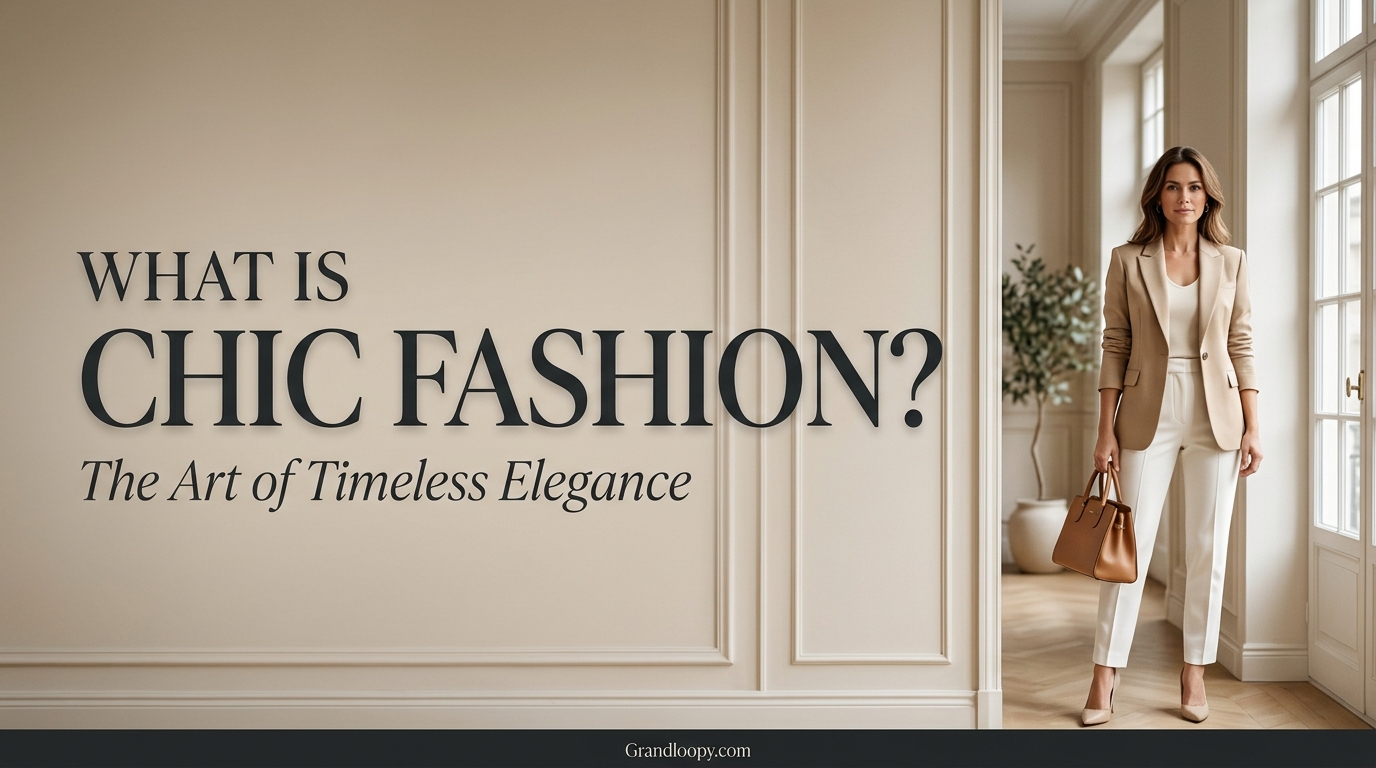
What is chic fashion in plain terms? It is a polished, intentional way of dressing built on clean lines, good fit, neutral colors, and quality fabrics rather than trends or logos.
A chic outfit looks simple at first glance, yet every piece earns its place through fit, fabric, and purpose, and nothing in the look shouts for attention.
Chic fashion is not a brand, a price tag, or a single aesthetic, since the same habits can lift casual clothes, work clothes, and evening clothes alike.
The sections below explain the dictionary meaning, the disputed history of the word, and the designers who shaped the style.
It also covers the five core traits, the seven types, a twelve-piece capsule wardrobe, budget tiers, and the mistakes that break a look.
What Is Chic Fashion in One Sentence
Chic fashion is a style of dressing that looks polished and intentional, using simple, well-fitted clothing rather than loud logos, excessive accessories, or fast-changing trends.
The Merriam-Webster definition of chic calls the noun smart elegance and sophistication especially of dress or manner, and the adjective cleverly stylish and smart.
The dictionary gives a useful example sentence: the woman who is chic adapts fashion to her own personality, a line credited to Elizabeth L. Post.
The Dictionary.com entry for chic gives a similar definition, calling chic attractive and fashionable, and it defines the noun as style and elegance, especially in dress.
One more Dictionary.com sense matters for modern use: casual and understated style, as in dress or decor, that expresses a specified trendy lifestyle or activity.
That third sense explains phrases like geek chic and urban chic, where the word describes a whole lifestyle rather than a single outfit.
Pronunciation matters too, since the word is pronounced sheek, not chick, and Dictionary.com notes that the spelling pronunciation is considered nonstandard except when used facetiously.
Chic Is, and Chic Is Not
Chic is about intention, not expense, and a cheap shirt that fits well beats an expensive shirt that hangs badly every single time.
Chic is not the same as trendy, since trends change every season while a chic wardrobe stays steady for years and only gains small updates.
Chic is not the same as formal, since a white shirt, straight jeans, and loafers can look chic at lunch without any evening wear at all.
Chic is not the same as minimalism, though the two overlap, since a chic outfit can carry color and pattern when the balance stays calm.
| Chic is | Chic is not |
|---|---|
| Polished and intentional | Flashy or overdone |
| Built on good fit | Built on logos and labels |
| Timeless with small updates | Chasing every new trend |
| Comfortable to wear all day | Stiff or hard to move in |
| Personal and adaptable | A fixed uniform for everyone |
| Quality over quantity | A closet full of cheap pieces |
Keep that table in mind while reading the rest of the guide.
Every section below returns to the same test: does the outfit look intentional, or does it look like it is trying too hard?
A chic outfit passes the test when a stranger notices the person first and the clothes second, not the other way around.
Where the Word Chic Came From
Chic is a French word, and its exact roots are still debated, which is why honest guides present both strands of the story instead of picking one.
Dictionary.com dates the word to 1855 to 1860 and traces it from French to the German word Schick, which carried the sense of skill.
The Wiktionary entry for chic gives a fuller chain: borrowed from French chic, meaning elegant, which in turn probably came from German Schick, meaning elegant appearance and tasteful presentation.
The same Wiktionary entry links the word to Dutch words for arranging and to Old English, which shows how far the root traveled before it reached fashion.
Merriam-Webster dates the noun to first known use in 1851 and the adjective to 1865, and it traces the noun directly to French.
Those dates differ slightly from Dictionary.com, so treat each as the dating of one dictionary rather than a single settled fact.
A second story circulates in fashion magazines: the word came from the old French term chicanery, meaning legal quibbling and sophistry, in the 17th century.
Stitch Fix reports that story with a link to Harper’s Bazaar and then hedges it, calling the claim a possibly true fact to impress friends with at parties.
Svelte Magazine repeats the same chicanery claim, also citing Harper’s Bazaar, without the competing German origin.
The chicanery story is popular, yet the dictionaries support the German Schick root, so the two accounts should stay separate and labeled by source.
| Source | Origin claimed | Date given |
|---|---|---|
| Dictionary.com | French, from German Schick, meaning skill | 1855 to 1860 |
| Wiktionary | French chic, probably from German Schick | Earliest English use 1842 to 1844 |
| Merriam-Webster | Noun from French | First known use 1851, adjective 1865 |
| Harper’s Bazaar, via Stitch Fix | Old French chicanery, meaning legal quibbling | 17th century |
Read the table as a warning against any guide that states one origin as settled fact, since the evidence itself is split between dictionaries and magazines.
Wiktionary preserves the earliest English uses in print, including Charles Dickens writing of the chicest spirits in Martin Chuzzlewit between 1842 and 1844.
William Makepeace Thackeray used the word in Punch in 1847, and London Society wrote of chic circles in 1870.
The sharpest early line comes from Temple Bar magazine in 1877: what is chic may, in a sense, be fashionable, but what is fashionable cannot be chic.
That 1877 line still captures the difference today, since anybody can wear what is fashionable, while chic needs personal judgment that cannot be bought off a rack.
A Short History of Chic
Chic traveled from French salons to American streets over about a century, and each decade added a layer that still shows in the style today.
By 1887, Stitch Fix reports, the word was being used in publications to describe just about anything, from clothing to architecture.
In 1925, chic exploded across the Atlantic onto the American fashion scene with the height of the jazz age, according to the same Stitch Fix history.
By 1954, chic was a frontrunner in the industry, and Audrey Hepburn ignited its flame with her wardrobe in the film Sabrina.
Hepburn was dressed by costume designer Edith Head for Sabrina, and the fashions in that film lifted her to chic style icon status.
The polished version of boho style emerged in late 2005, when a more fitted, neutral, and coordinated version was knighted as boho chic.
Quiet luxury, the logo-free luxury look of the 2020s, is the newest chapter, and it repeats the old chic rules under a fresh name.
| Date | Milestone | Why it matters |
|---|---|---|
| 17th century | Chicanery origin claimed by magazines | The popular story, not the dictionary one |
| 1842 to 1844 | Dickens uses chic in Martin Chuzzlewit | Earliest English use in print |
| 1851 | Merriam-Webster first known use, noun | The word enters the dictionary record |
| 1887 | Chic used in publications for anything stylish | From fashion word to general praise |
| 1910 | Chanel opens her millinery shop in Paris | Comfort and simplicity enter couture |
| 1925 | Chic explodes in America with the jazz age | The style crosses the Atlantic |
| 1926 | Chanel introduces the little black dress | One dress becomes the chic symbol |
| 1954 | Hepburn wears Edith Head designs in Sabrina | Chic gains its most famous face |
| Late 2005 | Boho chic emerges as a polished trend | Chic absorbs a free-spirited style |
| 2020s | Quiet luxury repeats the chic rules | Logo-free dressing returns to fashion |
Coco Chanel and the Foundations of Chic
Coco Chanel is the designer most tied to chic, and her biography explains why comfort and simplicity became the core of the style.
Gabrielle Bonheur Chanel was born on August 19, 1883, in Saumur, France, and died on January 10, 1971, in Paris, according to the Encyclopaedia Britannica biography of Coco Chanel.
She learned to sew in a convent-run orphanage in Aubazine after her mother died in 1895, and she later worked as a seamstress and a cafe singer.
With financial help from Arthur Boy Capel, she opened a small millinery shop at 21 rue Cambon in Paris in 1910, and she opened a boutique in Deauville in 1912.
Her early designs used jersey, then an inexpensive fabric used in men’s undergarments, and turned it into simple, elegant sweaters and jackets inspired by menswear.
Britannica quotes her maxim that luxury must be comfortable, otherwise it is not luxury, and her designs stressed simplicity and ease over corsets and petticoats.
In 1926 she introduced the little black dress, and American Vogue called it the Ford of Fashion, a reference to the Model T car.
The dress was versatile enough to move from day to evening with the right accessories, which is exactly the test a chic piece must pass.
Chanel No. 5 arrived in 1921, developed with Ernest Beaux, and she was among the first major designers to introduce a perfume.
She closed her couture house in 1939 at the outbreak of World War II, and she returned to Paris in 1954 with a collarless, braid-trimmed tweed suit.
By the end of the 1950s she had also debuted the quilted purse with gold chains and two-toned shoes, both now classic chic pieces.
One more fact belongs in any honest account: Britannica records that historians generally agree Chanel had ties to Nazi officials and tried to benefit from Nazi policies.
The extent of her intelligence work and ideological commitment remains debated.
Her wartime record is a separate subject from her design legacy, and the two should not be merged into a single verdict about her clothes.
A second Chanel line is widely attributed to her: in order to be irreplaceable, one must be different, as Stitch Fix quotes it.
Treat that line as attributed rather than verified verbatim, since no primary source is cited for the exact wording.
Chanel sold her couture brand in 1954 to Pierre Wertheimer, and the house was later led by Karl Lagerfeld from 1983 to 2019.
What Makes a Look Chic: The Five Core Traits
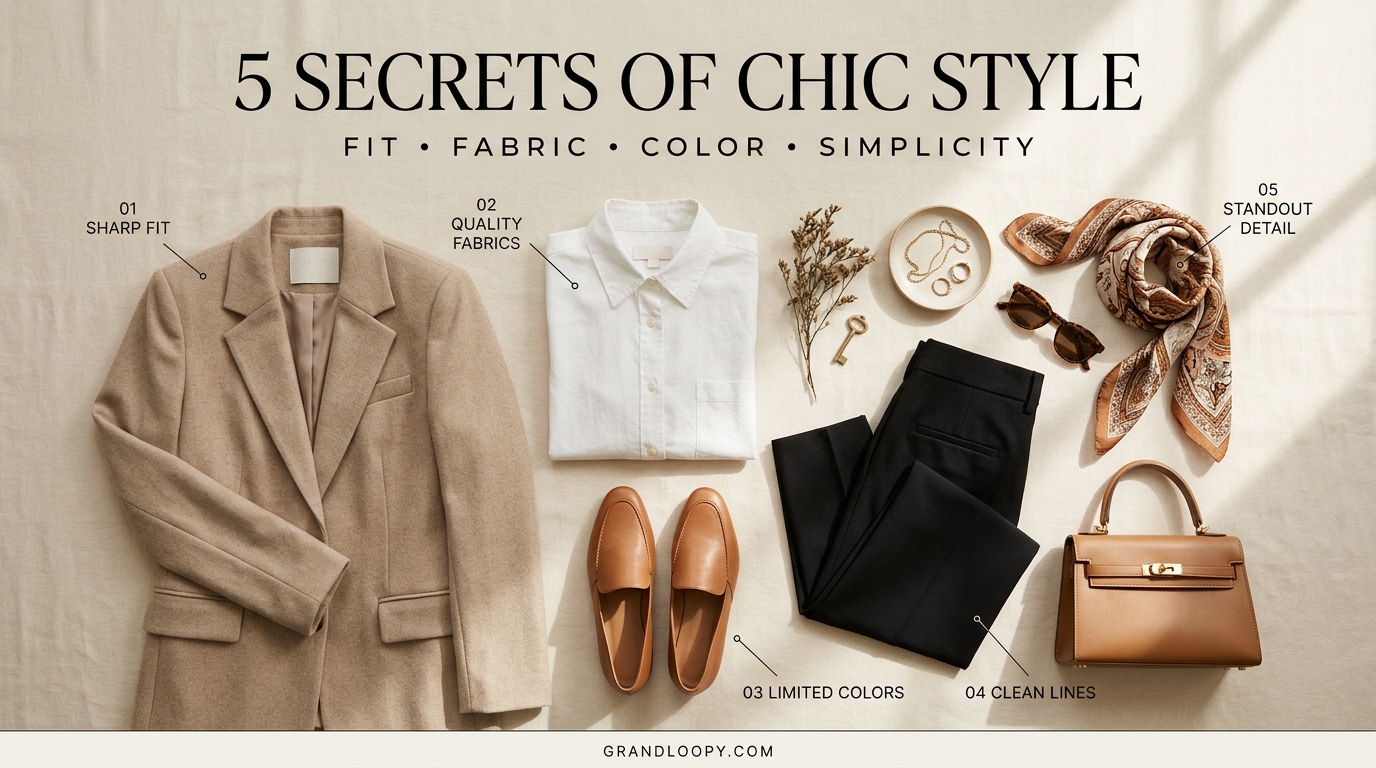
Five qualities show up in almost every outfit people call chic, and none of them needs a big budget, only a little attention.
Learn the five traits first, since they are the test every later section uses to judge blazers, dresses, shoes, and accessories.
Clean Lines
Chic outfits rarely look busy, since straight seams, simple necklines, and uncluttered shapes let the clothes speak softly.
Think of a plain shirt dress, a straight skirt, or trousers with a smooth front, where the outline is clear and the eye moves calmly.
When the silhouette is clean, even a basic piece reads as a confident decision, and that sense of intention is what people mean by chic.
Avoid fussy ruffles, heavy embellishment, and competing prints in the same outfit, since clutter is the opposite of clean lines.
Quality Fabrics
Fabric decides how an outfit hangs and how it ages, and you do not need luxury prices, only cloth that drapes well and keeps its shape after washing.
Feel the weight in your hands before you buy, and check for even stitching, since a modest piece in good fabric beats an expensive one that clings or creases badly.
Wool keeps its form for structured outerwear, cotton poplin stays crisp and breathable for everyday tops, and linen blends bring light texture to warm-weather layers.
Silk and satin give a soft, fluid drape for dressier tops and skirts, while fine knits stay smooth and comfortable for layering.
| Fabric | Why it works | Best for |
|---|---|---|
| Wool | Keeps its form | Structured outerwear |
| Cotton poplin | Crisp and breathable | Everyday tops |
| Linen blend | Light with a textured finish | Warm-weather layers |
| Silk or satin | Soft, fluid drape | Dressier tops and skirts |
| Fine knit | Smooth and comfortable | Layering |
| Cashmere | Warm without bulk | Sweaters and scarves |
| Crepe | Holds shape, resists creasing | Dresses and jumpsuits |
| Leather | Structured and durable | Jackets, belts, bags |
Limited Colours
A small palette keeps an outfit calm and cohesive, and two or three shades across clothes, shoes, and bag are usually enough.
Build around neutrals like black, white, beige, navy, camel, and grey, since they mix easily and look polished in almost any combination.
A single bold shade works too, as long as everything around it stays simple, so the eye travels smoothly from top to bottom instead of jumping around.
Glance recommends a working palette of six to eight tones that mix well across pieces, which is a practical limit for a whole wardrobe.
| Anchor | Partner | Accent |
|---|---|---|
| Navy | Cream | Tan leather |
| Black | Ivory | Gold |
| Charcoal | Camel | White |
| Olive | Stone | Brown |
| Burgundy | Grey | Blush |
Test any pairing against your own skin tone before you commit, since the same navy and cream can look warm on one person and cool on another.
Sharp Fit
Fit is the quickest way to make affordable clothes look expensive, and it matters more than the label sewn inside.
Shoulders should sit where the seam is meant to sit, sleeves should end near the wrist, and trousers should skim the body rather than strain or swamp it.
A tailor can adjust hems, waists, and sleeve lengths for a small fee, which often turns a good piece into a great one.
Comfort counts as much as shape, since stiff or tight clothes make you move awkwardly, and awkward movement ruins any outfit.
| Body area | Fit check | Fix |
|---|---|---|
| Shoulders | Seam sits on the shoulder bone | Size down or tailor the seam |
| Sleeves | End near the wrist bone | Shorten at a tailor |
| Waist | Skims without pulling or gaping | Take in or let out |
| Trouser hem | Just brushes the top of the shoe | Hem to your shoe height |
| Chest and bust | No pulling at buttons | Size up, then tailor the waist |
| Skirt and dress hem | Moves freely when you walk | Adjust length to your leg line |
One Standout Detail
Chic looks usually have a single point of interest and keep everything else plain, so the eye has somewhere to land.
It might be a statement earring, a patent belt, a textured bag, or a bright scarf, and choosing one hero stops the outfit from feeling overworked.
If you catch yourself reaching for a second showpiece, take one of them off, since two heroes compete and neither wins.
Stitch Fix calls this a simple voice with an extravagant exclamation point, which captures the balance in one image.
Chic vs Classy vs Elegant vs Trendy
These words overlap, yet each points to something slightly different, and knowing the difference helps you aim for the right mood instead of copying a single formula.
Chic is about attitude and ease, with a fresh look that often feels current, while classy suggests good taste with modest cuts and a timeless mood.
Elegant leans toward grace and refinement, usually in flowing or formal pieces, and a look can be one, two, or all three at once.
Trendy follows what is popular right now, which makes it the opposite of chic in one key way: trends fade, while chic stays.
Minimalist focuses purely on simplicity, while chic also carries elegance and personal confidence, so a minimalist wardrobe can be chic, and so can a colorful one.
Classic means traditional and rarely changing over decades, like a trench coat with pearl earrings, while chic borrows from classic and adds a current edge.
| Style word | Main feeling | Typical example |
|---|---|---|
| Chic | Smart, current, easygoing | Leather jacket over a slip dress with flat boots |
| Classy | Modest, timeless, respectful | Knee-length skirt with a neat cardigan |
| Elegant | Graceful, refined, formal | Flowing satin gown with soft jewelry |
| Trendy | Current, bold, short-lived | An outfit currently viral on social media |
| Minimalist | Plain, reduced, calm | Black trousers, white shirt, no jewelry |
| Classic | Traditional, steady, familiar | Trench coat and pearl earrings |
Chic is the most flexible of the six, since a relaxed outfit can be chic even when it would rarely be called elegant.
Chic vs Quiet Luxury vs Old Money
Quiet luxury is the closest cousin to chic, since both avoid logos and rely on quality fabric, clean tailoring, and neutral colors.
The difference is scope: quiet luxury is mainly a price and branding stance, while chic is a way of putting any outfit together at any price.
Old money is a lifestyle aesthetic built on heritage pieces like tweed, loafers, and pearls, and it overlaps with chic but adds a social signal that chic does not need.
A thrifted blazer can be chic, yet it would rarely be called old money, which shows why chic is the broader and more useful term.
| Style | Core idea | Price signal | Logo use |
|---|---|---|---|
| Chic | Polished, intentional dressing | Any budget | None needed |
| Quiet luxury | Expensive fabrics, no branding | High | Deliberately absent |
| Old money | Heritage, tradition, understatement | High, inherited look | Absent, with heritage cues |
The Types of Chic Fashion
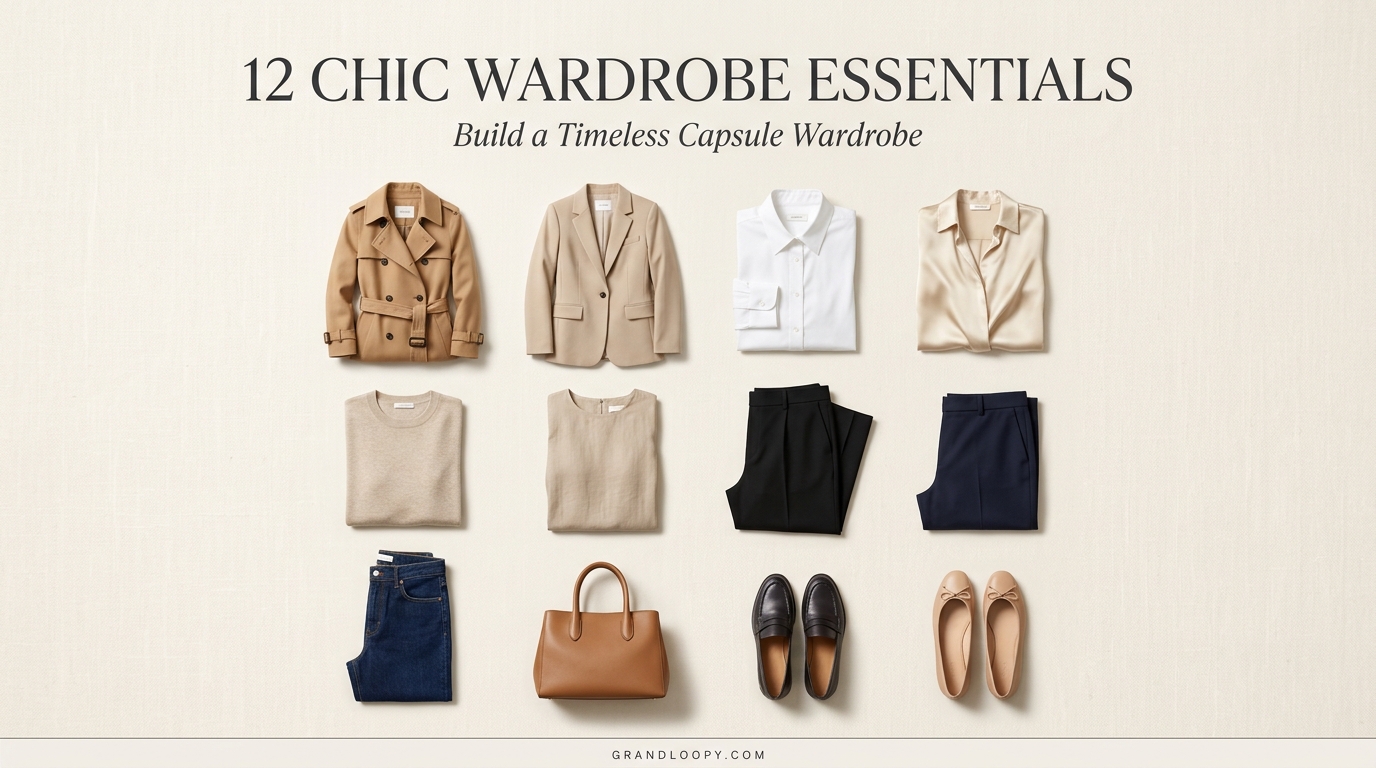
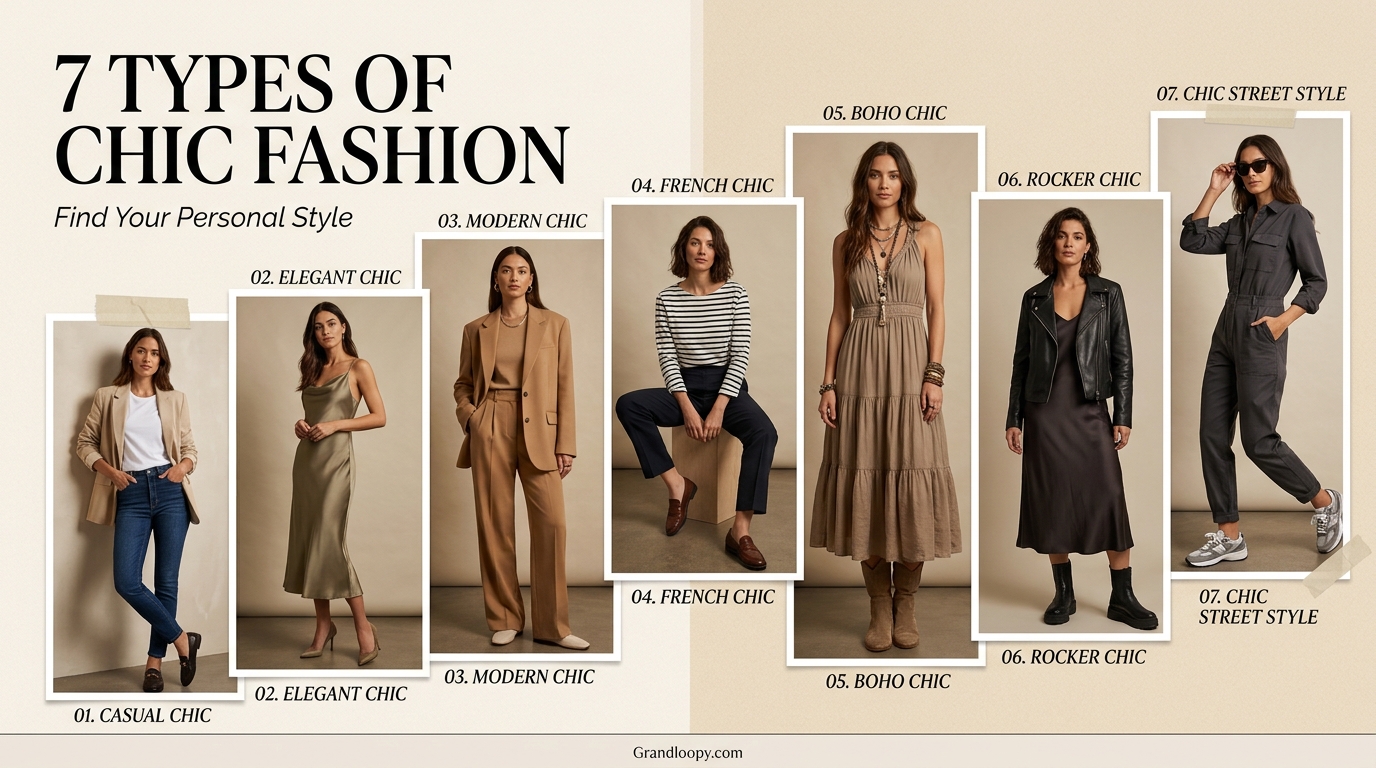
Chic fashion is not one-size-fits-all, since it adapts to your lifestyle, mood, and setting, and each type keeps the same five traits with a different accent.
Pick one type as your home base, then borrow pieces from the others, since a wardrobe with a clear center is easier to build than one that tries to be everything.
Casual Chic
Casual chic blends relaxed pieces with class, and it is the type most people wear on ordinary days.
Pair fitted jeans with a white tee and a linen blazer, or wear a midi dress with sneakers and a leather crossbody bag.
The rule is one tailored or polished piece in every look, which keeps the outfit intentional instead of sloppy.
Elegant Chic
Elegant chic thrives on clean lines, minimal patterns, and luxurious fabrics, and it suits formal dinners, work functions, and upscale events.
Think wrap dresses in solid tones, blazers layered over a slip dress, pencil skirts with silk blouses, and monochrome looks with gold accessories.
Soft silks, fine knits, and well-cut dresses do the work, while the accessories stay small and deliberate.
Modern Chic
Modern chic focuses on contemporary shapes and never compromises on polish, often playing with asymmetry, layering, and unexpected fabric pairings.
Structured pants with cut-out tops, sleeveless blazer vests over minimal tank dresses, and matching sets with sharp tailoring are typical modern chic pieces.
Colorblocking, structured design, and fresh solid color palettes mark the type, much like modern architecture.
French Chic
French chic is the origin of all chic styles, and it is wrapped in beautiful simplicity with basics that carry unique details like balloon sleeves and pleats.
It is never overdone, and it relies heavily on statement pieces that take a simple look to the next level with one unexpected pop.
Basics with unique details make everyday dressing easy, since the pieces mix and match into numerous fresh looks.
Boho Chic
Boho chic comes from the French Bohemians, travelers and artists from central Europe whose flowing, effortless clothes became a style statement in the early 20th century.
The polished version emerged in late 2005, with pieces more fitted, neutral, and coordinated than boho alone, yet still self-expressive.
Boho chic is far more curated and versatile than plain boho, and it expands a wardrobe with each piece instead of repeating one look.
Rocker Chic
Rocker chic adds edge to elegance, marked by leather, fringe, and distressing, with a sexy silhouette that still reads polished.
The style began with motorcycle protection, since riders needed a thick layer of armor, and the biker jacket became a fashion point over time.
Pair a leather jacket with a slip dress and flat boots, and the outfit turns chic instead of costume.
Gothic fashion is the darker, more dramatic cousin of rocker chic, and the What Is Gothic Fashion guide covers its styles, history, and outfit formulas.
Chic Street Style
Chic street style evolved from the street rather than the runway, and it mixes retail pieces with designer items into looks that are functional and fashionable.
Crisp chic lines and neutral colors keep the streetwear base clean, and athleisure with comfort and style in mind dominates the current version.
A versatile jumpsuit with a utility-inspired open-front top and a pair of trainers makes an instantly chic street look.
Streetwear is a different fashion language built on logos, drops, and bold graphics, and the What Is Streetwear Fashion guide covers its history and brands in full.
| Your lifestyle | Best chic type | Start with |
|---|---|---|
| Office and meetings | Elegant chic | Blazer, silk blouse, pencil skirt |
| Relaxed days and errands | Casual chic | Jeans, white tee, linen blazer |
| Creative work and nights out | Modern chic | Matching set, cut-out top |
| Minimal wardrobe, high standards | French chic | Basics with one statement piece |
| Free-spirited and artistic | Boho chic | Flowing dress, neutral layers |
| Bold and edgy | Rocker chic | Leather jacket, slip dress |
| City life and comfort | Chic street style | Jumpsuit, trainers, utility layer |
The Chic Wardrobe: 12 Pieces That Do the Work
You do not need a closet full of clothes to dress chic, since the right twelve pieces combine into dozens of outfits when each one works with at least three others.
Think of a chic collection as a small team, where every piece must earn its place by pairing with clothes you already own.
Before buying anything, picture three outfits you could make with it from clothes you already own, and leave it in the shop if you cannot.
| Piece | Count | Buy order | Why it earns its place |
|---|---|---|---|
| Tailored blazer | 1 | First | Structures jeans, dresses, and trousers |
| White button-down shirt | 2 | First | Works tucked, open, or layered |
| Tailored trousers | 2 | Second | Black and navy cover work and evenings |
| Straight-leg jeans | 1 | Second | Dark wash, no heavy distressing |
| Silk blouse | 1 | Third | Softens structured pieces |
| Midi dress | 1 | Third | One piece, one complete outfit |
| Fine-knit sweater | 2 | Third | Crewneck and turtleneck cover seasons |
| Trench coat | 1 | Fourth | The outer layer people see first |
| Loafers | 1 | Fourth | Polished without heels |
| Ballet flats | 1 | Fourth | Light, neat, all-day comfort |
| Structured bag | 1 | Fifth | Finishes the outfit like a frame |
| Ankle boots | 1 | Fifth | Covers fall, winter, and evenings |
That is twelve core garments plus three pairs of shoes and one or two coats, which matches the compact starting point Alamdiya recommends in its collection building section.
Anything beyond that should fill a gap you can name, such as a summer linen piece or a formal dress for a wedding.
Build slowly and spend wisely, putting more money into the items you wear most, such as coats, shoes, and bags, and less into pieces that follow short-lived trends.
Edit your closet twice a year and let go of anything that no longer fits or that you never reach for, since a smaller, tidier closet makes dressing faster and looks sharper.
The Tailored Blazer
A structured blazer is the most versatile piece you will ever own, since it instantly upgrades casual jeans and polishes a dress.
Look for quality tailoring with shoulders that sit right, sleeves that hit the wrist, and a length that flatters your height.
Stick with neutrals like black, beige, or navy for maximum wearability, and wear it open for a relaxed finish or buttoned for meetings.
The White Shirt
A clean white shirt is like a blank canvas, and cotton poplin gives structure while silk adds a fluid, elegant touch.
Tuck it into high-waisted trousers for a sharp look, or leave it slightly unbuttoned with rolled-up sleeves for laid-back chic.
Keep two in rotation, since a white shirt needs washing often and a spare keeps the look fresh.
Trousers, Jeans, and the Midi Dress
High-waisted, well-fitted trousers elongate your frame and bring instant refinement, whether wide-leg or straight.
Go for neutral tones like charcoal, ivory, or camel to pair with almost anything in your wardrobe.
Dark or mid-blue denim without heavy distressing, in a straight or wide leg with a tidy hem, makes jeans look deliberate instead of casual.
A midi dress needs very little styling, which makes it ideal for busy mornings, and a clean A-line or wrap shape moves well when you walk.
Three Outfit Formulas You Can Reuse
Formulas remove the morning guesswork, since you repeat a proven shape and change only the colors, fabrics, and shoes.
The Structured-and-Relaxed Formula
Pair one tailored item with one relaxed item, such as a blazer with jeans, tailored trousers with an oversized knit, or a fitted top with wide-leg pants.
The balance creates polished outfits that still feel comfortable, which is the heart of everyday chic.
The Basics-Plus-One Formula
Build around wardrobe essentials, then add one standout item such as colorful shoes, a patterned scarf, a textured handbag, or a structured jacket.
Keeping the rest simple allows the focal piece to stand out naturally, which is the one standout detail rule in formula form.
The Three-Color Formula
Choose one primary color, one supporting neutral, and one small accent through a shoe, bag, scarf, or piece of jewelry.
It is a useful guideline rather than a fixed fashion rule, and it keeps outfits calm without making them boring.
The 3-3-3 Wardrobe Method
The 3-3-3 method is a flexible wardrobe-planning exercise: choose three tops, three bottoms, and three pairs of shoes or key accessories, then combine them into several outfits.
It works well for travel packing and capsule wardrobes, and it shows which basics are genuinely versatile.
There is no universal definition of the method, so treat it as a way to edit your wardrobe rather than a formal fashion rule.
| Tops | Bottoms | Outerwear | Shoes |
|---|---|---|---|
| White shirt | Straight-leg jeans | Tailored blazer | Loafers |
| Fine knit sweater | Wide-leg trousers | Trench coat | Minimal sneakers |
| Black T-shirt | Black trousers | Wool coat | Ankle boots |
| Knit polo | Midi skirt | Denim jacket | Ballet flats |
How to Dress Chic in Five Steps
When you are short on time, this routine works with almost any wardrobe, and it takes less than five minutes once the habits settle.
Follow the steps in order, since each one builds on the last and skipping ahead is how outfits go wrong.
- Start with the setting. Think about where you will sit, walk, and stand, then pick clothes that suit all three.
- Choose one base piece. Build around trousers, a skirt, or a dress rather than a pile of separates.
- Balance the proportions. Pair something fitted with something looser, so the outfit has shape without strain.
- Test it in motion. Sit down, raise your arms, and walk across the room, and change anything that pulls or rides up.
- Step back and scan once. Notice the first thing your eye lands on, and adjust it if it is not the part you meant to feature.
The motion test is the step most people skip, and it is the step that catches the gaping shirt, the riding skirt, and the shoe that pinches after ten minutes.
Finish with practical details before you leave home: check that the clothing is comfortable, the shoes are clean, the bag suits the occasion, and the layers create a balanced shape.
Chic for Women
Six pieces cover most situations for women, and each one is easy to wear again and again without repeating an outfit.
Tailored Blazer
A blazer gives instant structure to jeans, dresses, or trousers, and one good blazer replaces several tired layers.
Choose a cut that suits your frame, wear it open for a relaxed finish, and button it for meetings.
Wide-Leg Trousers
Wide-leg trousers lengthen the leg and feel wonderfully comfortable, especially in a high waist and a fluid fabric.
Hem them so they just brush the top of your shoes, and pair them with a fitted knit, a crisp shirt, or a simple tank.
Silk Blouse
A silk or satin blouse adds softness against structured pieces, and a plain neckline keeps it versatile.
Tuck it in for work, leave it loose over jeans for a lighter feel, and add nothing more than small studs.
Midi Dress
A midi dress needs very little styling, which makes it ideal for busy mornings, and a clean A-line or wrap shape moves well when you walk.
Add a slim belt and flats or heels depending on the day, and the same dress works for lunch and for dinner.
Pointed Flats
Pointed flats lengthen the leg while staying comfortable for a full day, and a neat leather pair in a neutral shade moves from a desk to a dinner table.
They suit trousers, skirts, and dresses equally well, which makes them one of the most useful shoes in a chic wardrobe.
Structured Bag
A bag with firm edges finishes an outfit the way a frame finishes a picture, and a medium tote or top-handle style in leather holds its shape far longer than a slouchy alternative.
Chic for Men
Chic for men is about precision rather than loud trends, and five areas matter most.
Crisp Shirts
A well-pressed shirt in a plain light shade or a fine stripe is the base of most chic male outfits.
Choose a collar that holds its shape and sleeves that end at the wrist bone, then wear it tucked in for a smarter look or open over a plain tee for the weekend.
Fitted Chinos
Chinos in an earthy tone give a polished base that still feels comfortable, and a slightly tapered leg keeps proportions tidy.
Hem them so they just touch the shoe and avoid sloppy pooling, and they move from the office to dinner with only a change of shirt.
Knitwear Layers
A merino crewneck or a fine cardigan adds warmth without bulk, and layering it over a collared shirt softens a structured outfit.
Keep the shade close to your trousers, since that balance is exactly what men’s chic style depends on.
Smart Footwear
Leather loafers, derby shoes, or plain leather sneakers in black, brown, or tan finish most outfits.
Match the belt to the shoes, keep the leather in good condition, and resole them when the soles wear thin.
One well-kept pair looks better than three tired ones, and clean shoes are noticed long before any label.
Grooming Touches
Clothes only work when the person wearing them looks cared for, and a tidy haircut, trimmed facial hair, and clean nails complete the picture.
These small habits cost very little, and they are noticed long before any label is.
Chic on a Budget
Chic does not need a big budget, and the biggest myth around the style is that it means expensive clothes.
Chic is about how you put things together, not how much you spend.
A simple, well-fitted outfit from an affordable store can look far more chic than an expensive outfit that is mismatched or ill-fitting.
Thrift stores, resale apps, and end-of-season sales often hold wool coats, leather bags, and silk shirts at a fraction of the original price.
Buying fewer pieces that you will wear often brings the cost per wear down quickly, which is the math that matters.
Cost Per Wear: The Math That Matters
Cost per wear divides the price of a piece by the number of times you wear it, and it turns vague budget advice into a number you can use.
As an example, a 60-dollar blazer worn 60 times costs 1 dollar per wear, while a 20-dollar trendy top worn twice costs 10 dollars per wear.
The cheaper item is the worse buy in that example, since it leaves the closet after two wears while the blazer keeps working.
Use the same math before every purchase: estimate honest wears, divide, and buy the piece with the lower cost per wear.
| Tier | Where to shop | Best buys | Watch out for |
|---|---|---|---|
| Thrift and resale | Thrift stores, resale apps | Wool coats, leather bags, silk shirts | Worn linings, missing buttons, dated cuts |
| High-street | High-street retailers | Blazers, trousers, white shirts, loafers | Thin fabric, weak stitching, fast trends |
| Investment | Quality brands, tailors | Trench coat, leather bag, tailored blazer | Overpaying for a logo instead of craft |
Put more money into the items you wear most, such as coats, shoes, and bags, and less into pieces that follow short-lived trends.
High-street shops are the usual source for chic basics, and the Is Zara Fast Fashion guide covers what that brand is and how it works before you shop there.
A fabric shaver, a handheld steamer, and regular shoe polish keep affordable clothes looking fresh for years.
Learn to restyle what you own too: a belt over a long cardigan, a scarf tied to a bag handle, or a jacket worn over a dress.
Each of those small moves can create a new outfit at no cost.
Chic Across Seasons and Occasions
Chic fashion is incredibly adaptable, and the fabrics, layers, and color choices shift with the weather while the rules stay the same.
| Season | Fabrics | Colors | Pieces |
|---|---|---|---|
| Spring and summer | Cotton, linen, satin, light crepe | Soft pastels, whites, tans, navy | Breezy midi dresses, wide-leg linen trousers, light blazers |
| Fall | Wool blends, suiting fabrics, light knits | Earth tones, deep greens, charcoal, warm beige | Long coats, structured jackets, midi skirts, turtlenecks |
| Winter | Cashmere, wool, faux fur, structured leather | Deep neutrals, burgundy, navy, greys | Tailored coats, knit dresses, high-neck sweaters, wool trousers |
Heavier layering does not mean bulk, so use clean outerwear and elegant footwear like knee-high boots or pointed heels to stay warm and polished.
Summer chic survives heat with breathable fabrics such as linen blends and cotton, lighter shades, and breezy cuts that let air move.
Keep accessories minimal in summer, wear comfortable flat sandals or clean loafers, and carry a light layer for air-conditioned rooms.
| Occasion | Formula | Finish |
|---|---|---|
| Everyday errands | Lightweight knit, straight-leg jeans, loafers | Structured shoulder bag |
| Office | Tailored blazer, simple blouse, wide-leg trousers | Slim belt, understated earrings |
| Weekend brunch | Relaxed blazer, T-shirt, jeans, ballet flats | Light cardigan if warm |
| Date night | Satin blouse, tailored trousers, heeled sandals | Small handbag, simple jewelry |
| Evening event | Simple black or jewel-tone dress | Compact clutch, one piece of jewelry |
| Travel | Wide-leg trousers, lightweight knit, long coat | Crossbody bag, comfortable shoes |
| Airport | Matching knit set, trench coat, sneakers | Simple layers for security checks |
| Wedding or formal | Elegant dress or tailored suit | Minimal accessories, no oversized bag |
For weddings, dinners, and formal gatherings, start with the dress code, since knee-length or midi dresses, jumpsuits in crepe or satin, and coordinated separates all sit comfortably in that space.
Closed-toe heels, block heels, or elegant flats look refined, and a small bag keeps the outfit streamlined.
For formal or religious events, check the venue expectations first and choose fuller sleeves or longer hems if needed, since chic dressing respects the setting.
Chic for Every Body and Every Age
Chic depends on balance and comfort rather than a fixed body type, so the same five traits work at any size, height, or age.
Pick shapes that follow your frame without clinging, experiment with waist definition, and adjust hemlines until the outfit feels easy.
Petite Frames
Petite dressing is about proportion, not shrinking everything, and a single-column silhouette with a defined waist usually works best.
Choose cropped jackets, straight trousers with a neat hem, and pointed flats that lengthen the leg without adding height.
Avoid oversized prints and heavy layers that swallow a small frame, since clean lines matter even more at a smaller scale.
Tall Frames
Tall dressing is about breaking up length without hiding it, and wide-leg trousers with a fitted top do that naturally.
Long coats, midi skirts, and belts at the waist add structure, while monochrome dressing in one tone can make height look deliberate.
Check sleeve and trouser length first when you shop, since off-the-rack pieces often run short on tall frames.
Plus Sizes
Plus size chic is about structure and drape, not hiding, and a tailored blazer over a well-fitted dress is one of the strongest combinations.
Wrap shapes, A-line skirts, and trousers with a smooth front define the waist without squeezing it.
A belt or a wrap shape can define the waist without squeezing, and dark neutrals with one accent color keep the look calm.
Women Over 50
A softly structured jacket, fine knit, straight-leg trousers, and leather loafers make a comfortable foundation for everyday dressing after 50.
The goal is not to look younger, so choose pieces that fit properly, move easily, and work with the rest of your wardrobe.
A modern bag, scarf, or pair of glasses can update a classic combination without making it feel forced.
The principles stay the same at any age: good fit and comfortable fabrics, with cuts and lengths chosen for what makes you feel at ease.
Grooming and the Finishing Touches
Chic style is not only about clothes, since neat hair, clean shoes, and simple makeup all add to that put together look.
Hair
Neat, healthy hair frames the whole outfit, and a simple cut that suits your face beats an elaborate style that needs constant fixing.
Keep the style tidy through the day, and choose a cut you can maintain yourself between salon visits.
Makeup
Simple makeup suits chic dressing best, with even skin, one defined feature, and a natural lip or a classic red for evenings.
Avoid heavy contouring and glitter for daytime, since the chic look is polished rather than dramatic.
Nails and Skin
Clean, shaped nails in a neutral shade finish the hands, and moisturized skin reads as care rather than effort.
Short, neat nails suit every outfit, while a single accent color can serve as the one standout detail.
Fragrance
A light, clean fragrance is the invisible accessory, and one or two sprays is enough for a whole day.
Choose a scent you can wear in every season, and keep it subtle enough that people notice it only when they stand close.
Accessories
Accessories can make or break a look, especially in chic fashion where subtlety reigns supreme.
Go for structure over slouch in bags, with clean lines like a crossbody with gold accents or a medium-sized leather tote in black, tan, or cream.
Think classic silhouettes with quality finishes in shoes: pointed flats, slingback heels, or ankle boots for women, and brogues, leather loafers, or clean white sneakers for men.
Keep jewelry delicate with small hoop earrings, stackable rings, or a dainty necklace in gold or silver, matched to your wardrobe palette.
A slim leather belt can define your waistline over a dress or add structure to trousers, and one with minimal hardware looks cleanest.
A classic pair of sunglasses in black or tortoiseshell adds polish, a silk scarf tied around the neck gives French-girl flair, and a simple leather-strap watch reflects good taste.
Mistakes That Break a Chic Look
Even good clothes lose their charm when small things slip, and most chic mistakes are habits rather than missing pieces.
Creased fabric, loose threads, scuffed shoes, and pilled knitwear all signal neglect, so steam, brush, and clean your items before wearing them.
Visible bra straps, underwear lines, and ill-fitting underlayers can also undo an otherwise sharp outfit.
Forcing a trend you do not love, or dressing for a different occasion than the one you are attending, backfires as well.
Wearing too many logos or loud prints at once is another giveaway, because it draws attention to the labels instead of the person.
| Mistake | Better approach |
|---|---|
| Too many colors or patterns at once | Build around two or three coordinated colors |
| Ill-fitting clothes just because they are on trend | Choose fit first, trend second |
| Over-accessorizing with multiple loud pieces | Pick one focal accessory only |
| Ignoring grooming and shoe condition | Clean shoes, neat hair, simple makeup |
| Copying an entire outfit instead of adapting it | Adapt the formula to your body and lifestyle |
| Wearing multiple trends together | Choose one current detail, keep the rest timeless |
| Ignoring the occasion | Consider the dress code, weather, and plans |
Avoiding these mistakes matters as much as knowing the rules, since one broken habit can undo an otherwise perfect outfit.
Iron or steam clothes before wear, since wrinkled clothes instantly reduce visual polish, and replace worn basics like white tees or black trousers every few seasons.
Frequently Asked Questions
What is chic fashion in one sentence?
Chic fashion is a simple, polished style built on good fit, neutral colors, and quality basics rather than trends or logos.
The sentence works as a test too, since any outfit that fails on fit, color, or quality will not read as chic.
What does chic mean in fashion?
Chic means smart elegance and sophistication in dress, according to Merriam-Webster, and Dictionary.com calls it attractive and fashionable.
In everyday use it means a look that feels polished and intentional without trying too hard, which is why the word also describes people, places, and rooms.
How do you pronounce chic?
Chic is pronounced sheek, not chick, and Dictionary.com notes that the spelling pronunciation is considered nonstandard except when used facetiously.
The French origin explains the sound, since the word entered English from French in the 19th century.
Where does the word chic come from?
The dictionary answer is French, from the German word Schick, meaning skill or elegant appearance, dated by Dictionary.com to 1855 to 1860.
A magazine story traces it instead to the old French term chicanery, meaning legal quibbling, and Stitch Fix itself hedges that claim as a possibly true fact.
Is chic the same as classy?
Not exactly, since classy suggests good taste with modest cuts and a timeless mood, while chic is about attitude and ease with a fresh, current feel.
A look can be both at once, such as a knee-length skirt with a neat cardigan worn with confidence.
Is chic the same as elegant?
No, since elegant leans toward grace and refinement, usually in flowing or formal pieces, while chic is more relaxed and wearable every day.
A relaxed outfit can be chic even when it would rarely be called elegant.
Is chic the same as minimalist?
Not exactly, since minimalism is about having less and keeping things plain, while chic describes the finished look.
A minimalist wardrobe can be chic, and so can a colorful, layered one, provided it feels balanced.
Is chic the same as trendy?
No, and in some ways they are opposites, since trendy fashion changes every season and copies what is viral online.
Chic fashion stays consistent and focuses on what suits you, not what is currently popular, so trends fade while chic does not.
Is chic the same as quiet luxury?
They overlap closely, yet quiet luxury is mainly a price and branding stance, while chic is a way of putting any outfit together at any price.
Both avoid logos and rely on quality fabric and clean tailoring, which is why quiet luxury looks so much like chic.
Is chic the same as old money?
No, since old money is a lifestyle aesthetic built on heritage pieces like tweed, loafers, and pearls, with a social signal that chic does not need.
A thrifted blazer can be chic, yet it would rarely be called old money.
Is chic fashion only for women?
No, chic works for anyone, since the five traits of clean lines, quality fabric, limited color, sharp fit, and one standout detail apply to men too.
Most guides focus on women, which is a gap in the coverage, and the men’s section above gives the male version in full.
Can men be chic?
Yes, through precision rather than loud trends, with crisp shirts, fitted chinos, knitwear layers, smart footwear, and neat grooming.
A charcoal blazer over a black crew-neck shirt with tapered trousers and leather sneakers is a simple example that reads chic at once.
Is chic fashion expensive?
Not necessarily, since chic is about how you put things together, not how much you spend.
A simple, well-fitted outfit from an affordable store can look far more chic than an expensive outfit that is mismatched or ill-fitting.
How much does a chic wardrobe cost?
There is no fixed price, since the same twelve pieces can come from thrift, high-street, or investment sources at very different totals.
The number that matters is cost per wear, so divide each price by honest wears and buy the piece with the lower result.
Can you dress chic on a thrift budget?
Yes, since thrift stores and resale apps often hold wool coats, leather bags, and silk shirts at a fraction of the original price.
Check linings, buttons, and cuts before you buy, and spend the savings on tailoring, which turns a good thrift find into a great piece.
Can jeans look chic?
Yes, with dark or mid-blue denim without heavy distressing, in a straight or wide leg with a tidy hem, paired with a white shirt or a fine knit and neat shoes.
Jeans can look chic with a blazer and neat shoes, and the Are Jeans Business Casual guide covers where denim fits at work.
Can sneakers be chic?
Yes, if they are clean, low-profile, and simple, such as white or neutral leather sneakers with straight trousers, midi skirts, or slip dresses.
Avoid bulky, worn, or neon pairs when you want the smart side of the outfit to lead.
Does chic mean you must wear black?
No, black is a useful anchor, not a rule, and navy, cream, camel, grey, olive, burgundy, and white all build chic outfits.
All-black outfits work when the fabrics vary, such as a soft knit with tailored trousers and leather shoes.
Can chic be colorful?
Yes, as long as the color stays controlled, with one bold shade surrounded by simple neutrals so the eye travels smoothly.
A single bold shade works too, and a bright scarf or a colorful shoe can serve as the one standout detail.
Is chic fashion age-limited?
No, the principles stay the same at any age, since good fit and comfortable fabrics matter at 20, 50, and 80 alike.
What changes is the choice of cuts and lengths, so pick what makes you feel at ease rather than following a rule about what your age should wear.
Can chic work for plus sizes?
Yes, since chic depends on balance and comfort rather than a fixed body type, and structure plus drape matter more than size.
Wrap shapes, A-line skirts, and trousers with a smooth front define the waist without squeezing it.
Can chic work for petite frames?
Yes, with proportion as the guide, using a single-column silhouette, a defined waist, cropped jackets, and pointed flats that lengthen the leg.
Avoid oversized prints and heavy layers that swallow a small frame, since clean lines matter even more at a smaller scale.
What are the essentials of a chic wardrobe?
Twelve core pieces cover most situations: a blazer, two white shirts, two pairs of tailored trousers, straight-leg jeans, a silk blouse, and a midi dress.
Add two fine-knit sweaters, a trench coat, loafers, ballet flats, a structured bag, and ankle boots to complete the set.
That is the capsule table above, and each piece must pair with at least three others to earn its place.
How do I find my chic type?
Start with your lifestyle, not a magazine, and match it to the decision table above: office life points to elegant chic, relaxed days to casual chic, creative work to modern chic.
Pick one type as your home base, then borrow pieces from the others once the base feels natural.
What shoes are chic?
Loafers, ballet flats, ankle boots, pointed flats, slingback heels, brogues, derby shoes, and clean white sneakers all count as chic when they are clean and well kept.
Classic silhouettes with quality finishes matter more than the brand, and one well-kept pair beats three tired ones.
Is a logo bag chic?
Usually not, since chic relies on structure and quality rather than a visible logo, and a plain structured bag in good leather reads more chic than a loud monogram.
A small, tasteful logo is fine when the bag itself is well made, yet the logo should never be the point of the outfit.
Can athleisure be chic?
Yes, when it is clean, coordinated, and intentional, such as a matching knit set with a trench coat and supportive sneakers for travel.
Keep the colors within one family, the shoes clean, and the layers simple, and athleisure turns into chic street style.
How do I dress chic for work?
Use the office formula of a tailored blazer, a simple blouse, and wide-leg trousers, in neutral colors with a slim belt and understated earrings.
For less formal workplaces, swap the blouse for a fine knit or a clean T-shirt and keep the same structure.
How do I dress chic for a job interview?
Choose the most polished version of your normal chic outfit, with a blazer, a crisp shirt, tailored trousers or a midi skirt, and clean closed-toe shoes.
Keep jewelry small, skip loud prints, and test the outfit in motion the day before so nothing pulls or rides up.
How do I dress chic on video calls?
Dress the top half with the same care as the whole outfit, since the camera shows shoulders, neckline, and background most of all.
A structured top in a solid color, neat hair, simple earrings, and a tidy background behind you do more than any full outfit the camera never sees.
What is French chic fashion?
French chic is the origin of all chic styles, built on beautiful simplicity with basics that carry unique details like balloon sleeves and pleats.
It is never overdone, and it relies on one statement piece that takes a simple look to the next level.
What is modern chic fashion?
Modern chic focuses on contemporary shapes and never compromises on polish, playing with asymmetry, layering, colorblocking, and unexpected fabric pairings.
Structured pants with cut-out tops, sleeveless blazer vests, and matching sets with sharp tailoring are typical modern chic pieces.
What is boho chic?
Boho chic is the polished version of bohemian style, with pieces more fitted, neutral, and coordinated than boho alone, yet still self-expressive.
It comes from the French Bohemians, travelers and artists whose flowing clothes became a style statement, and the polished version emerged in late 2005.
What is casual chic?
Casual chic blends relaxed pieces with class, pairing comfortable clothes with one tailored or polished piece in every look.
Fitted jeans with a white tee and a linen blazer is the classic example, and the key is effortless mixing.
Who invented chic fashion?
No single person invented chic, since the word and the style grew over a century, yet Coco Chanel is the designer most tied to it.
Her jersey dresses, little black dress, and tweed suits turned comfort and simplicity into the foundation of chic dressing.
When did chic fashion start?
The word entered English in the 1840s and 1850s, with Dickens using it in 1842 and Merriam-Webster dating first known use to 1851.
As a style, chic took shape in Paris in the early 20th century through Chanel, then spread to America in 1925 with the jazz age.
What is the difference between French chic and American chic?
French chic is simpler and more restrained, with a few good pieces worn well, while American chic is often bolder, more varied, and more open to trends.
Both share the same five traits, and the difference is mainly in how much decoration each culture adds.
How do I look chic in summer heat?
Choose breathable fabrics such as linen blends and cotton, lighter shades, and breezy cuts that let air move.
Keep accessories minimal, wear comfortable flat sandals or clean loafers, and carry a light layer for air-conditioned rooms.
How do I keep a chic wardrobe tidy?
Edit your closet twice a year and let go of anything that no longer fits or that you never reach for, since a smaller, tidier closet makes dressing faster.
Store blazers and trousers properly to keep their structure, steam clothes before wear, and replace worn basics every few seasons.
What mistakes ruin a chic look?
The most common mistakes are too many colors at once, ill-fitting clothes, over-accessorizing, poor grooming, and copying an outfit that does not suit you.
Creased fabric, scuffed shoes, and visible underwear lines also undo a sharp outfit, so fix the small things first.
Conclusion
What is chic fashion at its core? It is a polished, intentional way of dressing built on clean lines, good fit, neutral colors, and quality fabrics rather than trends or logos.
The word traveled from French salons to American streets over a century, and Chanel, Hepburn, and the designers who followed turned it into a style anyone can learn.
Start with the five traits, build the twelve-piece capsule, follow the five-step routine, and let cost per wear guide every purchase.
Chic is less about owning the right label and more about making considered choices again and again, until looking stylish stops feeling like hard work.
Begin today with what you already own: pick one base piece, balance the proportions, test it in motion, and step back for one last look before you leave.