What Is Business Casual for Women? Meaning, Outfits & Rules
What is business casual for women? It means tailored separates in structured fabrics, worn without a full suit, and finished with closed-toe shoes.
That one sentence answers the question, yet it leaves the real problem unsolved, since every office draws the line in a slightly different place.
One office treats dark jeans as normal on any day, while the office upstairs has never allowed them, and both call their rule business casual.
The sections below help you read any office code in minutes, settle the jeans and sneaker questions by industry, and build outfits that pass a client meeting.
What Is Business Casual for Women?
Business casual for women means slacks, khakis, or a skirt with a dress shirt, blouse, or polo, with closed-toe shoes and the tie optional.
That is the Emily Post Institute definition, and it is the clearest one in use, since it names the pieces instead of hiding behind vague words like professional.
The Emily Post business casual guide adds the working rule that makes the definition useful in practice, and the rule is about one notch down.
What is acceptable is about one notch down the formality chain from the usual expectations, so the code changes with the office it sits in.
Where people usually wear suits, business casual means a jacket, a button-down dress shirt with the tie optional, slacks, and loafers.
Where people do not usually wear suits, it means an optional sweater, a button-down, chinos or khakis, and casual leather shoes or well-kept sneakers.
Emily Post lists the women’s version plainly: a skirt, khakis, or pants, plus an open-collar shirt, knit shirt, or sweater, or a dress.
Two limits sit inside that list, and both matter: no spaghetti straps and no low neckline, since the institute rules out both for work.
The dressy casual version adds a dress, a skirt with a dressy top, a dressy pants outfit, or nice jeans with a dressy top.
Merriam-Webster defines business casual more briefly, as a style of dressing for white-collar employees that is less formal than traditional business attire.
The Merriam-Webster definition of business casual also records that the first known use of the term was in 1968, which shows how young the code is.
The Oxford Learner’s Dictionary gives a third wording, calling it a style in which people who work in business wear clothes suitable for their profession but less formal than traditional business clothes.
Read the three definitions together and the shared core is plain: less formal than a suit, still professional, and shaped by the workplace rather than fixed by a list.
Emily Post also gives the shoe rule in one line: stick to closed-toe shoes as long as the word business is in the description.
That rule alone settles most shoe arguments, since open sandals, flip-flops, and beach shoes fail it before any other test is needed.
The institute has promoted etiquette based on consideration, respect, and honesty since Emily Post wrote her first book on etiquette in 1922.
Its business casual guide was published on May 4, 2021, and its one-notch-down rule is still the most quoted version of the definition in style writing.
One more fact belongs in the definition: your own company code always overrides the general rule, and Emily Post says the same thing on every page.
Always check and abide by your company dress code first, since a handbook beats any guide, including this one, when the two disagree.
Where Business Casual Sits on the Dress-Code Ladder
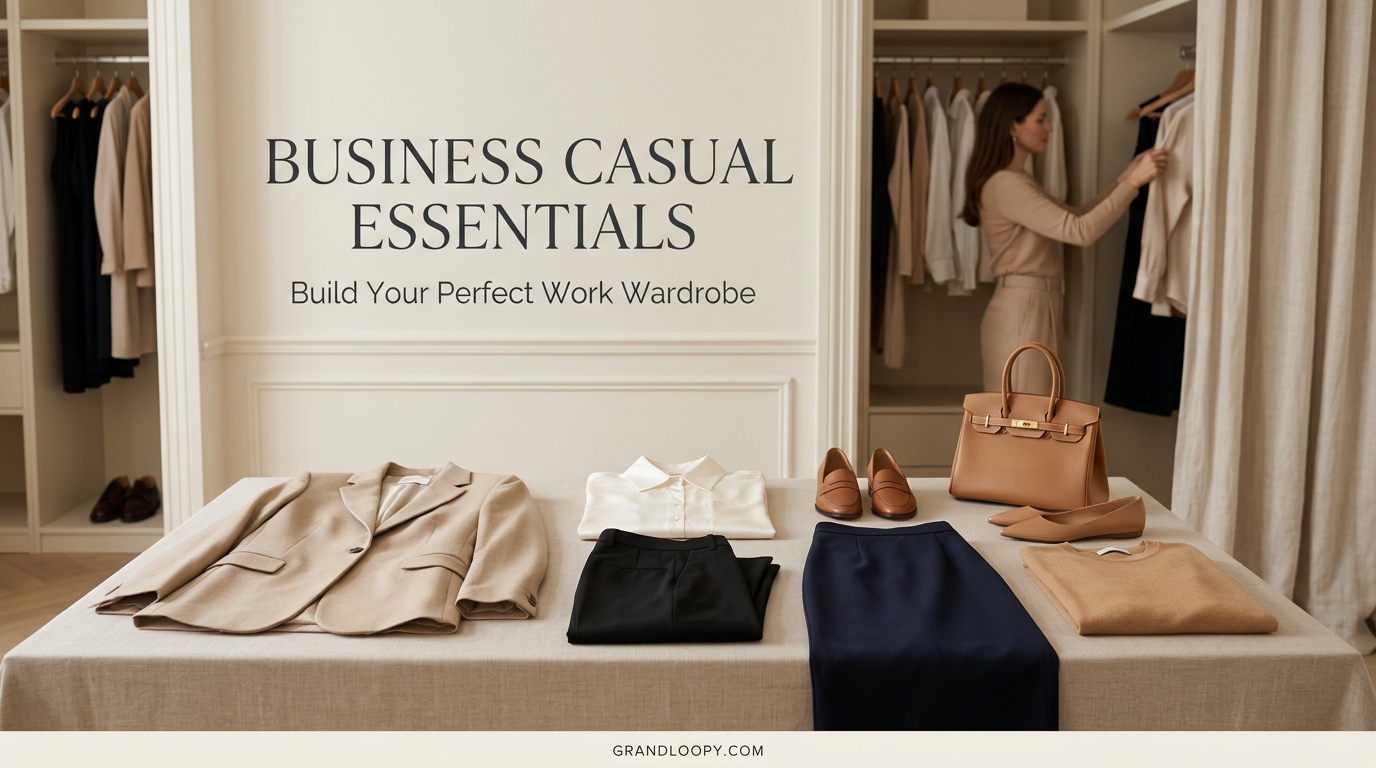
Business casual sits in the middle of the formality ladder, between business professional above it and smart casual below it.
The ladder runs from business formal at the top to casual at the bottom, and each step down removes one layer of structure.
Learning the ladder matters more than memorizing a list of pieces, since the same blouse can be business casual in one office and smart casual in another.
| Level | Definition | Typical pieces | Shoes | Where it appears |
|---|---|---|---|---|
| Business formal | Matching suit, full formality | Suit with matching jacket and trousers or skirt, conservative shirt | Closed-toe pumps or formal dress shoes | Law, finance, executive meetings |
| Business professional | Suit-level polish, tie optional | Suit or sheath dress with a jacket | Closed-toe pumps or polished leather shoes | Client-facing roles, interviews |
| Business casual | Tailored separates, no matched suit | Trousers or skirts with blouses, knits, or cardigans, optional blazer | Loafers, flats, low heels, ankle boots | Most offices, the default code |
| Smart casual | Polished but relaxed, one notch below | Dark jeans, clean leather sneakers, fine knits | Clean leather sneakers, dressy flats | Tech, media, creative companies |
| Casual | Neat everyday clothes | Tees, everyday jeans, sneakers | Everyday sneakers, sandals | Fridays, internal-only days |
Streetwear sits far below business casual on this ladder, built on logos, drops, and bold graphics rather than tailoring and restraint.
The What Is Streetwear Fashion guide covers that language in full, and none of it belongs in an office that calls itself business casual.
The general guide for both sexes places the same ladder in wider context, with men’s pieces beside women’s pieces at every level.
The What Is Business Casual? Guide for Men & Women (2026) is the companion page for readers who also dress a partner, a team, or a whole office.
The Three Tests for Any Outfit
Three different tests circulate in the best guides, and each one catches a different kind of mistake, so learn all three before you trust one.
Presenting them side by side matters, since no single test has won the argument, and each source stands behind its own version.
| Test | Source | The question | What it catches |
|---|---|---|---|
| CEO test | SoloTravely | Would you be comfortable if your CEO walked in? | Outfits that feel fine until someone senior appears |
| Client-meeting test | Noor Magazine and Time Businesses | Would you feel comfortable wearing it in a meeting with a client? | Outfits that work at a desk but fail in front of a client |
| Trusted-with-a-meeting test | Her Style Code | Do you look like someone who can be trusted with an important meeting at a moment’s notice? | Outfits that look tidy yet read as unprepared |
The CEO test comes from a writer who spent eight years in business-casual offices, and it is the bluntest of the three.
If the answer is yes, and you are not in a suit, that is business casual, which is a useful rule for mornings when you are short on time.
The client-meeting test is the one Noor Magazine uses to draw the line between business casual and smart casual.
Business casual survives a client meeting, while smart casual survives a client lunch, and that single sentence settles most borderline calls.
Time Businesses asks the same question with a wider room in mind: a meeting with a client, a manager, or a hiring panel.
The trusted-with-a-meeting test comes from Her Style Code, and it looks past the clothes to the impression they leave.
It asks whether you look considered, comfortable, and ready, not whether you are wearing a suit or an expensive label.
Her Style Code adds a line worth remembering: business casual is not about wearing less formal clothes, but about wearing formal clothes less formally.
Use the client-meeting test as your default, since it is the one two independent guides agree on, and keep the other two as backups.
When all three tests pass, the outfit is safe in almost any office, and when any one of them fails, change one piece before you leave.
What Counts as Business Casual for Women
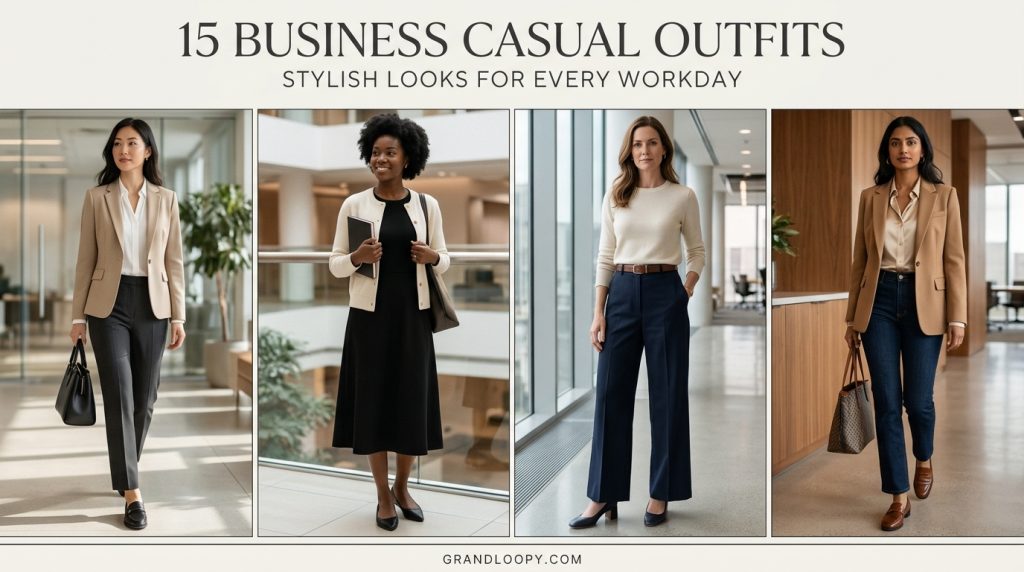
The safe core is small and stable across every guide: tailored trousers, skirts, dresses, blouses, fine knits, and polished shoes.
Reader’s Digest asked two named experts for its guide, and both agreed on the same starting point: fit first, everything else second.
Alison Lumbatis, chief executive of Outfit Formulas, calls business casual a more relaxed version of formal business wear.
Kat Griffin, founder and editor-in-chief of Corporette, adds the fit rule: clothing should fit properly, since too-tight pants or pants that fall down suit no office.
Griffin also warns against unexpected skin, which covers cutout details, midriff-baring tops, shorts, skirts that expose the upper thigh, and excessive cleavage.
That warning applies to both sexes in her guide, and it is the clearest single boundary in the whole Reader’s Digest piece.
Griffin frames the outfit as self-representation, not just clothing, and says it communicates work ethic, competence, and professionalism without a word.
Tops: Blouses, Shirts, Shells, and Fine Knits
Tops set the tone of a business casual outfit, since the eye lands on the upper half first, especially on video calls.
Fitted button-down dress shirts go with almost anything, from pants to skirts to jeans, and this is where personality can show.
Prints, bold colors, neutrals, lace details, tie necks, ruffles, and puffed sleeves all work on a fitted shirt, as long as the fabric holds its shape.
Silk and satin blouses add softness against structured pieces, and a plain neckline keeps them versatile across offices.
Fine-gauge sweaters in wool, merino, or cashmere are business casual staples, especially over a collared shirt or with tailored trousers.
Styloy warns against chunky, stretched-out, or graphic sweaters for work, and recommends fitted knits that sit neatly at the waist.
Sleeveless shells work under a structured cardigan or blazer, and the layer on top is what makes the shell office-ready.
T-shirts are a yes with caveats: clean, structured, solid or patterned, never blazed with graphic images, and best under a jacket.
Athleisure tees belong at the gym, not the office, and the same rule covers workout tops of every kind.
Knit polos sit in the middle ground, since the collar keeps them professional while the knit keeps them comfortable.
Bottoms: Trousers, Skirts, and Chinos
Tailored trousers are the spine of business casual, and two pairs in black and navy cover most weeks without repeating a look.
Straight-leg, wide-leg, and ankle-length cuts all work, and the choice depends on your height, your shoes, and your office.
High-waisted, well-fitted trousers lengthen the frame and bring instant refinement, whether wide-leg or straight.
Styloy gives the hem rule plainly: slim and cropped trousers look neatest when the hem grazes the ankle bone.
Wide-leg styles should nearly cover the shoe, and the hem must be set for the shoe you wear most, since flats and heels need different lengths.
Pencil and A-line skirts look most professional between the top of the knee and mid-calf, which is the range every guide agrees on.
Knee-length to midi skirts are as flexible as dress pants, and a pencil skirt with a printed blouse is a reliable look for almost any situation.
Chinos in navy, khaki, or black give a polished base that still feels comfortable, and a slightly tapered leg keeps proportions tidy.
Ponte pants deserve a note of their own, since they feel like leggings yet look like tailoring, which makes them a comfort-first option.
SoloTravely calls ponte pants a comfort-maximum choice, and adds one non-negotiable rule: the tunic on top must cover the front and back fully.
Dresses: The One-and-Done Outfit
Dresses offer a fuss-free, one-and-done outfit, and sheath, A-line, and midi styles give the most versatility across offices.
A sheath dress pairs with a blazer for meetings or a cardigan for desk days, and the same dress covers both without a change.
Wrap dresses flatter most figures, since the tie waist adjusts to the body, and a blazer over one adds boardroom authority.
Check the neckline before you buy a wrap dress, since a small snap at the cross-over point fixes gaping when you lean forward.
Shift dresses are the quietest option, with clean lines and no clinging, and a structured jacket over one completes the look.
Shirt dresses work when the fabric has weight, since a medium-weight crepe or jersey drapes without clinging under office light.
Knit dresses need the same weight test, since thin, clingy knits read as casual while a medium-weight knit reads as deliberate.
Hem length follows the skirt rule: at or just below the knee for most offices, and midi length for the most versatile option.
Layers: Blazers, Cardigans, and the Third Piece
A blazer is the single most effective formality-raiser in business casual, and The Workwear calls it exactly that.
One blazer turns jeans and a blouse into an office outfit, and the same blazer turns a dress into a meeting outfit.
Look for quality tailoring with shoulders that sit right, sleeves that hit the wrist, and a length that flatters your height.
Styloy gives the shoulder test plainly: blazer shoulder seams should end at your shoulder bone, and the jacket should button without pulling into an X.
Unstructured blazers with soft shoulders and little padding look put together without feeling formal, which suits creative offices best.
Cardigans work when structured, since a fine-knit buttoned cardigan reads as intentional while an oversized chunky knit reads as weekend.
Longline cardigans over a sleeveless shell or knit top, with a pleated or A-line midi skirt, give a soft alternative to a blazer.
Trench coats cover spring and fall commutes, and a cotton gabardine trench is comfortable from roughly 45 to 65 degrees.
Petite women usually look best in a trench at or just below the knee, while taller women can go mid-calf without losing the line.
Shoes: Loafers, Flats, Heels, Boots, and Sneakers
Shoes are the quickest way to move a look up or down, since the same trousers and knit read dressier with loafers and more relaxed with clean sneakers.
Noor Magazine calls footwear the loudest signal in the room, and advises choosing the shoe first and building back up from there.
Leather or suede loafers are the safest business casual shoe, and they suit trousers, skirts, and dresses equally well.
Pointed or almond-toe flats lengthen the leg while staying comfortable for a full day, and a neat leather pair moves from desk to dinner.
Block heels between 1 and 3 inches are the reliable heel height, with kitten heels and low ankle boots as close alternatives.
Slingbacks and clean mules are fine in most offices, while slingbacks with a closed toe read more formal than open ones.
Knee-high boots disappear under a midi skirt hem, and matching tights to the boots keeps the leg line continuous.
Clean, simple sneakers belong in the sneaker section below, since their verdict changes by industry and deserves its own matrix.
Flip-flops, beach sandals, and athletic shoes fail the closed-toe rule and the polish test, and no office in the guides accepts them.
Accessories: The One Standout Detail
Accessories finish a business casual outfit, yet the rule is restraint, since one focal piece beats three competing ones.
A structured bag with firm edges finishes an outfit the way a frame finishes a picture, and a medium tote or top-handle style in leather holds its shape.
The bag should hold a laptop without bending out of shape and sit comfortably on the shoulder, which rules out most slouchy styles.
Keep jewelry delicate with small hoop earrings, stackable rings, or a dainty necklace in gold or silver, matched to your wardrobe palette.
A slim leather belt can define the waist over a dress or add structure to trousers, and one with minimal hardware looks cleanest.
A classic pair of sunglasses in black or tortoiseshell adds polish off the clock, and a simple leather-strap watch reflects good taste.
Bold subculture styles are a different language from office dress, and the contrast shows why restraint matters at work.
The What Is Gothic Fashion? Styles, History, and How to Wear It guide covers a darker, more dramatic style, and none of its drama belongs in a business casual office.
Fabrics and Colors That Work
Fabric decides how an outfit hangs and how it ages, and the same cut in a better cloth reads as more expensive all day.
| Fabric | Why it works | Best for |
|---|---|---|
| Wool blend | Keeps its form, resists creasing | Trousers, blazers, skirts |
| Ponte knit | Structured, stretchy, wrinkle-proof | Trousers, pencil skirts, dresses |
| Crepe | Holds shape, drapes cleanly | Dresses, blouses, wide-leg trousers |
| Cotton poplin | Crisp and breathable | Button-down shirts, shirt dresses |
| Silk or satin | Soft, fluid drape | Blouses, shells, midi skirts |
| Merino wool | Warm without bulk | Fine knits, sweaters, cardigans |
| Modal or Tencel | Smooth, breathable, soft | Knit tops, shells, dresses |
| Linen blend | Light with a textured finish | Warm-weather trousers and blazers |
Flimsy jersey and shiny stretch polyester wrinkle and cling, and Styloy names them as the fabrics that fail fastest after eight hours.
Crepe, ponte, wool blends, and cotton poplin look sharper after a full day, which is the real test for work fabrics.
Spocket lists the 2026 color palette as a core of black, white, beige, navy, charcoal, soft brown, and taupe, with accents of sage, soft blue, terracotta, dusty rose, and olive green.
Treat that palette as one guide’s trend report, not a rule, since neutral colors have anchored business casual for decades.
Glassdoor gives the simplest color advice in the set: neutrals like white, tan, beige, brown, and black, with bold and patterned prints accepted when the office allows them.
Build around two or three neutrals that all mix, then add color with one piece at a time, so almost everything pairs with everything else.
Are Jeans Business Casual for Women?
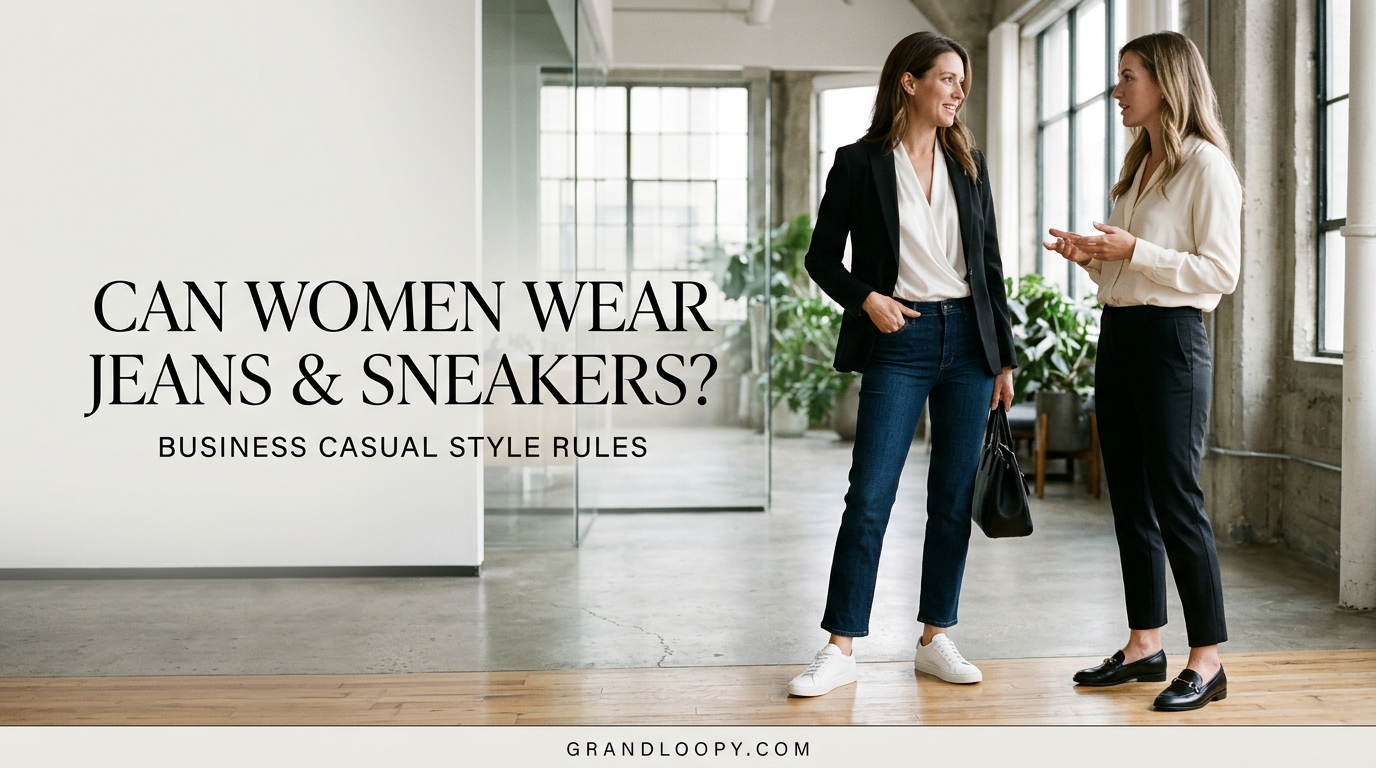
Jeans are the most argued-over item in business casual, and the guides disagree, which is why this section gives a verdict by industry instead of one flat answer.
Emily Post says jeans are usually a no, and adds that clean, neat, well-fitted jeans in a casual atmosphere might work, which is the strictest reading in the set.
Noor Magazine agrees with the strict reading, saying jeans sit on the smart casual side of the line in most workplaces.
Reader’s Digest, Glassdoor, Styloy, SoloTravely, Clozzie, and Time Businesses all say yes with rules, and their rules agree with each other almost word for word.
The honest answer is therefore conditional: dark, clean, well-fitting jeans can qualify in many modern workplaces, but not in traditional ones, and never on a first day.
For the full jeans question, including how to wear them to work and which washes pass, the dedicated guide covers it in depth.
The Are Jeans Business Casual? The Honest Answer, Plus How to Wear Them to Work guide is the companion page for this section, and it carries the same conditional verdict.
The Five-Rule Jeans Test
Run every pair through five checks before you wear jeans to work, and if any answer is no, choose trousers instead.
- Dark wash or black? Dark indigo, black, or a very dark wash only, with no fading or whiskering.
- No rips, fading, or distressing? Clean hems, quality fabric, and no holes, tears, or fraying anywhere.
- Tailored fit rather than baggy? Slim-straight or straight tailored fit, never skinny-legging hybrids and never baggy.
- Paired with a collared shirt, knit polo, blazer, or polished sweater? The top and layer must do the professional work.
- Worn with loafers, derbies, boots, or clean minimal leather sneakers if permitted? The shoes must look like a choice, not a shortcut.
Time Businesses built this five-point test, and it is the most practical version in the set, since it turns a vague debate into five yes-or-no questions.
Reader’s Digest adds the cut that works best: a trouser-style or wide-leg cut in a dark wash, kept in prime condition.
SoloTravely adds the blouse rule: the blouse, not a tee, is what makes jeans office-appropriate, since it draws the line between casual Friday and just casual.
Styloy adds the denim rule: rigid or low-stretch denim reads more like a trouser than skinny jeans do, so choose structure over stretch.
Jeans Verdict by Industry
| Industry | Verdict | Conditions |
|---|---|---|
| Finance, law, consulting | No | Trousers only, except on a stated casual Friday |
| Government, client-facing roles | No | Trousers or skirts; jeans read as underdressed |
| Corporate office, general | Sometimes | Dark, clean jeans with a blazer and loafers; Fridays safest |
| Healthcare administration, education | Sometimes | Dark jeans with a blouse and flats; never with sneakers |
| Tech, startups, creative agencies | Yes | Dark jeans most days; keep one tailored piece in the outfit |
Glassdoor states the same split in plainer terms: dark, clean jeans with no rips can pass in relaxed offices, but some workplaces still ban denim outright.
Clozzie agrees, and adds a timing rule: in a dressier office, keep jeans for Fridays, and wear trousers for the rest of the week.
When you are new to an organization, start with chinos or dress trousers until you understand the culture, since no guide disagrees on that point.
If you are unsure, try jeans once and compare with what colleagues wear, which is Styloy’s advice for offices that clearly allow denim.
Are Sneakers Business Casual?
Sneakers are the second borderline item, and the guides split even more sharply on them than on jeans, so the same matrix approach applies.
Spocket says sneakers are widely accepted in 2026, naming white leather sneakers, beige or black minimalist designs, and low-profile silhouettes.
Noor Magazine says usually not, and adds that a clean leather sneaker can work in a smart casual context, but business casual calls for closed leather shoes.
Reader’s Digest sits in the middle: clean, simple sneakers with dresses and dress pants make a super stylish modern look, yet athletic sneakers are out.
Glassdoor agrees with the middle: clean, minimalist leather sneakers can work in more relaxed offices, while running shoes and obviously athletic styles fail.
Styloy draws the line by role: minimal leather sneakers in white, black, or tan pass in smart casual and many tech or creative offices.
Loafers, flats, or low heels are safer in law, finance, and client-facing roles, where sneakers read as underdressed.
The honest answer is therefore the same shape as the jeans answer: clean minimalist leather sneakers pass in relaxed offices, and fail in conservative and client-facing ones.
The Clean-Minimalist Rule
Only one kind of sneaker ever qualifies, and it has four traits: clean, minimal, leather, and free of bright logos or athletic mesh.
White or black leather in a low-profile silhouette is the safest choice, with beige or tan as a close alternative.
Everything else in the outfit must be tailored, so the shoes look like a choice rather than a shortcut, which is Styloy’s exact warning.
Wipe the soles weekly with a damp cloth and a little soap to keep them bright, since scuffed sneakers undo the whole outfit.
Commuters who walk a lot, hybrid workers, and tech or creative teams get the most from this option, and it is wasted in a formal office.
Sneaker Verdict by Industry
| Industry | Verdict | Conditions |
|---|---|---|
| Finance, law, consulting | No | Loafers, flats, or low heels only |
| Government, client-facing roles | No | Closed leather shoes; sneakers read as underdressed |
| Corporate office, general | Sometimes | Minimal leather sneakers on internal days; never for client meetings |
| Healthcare administration, education | Sometimes | Clean leather sneakers with tailored pieces; never athletic styles |
| Tech, startups, creative agencies | Yes | Clean minimalist sneakers most days; keep the rest tailored |
Her Style Code lists athletic fabrics among the things to leave at home, and leggings, joggers, and technical sportswear belong at the gym however comfortable they are.
Clozzie agrees that shoes are the quickest way to move a look up or down, and the same trousers read dressier with loafers and more relaxed with clean sneakers.
When in doubt, wear the loafers, since nobody ever got in trouble for looking too polished, which is SoloTravely’s closing rule for both jeans and sneakers.
15 Business Casual Outfit Formulas for Women
Formulas remove the morning guesswork, since you repeat a proven shape and change only the colors, fabrics, and shoes.
Every formula below follows the same structure: one polished piece, comfort built in, and intention in the details, which is SoloTravely’s three-part test.
Miss the polish and the outfit is casual, miss the comfort and you will not survive the day, and miss the intention and it all falls apart.
For a deeper women’s catalogue with fifteen formulas of its own, the companion guide below covers pieces, fits, and scenarios in full.
The What Is Business Casual Woman? Guide + Outfits 2026 is the deeper women’s guide, covering pieces, fits, and scenarios in full.
1. Blazer, Dark Jeans, and Blouse
A structured blazer, dark indigo jeans with no distressing, a silk blouse tucked in, and loafers or low heels make the classic Friday uniform.
The blazer does the professional heavy lifting, the jeans keep it modern and comfortable, and the blouse is what makes the jeans office-appropriate.
Best for creative offices, casual Fridays, and client meetings where you want to look sharp without a suit.
2. Midi Dress, Cardigan, and Loafers
A solid or subtly printed midi dress, a structured cardigan over it, loafers, and simple jewelry make a complete outfit in one decision.
The midi dress is the business-casual cheat code: always appropriate, comfortable for ten-hour days, and easy to rotate in several colors.
The cardigan should be structured, not slouchy, since a lady-jacket style or fine-knit buttoned cardigan reads as intentional, while an oversized chunky knit reads as weekend.
3. Tailored Trousers, Sweater, and Flats
Well-fitted trousers in navy, black, or grey, a fine-gauge sweater half-tucked, pointed flats, and minimal jewelry give understated, quiet authority.
The trousers’ tailoring is the entire message here: precise, professional, and in control, even without a blazer in the outfit.
Throw a blazer over it for important meetings, or swap the flats for low heels when the day runs into evening.
4. Pencil Midi Skirt, Button-Down, and Heels
A knee-length pencil or straight midi skirt, a crisp button-down tucked in, low block heels, and a structured tote make the uniform that never fails.
Some call it boring, yet it is bulletproof, since zero decisions and maximum authority is exactly what a big presentation needs.
Avoid it when your office involves lots of movement, stairs, or floor-sitting, since pencil skirts restrict stride, and swap to an A-line midi for the same polish with mobility.
5. Ponte Pants, Tunic, and Ankle Boots
Black ponte pants, a tunic-length top covering the hip, ankle boots, and a long necklace make the comfort-maximum professional outfit.
Ponte feels like leggings and looks like tailoring, and the pants are machine washable, wrinkle-proof, and structured enough for any business-casual room.
The tunic must cover the front and back fully, since ponte pants are fitted, and the top’s length is what keeps the proportions professional.
6. Sleeveless Shell, Cardigan, and Trousers
A sleeveless shell top, a structured cardigan over it, tailored trousers, and flats or low heels make the classic layering formula.
The shell is the base and the cardigan is the polish, and the combination survives every office temperature war, cardigan on for freezing air conditioning and off for the commute.
Sleeveless shells are thrift-store gold, since silk ones cost a few dollars secondhand, while the cardigan is worth buying new because fit matters.
7. Wrap Dress and Blazer
A solid wrap midi dress, a blazer over it, and pointed flats or low heels turn one dress into a boardroom outfit.
The wrap dress is the hardest-working dress in business casual: adjustable, forgiving, feminine, and professional, and the blazer takes it from nice dress to she means business.
Swap flats for heels and add statement earrings, and the same dress handles after-work events without a change.
8. Chinos, Knit Polo, and Loafers
Tailored chinos in navy, khaki, or black, a fine-knit polo shirt tucked in, leather loafers, and a simple watch make a preppy-professional look.
The knit polo is the button-down’s relaxed cousin: the collar keeps it professional, the knit keeps it comfortable, and the combination suits days with no external meetings.
Best for business-casual offices with a modern culture, team offsites, and days when you want polish without stiffness.
9. Sweater and Pleated Trousers
A fine-gauge sweater half-tucked into pleated wide-leg trousers, loafers or pointed flats, and delicate jewelry make soft tailoring look elegant.
The pleats bring elegance and the sweater brings ease, and the half-tuck is essential, since a fully untucked sweater hides the pleats that are the entire point.
Front-tuck, back loose, done, and the look suits creative offices and internal days best.
10. Jumpsuit and Blazer
A tailored jumpsuit in black, navy, or olive, a blazer over it, and pointed flats or low heels make one piece do the work of a whole outfit.
The jumpsuit is the outfit and the blazer is the authority, and without the blazer the same jumpsuit reads as weekend.
Wear the blazer off and sneakers on for the commute, then blazer on at the desk, for the easiest day-to-evening transition in this list.
11. Dark Jeans, Knit Blazer, and Loafers
Dark jeans, a knit blazer with structured shoulders and a stretchy body, a simple top, and loafers give all the authority of tailoring with the comfort of knitwear.
Knit blazers survive long days, commutes, and office chairs without a single wrinkle of complaint, which is why they became a modern office uniform.
Avoid them when your office is formal business, since knit blazers are business casual’s ceiling, not formal’s floor, and you must know which room you are dressing for.
12. A-Line Skirt, Fitted Sweater, and Boots
An A-line midi skirt, a fitted sweater tucked in, knee-high or ankle boots, and simple earrings make fall-office perfection.
The A-line skirt is the pencil skirt’s comfortable sister: same polish, full mobility, and it looks better in motion than standing still.
Match the boot color to the skirt’s darkest tone for a seamless leg line, and keep the sweater fitted, since volume on top plus volume below overwhelms.
13. White Shirt, Wide-Leg Trousers, and Heels
A crisp white shirt, high-waisted wide-leg trousers in black or navy, pointed heels, and gold hoops make high-contrast, high-impact minimalism.
The wide leg brings drama, the white shirt keeps it classic, and the heels add the final polish, so the outfit looks like it came from a personal stylist.
White shirts are everywhere secondhand in great condition, since people donate them barely worn, while the trousers are worth buying new because fit is everything there.
14. Cardigan as Top and High-Waist Trousers
A buttoned cardigan worn as a top, high-waisted tailored trousers, pointed flats, and a delicate necklace make a soft, feminine, modern outfit.
The cardigan-as-top trick is endlessly chic, and the high waist is non-negotiable for the proportions, since it anchors the whole shape.
Add a blazer over it for formal meetings, or swap flats for heels, and the base handles both directions effortlessly.
15. Shift Dress and Structured Jacket
A simple shift dress at knee length, a structured jacket or blazer over it, and low heels or pointed flats give clean lines with zero fuss.
Shift dresses are the introvert’s office outfit: no clinging, no adjusting, just clean lines that look professional from every angle.
Best for job interviews at business-casual companies, big presentations, and days when you need authority with zero effort, since the jacket adds the authority.
Which Outfit for Which Workday
Match the outfit to the day, since the same wardrobe serves a client meeting and a quiet desk day with different choices.
| Outfit | Formality | Works best in | Season |
|---|---|---|---|
| Blazer, dark jeans, blouse | Mid | Creative offices, casual Fridays | All year |
| Midi dress, cardigan, loafers | Mid | Any office, long desk days | All year |
| Tailored trousers, sweater, flats | Mid | Any office, no-meeting days | All year |
| Pencil midi skirt, button-down, heels | Mid to dressy | Presentations, formal offices | All year |
| Ponte pants, tunic, ankle boots | Mid | Busy days, long hours | Fall, winter |
| Sleeveless shell, cardigan, trousers | Mid | Offices with cold air conditioning | All year |
| Wrap dress, blazer | Mid to dressy | Meetings, after-work events | All year |
| Chinos, knit polo, loafers | Relaxed to mid | Modern offices, offsites | Spring, summer |
| Sweater, pleated trousers | Mid | Creative offices, internal days | Fall, winter |
| Jumpsuit, blazer | Mid | Chaotic mornings, conferences | All year |
| Dark jeans, knit blazer, loafers | Mid | Modern offices, commutes | All year |
| A-line skirt, fitted sweater, boots | Mid | Fall offices, school settings | Fall, winter |
| White shirt, wide-leg trousers, heels | Mid to dressy | Meetings, presentations | All year |
| Cardigan as top, high-waist trousers | Mid | Creative offices, relaxed days | Spring, fall |
| Shift dress, structured jacket | Mid to dressy | Interviews, presentations | All year |
Styloy built the first version of this formality table, and it is the only table of its kind in the top ten guides.
Her Style Code gives the same fifteen ideas in a different shape: a week of five outfits built from roughly a dozen pieces.
Each day uses one structured piece, one soft piece, and one polished finish, and the same three-part formula repeats all week.
Monday is the confident start with a navy blazer, a cream fine-knit crew neck, camel wide-leg trousers, and black leather loafers.
Tuesday is the soft power look with a silk blouse in a soft blush tone tucked into charcoal straight-leg trousers, a slim belt, and small gold hoops.
Wednesday is the midweek midi with a fitted black knit, a pleated camel midi skirt, and sleek ankle boots.
Thursday is the meeting-ready day with a crisp white shirt under a grey blazer, dark tailored trousers, and low block heels.
Friday is the relaxed finish with dark, clean straight-leg jeans, a camel cardigan over a striped tee, and ballet flats.
Business Casual by Industry
Industries vary more than the term implies, and The Workwear states the split plainly: finance, law, and consulting hold closer to business attire, while tech, creative, and startup cultures admit jeans and trainers readily.
The same outfit lands differently in each sector, so read the industry before you read the outfit, and adjust one piece at a time.
Finance, Law, and Consulting
These offices hold closest to business attire, so blazers most days, trousers and skirts over jeans, polished loafers or heels, and a structured bag.
Swap knits for blouses when a client is in the room, since a blouse under a blazer reads as deliberate while a knit reads as comfortable.
Jeans and sneakers are out except on a stated casual Friday, and even then the dark-wash and clean-leather rules still apply.
Tech and Startups
Comfort and function come first here, with knit tops, ankle trousers, loafers or clean sneakers, comfortable dresses, and minimal layering.
Dark jeans most days are normal, and the test is whether the rest of the outfit is tailored enough to carry them.
Look put together, not overdressed, since a full suit in a startup reads as a job interview, not as a workday.
Creative Agencies and Media
Personal style counts for more in creative offices, with patterned skirts, unusual textures, soft colors, and statement accessories kept minimal.
Tailored wide-leg trousers, a knit top, and stylish flats make a good default, and the outfit can carry one bold choice without breaking the code.
Interesting cuts, bright colors, and patterns a little outside the box are welcome here, which is Reader’s Digest expert Alison Lumbatis’s advice for creative careers.
Healthcare Administration and Education
These offices sit in the middle, with longline cardigans, midi skirts, fine knits, and comfortable flats as the working uniform.
Movement matters more here than in a desk office, so A-line skirts beat pencil skirts, and low heels beat high ones.
Schools, healthcare administration, and relaxed offices suit the soft cardigan pairing best, with merino and cotton blends that pill less than acrylic.
Government and Client-Facing Roles
Government and client-facing roles lean formal, with matching or tonal trousers, a plain shell or blouse, and closed-toe flats or low heels.
Conservative offices, banks, and schools are the home turf of the white shirt layered under a crewneck, with the collar and cuffs showing.
When a client is involved, dress one notch above your everyday office business casual, since darker trousers, leather shoes, and a blazer rarely look out of place.
Business Casual by Scenario
Scenarios change the code faster than industries do, since a first day, an interview, and a video call each ask for a different version of the same wardrobe.
First Day at a New Job
Err one notch above the office norm on day one, then calibrate, since you can always take a layer off by lunch but cannot add polish you did not bring.
If the workplace is genuinely formal, a suit is never wrong on day one, and if it is business casual, a blazer and trousers read as prepared without reading as overdressed.
Glassdoor’s community advice agrees: wear a nice outfit on the first day, slightly dressier than business casual, then adjust once you see how everyone else dresses.
A senior manager on Glassdoor Community puts it plainly: dress slightly dressier than business casual on day one, then adjust from there.
Do not buy a bunch of stuff before you start, since a PwC associate on Glassdoor Community warns against overhauling your closet before you see what people actually wear.
Job Interview
Interviews call for one step dressier than the daily dress code, so start with a navy or charcoal blazer and matching or tonal trousers.
An ivory shell top with pointed flats or low pumps completes the look, and the whole outfit reads as prepared without seeming stiff.
Neutral colors keep the focus on you, and a shell avoids gaping buttons when you sit across from the panel.
Reader’s Digest expert Alison Lumbatis gives the interview formula: a formal professional two-piece suit, a white or light blue button-down, and dress shoes or sleek flats with minimal accessories.
Leave jeans and sneakers at home even if employees wear them, and keep jewelry and fragrance light, which is Styloy’s interview rule.
Try the whole outfit on the day before, including walking and sitting, and pack a lint roller, since the panel notices details you stopped seeing.
Client Meeting and Presentation
Dress up more when you have a meeting with your boss, since looking more polished helps you show up as your best self and gives your confidence a boost.
Keep a blazer in the office so you can grab it for formal events, and for women, pointy-toed flats or low heels scale the same outfit up further.
That is Kat Griffin’s advice for presentations, and it works because the blazer is the fastest formality-raiser you own.
Feeling great in your outfit translates to a stronger performance, since confidence frees your attention for the meeting instead of your clothes.
Networking Event and Business Dinner
A structured dress or separates with a blazer covers most networking events, and the same outfit with a small handbag and simple jewelry covers dinner.
For a restaurant business dinner, the safe default is polished trousers with a blouse and blazer, with leather shoes and no athletic anything.
For an upscale business dinner, lean slightly dressier with pressed trousers, a long-sleeve button-down shirt, leather shoes, and a blazer.
A tie is usually not necessary unless the host or venue is explicitly formal, and the same holds for the women’s version of the rule.
Video Call and Hybrid Day
Hybrid work made the top half matter most, since the camera shows shoulders, neckline, and background, and the rest of the outfit stays out of frame.
Choose tops with clean, modest necklines and subtle patterns that avoid camera glare, since fine stripes can shimmer on screen.
Neutral-colored sweaters and fine knits look sharp on camera, and lightweight layers add structure when a video call starts without warning.
Spocket lists hybrid-friendly styles as the new norm, with minimalist blouses, light layers, and tops that frame the face well.
Keep one polished piece in the outfit on hybrid days, like a blazer or good shoes, so a surprise meeting never catches you out.
The First-Week Calibration Plan
Reading a new office takes five days, and the Workwear method is the most reliable one in the set, so follow it in order.
- Day one: dress one notch above the norm. Blazer, blouse, tailored trousers, and loafers, and watch what the respected people at your level actually wear.
- Day two: note the range. Record who wears jeans, who wears sneakers, and who wears a blazer, since the range is the real code.
- Day three: match the room. Wear the median outfit you saw, with one tailored anchor, and see how it feels by lunch.
- Day four: test one relaxed piece. Swap in dark jeans or a knit, keep everything else polished, and watch for reactions.
- Day five: settle your baseline. Keep the version that felt comfortable and looked intentional, and repeat it with color variation.
Glassdoor’s method agrees in spirit: become familiar with the handbook, look at what others wear, and when in doubt, overdress.
The Workwear adds the rule that makes the plan work: build the formal-capable foundation first, observe for two weeks, then relax downward deliberately.
Consistency matters more than perfection, since the person who reliably fits the code reads as more professional than one who swings between overdressed and underdressed.
The 12-Piece Business Casual Capsule Wardrobe
You do not need a closet full of workwear, since around a dozen well-chosen pieces in a shared color palette create weeks of combinations.
Think of a capsule as a small team, where every piece must earn its place by pairing with at least three others.
Before buying anything, picture three outfits you could make with it from clothes you already own, and leave it in the shop if you cannot.
| Piece | Count | Colors that mix | Buy order |
|---|---|---|---|
| Tailored trousers | 2 | Black, navy, or grey | First |
| Skirt | 1 | A neutral, knee or midi length | Third |
| Dark jeans | 1 | Dark wash, no rips | Second, if your office allows them |
| Blouses or shirts | 3 | White, cream, and one color | First |
| Fine knits | 2 to 3 | Camel, grey, black | Second |
| Blazer | 1 | Navy, black, or camel | First |
| Long cardigan | 1 | A neutral that matches the blazer | Third |
| Midi dress | 1 | A solid neutral or small print | Third |
| Work shoes | 2 to 3 pairs | Black and one neutral | First |
| Structured bag | 1 | Black, tan, or cream leather | Fourth |
That is twelve core garments plus two or three pairs of shoes and one bag, which matches the compact starting point every capsule guide in the set recommends.
Spocket lists a similar capsule: three neutral blouses, two fine knit tops, one white button-down, two tailored trousers, and one dark trouser option.
It continues with one pencil or midi skirt, one blazer, one cardigan or soft jacket, one shift or wrap dress, and two pairs of polished shoes.
Styloy counts the same way: four bottoms, five tops, two layers, and one dress, plus two pairs of shoes and a structured tote.
Build everything around one base color, such as black or navy, plus one warm neutral, such as camel, and any top will pair with any bottom on the rail.
Starting from scratch, buy the trousers and the blazer first, since together they turn almost any top you own into a work outfit.
Clozzie gives the same order, and adds that the core should stay in two or three neutrals that all go together, with color added one piece at a time.
A Five-Day Plan From the Same Twelve Pieces
| Day | Top | Bottom | Shoes |
|---|---|---|---|
| Monday | Blouse and blazer | Tailored trousers | Loafers |
| Tuesday | Fine knit sweater | Midi skirt | Ankle boots |
| Wednesday | Button-up shirt | Wide-leg trousers | Low block heels |
| Thursday | Tee and long cardigan | Straight-leg trousers | Ballet flats |
| Friday | Striped top and blazer | Dark jeans | Leather sneakers |
Swap any day for a knee-length dress with a blazer or cardigan over it, and run the same five formulas next week in other colors.
Few people will notice the pattern, since the same shapes in different colors read as different outfits, which is the whole point of a capsule.
Spocket builds the capsule in five steps: start with trousers and tops, add versatile layers, invest in footwear, add dresses and skirts, then expand slowly.
That method keeps the wardrobe growing with purpose instead of clutter, and it stops the rushed single purchases that fill closets with pieces that never work together.
Fit Checks That Make Any Outfit Look Polished
Fit matters more than price, and a cheap shirt that fits well beats an expensive shirt that hangs badly every single time.
Her Style Code calls fit that is almost right one of the four things to leave at home, since a blazer with sleeves past your knuckles always looks careless.
A quick visit to a tailor is the cheapest upgrade in fashion, and hems, waists, and sleeve lengths are the three adjustments worth paying for.
| Body area | Fit check | Fix |
|---|---|---|
| Shoulders | Blazer seam sits on the shoulder bone | Size down or tailor the seam |
| Bust | Button-down lies flat, no gaping | Size up, then tailor the waist, or switch to a shell or knit |
| Waist | Skims without pulling or gaping | Take in or let out at a tailor |
| Sleeves | End near the wrist bone | Shorten at a tailor |
| Trouser hem | Slim cuts graze the ankle bone, wide legs nearly cover the shoe | Hem to your shoe height |
| Skirt and dress hem | Between the top of the knee and mid-calf | Adjust length to your leg line |
| Chest and bust | No pulling at buttons when seated | Size up, then tailor the waist |
| Overall | Moves freely when you sit, walk, and raise your arms | Change anything that pulls or rides up |
Test every outfit in motion before you leave home: sit down, raise your arms, and walk across the room.
Change anything that pulls, rides up, or pinches after ten minutes, since the motion test catches the gaping shirt, the riding skirt, and the shoe that seemed fine in the shop.
Comfort counts as much as shape, since stiff or tight clothes make you move awkwardly, and awkward movement ruins any outfit.
Business Casual for Every Body
Business casual depends on balance and comfort rather than a fixed body type, so the same five traits work at any size, height, or age.
Pick shapes that follow your frame without clinging, experiment with waist definition, and adjust hemlines until the outfit feels easy.
Petite Frames
Petite dressing is about proportion, not shrinking everything, and a single-column silhouette with a defined waist usually works best.
Choose cropped jackets, straight trousers with a neat hem, and pointed flats that lengthen the leg without adding height.
Avoid oversized prints and heavy layers that swallow a small frame, since clean lines matter even more at a smaller scale.
Trench coats at or just below the knee suit petite women best, while mid-calf lengths can overwhelm the frame.
Tall Frames
Tall dressing is about breaking up length without hiding it, and wide-leg trousers with a fitted top do that naturally.
Long coats, midi skirts, and belts at the waist add structure, while monochrome dressing in one tone can make height look deliberate.
Check sleeve and trouser length first when you shop, since off-the-rack pieces often run short on tall frames.
Taller women can wear a trench to mid-calf, which is a length that suits them better than it suits shorter frames.
Plus Sizes
Plus size business casual is about structure and drape, not hiding, and a tailored blazer over a well-fitted dress is one of the strongest combinations.
Wrap shapes, A-line skirts, and trousers with a smooth front define the waist without squeezing it.
A belt or a wrap shape can define the waist without squeezing, and dark neutrals with one accent color keep the look calm.
Fit the bust first and tailor the waist second, since a button-down that gapes at the bust ruins an otherwise perfect outfit.
Women Over 50
A softly structured jacket, fine knit, straight-leg trousers, and leather loafers make a comfortable foundation for everyday dressing after 50.
The goal is not to look younger, so choose pieces that fit properly, move easily, and work with the rest of your wardrobe.
A modern bag, scarf, or pair of glasses can update a classic combination without making it feel forced.
The principles stay the same at any age: good fit and comfortable fabrics, with cuts and lengths chosen for what makes you feel at ease.
Business Casual on a Budget
Business casual does not need a big budget, and the biggest myth around office dressing is that it means expensive clothes.
A simple, well-fitted outfit from an affordable store can look far more polished than an expensive outfit that is mismatched or ill-fitting.
SoloTravely gives the budget rule in one line: ten great pieces beat thirty mediocre ones, and everything should match everything.
Thrift the blouses, shells, and blazers, since they are abundant secondhand, and buy trousers and shoes new, since fit matters most there.
| Tier | Where to shop | Best buys | Watch out for |
|---|---|---|---|
| Thrift and resale | Thrift stores, resale apps | Wool coats, leather bags, silk shirts | Worn linings, missing buttons, dated cuts |
| High-street | High-street retailers | Blazers, trousers, white shirts, loafers | Thin fabric, weak stitching, fast trends |
| Investment | Quality brands, tailors | Trench coat, leather bag, tailored blazer | Overpaying for a logo instead of craft |
High-street shops are the usual source for work basics, and it helps to know what a fast-fashion chain actually is before you shop there.
The Is Zara Fast Fashion? The Verdict & Evidence (2026) guide covers that question with evidence, and the verdict is yes, Zara is fast fashion.
Put more money into the items you wear most, such as coats, shoes, and bags, and less into pieces that follow short-lived trends.
Spocket gives the same budget advice: build slowly, choose versatile basics, invest in trousers and shoes first, use layering to extend outfits, and buy neutral colors for maximum use.
Cost Per Wear: The Math That Matters
Cost per wear divides the price of a piece by the number of times you wear it, and it turns vague budget advice into a number you can use.
As an example, a 70-dollar blazer worn 70 times costs 1 dollar per wear, while a 25-dollar trendy top worn twice costs 12 dollars and 50 cents per wear.
The cheaper item is the worse buy in that example, since it leaves the closet after two wears while the blazer keeps working.
Use the same math before every purchase: estimate honest wears, divide, and buy the piece with the lower cost per wear.
Those figures are labelled examples, not prices, since real prices change by store and season, and no price here is stated as a current fact.
Grooming and the Finishing Touches
Business casual is not only about clothes, since neat hair, clean shoes, and simple makeup all add to that put together look.
Hair, Makeup, Nails, and Fragrance
Neat, healthy hair frames the whole outfit, and a simple cut that suits your face beats an elaborate style that needs constant fixing.
Simple makeup suits office dressing best, with even skin, one defined feature, and a natural lip or a classic red for evenings.
Clean, shaped nails in a neutral shade finish the hands, and moisturized skin reads as care rather than effort.
A light, clean fragrance is the invisible accessory, and one or two sprays is enough for a whole day.
Glassdoor warns against excessively dramatic makeup like brightly colored eyeshadow or lipstick, and the same restraint applies to large or distracting jewelry.
The Foundation Nobody Sees
Here is the part most office style guides leave out: you can follow the formula perfectly and still feel off all day, and the reason is usually what is underneath.
Her Style Code built a whole section on it, and it is the only top-ten guide that covers undergarments at all.
A beautiful silk blouse loses all its polish when a lace bra shows through it, and tailored trousers look less tailored with visible lines.
Build your base layer with the same care as your outfit, starting with a smooth T-shirt bra in your skin tone, not white, which shows through light fabrics.
Seamless, laser-cut briefs are essential under tailored trousers and fitted skirts, where every line shows.
A fine camisole or bodysuit sits under sheer blouses and lightweight knits, smooths the silhouette, and saves your outer layers from wear.
A half-slip stops unlined skirts from clinging to tights and keeps fluid midis hanging the way they should.
Think of these as the quiet partner to the formula: structure, softness, and polish happen on the outside, while a smooth, invisible base makes all three look the way they are supposed to.
When the Handbook and the Real Culture Disagree
The written policy and the real practice are not always identical, and Time Businesses names that gap as one of its ten rules.
Observe the workplace culture before you trust either one alone, since the handbook says what the company wants and the floor shows what it accepts.
When the two disagree, dress to the stricter of the two for your first weeks, then relax only after you have seen what respected colleagues actually wear.
Religious dress is a separate matter from style, and the law treats it that way, so no office rule can simply override it.
The EEOC religious discrimination page explains that an employer must reasonably accommodate religious beliefs or practices, including dress and grooming.
The exception applies unless doing so would cause a burden that is substantial in the overall context of the business.
That standard comes from the Supreme Court decision in Groff v. DeJoy in 2023, which clarified that showing more than a minimal cost does not suffice to establish undue hardship.
Religious dress can include head coverings, turbans, and crosses, and religious practice can include a prohibition against wearing certain garments, such as pants or short skirts.
When an employee needs a dress accommodation for religious reasons, the employee should notify the employer, and the two sides should talk through the request together.
SHRM advises employers to write dress codes that are clear, inclusive, and specific, with examples of appropriate and inappropriate clothing, and with religious accommodation addressed in the policy itself.
A written policy should also cover special situations such as holiday parties, unusually hot or cold weather, hairstyles, tattoos, piercings, and jewelry.
If your office rule conflicts with a religious practice, ask human resources in writing, keep the reply, and do not accept a verbal no as the final word.
Care and Maintenance
Even good clothes lose their charm when small things slip, and most office mistakes are habits rather than missing pieces.
Creased fabric, loose threads, scuffed shoes, and pilled knitwear all signal neglect, so steam, brush, and clean your items before wearing them.
Visible bra straps, underwear lines, and ill-fitting underlayers can also undo an otherwise sharp outfit, which is why the foundation section matters.
Iron or steam clothes before wear, since wrinkled clothes instantly reduce visual polish, and replace worn basics like white tees or black trousers every few seasons.
A fabric shaver, a handheld steamer, and regular shoe polish keep affordable clothes looking fresh for years.
Store blazers and trousers properly to keep their structure, and hang knits folded rather than on hangers, since hangers stretch shoulders out of shape.
Mistakes That Break a Business Casual Look
Two classic mistakes explain most bad office outfits, and Her Style Code names them both: the over-correction and the slow slide.
The over-correction is a full suit on a Tuesday when everyone else is in knitwear, so you look like you are interviewing for your own job.
The slow slide is worse: each week gets a little more relaxed until leggings and a hoodie somehow feel acceptable.
Neither one is a style failure, since both are system failures, and a system is exactly what the formulas and the capsule are built to fix.
| Mistake | Better approach |
|---|---|
| Too many colors or patterns at once | Build around two or three coordinated colors |
| Ill-fitting clothes just because they are on trend | Choose fit first, trend second |
| Over-accessorizing with multiple loud pieces | Pick one focal accessory only |
| Ignoring grooming and shoe condition | Clean shoes, neat hair, simple makeup |
| Copying an entire outfit instead of adapting it | Adapt the formula to your body and lifestyle |
| Wearing multiple trends together | Choose one current detail, keep the rest timeless |
| Ignoring the occasion | Consider the dress code, weather, and plans |
| Treating casual as the main word | Remember the word business comes first |
| Forcing a trend you do not love | Wear what suits you, not what is viral |
| Wearing visible wear and tear | Fix stains, holes, missing buttons, and pilling first |
Spocket gives the golden rule that catches most of these at once, and it fits in one sentence.
The rule is simple: if an item feels too casual, too sporty, too revealing, too flashy, too much like partywear, or too close to loungewear, it is not business casual.
Reader’s Digest adds the don’ts list in full: stretched-out T-shirts, torn or distressed jeans, athletic shoes, flip-flops, spaghetti straps, and gym gear.
The list continues with graphic tees, overly tight or baggy clothes, overly loud clothing, heavy perfume, and anything with wear and tear.
Avoiding these mistakes matters as much as knowing the rules, since one broken habit can undo an otherwise perfect outfit.
Frequently Asked Questions
What is business casual for women?
Business casual for women means tailored separates in structured fabrics, worn without a full suit: trousers, skirts, or dresses with blouses, knits, or a blazer, and closed-toe shoes.
Emily Post defines it as slacks, khakis, or a skirt with a dress shirt, blouse, or polo, with closed-toe shoes and the tie optional.
What does business casual mean for women at work?
It means polished but not formal: professional enough for a client meeting, comfortable enough for a full day at a desk.
The code sits between business professional above it and smart casual below it, and your office draws the exact line.
Are jeans business casual for women?
Sometimes, and the industry decides: dark, clean, well-fitting jeans can qualify in tech, creative, and modern offices, but not in finance, law, or government.
Run the five-rule test first: dark wash, no rips, tailored fit, polished top and layer, and polished shoes.
Are sneakers business casual for women?
Clean, minimalist leather sneakers can work in relaxed offices, while running shoes and obviously athletic styles fail everywhere.
In law, finance, and client-facing roles, loafers, flats, or low heels are safer, since sneakers read as underdressed there.
Are leggings business casual?
Gym leggings are not business casual, and no guide in the top ten accepts them as pants.
Thick, opaque leggings under a long dress or tunic can pass in a relaxed office, but tailored trousers are the safer pick, and ponte pants are the better alternative.
Is a sweater business casual?
Yes, fine-gauge crewneck, V-neck, and turtleneck sweaters in wool, merino, or cashmere are business casual staples, especially over a collared shirt or with tailored trousers.
Avoid chunky, stretched-out, or graphic sweaters for work, and choose fitted knits that sit neatly at the waist.
What shoes are business casual for women?
Loafers, ballet flats, low heels, ankle boots, and clean leather sneakers in relaxed offices all work, and loafers are the safest single choice.
Block heels between 1 and 3 inches, kitten heels, and pointed flats cover most offices, while flip-flops and athletic shoes fail everywhere.
Can you wear sandals to a business casual office?
Only closed, substantial styles, and only in relaxed offices, since Emily Post’s rule is closed-toe shoes as long as the word business is in the description.
Choose sandals that provide substantial foot coverage, and keep flip-flops and beach sandals at home.
Can you wear a dress to a business casual office?
Yes, dresses are one of the easiest business casual choices, and sheath, A-line, wrap, and midi styles give the most versatility.
Keep the hem at or just below the knee, add a blazer or cardigan for meetings, and the same dress covers lunch and dinner.
Is a polo business casual for women?
Often yes, since Emily Post names the polo in its definition, and a high-quality polo works in many modern offices, tech companies, and sales environments.
Choose a structured cotton pique, merino knit, or performance knit polo in a solid, muted color, and pair it with chinos or tailored trousers.
What is the difference between business casual and business professional?
Business professional means a suit or a matching set, usually with formal shoes, while business casual mixes separates like trousers with a knit and allows softer shoes.
The jacket becomes optional in business casual, and the palette opens into muted color, texture, and pattern.
What is the difference between business casual and smart casual?
Business casual keeps one foot in the office, with tailoring-adjacent pieces and closed shoes, while smart casual relaxes the same wardrobe by one notch.
The test is simple: business casual survives a client meeting, while smart casual survives a client lunch.
What is the difference between business casual and business formal?
Business formal means the suit returns, complete, with a matching jacket and trousers or skirt, while business casual breaks the suit apart into separates.
Formal is a line from shoulder to hem that holds its shape, while business casual deliberately breaks that line with a knit, a softer trouser, or an open collar.
What should I wear to a business casual interview?
Dress one level above the company’s everyday code: a blazer with matching or tonal trousers or a knee-length skirt, a plain shell or blouse, and closed-toe flats or low heels.
Leave jeans and sneakers at home even if employees wear them, and keep jewelry and fragrance light.
What should I wear on my first day if the dress code says business casual?
Dress one notch above the office norm, with a blazer, blouse, tailored trousers, and loafers, then calibrate once you see what colleagues wear.
Ask your recruiter what the team usually wears before you start, then lean slightly dressier than that for day one.
What should I wear to a client meeting in a business casual office?
Add the blazer, choose the blouse over the knit, and wear loafers or low heels, since the meeting is the moment the code is strictest.
Keep a blazer in the office so you can grab it for formal events, and test the outfit in motion before the meeting starts.
What is business casual for women in summer?
Choose breathable fabrics such as linen blends and cotton, lighter shades, and breezy cuts that let air move.
Keep accessories minimal, wear comfortable flat sandals or clean loafers, and carry a light layer for air-conditioned rooms.
What is business casual for women in winter?
Layer a fine merino sweater over a collared shirt, then add a wool or tweed midi skirt, opaque tights, and leather knee boots.
Burgundy, forest green, and camel warm up the darker winter palette, and a wool coat over the outfit keeps the line clean.
Can I wear jeans on a Friday in a business casual office?
In most modern offices, yes, if the jeans are dark, clean, and free of rips or fading, and worn with a blazer, blouse, or fine knit and polished shoes.
In conservative and client-facing workplaces, denim is often limited to Fridays or banned, so check your company policy first.
Are dark jeans business casual?
Yes, dark jeans are the only jeans that qualify, and the wash must be dark indigo, black, or very dark, with no fading or whiskering.
Pair them with a silky shell or blouse, a tailored blazer, and block heels or pointed flats, and save them for Fridays or internal days when unsure.
Are white sneakers business casual?
White leather sneakers in a clean, low-profile silhouette can pass in relaxed offices, especially in tech and creative workplaces.
They must be spotless, with no running mesh or bright logos, and everything else in the outfit should be tailored so the shoes look like a choice.
Are ankle boots business casual?
Yes, low ankle boots are a reliable business casual shoe, and they pair with trousers, midi skirts, and dresses across seasons.
Choose leather or suede in a neutral shade, and keep the heel low, since a sleek ankle boot reads as polished rather than rugged.
Are ballet flats business casual?
Yes, ballet flats are a daily staple, and a comfortable pair goes with pretty much anything in a business casual wardrobe.
Pick a neutral shade or a vibrant hue, or go bolder with a print, and the same rule covers low heels.
Is a cardigan business casual?
Yes, when the cardigan is structured, since a fine-knit buttoned cardigan reads as intentional while an oversized chunky knit reads as weekend.
A longline cardigan over a sleeveless shell or knit top, with a pleated or A-line midi skirt, is a soft alternative to a blazer.
Is a blazer required for business casual?
No, a blazer is optional, yet it is the single most effective formality-raiser, so keep one nearby even when you do not wear it.
The Workwear calls the blazer exactly that, and one blazer turns jeans and a blouse into an office outfit.
Can I wear a T-shirt to a business casual office?
Yes, with caveats: clean, structured, solid or patterned, never blazed with graphic images, and best under a jacket.
A solid, well-fitted T-shirt layered under a blazer is acceptable in certain offices, while graphic and slogan tees fail everywhere.
Are crop tops business casual?
No, crop tops and midriff-baring clothing are not suitable for a professional setting, regardless of workplace culture.
Anything revealing the stomach area falls outside business casual, and the same rule covers cutout details and excessive cleavage.
Are shorts business casual for women?
No, shorts are not business casual, and every guide in the top ten lists them among the items to leave at home.
Shorts that expose the upper thigh fall under the unexpected skin rule, and tailored culottes are the closest acceptable alternative.
What colors are business casual?
Neutrals lead: black, white, beige, navy, charcoal, grey, camel, and taupe, with one accent color at a time.
Bold and patterned prints are accepted in many offices, so add pops of color when the office allows it, and keep the base neutral.
How do I build a business casual wardrobe on a budget?
Start with the twelve-piece capsule, buy trousers and the blazer first, and thrift the blouses, shells, and blazers, since they are abundant secondhand.
Build slowly, choose versatile basics, invest in trousers and shoes first, and use cost per wear to judge every purchase.
How many pieces do I need for a business casual capsule wardrobe?
Twelve core pieces cover most weeks: two trousers, one skirt, one dark jeans, three blouses, two or three fine knits, one blazer, one cardigan, and one midi dress.
Add two or three pairs of shoes and one structured bag, and the same twelve pieces make dozens of outfits.
What is business casual for women over 50?
The same five traits apply: clean lines, quality fabric, limited color, sharp fit, and one standout detail, with cuts and lengths chosen for comfort.
A softly structured jacket, fine knit, straight-leg trousers, and leather loafers make a comfortable foundation, updated with a modern bag or scarf.
What is business casual for women plus size?
Structure and drape matter more than size, and a tailored blazer over a well-fitted dress is one of the strongest combinations.
Wrap shapes, A-line skirts, and trousers with a smooth front define the waist without squeezing it.
What is business casual for women petite?
Proportion is the guide, with a single-column silhouette, a defined waist, cropped jackets, and pointed flats that lengthen the leg.
Avoid oversized prints and heavy layers that swallow a small frame, and hem trousers so they graze the ankle bone.
Can I wear business casual on a video call?
Yes, and the top half matters most, since the camera shows shoulders, neckline, and background, and the rest stays out of frame.
Choose a structured top in a solid color, neat hair, simple earrings, and a tidy background, and avoid fine stripes that shimmer on screen.
What should I wear to a business casual restaurant dinner?
Polished trousers with a blouse and blazer, leather shoes, and no athletic anything is the safe default for a business dinner.
For an upscale dinner, lean slightly dressier with pressed trousers, a long-sleeve button-down shirt, leather shoes, and a blazer.
What is business casual for women in a creative office?
Tailored wide-leg trousers, a knit top, and stylish flats make a good default, with one bold choice allowed, such as a pattern, a texture, or a color.
Interesting cuts, bright colors, and patterns a little outside the box are welcome here, which is the creative-office advice from Reader’s Digest.
What is business casual for women in finance or law?
Blazers most days, trousers and skirts over jeans, polished loafers or heels, and a structured bag, with blouses swapped in for knits when clients are present.
Jeans and sneakers are out except on a stated casual Friday, and the code holds closest to business attire in these industries.
How do I know if my outfit is too casual for work?
Run the client-meeting test: would you feel comfortable wearing it in a meeting with a client, a manager, or a hiring panel, and if the answer is no, change one piece.
Spocket’s golden rule catches the rest: if an item feels too casual, too sporty, too revealing, too flashy, too much like partywear, or too close to loungewear, it is not business casual.
What should I never wear as business casual?
Athletic wear, flip-flops, shorts, graphic tees, club dresses, and anything wrinkled or stained are the bright line, since anything you would wear to the gym, the beach, or a nightclub fails.
Add ripped or distressed jeans, crop tops, sheer fabrics with nothing underneath, and overly tight or baggy clothes, and the list is complete.
Conclusion
What is business casual for women at its core? It is tailored separates in structured fabrics, worn without a full suit, and finished with closed-toe shoes.
Emily Post gives the definition, Merriam-Webster gives the dictionary wording, and the ladder gives the context, yet the code itself lives in your office, not in any book.
Learn the three tests, run the five-rule jeans test, and keep the sneaker matrix in mind, since those tools settle most arguments before they start.
Build the twelve-piece capsule, follow the five-day plan, and calibrate in your first week, since a wardrobe that thinks for you beats a daily puzzle every morning.
Start tomorrow with what you already own: pick one tailored anchor, add one soft piece, finish with one polished detail, and check the outfit against the client-meeting test before you leave.
Business casual was never the enemy, and once the code is clear, getting dressed takes five minutes instead of twenty, every single morning.