How Much Is Business Insurance? Medians by Policy, the Rating Formula, and Why Every Average Lies a Little

How much is business insurance is the first money question most founders ask after formation, and the honest answer starts with a warning. No official price exists. No government dataset publishes premiums.
Every figure online comes from one seller’s book of customers. Read the book behind a number and the number becomes useful. Ignore the book and the same number misleads you.
One marketplace dominates the published data. Insureon’s published cost medians for small business policies describe roughly 100,000 customers, mostly under five employees, typically earning 50,000 to 200,000 dollars in revenue.
That population matters. A three person consultancy and a forty person roofing firm both buy business insurance. Their prices share almost nothing except the product names on the policy.
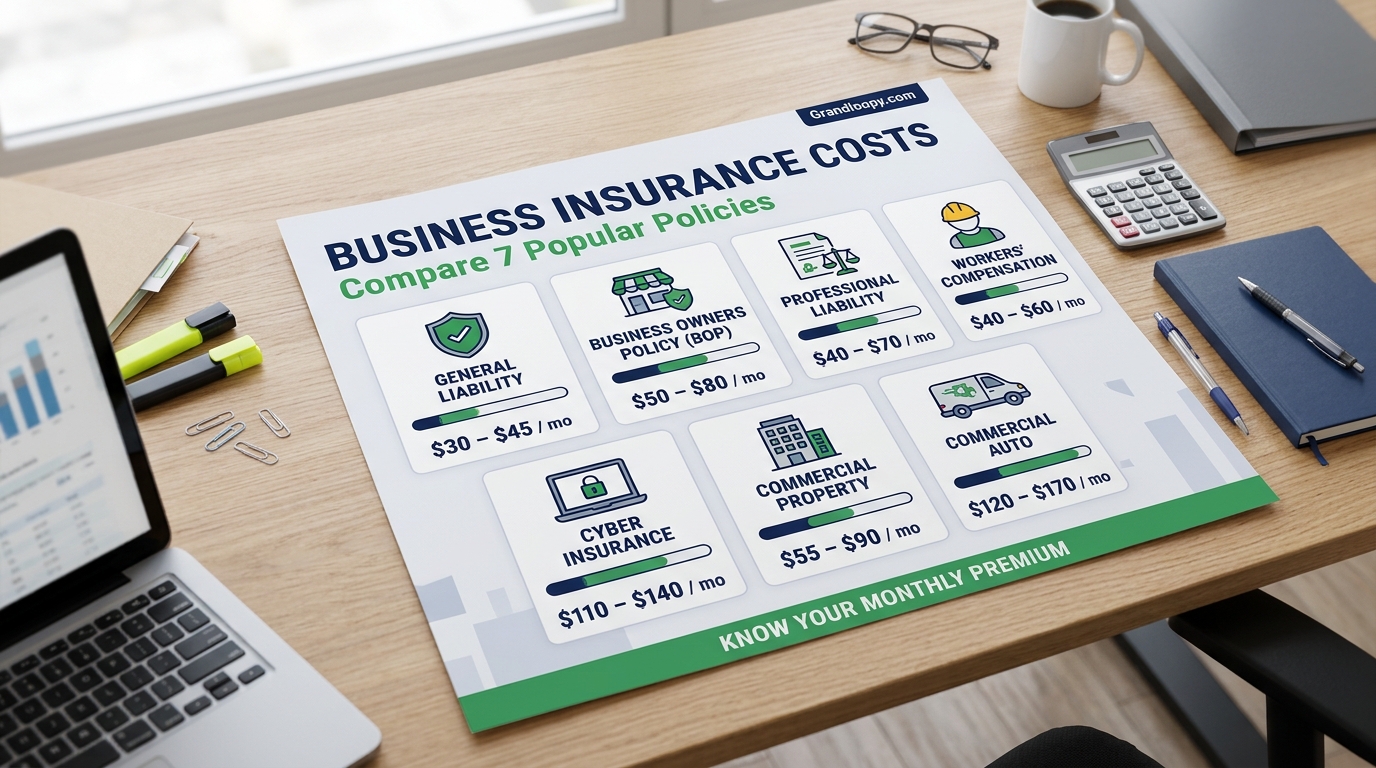
The quick answer, for that small business population, is a short ladder. General liability sits near 45 dollars a month, a business owners policy near 83, and workers compensation near 54.
Professional liability runs near 88 dollars a month in the same book. Cyber liability sits near 129, commercial property near 108, and commercial auto is the outlier at 245.
Those are medians, not averages and not quotes. Half of that book paid less, half paid more, and your industry can move you far from the middle in either direction.
Workers compensation breaks the monthly pattern entirely. It is priced by formula, per 100 dollars of payroll, multiplied by your class rate and your experience modifier. The formula section below works real payrolls.
Founders sequencing a launch can place this page inside GrandLoopy’s step by step guide to starting a small business, where insurance sits in the legal stack after registration and tax IDs. Price it there, not as an afterthought.
Online sellers have a particular shape of risk. GrandLoopy’s guide to AI customer support for small online stores shows how much of a small store now runs through software, data, and third party platforms, and each dependency carries an insurable exposure.
Read the medians as a budgeting floor, not a promise. Then adjust for your trade, your state, your payroll, and your claims history, because those four variables do most of the pricing work.
The Medians by Policy, in One Table
One table answers the headline question honestly. Each row is a median from one book, labeled with its source, so you can see exactly whose customers produced the figure.
|
Policy |
Median per month |
Median per year |
Source book |
|---|---|---|---|
|
General liability |
$45 |
$538 |
Insureon, 2026 |
|
Business owners policy |
$83 |
$990 |
Insureon, 2026 |
|
Professional liability |
$88 |
about $1,050 |
Insureon, 2026 |
|
Workers compensation |
$54 |
about $645 |
Insureon, 2026 |
|
Commercial property |
$108 |
about $1,296 |
Insureon, 2026 |
|
Cyber liability |
$129 |
$1,548 |
Insureon, 2026 |
|
Commercial auto |
$245 |
$2,940 |
Insureon, 2026 |
Read the spread, not just the rows. The cheapest common policy and the most expensive differ by more than five times, and the difference is the risk being transferred, not insurer markup.
Commercial auto leads because vehicles injure people at highway speeds. General liability trails because a small office or online business presents modest third party injury and property risk.
How to use this table
Budget from the row that matches your first purchase. Most new businesses buy general liability or a business owners policy first, then add workers compensation with the first employee.
Then stress the figure. If your trade appears in the industry table below with a higher median, budget that number instead. The policy table describes the average small business, not yours.
Why No Official Price Exists
Premiums are private contracts. Insurers file rates with state regulators, but the filed rate is a formula, not a shelf price. Your premium is the formula applied to your business.
That is why every published cost is a book statistic. A marketplace reports its own customers, a carrier reports its own policyholders, and a comparison site models a hypothetical buyer.
None of them is wrong, and none of them is universal. The error is stripping the label off a figure and repeating it as the price of business insurance for everyone.
A second trap is the advertised floor. One national seller advertises general liability from 19 dollars a month, and another advertises from 17 dollars. Floors describe the cheapest qualifying risk, not the typical buyer.
The three kinds of number
Medians describe the middle customer of a real book. Averages describe the same book pulled upward by expensive risks. Modeled figures describe a study’s assumptions about a business that may not exist.
Keep the three apart and most confusion in this market disappears. Blend them and you get the familiar internet soup where one page quotes three incompatible prices in three paragraphs.
Median Versus Average, With a Clean Example
One carrier pair teaches the lesson perfectly. Progressive Commercial reported new business owners policy customers in 2025 paying a median of 80 dollars a month and an average of 127 dollars.
Same policy, same year, same seller. The 47 dollar gap is the shape of risk: a minority of expensive businesses drag the average far above what the middle customer pays.
A large carrier’s averages run higher still. Hartford book averages compiled in 2026 put general liability near 68 to 69 dollars and a business owners policy near 141 dollars, describing a broader, larger customer base.
Neither book is lying. They insure different populations. A solo consultant belongs in the marketplace book; a thirty person manufacturer belongs closer to the carrier book.
A widely cited study lands between them by construction. MoneyGeek’s 2026 analysis modeled about 111 dollars a month across six common coverage types for a one to four person business. Useful as a model, labeled as a model.
General Liability, the First Policy Most Businesses Buy
General liability covers third party claims for bodily injury, property damage, and advertising injury. A customer slips in your shop, your work damages a client’s property, a competitor alleges copying.
The median is 45 dollars a month in the marketplace book. The distribution matters more: 22 percent of those customers pay under 30 dollars, and 41 percent pay between 30 and 60.
Typical limits are standard. Most small buyers choose 1 million dollars per occurrence and 2 million dollars aggregate. Leases and client contracts commonly demand exactly that pairing, which is why it became the default.
A published range brackets the median honestly. Compilations place typical general liability premiums between about 265 and 3,030 dollars a year, with the top of the range belonging to hazardous trades and larger revenues.
Who pays the least, who pays the most
Desk based risks sit at the bottom. Consultants, designers, and online sellers present few physical hazards, so their liability premiums cluster near or below the median month after month.
Physical trades sit at the top. Construction, installation, and repair work puts bodies and property at risk daily, and the premium follows the exposure rather than the business’s size alone.
The Business Owners Policy, the Bundle
A business owners policy, called a BOP, bundles general liability with commercial property cover in one contract. The bundle usually costs less than the two policies bought separately.
The median is 83 dollars a month, or 990 dollars a year, in the marketplace book. About 87 percent of those BOP buyers chose the standard 1 million and 2 million dollar liability limits.
Property value drives the BOP spread. A home based seller with a laptop insures almost no property. A restaurant with ovens, refrigeration, and a fitted interior insures a small factory’s worth.
Know the exclusions. A BOP does not include workers compensation, commercial auto, professional liability, or cyber cover. Those are separate purchases, and assuming the bundle covers them is a classic first year gap.
BOP range and the bundle test
Published BOP ranges run from about 400 dollars a year for the smallest low risk buyers to 6,000 dollars and beyond for property heavy operations. The median sits near the bottom because most small businesses are small.
The bundle test is simple. Price the BOP against liability alone. If your business owns equipment, stock, or a fitted premises, the property half usually earns its premium in the first claim.
Professional Liability, the Advice Policy
Professional liability covers claims that your advice, service, or work product caused a client a financial loss. It is also called errors and omissions insurance, and no physical injury is required.
The median is 88 dollars a month in the marketplace book. Consultants, accountants, designers, and technology providers form the core buying population, because their product is judgment.
A missed deadline, a flawed report, a software defect, or a breached contract can each trigger a claim. Defense costs alone often exceed a small firm’s cash reserve, which is the real purchase.
Published ranges run from about 400 dollars a year for low risk solo practitioners to 7,000 dollars and more for larger professional firms with riskier engagements and higher limits.
Claims made, the timing trap
Most professional policies are written on a claims made basis. The policy that responds is the one active when the claim arrives, not when the work was done.
That timing makes continuity valuable. Letting the policy lapse can orphan last year’s work. Buy before you start client work, keep it renewed, and ask about retroactive dates when switching carriers.
Workers Compensation, the Formula Policy
Workers compensation pays medical costs and part of lost wages when an employee is injured at work. Most states require it once a business has employees, with narrow exceptions that vary by state.
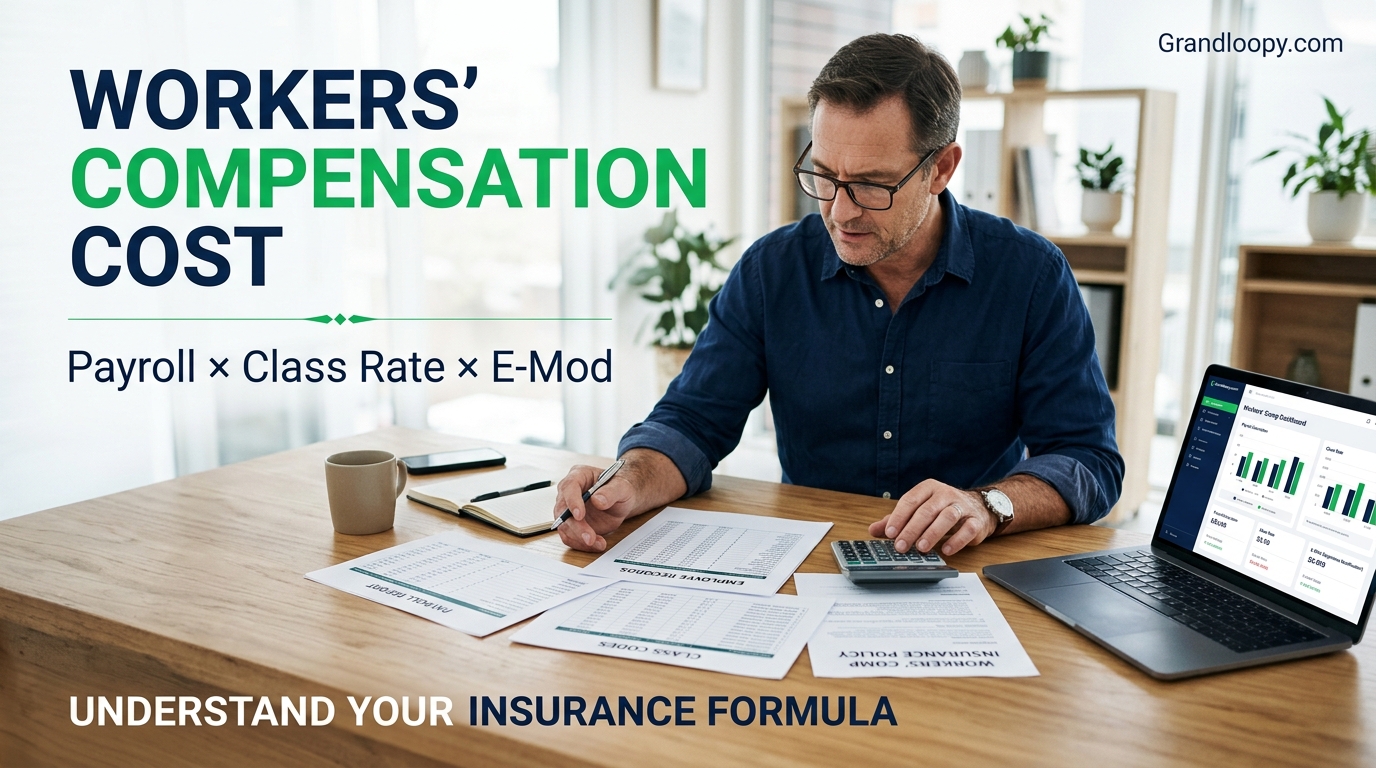
Forget monthly medians here, even though the marketplace book prints one near 54 dollars. The real price comes from a formula every serious buyer should be able to run on an envelope.
The rating formula
The formula has three parts. Take annual payroll divided by 100, multiply by your class code rate, then multiply by your experience modification rate. That product is the estimated premium.
The class code names what your employees actually do. Office classes price around 0.10 to 0.50 dollars per 100 of payroll. Roofing, framing, and tree work classes run 5 to 25 dollars per 100.
The national average employer cost was about 0.90 dollars per 100 of payroll in 2024, easing from 0.93 in 2023. State averages in the most recent national comparison ran from about 0.35 to 1.83 dollars, dated 2021 data.
Your experience modifier, the e-mod, compares your claims history with similar firms. A 1.00 is average. A clean record earns a credit below 1.00, and a poor record earns a debit that can raise premium sharply.
Worked examples on real payrolls
Run the formula on three payrolls and the class code’s power becomes obvious. The same wages cost ten to fifty times more to insure in a hazardous class than in an office class.
|
Business |
Payroll |
Class rate per $100 |
E-mod |
Estimated premium |
|---|---|---|---|---|
|
Office consultancy |
$200,000 |
$0.30 |
1.00 |
$600 a year |
|
Cleaning company |
$200,000 |
$2.50 |
1.00 |
$5,000 a year |
|
Roofing contractor |
$200,000 |
$12.00 |
1.00 |
$24,000 a year |
|
Roofing, poor record |
$200,000 |
$12.00 |
1.25 |
$30,000 a year |
Classification is therefore a financial control. Misclassifying field staff as office staff understates premium now and creates a painful audit bill later, when the insurer corrects the payroll by class.
Pay as you go billing exists for this policy. Several national carriers named in market coverage let employers remit premium with each payroll run, which smooths cash flow and shrinks the year end audit surprise.
Cyber, Property, and Auto, the Expensive Three
Cyber liability medians sit near 129 dollars a month in the marketplace book. The policy covers breach response, notification, recovery, and third party claims when customer or payment data is exposed.
Online businesses underestimate this exposure because they hold little data themselves. Their processors, platforms, and support tools hold it instead, and a compromise anywhere in that chain can still land on the seller.
Commercial property medians sit near 108 dollars a month. Price follows insured value, construction, location hazards, and protection. A warehouse of stock and a rented desk are different universes under one policy name.
Commercial auto medians sit near 245 dollars a month, the budget outlier. Vehicle risk is frequent, severe, and priced per vehicle and driver record. Personal auto policies commonly exclude business use, which makes this gap dangerous.
The umbrella option
Commercial umbrella cover adds limits above your underlying liability policies. Small business umbrella pricing commonly starts in the few hundred dollars a year range for the first extra million, rising with the underlying risk.
Contracts sometimes require it. A landlord or enterprise client demanding limits above a standard BOP is effectively asking for an umbrella. Price it when the contract is being negotiated, not after signing.
Cost by Industry, Where the Median Breaks

Industry is the single strongest pricing variable for liability cover. The marketplace book’s general liability medians by trade show how fast the headline 45 dollars stops describing anyone in particular.
|
Industry |
General liability median |
Workers comp median |
|---|---|---|
|
Consulting |
$29 a month |
about $40 a month |
|
Technology |
$30 a month |
about $34 a month |
|
Healthcare services |
$31 a month |
about $60 a month |
|
Food and beverage |
$44 a month |
about $106 a month |
|
Cleaning |
$48 a month |
about $136 a month |
|
Construction |
$82 a month |
$179 to $254 a month |
Construction’s workers comp figure prints as two numbers deliberately. Two published cuts of marketplace based tables put it at 179 dollars and at 254 dollars a month, describing different customer slices. Print both, never blend them.
Food businesses split their risk. Their liability median sits near the overall middle, but a business owners policy for food runs near 148 dollars a month, because kitchens concentrate property and fire exposure.
The lesson generalizes. Your trade sets the class, the class sets the rate, and revenue and payroll scale it. Two businesses with identical revenue can pay fivefold different premiums for sound actuarial reasons.
The handyman conflict, exhibited
One trade shows why sources disagree in print. For a handyman’s general liability, one national seller reports most customers paying 37 to 73 dollars a month, the marketplace median is 67 dollars, and another marketplace reported a 55 dollar median for late 2024.
All three can be honest. Different books, different limit choices, different states, different halves of different years. The failure mode is a page that averages them into a single confident figure nobody actually pays.
Use conflicts as a range. When sources disagree, budget toward the higher figure for your trade and treat anything lower as a pleasant surprise at quote time. That habit generalizes across every cost category in BizInsuranceCompare’s 2026 cost guide.
The Rating Factors, Ranked by Force
Insurers price a file, not a hope. The factors below decide most quotes, roughly in order of force for small business policies, and each one is partly within your control.
1. Industry and class code
Your trade comes first. The class code translates your daily work into an expected claim frequency and severity. It is the multiplier everything else scales, especially for workers compensation.
2. Payroll and revenue
Payroll prices workers compensation directly through the formula. Revenue prices liability, because more sales mean more customers, more work product, and more exposure hours in the world.
3. State and location
The same business pays differently across state lines. Litigation climate, medical costs, regulation, and catastrophe exposure all vary. State workers compensation averages spanning 0.35 to 1.83 dollars per 100 of payroll prove the point.
4. Limits and deductible
Higher limits cost more, predictably and usually modestly at small business scale. A higher deductible lowers premium by keeping small losses on your books. Raise it only to a level your cash reserve can pay twice.
5. Claims history and loss runs
Insurers ask for loss runs, the official record of your past claims. A clean three to five year history earns better pricing. Frequent small claims hurt more than one large unlucky loss, because frequency predicts frequency.
6. Years in business and controls
Operating history reassures underwriters. So do visible controls: written safety practices, training records, contracts with limitation clauses, and data security basics. Controls are premium arguments you build during the year.
What a Full Program Costs
Most established small businesses carry three to five policies. A comparison analysis of marketplace data modeled a typical full program, a BOP plus workers compensation plus one specialty line, at roughly 150 to 500 dollars a month.
That is a modeled range, not a measured median. It is useful for first year budgeting precisely because it forces the honest unit: the program, not the single policy a search result happens to headline.
As a revenue share, small business insurance commonly lands in the low single digits as a percentage of revenue for low hazard firms. Hazardous trades run far higher, driven mostly by the workers compensation formula.
The online store program
A small online store typically needs a BOP or liability policy, product liability for what it sells, and cyber cover for its data chain. Its support operation matters too, a theme running through GrandLoopy’s AI technology coverage.
Product liability is the sleeper. Goods you import or relabel can make you the responsible seller in a claim. Marketplace platform requirements increasingly demand certificates, which turns this cover from optional to contractual.
Home based does not mean uninsured. Homeowner policies commonly exclude business property and liability. Home based businesses often pay less because their exposure is smaller, not because their home policy quietly covers the business.
Required, Contractual, and Optional
Law requires surprisingly little. Workers compensation is the main legal mandate, imposed by most states on employers. Commercial auto cover is required where state vehicle law applies to business vehicles.
Contracts require much more. Landlords commonly require general liability certificates before handing over keys. Enterprise and government clients require stated limits, additional insured status, and sometimes umbrella cover, all before work begins.
Lenders require property cover on financed equipment and premises. Read the requirement before shopping, because buying below a contractual limit means buying twice.
The certificate economy
A certificate of insurance is the proof document clients and landlords file. Speed matters: businesses lose start dates waiting on certificates. Ask any broker or platform how fast certificates issue before you buy, not after.
Additional insured endorsements extend your policy’s protection to a client or landlord for claims arising from your work. They are routine, usually inexpensive, and frequently non negotiable in commercial contracts.
How to Lower the Premium Without Hollowing the Cover
Lowering premium honestly means reducing risk or restructuring the purchase. Cutting limits below your contracts, or misdescribing your work, lowers price by quietly removing the protection you bought.
1. Classify correctly, then audit yourself
Review every employee’s class before renewal. People whose roles changed may belong in cheaper classes, legitimately. Keep time and duty records so the correction survives the insurer’s own audit.
2. Manage the experience modifier
For workers compensation, safety practices, prompt injury reporting, and return to work programs reduce claim costs over time. The e-mod rewards that record mechanically, usually with a lag of a few policy years.
3. Bundle where bundling is real
The BOP exists because bundling liability and property is genuinely cheaper for most small firms. Ask for the bundled and unbundled price in writing, and keep whichever wins for your property profile.
4. Set the deductible at reserve level
Choose the highest deductible your reserve can pay without stress, and no higher. The premium saving from an unreachable deductible is imaginary, because the first claim converts it into a cash crisis.
5. Pay annually when cash allows
Annual payment usually costs less than monthly installments, which often carry financing or billing fees. When cash is tight, monthly billing is a legitimate cash flow tool, priced as one.
6. Shop the renewal, keep the continuity
Quotes vary between carriers for the same file because appetites differ by trade and state. Shop at renewal, but protect claims made continuity on professional lines, where a careless switch can orphan past work.
The Premium Audit, Budgeted in Advance
Workers compensation and some liability policies are sold on estimated payroll and revenue. After the policy period, the insurer audits actual figures and settles the difference.
An audit bill is not a penalty. It is the true premium for the exposure you actually had. Growing businesses owe additional premium in most audit years, which surprises only those who never heard the mechanism explained.
Budget a reserve. Hold back a slice of the estimated audit difference whenever payroll grows mid year, and report major changes as they happen. Voluntary mid term adjustments are smaller and calmer than year end corrections.
Keep the records auditors ask for: payroll summaries by employee, class documentation, subcontractor certificates, and revenue records. Missing subcontractor certificates can pull their payroll into your audit, a classic and avoidable cost.
Mistakes That Distort the Price
Mistake one is budgeting from an advertised floor. The 17 and 19 dollar starting prices describe the cheapest qualifying risks in the market. Most operating businesses should budget from medians for their trade instead.
Mistake two is comparing a median from one book with an average from another. The comparison manufactures a price difference that is really a population difference wearing a price tag.
Mistake three is insuring last year’s business. Payroll, revenue, headcount, vehicles, and locations all feed the formula. A business that doubled while its policy stood still is underpaying now and overpaying at audit.
Mistake four is hiding work from the application. Undisclosed roofing, delivery, or installation activity discovered after a claim can jeopardize the claim itself. Honest classification is the cheapest claims strategy that exists.
Mistake five is letting a required certificate lapse. Contracts can suspend work or payment over an expired certificate, so calendar every renewal and certificate date next to tax and license dates in GrandLoopy’s small business and technology library.
A First Year Budget Method
Step one: pick the program, not a policy. List the covers your law, leases, clients, and actual risks require. For most small firms that is liability or a BOP first, then compensation, then the trade specialty.
Step two: price from medians in your industry row, not the headline table. Where two published cuts disagree, as with construction compensation, carry the higher figure into the budget and note the range beside it.
Step three: add the audit reserve and the certificate driven extras. Umbrella limits demanded by a big client, and additional insured endorsements, belong in the budget the year the contract is signed.
Step four: revisit at triggers. Hiring, a new vehicle, a lease, a new service line, or a revenue jump each reopen the pricing formula. Ten minutes at each trigger keeps the annual renewal boring, which is the goal.
General information only: this page explains published pricing data and rating mechanics. It is not insurance advice for your specific business; a licensed broker or agent prices your actual file.
Frequently Asked Questions
1. How much is business insurance per month?
About 45 to 129 dollars for most small firms. That band covers general liability at a 45 dollar median up to cyber at 129, in the marketplace book of roughly 100,000 mostly tiny businesses.
Your trade moves you inside or beyond it.
2. How much does general liability insurance cost?
A 45 dollar monthly median. That is the Insureon 2026 figure, with 22 percent of customers under 30 dollars and 41 percent between 30 and 60.
Hazardous trades and larger revenues sit well above the median.
3. How much is a business owners policy?
An 83 dollar monthly median. The business owners policy bundles liability and property at 990 dollars a year in the same book.
About 87 percent of buyers chose standard 1 million and 2 million dollar limits.
4. How much is professional liability insurance?
An 88 dollar monthly median. Professional liability covers financial loss claims from your advice or work product.
Solo low risk practitioners can pay near 400 dollars a year; larger firms pay several thousand.
5. How much is workers compensation insurance?
Priced by formula, not a flat rate. The marketplace median prints near 54 dollars a month, but real cost is payroll divided by 100, times your class rate, times your experience modifier.
6. How is workers comp calculated?
Payroll divided by 100, times class rate, times e-mod. A 200,000 dollar office payroll at a 0.30 rate costs about 600 dollars a year.
The same payroll in roofing at 12 dollars costs about 24,000.
7. How much is cyber insurance for a small business?
A 129 dollar monthly median. Cyber liability covers breach response, notification, recovery, and related claims.
Online sellers carry real exposure through their platforms and processors, not only through data they store themselves.
8. How much is commercial auto insurance?
A 245 dollar monthly median. Commercial auto is the budget outlier because vehicle claims are frequent and severe.
Price follows vehicle type, use, garaging, and each driver’s record.
9. Why is my business insurance quote higher than the average?
Your file differs from the book. Industry class, payroll, revenue, state, limits, and claims history all price the quote.
A median describes the middle of someone else’s customers, not your exposure.
10. What is the difference between median and average insurance cost?
Median is the middle customer; average is pulled upward. One carrier’s 2025 BOP figures show an 80 dollar median against a 127 dollar average.
Expensive risks drag the average far above what typical buyers pay.
11. How much insurance does a small business need?
Enough to satisfy law, contracts, and your real risks. Workers compensation where employees require it, liability limits your leases and clients demand, plus cover for property and exposures that could close the business.
12. What limits do most small businesses buy?
One million per occurrence, two million aggregate. That pairing is the standard liability choice in the marketplace book and the level leases and client contracts most commonly demand by name.
13. How much is business insurance for an LLC?
An LLC pays like any similar business. Structure alone barely moves price.
Trade, revenue, payroll, and location decide it, so a consulting LLC sits near 29 dollars for liability while a contracting LLC pays far more.
14. How much is business insurance for a contractor?
Well above the small business median. Construction general liability medians run near 82 dollars a month, and workers compensation medians print at 179 to 254 dollars depending on the table cut.
Class codes drive both.
15. How much is business insurance for a restaurant?
Liability near the middle, property heavy overall. Food general liability medians sit near 44 dollars a month, while a food business owners policy runs near 148, because kitchens concentrate fire and equipment exposure.
16. How much is business insurance for a consultant?
Among the cheapest buyers in the book. Consulting general liability medians run near 29 dollars a month.
Many consultants add professional liability near the 88 dollar median, because their product is advice.
17. What factors affect business insurance cost the most?
Industry class code, payroll, and revenue. Then state, limits, deductible, and claims history.
Class decides the rate, payroll and revenue scale it, and your loss record adjusts it through pricing and the e-mod.
18. What is an insurance class code?
The code naming what employees actually do. Insurers classify work into codes with very different rates.
Office classes run about 0.10 to 0.50 dollars per 100 of payroll; roofing classes run 5 to 25 dollars.
19. What is an experience modification rate?
A multiplier comparing your claims record with similar firms. An e-mod of 1.00 is average.
Clean records earn credits below 1.00; poor records earn debits that can raise workers compensation premium sharply.
20. How can I lower my business insurance premium?
Reduce real risk and restructure honestly. Correct classifications, safety practices that improve the e-mod, a BOP bundle, a reserve level deductible, annual payment, and competitive renewal quotes.
Never savings from misdescribing your work.
21. Does a higher deductible lower business insurance cost?
Yes, within your cash limits. A higher deductible keeps small losses on your books, so premium falls.
Set it at a level your reserve can pay twice, not at the highest number offered.
22. Is it cheaper to pay business insurance annually or monthly?
Annually is usually cheaper overall. Monthly billing often adds financing or service fees.
Monthly still makes sense as a cash flow tool for young businesses, as long as the extra cost is a deliberate choice.
23. What is a premium audit?
The insurer’s check of your real exposure. Compensation and some liability policies are priced on estimated payroll and revenue.
After the period, auditors compare actuals and settle the difference in either direction.
24. Will I owe more after a workers comp audit?
Often, if payroll grew. Additional premium is the true price of exposure you actually had, not a penalty.
Reporting growth mid term and holding an audit reserve keeps the settlement calm.
25. Is business insurance required by law?
Mostly workers compensation, by state. Most states require it once you employ people.
Commercial auto cover follows vehicle law.
General liability is rarely mandated by law itself.
26. Do clients and landlords require insurance minimums?
Frequently, and their terms govern. Landlords and clients commonly require liability certificates, stated limits, and additional insured status before keys or work change hands.
Buy to the contract to avoid buying twice.
27. How much is insurance as a percentage of revenue?
Low single digits for low hazard firms. Insurance commonly takes a small percentage of revenue for desk based businesses.
Hazardous trades run much higher, driven mainly by the workers compensation formula.
28. What does a full business insurance program cost?
Roughly 150 to 500 dollars a month, modeled. That comparison range covers a BOP plus workers compensation plus one specialty line for a typical small firm.
It is a modeled planning range, not a measured median.
29. Is a BOP cheaper than buying policies separately?
Usually, for firms with property. The BOP packages liability and property at a lower combined price for most small businesses.
Ask for bundled and separate quotes in writing and keep the cheaper structure.
30. How much is umbrella insurance for a business?
Often a few hundred dollars a year to start. Umbrella cover adds limits above your liability policies, with the first extra million priced modestly for low risk firms and rising with the underlying exposure.
31. How much is product liability insurance?
Priced with your liability program. Product liability cost follows what you sell, how it is made, and your sales volume.
Sellers of imported or relabeled goods should treat it as core cover, not an extra.
32. Do home based businesses pay less for insurance?
Often less, because exposure is smaller. Home based firms usually insure little property and few visitors.
But homeowner policies commonly exclude business activity, so smaller is not the same as already covered.
33. How much is insurance for a one person business?
Near the bottom of every table. One person desk based businesses cluster near the consulting and technology medians, roughly 29 to 30 dollars for liability, plus professional cover if they sell advice.
34. Why did my premium go up at renewal?
Exposure and records change. Payroll growth, revenue growth, new claims, a worse e-mod, and market wide rate changes all lift renewals.
Insurers also reprice trades whose claim costs rose across the industry.
35. Do claims raise business insurance prices?
Yes, especially frequent claims. Insurers review loss runs covering three to five years.
Frequency hurts more than one large unlucky loss, because repeated small claims predict more of the same.
36. What are loss runs and why do insurers ask for them?
Your official claims history from past insurers. Loss runs list dates, types, and amounts of prior claims.
Underwriters request them to price your record; request your own copy before renewal shopping begins.
37. How much is business insurance in high cost states?
State averages differ about fivefold. Workers compensation state averages ran from about 0.35 to 1.83 dollars per 100 of payroll in the 2021 national comparison.
Litigation climate, medical costs, and regulation drive the spread.
38. Can I get business insurance for under 50 dollars a month?
Yes, some real buyers do. In the marketplace book, 22 percent of general liability customers pay under 30 dollars a month.
Low hazard, low revenue, home based firms make up most of that group.
39. What do advertised starting prices for insurance really mean?
They are floors for the cheapest qualifying risk. Advertised figures like 17 or 19 dollars a month describe best case low hazard buyers.
Budget from medians for your trade, not from the floor in the advertisement.
40. How much is commercial property insurance?
A 108 dollar monthly median. Commercial property price follows insured value, construction, location hazards, and protection.
A fitted premises or a warehouse of stock costs far more than a rented desk.
41. Does my industry really change the price that much?
Yes, it is the strongest single factor. Liability medians run from about 29 dollars for consulting to 82 for construction, and compensation class rates span 0.10 to 25 dollars per 100 of payroll.
42. How do I budget for business insurance in my first year?
Budget the program, from your industry row. List legally and contractually required covers, price them from trade medians, carry the higher figure where sources conflict, and add an audit reserve for payroll growth.
Conclusion
How much is business insurance stops being a mystery once every number carries its book, its population, and its formula. Medians budget the typical policy, the workers compensation formula prices your actual payroll, and your class code explains the rest.
Start with the required stack, price it from your industry row, and keep the higher figure wherever published sources conflict. Add the audit reserve, calendar the renewals, and revisit the program at every hiring, vehicle, lease, or revenue trigger.
Get competing quotes on the same file before you buy: identical limits, identical classifications, identical payroll and revenue. Quotes built on the same facts are the only quotes worth comparing, and they turn this page’s medians into your real number.