How to Get a Startup Business Loan With No Money: Split the Problem, Pick the Door
How to get a startup business loan with no money starts with a correction. No lender funds a business on nothing, and any page implying otherwise is selling something.
What lenders actually do is trade the missing money for something else: your personal credit, your signature on a guarantee, an asset, a cosigner, or a plan with projections they can believe.
One program was built for exactly this trade. The SBA Microloan exists for borrowers with no revenue, no track record, and no down payment, and it is where this article starts after it splits your problem into the four deficits hiding inside the words no money.
Everything here is general information, not financial advice. Every figure carries its source, because on this topic the sources disagree, and the disagreements are the useful part.
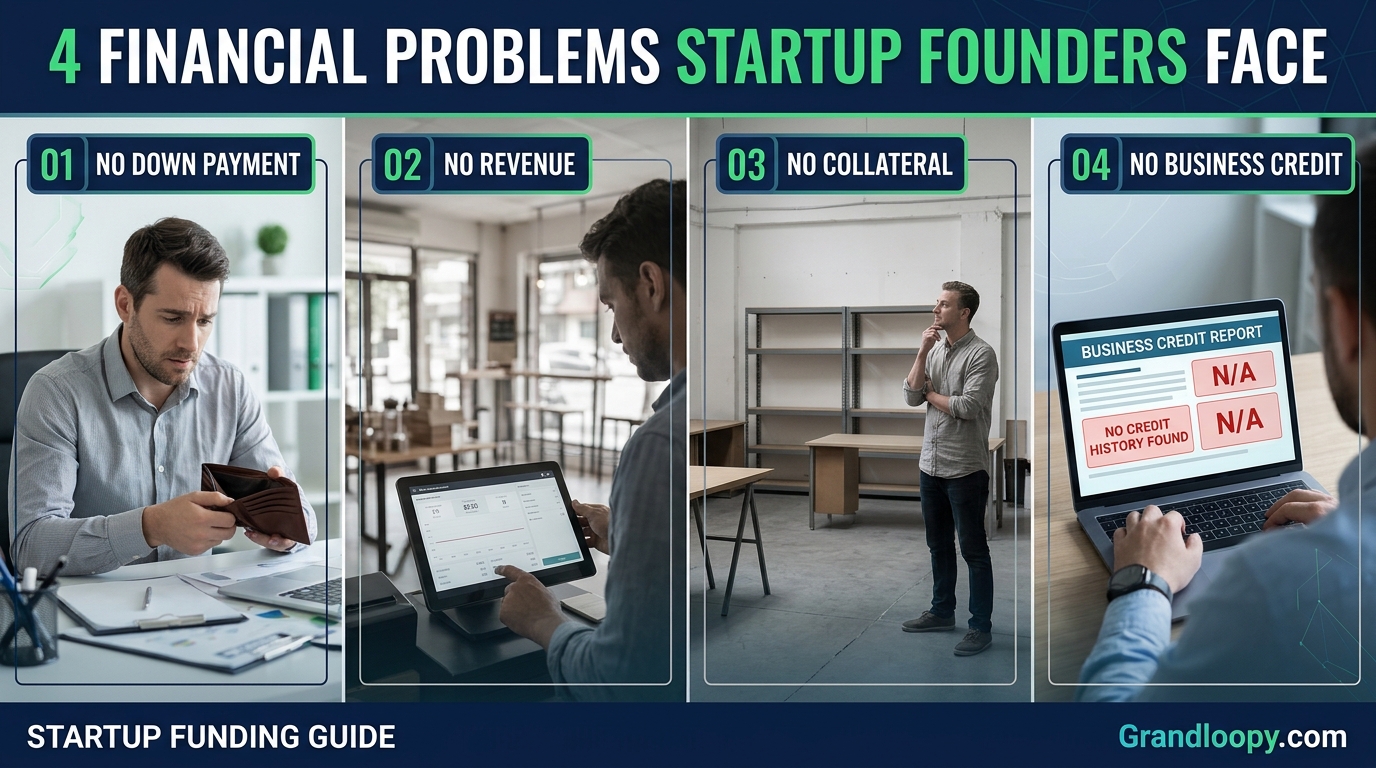
No Money Is Four Different Problems
The framing this article borrows comes from the Crestmont Capital startup loan guide, which points out that lenders hear four different requests inside the same phrase. Each one opens different doors.
Treating them as one problem is why founders get bad advice. A borrower with no revenue keeps getting invoice financing recommended, a product that needs the invoices they do not have.
No Down Payment
This is the narrowest deficit and the easiest to route. Microloans and equipment financing are commonly written without a down payment at all.
The deficit only bites on larger SBA loans, where the borrower’s own contribution, the equity injection, is a formal requirement rather than a preference.
No Revenue Yet
No revenue closes traditional term loans, which underwrite your history. Banks generally want one to two years in business and substantial revenue before they engage.
It does not close the mission lenders. Microloans, CDFIs, cards, and Kiva all underwrite the founder and the plan when there is no sales record to underwrite.
No Collateral
Collateral is what a lender takes when repayment fails. Without it, you are asking the lender to carry the whole risk on your character and credit.
That ask is answered three ways: character based lending at CDFIs, a personal guarantee that puts your own assets behind the business, or a product like equipment financing where the purchase itself becomes the security.
No Business Credit History
A new business has no credit file at all, which is not the same as bad credit. Lenders respond by underwriting you personally.
The fix is sequencing. Small, well handled credit, a card paid in full, vendor terms paid early, a small loan repaid, writes the file into existence while it funds the early needs.
The Routing Table
Find your row before you read another product list. The deficit decides the door, not the marketing.
|
Your deficit |
Doors that stay open |
What the lender takes instead |
|---|---|---|
|
No down payment |
SBA microloan, equipment financing |
Your credit and a personal guarantee |
|
No revenue |
Microloan, CDFI loan, Kiva, business credit card |
Your plan, projections, and outside income |
|
No collateral |
CDFI character lending, Kiva, equipment financing |
Your guarantee, or the equipment itself |
|
No business credit |
Cards, vendor terms, a first small microloan |
Your personal credit file, fully |
What Lenders Take Instead of the Missing Money
Every approval on this page is an exchange. Know what you are offering before you apply, because each substitute has a price.
Your Personal Credit Score
With no business record, your personal score is the application. Current guides agree on the shape: around 680 opens traditional doors, the low 600s open microloans and equipment routes, and below 600 the mission lenders and no check routes remain.
Paying down card balances before applying is the one tactic the score guides repeat, because utilization moves a score within a cycle. Treat any exact points promised as marketing, not measurement.
Your Personal Guarantee, and What It Really Risks
For SBA loans, every owner of 20 percent or more signs an unlimited personal guarantee. It is not a formality: it means your personal assets answer for the debt if the business fails.
This article repeats that warning at every guarantee mention, because the guarantee is the true price of no money down. A founder who cannot accept it should route to Kiva, grants style programs, or equity instead.
Collateral Substitutes You May Already Own
Collateral does not have to be a building. Guides list equipment, vehicles, inventory, and personal assets, and lenders accept future invoices once a business is trading.
The equipment case is the cleanest. Buy a machine or a vehicle with equipment financing and the asset secures its own loan, which is why that product funds up to the full price.
A Cosigner or Guarantor
A cosigner with strong financials is a recognized approval lever across the guides. Their credit and income stand where yours are thin.
Protect the relationship while you use it. Put the arrangement, the amounts, and what happens if the business struggles in writing before anyone signs.
A Plan With Projections They Can Believe
For a pre revenue borrower, the plan is the underwriting. Lenders read it for a specific use of funds, realistic projections, and evidence you understand your market.
The detail that separates credible plans is specificity. Itemized costs with quotes beat round numbers, and assumptions written down beat confidence performed in a meeting.
Evidence That Revenue Is Coming
A pre revenue business can still show revenue in transit. Lenders in the research name the evidence: preorders with deposits, signed contracts or letters of intent, a waitlist with real numbers, or a soft launch’s first sales.
None of it is revenue yet, and the article does not pretend otherwise. It is trajectory evidence, and for an underwriter deciding between two plan only files, it is often the difference.
Gather it before you apply, in writing. A screenshot of a preorder list and two signed letters outweigh a confident verbal forecast in every lending conversation this topic produces.
Your Outside Income
The most useful single tip in the research comes from a working lender. Quoted in the NerdWallet startup loan guide, Karla De Leon, chief lending officer at two California CDFIs, advising founders: do not quit your day job just yet.
Outside income is repayment support an underwriter can count. While the business earns nothing, your salary is the cash flow the application quietly stands on.
The Door Built for This Searcher: SBA Microloans

The Microloan program is the one mainstream product designed for a borrower with none of the usuals. It deserves the deepest section on the page.
How the Program Works
The SBA does not lend the money itself. It funds nonprofit intermediary lenders, community organizations that specialize in small borrowers, and they make the loans and set many of the criteria.
Maximum loan: 50,000 dollars. Proceeds fund working capital, inventory, supplies, furniture, fixtures, and equipment, and the program bars two uses: buying real estate and repaying existing debt.
Many intermediaries bundle training and technical assistance with the loan. For a first time founder, that coaching is part of the product, not a bonus.
Amounts, Rates, and Terms, With the Conflicts Labelled
Reported rates run 8 to 13 percent. The average loan is reported at about 13,000 dollars by one program guide and about 15,000 dollars by a lender requirements guide; both figures are printed here as strands, because neither source outranks the other.
The same discipline applies to the term. Most guides put the maximum at six years; one 2026 guide says seven. Six is the long standing figure, and your intermediary’s own paperwork settles it for your loan.
One more strand dates the program’s reach: about 24 percent of fiscal 2024 microloans went to businesses two years old or younger, per the program guide. This is a startup product in practice, not just in name.
The Score Ladder
The SBA publishes no minimum credit score. Every floor below belongs to a named lender or guide, and printing them as a ladder is the honest replacement for the single invented minimum most pages offer.
|
The rung |
Whose standard it is |
What it opens |
|---|---|---|
|
540, exceptional only |
One lender requirements guide, for a few mission driven microlenders |
A conversation, with strong compensating factors |
|
575 |
Several guides’ typical microloan floor; some named intermediaries sit here |
The microloan door, at its most accessible |
|
620 |
The most repeated expectation across guides |
Most microlenders, plus equipment financing |
|
640 |
The level one industry report says many microlenders target in 2026 |
The comfortable middle of the microloan market |
|
680 and above |
The traditional lender comfort line |
Cards with real limits, SBA adjacent programs, better rates |
|
700 and above |
Quoted for true startup 7(a) approvals |
The largest door, with injection and experience |
The practical source behind the ladder is the StartupOwl microloan guide, because it makes the rungs usable, because it names intermediaries and their actual floors instead of quoting one number for a national program.
The tier logic from the other side comes from the BitX Capital credit score guide, which adds the product mapping, mapping score bands to product doors: fair credit limits unsecured options, while asset backed routes stay open.
What a Microloan Cannot Do
Size is the first limit: 50,000 dollars is a ceiling, not a target, and franchise purchases and real estate sit outside it entirely.
The second limit is standing. Owners of 20 percent or more must be US citizens, nationals, or lawful permanent residents, and a default on prior federal debt disqualifies an applicant before the plan is read.
A Worked Example: The 12,000 Dollar Launch
Consider a founder launching a mobile coffee cart with no savings and a 640 credit score. The costs are itemized: a used cart at 6,500 dollars, an espresso machine at 2,800, permits and deposits at 1,200, and opening stock at 1,500.
The routing table sends her to a microloan first, because the amount sits inside the cap and her score clears the typical intermediary floors. The equipment could alternatively carry its own financing, splitting the ask into a smaller loan and an asset backed purchase.
Her application stands on the trades: the guarantee signed knowingly, a plan with market evidence from two event contracts, and her weekend job kept deliberately. Nothing in the file is money she does not have; everything in it is a substitute a lender accepts.
The Other Real Doors
The microloan is first, not only. Match the door to the deficit using the routing table, and expect to combine two of these rather than bet everything on one.
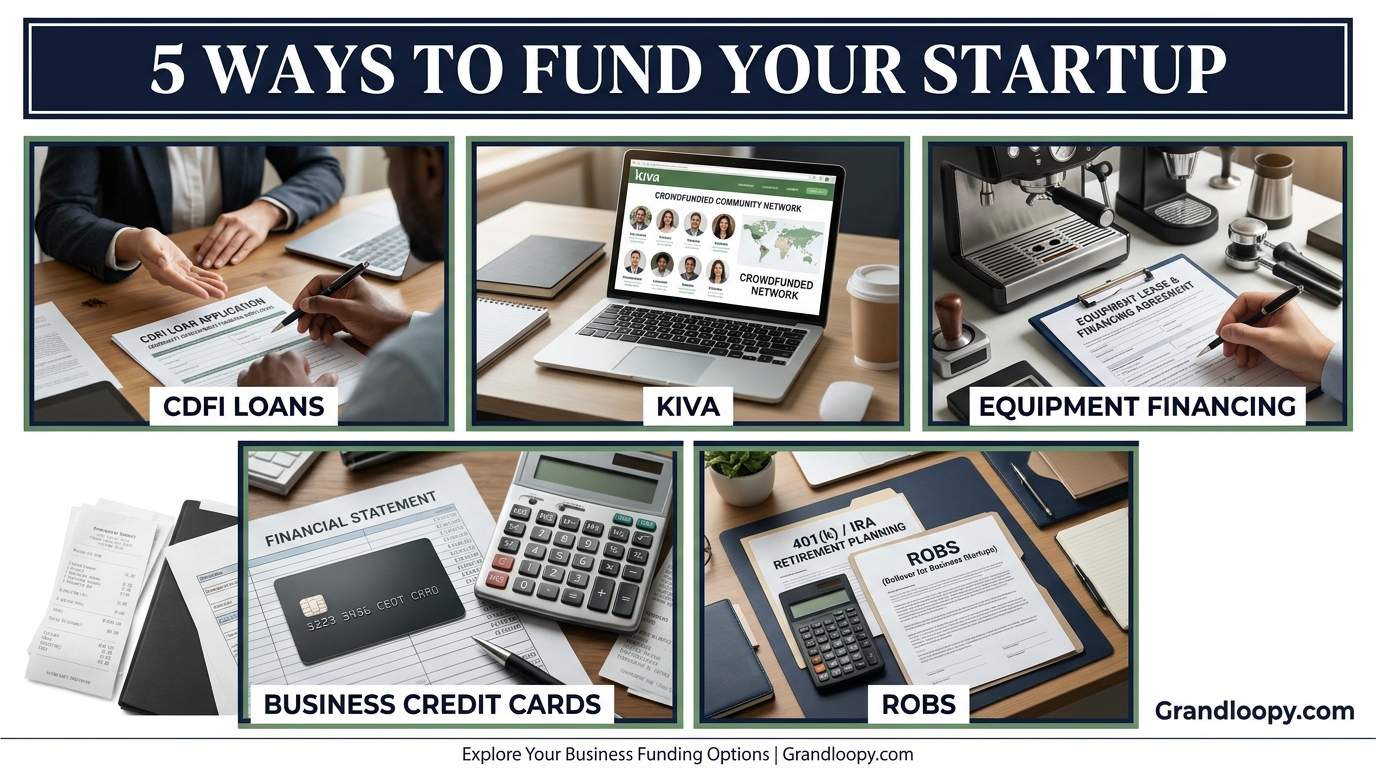
CDFIs and Nonprofit Lenders Beyond the SBA Program
Community Development Financial Institutions are Treasury certified mission lenders. They weigh character, the plan, and local knowledge more heavily than a bank’s scorecard, which is why a CDFI can approve a founder a bank’s formula rejected.
Expect a slower, more human process: conversations, references, and questions about your market. In exchange, the underwriting sees the parts of your file a score cannot.
Equipment Financing, Where the Asset Is the Collateral
For a vehicle, a machine, or a kitchen fit out, equipment financing is the most mechanical yes on the page. The lender funds the purchase, up to 100 percent of the cost in the guides’ reporting, and holds the asset as security.
The trade is scope: the money buys that equipment and nothing else. For launch needs that are mostly one asset, that constraint is the approval.
Business Credit Cards as the First Small Yes
Cards approve on personal credit, with most expecting about 690 or above, and they start writing your business credit file from the first statement.
Used as a bridge, they fund deposits and small stock while a microloan processes. Used as the main engine, their rates punish every carried balance, so size the charges to what clears monthly.
Kiva: The 0 Percent Crowdfunded Loan
Kiva US crowdfunds loans at 0 percent interest, up to 15,000 dollars, with no minimum credit score and no collateral. Your own network vouches and lends first; the loan then opens to Kiva’s worldwide lenders.
It is still a loan, repaid in full, and the vouching step means your community is part of the underwriting. Founders with a real local network hold an advantage no score can buy.
ROBS: Funding From Your Own Retirement
A rollover as business startup moves 401(k) funds into a new C corporation that sponsors a plan which buys the business’s stock. No credit check, no lender, and no monthly payment.
The warnings are structural. It needs a meaningful balance, lender guidance puts the practical floor near 50,000 dollars, the compliance rules are strict, and the money at risk is your retirement. Treat it as a specialist product with professional setup, never a loophole.
SBA 7(a) and Express for Startups With Some Injection
These are the big doors: 7(a) loans run to 5 million dollars, and the Shopify startup loan guide lists Express loans to 500,000 dollars for faster decisions.
For startups they ask the most in return: an equity injection that lender practice for new businesses places well above the 10 percent baseline, strong personal credit, and relevant experience. They belong at the end of a graduation path, not the start of a search.
A platform strand dates the traffic: the same guide reports the SBA approved 8,900 loans worth 5.6 billion dollars to startups between January and September 2025. The doors are real; they are simply not the first ones.
A Note for Online and Retail Founders
Store founders feel the no revenue problem first, because stock must exist before sales can.
The pattern shows in our guide to AI customer support for small online stores, where small online stores already automate support. The funding version of that lesson is to stage the spend: card for the first small order, microloan for the range.
Fashion founders get a market warning instead of a product: our verdict on whether Cider is fast fashion is a reminder that the low price end of retail runs on volume economics a startup cannot match, so borrow for a niche, not for a price war.
Doors That Are Closed Until Revenue Exists
Two popular products appear in almost every competitor’s list for this query. Both require the revenue you do not have, and naming that plainly saves readers weeks.
Invoice Financing Needs Invoices
Invoice financing advances money against invoices your customers already owe you. No customers, no invoices, no product. It becomes genuinely useful later, as working capital once trading starts.
Revenue Based Financing Needs Revenue
Revenue based products advance cash against future sales and price by a factor rate, not an interest rate. At a 1.3 factor, 50,000 dollars advanced means 65,000 repaid, collected on a daily or weekly rhythm.
Merchant cash advances sit in the same family. For a pre revenue founder they are not expensive options; they are unavailable options, and they stay expensive after revenue arrives.
The Grants Honesty Section
Grant searches bring founders to this page, so the honest answer gets its own section instead of a footnote.
Why SBA Grants Will Not Start Your Business
The SBA’s grant programs fund research organizations, nonprofits, and community programs, not business launches. A startup guide in the research carries the sentence plainly: SBA grants will not help you start or grow a business.
State and local grants exist, but they are narrow, themed, and competitive. Budget them as a possible bonus, never as the plan.
SBIR and STTR: Research Money, Not Startup Money
The federal research programs are real money with a real boundary: they fund research and development with commercialization potential. A technology founder may qualify; a café does not.
The Upfront Fee Scam
Founders with no money are the prime target for a specific fraud: a fee charged upfront to secure a grant. Legitimate applications are free, and the fee buys an application form anyone can download.
The verification habit protects every section of this article: check the program on its official site, and treat any promise of guaranteed approval, for a grant or a loan, as the tell.
The Application, Step by Step
Order matters. These steps follow the order lenders and guides assume, and doing them out of order is a quiet cause of denials.
Step 1: Form the Business and Open the Accounts
Register the entity, get the EIN, and open a separate business bank account before you apply.
The sequence in the Experian startup loan guide builds on exactly this foundation: lenders read commingled personal finances as risk.
Sequencing help sits in our how to start a small business guide, which orders the formation steps by what actually decides survival.
Step 2: Write the Plan and the Use of Funds Statement
The plan needs projections with stated assumptions, and the use of funds statement needs line items: equipment with quotes, opening inventory, deposits, and a working capital figure.
Vague uses are a quiet denial cause. Specificity is the cheapest credibility a broke founder can buy.
Step 3: Assemble the Document Pack
Gather the pack before the first conversation: personal financial statement, tax returns, bank statements, entity documents, licenses, and your resume, because at this stage your experience is an underwriting document.
Loans also carry running costs founders forget to budget. One of them is covered in our business insurance cost guide; insurance requirements appear in loan covenants as well as in good practice.
Step 4: Get Free Help Before You Apply
Small Business Development Centers provide no cost help with plans and loan packaging, and SCORE mentors review applications free. The CDFI officer quoted earlier points applicants to the SBDC by name.
An hour there fixes the errors intermediaries see weekly, before your file carries them.
Step 5: Apply to More Than One Intermediary
Intermediaries set their own criteria, so the same file can fail at one and pass at another. Two or three applications to lenders whose stated floors fit your profile is rational, not desperate.
The SBA’s Lender Match tool on its official site connects owners with approved lenders for the same reason: fit beats volume.
Step 6: Check the Country Before the Program
A top result for this exact query recommends a government Start Up Loan of up to 25,000 pounds at 7.5 percent. It is a UK scheme for UK businesses, useless to a US founder and easy to mistake at midnight.
The general rule travels: if a program’s currency is not dollars, it is not your program.
If You Are Denied
A denial is information about which compensating factor failed, and lenders will often say which one if asked directly.
The 90 Day Build
Spend a quarter writing the file you lacked: pay card balances down, pay every bill on time, open vendor terms and clear them early, and document revenue evidence as it appears: preorders, contracts, a waitlist with numbers.
Then reapply with the new file, not the same one. The second application succeeds on evidence the first one could not show.
Graduate: The Ladder Is the Strategy
The endgame of this topic is a sequence, not a single loan. A repaid microloan plus a year of trading moves a founder toward CDFI term loans, then Express, then a standard 7(a).
Each rung writes the record the next rung underwrites. Founders with nothing do not skip the ladder; they climb it faster by treating the first small loan as the asset it is.
Frequently Asked Questions
1. Can you really get a startup business loan with no money?
Yes, but never for nothing. Lenders trade the missing money for personal credit, a personal guarantee, collateral, a cosigner, or believable projections.
The SBA Microloan, built for exactly this borrower, is the door to try first.
2. What does no money actually mean to a lender?
It means one of four deficits. No down payment, no revenue, no collateral, or no business credit history.
Each deficit has different doors, which is why the article splits them before recommending anything.
3. Does the SBA lend money directly to startups?
No, the SBA does not lend directly. It guarantees loans made by banks and, for microloans, funds nonprofit intermediary lenders who decide applications.
Verify any program on the official SBA site before applying.
4. How much can I borrow with an SBA microloan?
Up to 50,000 dollars. That is the SBA Microloan program cap, delivered through nonprofit intermediaries.
Reported averages are far smaller: about 13,000 dollars in one 2026 guide and about 15,000 in another, printed as separate strands.
5. What credit score do I need for an SBA microloan?
There is no single SBA minimum, because the SBA sets none. Intermediary standards in current guides run from 575 typical to 620 expected.
Some accept lower with strong compensating factors; your intermediary’s own floor is the only one that counts.
6. Why do different websites quote different minimum credit scores?
Because every floor belongs to a different lender. Guides quote their own sources: 540 exceptional, 575 typical, 620 expected, 640 targeted, 680 traditional.
The ladder is honest once each rung carries its source.
7. What interest rate does an SBA microloan charge?
Typically 8 to 13 percent. That is the range current microloan guides report for the SBA program.
Your intermediary sets the actual rate inside program limits, so two borrowers in the same month can pay different rates.
8. How long do I get to repay a microloan?
Up to six years in most guides. One 2026 guide says seven, and this article prints the conflict rather than merging it.
Six years is the long standing program figure; confirm the term your intermediary offers.
9. What can an SBA microloan not be used for?
Real estate purchases and repaying existing debt. Microloan proceeds fund working capital, inventory, supplies, furniture, fixtures, and equipment.
Anything outside that list needs a different product, usually an SBA 7(a) loan.
10. How long does a microloan application take to fund?
Plan on weeks, not days. One microloan guide puts funding at roughly two to six weeks, including the plan review and the intermediary’s own process.
A complete document pack is the main speed lever you control.
11. Do SBA loans require a down payment?
Microloans and equipment financing usually do not; larger SBA loans do. The borrower contribution on 7(a) deals is called an equity injection.
Startup purchases in lender practice can run well above the baseline percentage.
12. What is an equity injection?
It is your own cash share of the project cost. SBA rules for acquisitions set a 10 percent baseline; startup lenders often require more.
Seller financing on standby can count toward part of it under the current rules.
13. What is a personal guarantee and what does it risk?
It is your personal promise to repay if the business cannot. SBA owners of 20 percent or more sign an unlimited guarantee.
It means personal assets, not just business assets, answer for the debt.
Read it as the serious commitment it is.
14. Do I have to put my house up as collateral?
Not automatically, but the risk is real. A guarantee lets a lender pursue your personal assets after a default, which can include your home depending on your state’s law and what you pledged.
Get advice before signing anything that pledges property.
15. What can I use as collateral if my business owns nothing?
The equipment itself, future invoices once they exist, vehicles, and personal assets all count. Equipment financing works precisely because the asset is the collateral.
Personal property pledged knowingly beats business assets you do not own yet.
16. Can a cosigner get me approved with no money?
Yes, a cosigner or guarantor with strong financials is a recognized lever. Guides list it among the five things that can replace missing money.
The cosigner takes real risk, so the terms between you belong in writing.
17. Can I get a startup loan while I still have a day job?
Yes, and it can help rather than hurt. A CDFI lending officer quoted by NerdWallet advises founders not to quit the day job yet.
Outside income is repayment support an underwriter can count while the business has none.
18. Can I get a business loan with no revenue at all?
Yes, through the routes built for pre revenue borrowers. Microloans, CDFIs, equipment financing, business credit cards, and Kiva all underwrite the founder and the plan instead of sales history.
Traditional term loans are the ones closed to you.
19. What is a CDFI and why might it say yes when a bank said no?
It is a Treasury certified Community Development Financial Institution. CDFIs lend on mission, weighing character, plan, and local knowledge more heavily than a bank’s scorecard.
That is why a CDFI can say yes after a bank’s formula said no.
20. How does equipment financing work with no money down?
The loan buys the equipment and the equipment secures the loan. Guides note lenders can fund up to 100 percent, sometimes more, of the equipment cost.
No separate down payment is needed because default hands the lender the asset.
21. Are business credit cards a good way to fund a startup?
They are a useful first yes and a risky main engine. Cards approve on personal credit, about 690 or above for most per NerdWallet, and build business credit.
Their rates punish carrying a balance, so size charges to what clears monthly.
22. What is Kiva and is a Kiva loan really 0 percent?
Kiva is a nonprofit that crowdfunds 0 percent loans up to 15,000 dollars. There is no minimum credit score, and your own network vouches first before the loan opens to worldwide lenders.
It is still a loan: you repay it in full.
23. What is ROBS and is it risky?
ROBS rolls retirement funds into a new C corporation that funds the business. It needs a qualifying balance, commonly around 50,000 dollars in lender guidance, and no credit check.
It risks your retirement and carries strict compliance, so it is a specialist route, not a loophole.
24. Are there grants to start a small business?
Almost never for starting one, despite the search results. The SBA’s own position, carried in startup guides, is that its grants fund research and community organizations, not business launches.
State and local programs exist but are narrow and competitive.
25. Someone wants an upfront fee to get me a grant. Is that legitimate?
Treat it as the FTC scam pattern. Legitimate grant applications are free, and anyone charging an upfront fee to secure a grant is selling the application, not the grant.
Walk away and check the program on its official site.
26. What documents do I need for a startup loan application?
The pack is predictable. Business plan with projections, use of funds statement, personal financial statement, personal and business tax returns, bank statements, entity documents and EIN, and licenses.
One requirements guide also lists federal debt standing and ownership details.
27. Do I need a business plan to get a microloan?
For a microloan, effectively yes. With no revenue history, the plan and its projections are the underwriting, so intermediaries treat a serious plan as the core document.
Free help exists: your local SBDC will review it at no cost.
28. What is a use of funds statement?
It is a short statement naming exactly what the money buys. Itemized uses, equipment quotes, inventory, deposits, working capital, with amounts.
Vague uses are a quiet denial cause; specificity is credibility.
29. Can I get a startup loan with bad credit under 600?
Your doors narrow but do not close. Sub 600 options in current guides include some mission driven microlenders at exceptional floors, Kiva with no minimum, ROBS with no credit check, and collateral backed routes.
A 90 day credit build moves you up the ladder.
30. What is invoice financing and can a pre revenue startup use it?
It advances money against invoices your customers already owe you. A pre revenue startup has no invoices, so the product cannot start until after your first sales.
It becomes useful later, as working capital, not launch capital.
31. What is revenue based financing and why is it expensive?
It advances cash against future sales and prices by a factor rate. A 1.3 factor on 50,000 dollars means repaying 65,000, before the daily repayment schedule is counted.
It needs revenue you do not have and costs the most when it becomes available.
32. Should I take a merchant cash advance to start my business?
Not to start. Merchant cash advances need existing card sales, price by factor rates, and collect daily or weekly.
Every serious guide treats them as a last resort for trading businesses, never as launch funding.
33. How do I build business credit from zero?
Use the small yeses lenders report. A business credit card paid in full, vendor net 30 terms paid early, and a small microloan repaid on time each write lines into your business credit file.
Separate accounts and an EIN come first.
34. What is the FICO SBSS change from March 2026?
One lender requirements guide reports the SBA stopped screening 7(a) Small loans with the FICO SBSS business score from March 1, 2026. The citation is SBA Procedural Notice 5000 875701.
Treat it as a dated rule change, reported as such, not a promise about your application.
35. Can I apply to more than one microlender at once?
Yes, and it is rational. Intermediaries set their own criteria, so the same application can fail at one and pass at another.
Apply to two or three whose stated floors and focus fit your profile.
36. What happens if my business fails and I signed a personal guarantee?
The guarantee makes you personally liable for what the business cannot pay. The SBA can pursue guarantors after a default and a guaranty claim.
That is general information, not legal advice; a failure plan belongs in a conversation with a professional.
37. Can immigrants and new citizens qualify for microloans?
Microloan guidance lists the standing rule. Owners of 20 percent or more must be US citizens, US nationals, or lawful permanent residents for the SBA program.
CDFIs also serve immigrant founders through community lending outside that specific federal rule.
38. Is the UK Start Up Loan available to US founders?
No. The Start Up Loan of up to 25,000 pounds at 7.5 percent that ranks for this query is a UK government scheme for UK businesses.
US founders have no access to it; it appears in this article only as a warning.
39. How much should I borrow for my first loan?
Borrow the smallest amount that proves the model. A first loan is also a credit building instrument: repaid on time, it becomes the record your next, larger application stands on.
Oversized first loans strain young cash flow.
40. What is the SBA Lender Match tool?
It is the SBA’s matching tool. Lender Match connects small business owners with SBA approved lenders who respond to a short description of the need.
It is free and lives on the official SBA site.
41. Where can I get free help with my loan application?
At your local Small Business Development Center and through SCORE. SBDCs give no cost help with plans and loan packaging, and a CDFI lending officer quoted in the guides points applicants to them by name.
Bring your draft plan; they will sharpen it.
42. After a microloan, what loan can I qualify for next?
The graduation is the strategy. A repaid microloan plus a year of revenue moves you toward CDFI term loans, SBA Express, and eventually a standard 7(a), each with better amounts and rates.
Keep the records; they are the application.
Conclusion
How to get a startup business loan with no money comes down to one honest exchange: name which of the four deficits is yours, then offer the lender its substitute in credit, guarantee, collateral, cosigner, or projections.
Start at the door built for the exchange. A repaid microloan becomes the revenue story and the credit file the next application needs, which is how founders with nothing graduate to loans that once required everything.
Prepare before you apply: form the business, open the accounts, write the plan, and check every program figure on the official SBA site on the day you apply. The wider shelf starts at the GrandLoopy home page for readers building the rest of their launch.