What Is a Business Plan? Definition, Sections, Types, and Examples
What is a business plan? It is a written document that describes what a business does, who it serves, how it makes money, and where it is headed.
A business plan covers goals, products or services, target market, and financial projections, and it works as a roadmap for running the business and securing funding.
The United States had 36,207,130 small businesses in February 2026, according to the SBA Office of Advocacy, and 99.9 percent of all firms in the country are small businesses.
The Census Bureau reported 531,728 business applications in August 2026 alone, which means hundreds of thousands of new founders face the same question every month.
The sections below answer that question in full: the definition, the four types, the SBA sections, the lender math, the AI question, the costs, and the mistakes to avoid.
What Is a Business Plan?
A business plan is a document that explains how a business operates, summarizing strategy, objectives, milestones, and financial goals in one place.
At its core, a business plan covers four things: what the business does, who it serves, how it makes money, and where it is headed.
The plan is a guide for the founder and for anyone else who needs to judge the business, including lenders, investors, partners, and employees.
A business plan is a living document, not a one-time filing, and it should be reviewed and updated as goals are met or conditions change.
A Business Plan in One Sentence
A business plan is a written guide that explains what a business does, how it makes money, who its customers are, and how it plans to grow.
That one sentence is the test for every section that follows: if a section does not help the reader answer one of those four questions, it does not belong.
What a Business Plan Is Not
A business plan is not a business model, because the model only explains how the company creates and captures value, while the plan adds market analysis, operations, team, and financials.
A business plan is not a pitch deck, because a deck is a short visual presentation for a meeting, while the plan is the detailed document behind it.
A business plan is not a marketing plan, because marketing covers only how customers are reached, while the business plan covers the whole company.
A business plan is not a feasibility study, because a feasibility study tests whether an idea can work, while the plan explains how the business will actually run.
Why You Need a Business Plan
A business plan does more than document a strategy: it forces the founder to understand the market, the numbers, and the risks before money is spent.
Writing things down exposes weak assumptions early, when fixing them costs hours instead of thousands of dollars.
Most new businesses fail early, and planning is one of the few levers a founder controls, so the numbers below matter more than any template.
The Numbers: What Planning Does for Survival and Growth
About 22.1 percent of new business establishments closed within their first year, according to the latest Bureau of Labor Statistics cohorts tracked to March 2025.
About 48.6 percent were gone within five years, and about 65.3 percent were gone within ten years, in the same BLS cohort data.
The SBA Office of Advocacy averages the same BLS series over every class from 1994 to 2022 and finds 67.7 percent survive two years, 49.2 percent survive five, and 33.9 percent survive ten.
Entrepreneurs who write formal plans are 16 percent more likely to achieve viability, according to research published in the Harvard Business Review.
Businesses with a plan grow 30 percent faster than those without one, according to University of Oregon research on the effectiveness of business planning.
LivePlan reports that planners have a 60 percent better chance of not going out of business, and that 71 percent of fast-growth firms had formal written plans.
Small businesses employ 62.3 million people, or 45.9 percent of the private workforce, according to the SBA Office of Advocacy, so the stakes reach far beyond the founder.
The Kauffman Foundation funds research on entrepreneurship and new business formation, and its findings shape how founders plan.
Internal Uses: Decisions, Hiring, and Tracking
Internally, a business plan is an organizational roadmap that sets goals, assigns responsibility, and gives the team a shared picture of where the business is going.
The plan forces a firsthand examination of operations, which shows the founder which areas need improvement before they become problems.
A plan makes hiring decisions easier, because the organization and management section shows which roles exist and which gaps still need filling.
The financial projections give the founder a baseline to measure against, so monthly results can be compared with the plan instead of judged by feeling.
Readers who are still deciding whether to start at all should read the guide to how to start a business, which covers the launch steps in ten parts.
External Uses: Loans, Investors, Partners, and Grants
Externally, a business plan is an investment tool that shows lenders and investors the financial projections and the case for funding.
Most lenders expect a business plan when a startup applies for funding, according to the SBA, and many grant programs ask for one too.
A plan helps bring on business partners, because it answers the questions a partner asks before committing time or money.
A plan is also required for some government programs, including the SBA 8(a) Business Development program, which requires a comprehensive plan under federal rule 13 CFR 124.402.
The funding angle is covered in depth in the guide to how to get a startup business loan with no money, which explains the real routes for founders without savings.
The 4 Types of Business Plans Compared
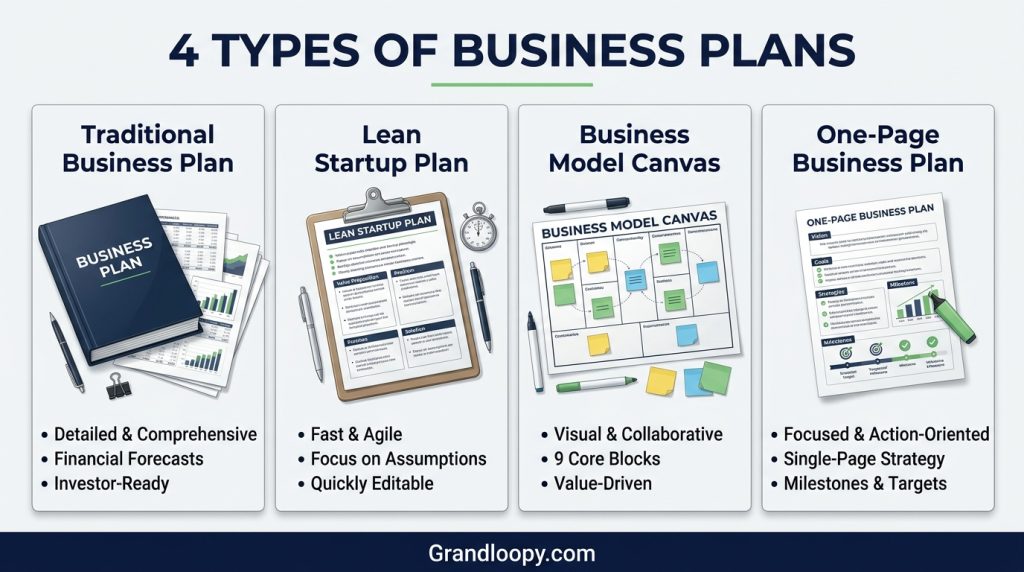
All business plans cover similar categories, but the style and function depend on how the plan will be used, so the format should follow the audience.
Four formats cover almost every situation: traditional, lean startup, Business Model Canvas, and one-page plan.
Most founders write the lean version first, then expand it into a traditional plan when a lender, investor, or grant committee needs to read it.
| Format | Length | Best audience | Best use |
|---|---|---|---|
| Traditional business plan | 10 to 50 pages | Banks, SBA lenders, investors | Loans, investment, grants |
| Lean startup plan | One page | Founder, cofounders, internal team | Fast decisions, early validation |
| Business Model Canvas | One page, nine boxes | Founder, team, workshop groups | Exploring an idea, mapping connections |
| One-page business plan | One page | Founder, small team | Internal management, idea testing |
Length figures in the table come from the competitors named in the research, and they vary by business complexity and reader expectations.
Traditional Business Plan
The traditional business plan is a formal document meant for external purposes, typically required when applying for a business loan or pitching to investors.
It follows a standard outline with executive summary, market analysis, and financials, and it can range from 10 to 50 pages depending on complexity.
A traditional plan takes the most work upfront, but it gives lenders and investors the detail they need to make a decision without follow-up questions.
Start with the traditional format when funding is needed immediately and the founder already has a solid handle on the business information.
Lean Startup Plan (One-Page)
The lean startup plan focuses on summarizing only the most important points, and it can take as little as one hour to make, according to the SBA.
Lean plans use charts built from a handful of elements, and the SBA lists nine lean components, from key partnerships to revenue streams.
A lean plan fits founders who plan to change and refine the business regularly, because it is fast to rewrite when assumptions change.
A lean plan is a thinking tool for founders and early teams, not a fundraising document, so it should be expanded before it goes to a lender.
Business Model Canvas and Lean Canvas
Canvas formats replace a linear, copy-heavy document with a cell-based layout that maps connections between every element of the business.
The Business Model Canvas has nine boxes: key partners, key activities, key resources, value proposition, customer relationships, channels, customer segments, cost structure, and revenue streams.
A canvas is faster to write and easier for teams to visualize, which makes it ideal for exploring a business idea for the first time.
Canvas formats work best in workshops and early ideation, where the team needs to see how the parts connect before writing full sections.
One-Page Business Plan Versus Lean Plan
The one-page business plan is the middle ground between a canvas and a traditional plan, hitting all the core aspects in a simplified format.
It uses bullet points and single sentences that are easy to expand later, which makes it useful for validating a business model or managing day-to-day operations.
The difference from a lean plan is mostly one of layout: the lean plan is often a chart of nine elements, while the one-page plan reads as short written sections.
Either one-page format works for internal use, and the choice comes down to which layout the founder will actually reopen and update.
What Does a Business Plan Include? The SBA Sections

The content of a business plan should include anything that helps the reader use it effectively, but investors and lenders expect certain sections to appear.
The SBA is the standard source for the section list, and its guidance is the one lenders and investors know best.
The SBA guide is available on the SBA plan your business page, which also offers two fictional example plans to download.
The 8 Versus 9 Sections Question, Explained
Some current guides report that the SBA lists eight sections, after a September 2026 update to the SBA guidance page.
Older versions of the same SBA page and most textbooks list nine sections, adding an appendix as the ninth.
The appendix did not disappear as a concept: supporting documents still belong at the end of a plan, whether or not they are numbered as a section.
Readers should check the SBA page itself for the current list, because third-party guides disagree and the SBA page is the source that decides.
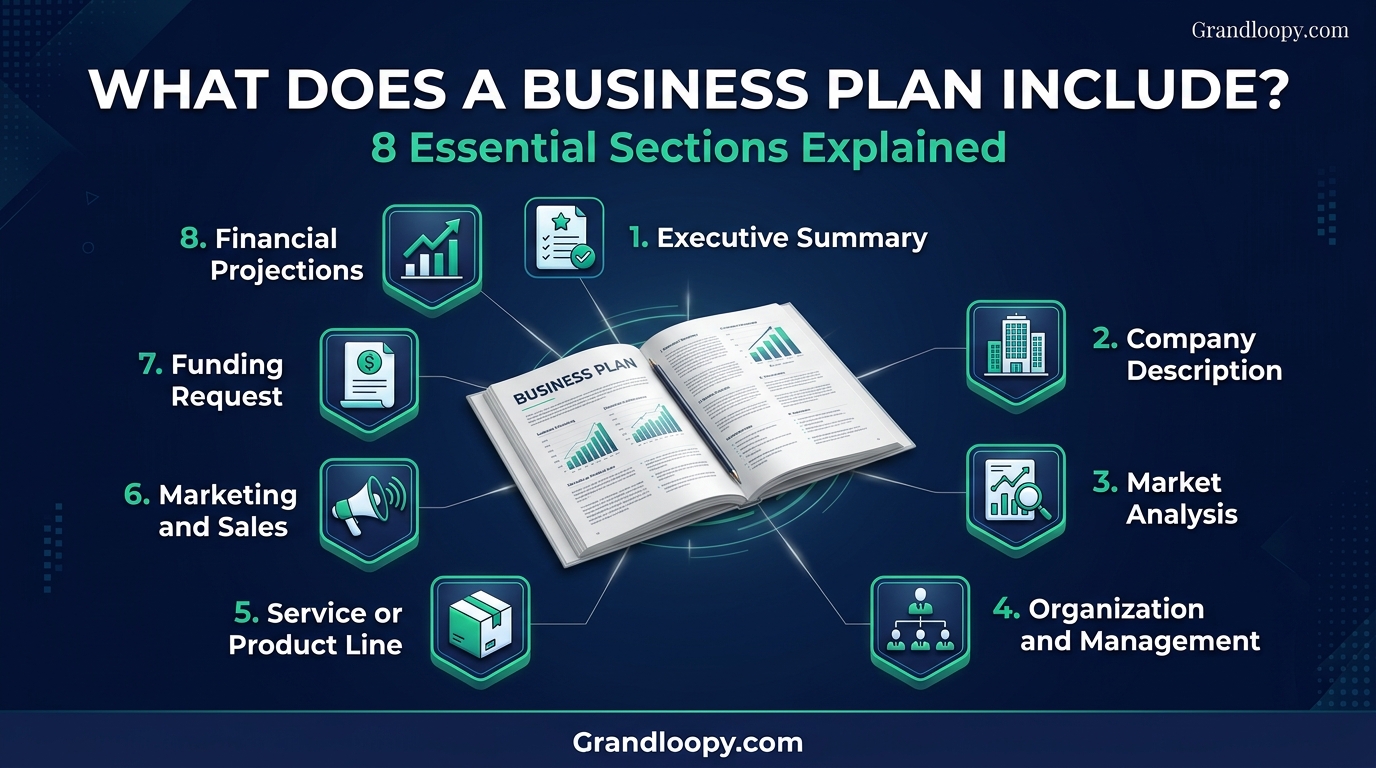
The eight core sections below follow the current SBA list, with the appendix covered as a supporting section at the end.
| Section | What it does | Length |
|---|---|---|
| Executive summary | Overviews the whole plan in one place | One to two pages |
| Company description | Explains the business, problem, and advantage | One to two pages |
| Market analysis | Shows industry, customers, and competition | Two to three pages |
| Organization and management | Shows structure, team, and ownership | One to two pages |
| Service or product line | Describes what is sold and why it wins | One to two pages |
| Marketing and sales | Explains how customers are reached and kept | One to two pages |
| Funding request | States how much money is needed and why | One page |
| Financial projections | Shows the numbers for the next five years | Two to three pages |
| Appendix | Holds supporting documents and detail | As needed |
Length figures in the table are working guides, not SBA rules, and the right length is the one that answers the reader questions without padding.
Executive Summary
The executive summary is a standalone overview of the business and the overall plan, complete enough that anyone can understand the strategy from this section alone.
It should cover the problem being solved, the product or service, the target market, the organization, a financial summary, and any funding requirements, according to the SBA.
The executive summary is the most important section for a lender, because it is the first thing read and it decides whether the rest gets read at all.
Write the executive summary last, even though it appears first, because it can only summarize a plan that already exists.
Company Description
The company description gives a closer look at how the business will function, including the opportunity, the solution, and the customers served.
It should name the problem the business solves and the people it serves, and it should list competitive advantages such as experts on the team or a strong location.
Include the legal structure, the location, and a short history when the business already exists, plus short-term and long-term goals for growth.
The SBA offers two fictional example plans that show the section in practice: Rebecca, who owns a consulting firm, and Andrew, who owns a toy company.
Market Analysis
A market analysis is a qualitative and quantitative assessment of the market being entered, covering the industry state, the ideal customers, and competitor positions.
It should answer four questions: who buys, why now, what alternatives buyers already use, and why this business can win.
Include industry outlook, target market, and competitive analysis, with trends, market size, and pricing evidence where it exists.
The SBA market research questions cover demand, market size, income range, employment rate, location, market saturation, and pricing, which is a useful checklist for the section.
Organization and Management
This section describes the legal structure, the team, and any staffing gaps, with the location, ownership information, and business history as relevant.
State the legal structure clearly: sole proprietorship, partnership, limited liability company, or C or S corporation.
The Internal Revenue Service explains the tax differences between these structures, so founders should check the IRS guidance before choosing.
Add an organizational chart showing who is in charge of what, and consider attaching resumes of key team members in the appendix.
The section matters most when pitching to investors, because the team is often the deciding factor in an early-stage funding decision.
Service or Product Line
Use this section to detail the offerings and any market differentiators such as copyrights, patents, or proprietary processes.
Describe what is sold, how it benefits customers, and what its lifecycle looks like, from launch through growth to replacement.
Explain pricing, product lifespan, and unique consumer benefits, plus production and manufacturing processes where they matter.
Include research and development information when the product is still being built, because investors want to know what is finished and what is not.
Marketing and Sales
Detail how the business will reach its target market: sales activities, pricing strategy, and marketing approach.
Include branding elements, sample campaigns, or messaging when they exist, because they show the reader the plan is real, not theoretical.
A SWOT analysis is useful here, showing how the business will leverage strengths and respond to competitive threats.
A common SBA-cited guideline puts marketing at 7 to 8 percent of gross revenue, which gives the founder a starting point for the marketing budget.
Funding Request
The funding request states how much money is needed over the next five years, whether the founder wants debt or equity, the terms desired, and how long the request covers.
It should explain what the money will be used for and the expected return on investment, in plain numbers rather than promises.
For an SBA loan, the funding request is one of the two sections that decide most applications, alongside the financial projections.
The funding request belongs in the plan only when funding is actually being sought; an internal plan can skip it entirely.
Financial Projections
The financial plan is arguably the most critical section, because it demonstrates viability to investors and gives the founder a baseline to measure against.
The SBA asks for a prospective financial outlook for the next five years, including forecasted income statements, balance sheets, cash flow statements, and capital expenditure budgets.
Year one should show monthly or quarterly detail, because lenders want to see when cash gets tight, not just the annual total.
Established businesses should include three to five years of historical statements, while new businesses provide the five-year outlook instead.
Keep categories simple and lean on assumptions that can be justified, because the assumptions will be questioned before the totals are believed.
Appendix
The appendix holds supporting detail, documentation, or extended notes that back up other sections of the plan.
Common appendix items include credit histories, resumes, product pictures, letters of reference, licenses, permits, patents, and legal documents, according to the SBA guidance.
Do not worry about filling the appendix at first; add only material that genuinely helps readers understand the business better.
Any crucial element, such as a patent application, can be referenced in the main document and included in full in the appendix.
How Long Should a Business Plan Be?
Length follows the reader, not a page target, and the right length is the one that answers the reader questions without making them work to find the answers.
A one-page or lean plan can be completed in under an hour and is often enough for internal use, early-stage validation, or ongoing management.
A traditional plan written for a bank loan or investor pitch typically runs 10 to 20 pages of narrative, plus financials, according to LivePlan.
Investopedia recommends gathering the basic information into a 15- to 25-page document, with additional material referenced and included as appendices.
| Reader | Typical length | What they read first |
|---|---|---|
| Bank or SBA lender | 20 to 30 pages plus financial appendices | Executive summary, use of funds, DSCR |
| Investor | 15 to 25 pages behind a pitch deck | Executive summary, market, team, financials |
| Internal team | One to five pages | Goals, milestones, financial baseline |
| Grant committee | 15 to 30 pages | Need, plan, budget, impact |
| Immigration reviewer | Often longer than the rest | Checklist items, job creation, investment |
Length figures in the table come from the competitor guides named in the research, and they are working guides, not official requirements.
Longer Is Not Better
Lenders and investors are experienced readers, and a 50-page plan that buries the key numbers in dense prose works against the founder.
Padding is actively harmful: reviewers skim, and a plan that hides the cash flow statement on page 34 gets read worse than a tight one that puts it on page 12.
Guidant Financial notes that even a thorough plan only needs to be seven to ten pages for many SBA loan applications, before financial appendices.
Cut everything that does not help a specific reader make a decision, and move supporting detail to the appendix.
How to Write a Business Plan, Step by Step
Write the plan in the order that fits the work, not the order it will be read, because the executive summary can only be written last.
Most weak plans are written narrative-first with numbers attached at the end, which is why their sections contradict each other.
The steps below follow the order the research recommends, and the full nine-step version is available in the guide to how to write a business plan on this site.
- Choose your format and audience. Pick traditional for a lender, lean for internal use, and canvas for early exploration.
- Build the financial model first. Work out pricing, costs, and cash flow before writing the story around them.
- Write the market analysis. Define the customer, size the market, and name the competitors.
- Write the company and product sections. Explain the problem, the solution, and the advantage.
- Write the funding request and use of funds. State the amount, the use, and the repayment plan.
- Write the executive summary last. Compress the finished plan into one or two pages.
- Get a review. Ask a SCORE mentor or a Small Business Development Center advisor to read it for free.
Step 1: Choose Your Format and Audience
Start with the reader, not the company: a lender needs a traditional plan, while a cofounder needs a lean plan.
The SBA says most business plans are either traditional or lean startup, and the choice should follow the immediate need.
A traditional plan is the most common and detailed format, and it is the one lenders and investors usually ask for.
Step 2: Build the Financial Model First
Build the financial model first, or at least in parallel with the narrative, because the numbers decide whether the story is believable.
Work out pricing, unit costs, and monthly cash flow for year one, then write the sections that explain those numbers.
If the first twelve months of revenue cannot be explained line by line, the plan is not done, no matter how polished the writing looks.
Step 3: Write the Market Analysis
Research the market before writing about it, because the market analysis is where weak plans are exposed fastest.
Answer who buys, why now, what alternatives exist, and why this business wins, with numbers from real sources where they exist.
Use the SBA market research questions as a checklist: demand, market size, income range, employment rate, location, saturation, and pricing.
Step 4: Write the Company and Product Sections
Write one sentence for what is sold, to whom, and why they switch, then expand that sentence into the company description.
List the customer segment as precisely as possible: industry, company size, buyer title, geography, and buying trigger.
Describe the offer in operational terms: product or service, pricing model, delivery model, and gross margin logic.
Step 5: Write the Funding Request and Use of Funds
State how much money is needed, what it is for, and how it gets repaid, in a table the lender can read in seconds.
The use of funds table is covered in the lender section below, with a worked example the founder can copy.
Step 6: Write the Executive Summary Last
The executive summary is a one-page overview of the whole plan, and it should be written after every other section is done.
Include the mission statement, the product or service, basic facts about the leadership team, employees, and location, plus financial information when funding is sought.
Keep it under two pages, because the summary exists to earn a reading of the rest, not to replace it.
Step 7: Get a Review
SCORE mentors and Small Business Development Center advisors will review a business plan at no cost, and they see hundreds of plans a year.
A review catches the mistakes the founder cannot see: unrealistic projections, missing sections, and claims without evidence.
Ask for the review before the plan goes to a lender, because a lender rejection is harder to undo than a mentor comment.
Financial Projections: What Lenders Actually Check
Financial projections are the section lenders read hardest, because the numbers decide whether the business can repay a loan.
Two numbers decide most SBA loan applications: the debt service coverage ratio and the use of funds, and neither appears in most definition guides.
The SBA lending rulebook is SOP 50 10 8.1, in effect since October 1, 2026, and it requires lenders to conduct a thorough credit analysis that includes a review of the business plan.
An earlier version, SOP 50 10 8, took effect June 1, 2025, so founders should confirm which version their lender follows.
Debt Service Coverage Ratio, Worked Example
The debt service coverage ratio compares the cash a business generates to the loan payments it has to make, and the formula is net operating income divided by annual debt payments.
Take a business with 120,000 dollars of net operating income a year and 96,000 dollars of annual loan payments.
Divide 120,000 by 96,000 and the DSCR is 1.25, which means the business generates 25 percent more cash than its loan payments need.
Many SBA lenders look for a DSCR of 1.25 or higher, according to lender guidance reported by PlanArmory, because the margin covers a bad month.
A DSCR below 1.0 means the business does not generate enough cash to pay the loan, and the application will almost certainly be declined.
Founders should show the DSCR calculation in the plan itself, with the assumptions stated, rather than leaving the lender to work it out.
| Line | Amount |
|---|---|
| Net operating income (year) | 120,000 dollars |
| Annual debt payments | 96,000 dollars |
| DSCR (120,000 divided by 96,000) | 1.25 |
| Cash cushion above loan payments | 24,000 dollars |
The figures in the table are a worked example, not a rule, and the founder numbers must come from the business own projections.
Use of Funds and Equity Injection, Worked Example
The use of funds table shows exactly what the loan money buys, and lenders read it before they read the narrative.
Take a 200,000 dollar project funded with a 150,000 dollar loan and 50,000 dollars of owner money: the loan covers 75 percent and the owner covers 25 percent.
The owner money is called the equity injection, and it shows the lender that the founder has skin in the game.
Lenders check two things in this table: that the uses add up to the total project cost, and that the owner share is real money, not a promise.
| Use | Loan | Owner equity | Total |
|---|---|---|---|
| Equipment | 80,000 dollars | 20,000 dollars | 100,000 dollars |
| Leasehold improvements | 40,000 dollars | 10,000 dollars | 50,000 dollars |
| Initial inventory | 20,000 dollars | 10,000 dollars | 30,000 dollars |
| Working capital | 10,000 dollars | 10,000 dollars | 20,000 dollars |
| Total project | 150,000 dollars | 50,000 dollars | 200,000 dollars |
The figures in the table are an illustrative example, and the real split depends on the lender program and the project.
SBA 7(a) loans go up to 5 million dollars, while SBA Express loans go up to 500,000 dollars.
The guarantee is up to 85 percent on loans of 150,000 dollars or less, and up to 75 percent above that.
Break-Even Analysis
Break-even analysis shows how much must be sold before the business starts making money, and it is the simplest check a lender runs.
The formula is monthly fixed costs divided by the contribution per unit, where contribution is price minus variable cost per unit.
Take a business with 5,000 dollars of monthly fixed costs, a 50 dollar price, and a 30 dollar variable cost: the contribution is 20 dollars per unit.
Divide 5,000 by 20 and the break-even point is 250 units a month, which tells the founder exactly what sales must reach.
Cash flow matters as much as profit, because a business can be profitable on paper and still run out of cash between invoice and payment.
Faster payments change that timing, and the guide to how instant payments change small business cash flow explains the effect on the cash gap.
Payment terms are often counted in business days, not calendar days, so the guide to what business days are helps founders read invoice terms correctly.
Business Plan Versus Business Model Versus Pitch Deck
Three documents get confused constantly, and each one has a different job, so the comparison below settles the question.
A business model describes how the company creates and captures money, and it is the engine of the business.
A business plan contains the business model plus everything else: market analysis, operational structure, team, milestones, and financial projections, which makes it the full vehicle.
A pitch deck is a short visual presentation, usually about ten slides, used in a meeting to win interest, while the plan is the document that backs it up.
| Aspect | Business model | Business plan | Pitch deck |
|---|---|---|---|
| Definition | How the business creates, delivers, and captures value | Detailed document on how the business operates and reaches goals | Short visual presentation for a meeting |
| Purpose | Outline the strategy for generating revenue | Roadmap for operations, financing, and growth | Win interest and a follow-up meeting |
| Focus | Value proposition, customers, revenue streams, costs | Market, operations, financials, organization | Problem, solution, market, team, ask |
| Length | One to two pages | 10 to 50 pages | About ten slides |
| Audience | Founder, team | Lenders, investors, partners, team | Investors, partners |
| Timeframe | Long-term, conceptual | Three to five years with milestones | Current pitch, near-term ask |
Guy Kawasaki popularized a ten-slide pitch deck structure: problem, solution, business model, underlying magic or technology, marketing and sales, competition, team, projections and milestones, status and timeline, and summary and call to action.
The business model comes first in the journey, because the plan cannot be written until the model is clear.
Subscription revenue is one model founders increasingly choose, and the guide to why small businesses offer subscription services explains the appeal and the risks.
Can AI Write a Business Plan?
AI tools can now produce a passable business plan draft in minutes, and that is genuinely useful for getting structure on the page.
AI can help generate section content, brainstorm ideas, and draft financial tables, which saves hours of blank-page work.
But AI output requires significant review and validation before it goes to a lender or investor, because the numbers and the market claims must be real.
What AI Does Well
AI is good at structure: it can produce a clean outline, draft each section heading, and suggest what belongs in each part.
AI is good at first drafts: it can turn a short description of the business into readable paragraphs in seconds.
AI is good at brainstorming: it can suggest pricing models, marketing channels, and risks the founder had not considered.
Founders who want to earn with AI tools should read the guide to how to make money with AI, which covers twelve real ways that pay in 2026.
What Lenders and Investors Probe
Lenders and investors are not evaluating the document itself: they are evaluating the founder understanding of the market, the credibility of the financial assumptions, and the ability to identify and address risk.
An AI-generated plan that has not been interrogated by the person running the business will fall apart under basic due diligence questions, because the founder cannot defend numbers they did not build.
AI tools often produce tables that look like financial forecasts but struggle to forecast cash flow properly and to connect the profit and loss statement to the balance sheet.
Market analysis needs to reflect the actual competitive landscape, and AI output often invents competitors, prices, or market sizes that do not exist.
How to Validate AI Output
Use AI as a drafting and thinking partner, then do the work of validating, refining, and owning every claim in the plan using a dedicated planning tool.
Check every number against a real source: market size against industry reports, prices against competitors, and costs against supplier quotes.
Rebuild the financial model by hand, even if AI drafted it, because the founder must understand every assumption before a lender asks about it.
Have a SCORE mentor or SBDC advisor read the finished plan, because a human reviewer catches the confident-sounding errors AI makes.
Common Business Plan Mistakes
Seven mistakes account for most rejected plans and most wasted effort, and every one of them is avoidable.
- Writing no plan at all. The biggest mistake is never writing one, because the thinking is the value, not the document.
- Writing the plan and never looking at it again. A plan that sits in a drawer cannot guide decisions or catch problems early.
- Unrealistic projections. Numbers that assume instant growth with no evidence are the fastest way to lose a lender.
- No market evidence. Claiming a large market without naming customers, competitors, or prices is not analysis.
- Burying the key numbers. Hiding the cash flow statement deep in the document makes reviewers stop reading.
- Copying a generic template. A plan that could belong to any business tells the reader nothing about this one.
- Ignoring the DSCR and use of funds. Lender applications fail on these two numbers more than on any narrative section.
What to Leave Out of a Business Plan
Leave out personal information that does not help the reader judge the business, such as family details or unrelated history.
Leave out unverified claims about market size, growth, or competitors, because one invented number damages the credibility of every real number.
Leave out jargon that hides weak thinking, because clear plain language shows understanding better than buzzwords.
Leave out sections that do not apply to the business: the SBA itself says to use the sections that make sense and remove the rest.
How Much Does a Business Plan Cost?
A business plan costs nothing to write by hand, and thousands of dollars to hire out, so the right choice depends on the audience and the budget.
Four routes cover the range: do it yourself, use a free template, use planning software, or hire a professional writer.
| Route | Typical cost | Time needed | Best for |
|---|---|---|---|
| Do it yourself | 0 dollars | Days to weeks | Founders with time and basic skills |
| Free template | 0 dollars | Hours to days | Founders who want structure fast |
| Planning software | About 10 to 30 dollars a month | Hours to days | Founders who want guided financials |
| Hired writer | About 1,000 to 5,000 dollars | Weeks | Complex plans, investor-grade documents |
Cost figures in the table are typical ranges reported by competitor guides, and actual prices vary by provider and plan complexity.
Hidden Costs Founders Forget
Business insurance is a cost many new plans omit, and the guide to how much business insurance costs breaks down prices by policy type.
Invoice and payment tools are another omitted cost, and the guide to why small businesses switch to digital invoices explains the shift and the savings.
Market research, legal structure, and licensing fees also belong in the startup costs, because a plan that omits them understates the funding need.
A hired writer does not remove the founder work: the founder must still supply the market facts, the pricing, and the financial assumptions.
How Often Should You Update Your Business Plan?
A business plan should be reviewed and updated periodically to reflect achieved goals or changes in direction.
A well-established business might review its plan once a year and make changes if necessary, according to Investopedia.
A new or fast-growing business in a fiercely competitive market might revise it more often, such as quarterly, for the same reason.
Review the plan whenever a milestone is hit, a major customer is won or lost, or the market shifts, because those events change the assumptions underneath the numbers.
Monthly, Quarterly, and Annual Review Checklist
Monthly, compare actual revenue and cash flow against the projections, and note where the plan was wrong.
Quarterly, revisit the market analysis and the competitive position, because competitors, prices, and customer needs move fast.
Annually, rewrite the goals and milestones for the next year, and decide whether the plan still matches the business being run.
An established business moving in a new direction might even create an entirely new plan, rather than patching the old one.
Business Plan Examples by Industry
Every industry plan follows the same sections, but the emphasis changes, and the examples below show where each type spends its pages.
The SBA example plans show the structure in practice: Rebecca, who owns a consulting firm, and Andrew, who owns a toy company.
Restaurant Business Plan
A restaurant plan spends its pages on location, menu pricing, and food costs, because those three decide survival.
Include the lease terms, the kitchen equipment list, and the staffing plan, plus a break-even analysis in covers per day, not just dollars.
Health and safety licenses belong in the appendix, with the permits listed by name and expiry date.
SaaS Business Plan
A software plan spends its pages on customer acquisition cost, lifetime value, and churn, because those three numbers decide whether the model works.
Include pricing tiers, the free trial or freemium logic, and the sales motion, plus monthly recurring revenue projections for the first two years.
Show the unit economics clearly: if acquiring a customer costs more than the customer is worth, no amount of growth fixes the plan.
E-Commerce Business Plan
An online store plan spends its pages on product sourcing, fulfillment, and return rates, because those decide the margin.
Include the platform choice, the shipping and returns policy, and the advertising channels, with cost per acquisition for each channel.
Show how returns and free shipping affect the margin, because both are easy to promise and expensive to deliver.
Service Business Plan
A service business plan spends its pages on the team, the hourly or project rates, and the client pipeline, because people are the product.
Include the service packages, the delivery process, and the client acquisition plan, plus utilization rates for billable staff.
Show what happens when a key person leaves, because a service business that depends on one person is a risk a lender will ask about.
Founders still choosing between a business and a smaller start should read the guide to how to start a small business, which reorders the ten steps by what actually decides survival.
Frequently Asked Questions
What is a business plan?
A business plan is a written document that describes what a business does, who it serves, how it makes money, and where it is headed.
What is a business plan in simple words?
A business plan is a written guide that explains what a business does, how it makes money, who its customers are, and how it plans to grow.
What are the parts of a business plan?
The main parts are the executive summary, company description, market analysis, organization and management, service or product line, marketing and sales, funding request, and financial projections, plus an appendix for supporting documents.
What are the 9 sections of a business plan?
Older SBA guidance and most textbooks list nine sections, adding an appendix to the eight core sections, while some current guides report eight sections after a September 2026 SBA update.
What is the purpose of a business plan?
A business plan serves two purposes: internally it acts as a roadmap for goals and decisions, and externally it shows lenders, investors, and partners that the business is viable.
Do I need a business plan to start a business?
Legally no, a business can be registered and operated without one, but a plan is almost always required for a bank loan, outside investment, most grants, or bringing on a partner.
Is a business plan legally required?
No, there is no general legal requirement to have a business plan, although some federal programs, such as the SBA 8(a) program, require one.
How long should a business plan be?
It depends on the reader: a bank or SBA package typically runs 20 to 30 pages plus financial appendices.
An investor plan runs 15 to 25 pages, and an internal plan can be as little as one page.
How long does it take to write a business plan?
A one-page plan can be completed in 30 minutes to an hour, while a full traditional plan with market research and financial projections typically takes several days to a few weeks.
How much does a business plan cost?
Writing it yourself costs nothing, a free template costs nothing, planning software costs about 10 to 30 dollars a month, and hiring a professional writer typically costs 1,000 to 5,000 dollars.
How do you write a business plan step by step?
Choose the format, build the financial model first, write the market analysis, then the company and product sections, followed by the funding request, and write the executive summary last.
What should a business plan include?
A business plan should include the executive summary, company description, market analysis, organization and management, service or product line, marketing and sales, funding request, and financial projections, with an appendix for supporting documents.
What is the most important part of a business plan?
The executive summary is the most important part for a lender, because it is read first and decides whether the rest gets read.
The financial projections are the most important part for proving the business can repay funding.
What is the difference between a business plan and a business model?
A business model describes how a company creates and captures money, while a business plan contains the business model plus market analysis, operations, team, milestones, and financial projections.
What is the difference between a business plan and a pitch deck?
A pitch deck is a short visual presentation of about ten slides used in a meeting, while a business plan is the detailed document that backs it up.
What is a lean business plan?
A lean business plan is a one-page plan that summarizes only the most important points, built from nine elements including key partnerships, value proposition, customer segments, and revenue streams.
What is a traditional business plan?
A traditional business plan is a formal, detailed document of 10 to 50 pages, following the standard SBA outline, and it is the format banks and investors usually require.
What is a one-page business plan?
A one-page business plan is a simplified plan that hits all the core aspects of the business in bullet points and single sentences, useful for internal management and early validation.
What is a Business Model Canvas?
The Business Model Canvas is a one-page template with nine boxes that maps key partners, activities, resources, value proposition, customer relationships, channels, customer segments, cost structure, and revenue streams.
What is an executive summary?
An executive summary is a standalone overview of the business and the overall plan, covering the problem, product or service, target market, organization, financial summary, and funding needs in one to two pages.
What goes in the market analysis section?
The market analysis covers the industry outlook, target market, and competitive analysis, answering who buys, why now, what alternatives exist, and why this business can win.
What are financial projections in a business plan?
Financial projections are forecasted income statements, balance sheets, cash flow statements, and capital expenditure budgets for the next five years, with monthly or quarterly detail in year one.
What is a debt service coverage ratio?
The debt service coverage ratio compares the cash a business generates to its loan payments, calculated as net operating income divided by annual debt payments, with many SBA lenders looking for 1.25 or higher.
What is a use of funds table?
A use of funds table shows exactly what loan money buys, split between the loan and the owner equity, so the lender can see that the uses add up to the total project cost.
Can I use AI to write a business plan?
Yes, AI can draft structure and first-draft content quickly, but the output needs significant review and validation, and the founder must be able to defend every number and market claim.
Conclusion
What is a business plan? It is the document that turns an idea into a business a lender, an investor, and a team can believe in.
The plan covers four things: what the business does, who it serves, how it makes money, and where it is headed.
The SBA sections give the structure, the financial model gives the proof, and the DSCR and use of funds give the lender the numbers that decide funding.
Start with the lean version today, expand it when a reader needs the full document, and review it every quarter, because a plan that is never reopened cannot guide anything.
Read the nine-step writing guide on this site next, then download the SBA example plans, and write the first draft this week while the idea is fresh.