Are Jeans Business Casual? The Honest Answer, Plus How to Wear Them to Work
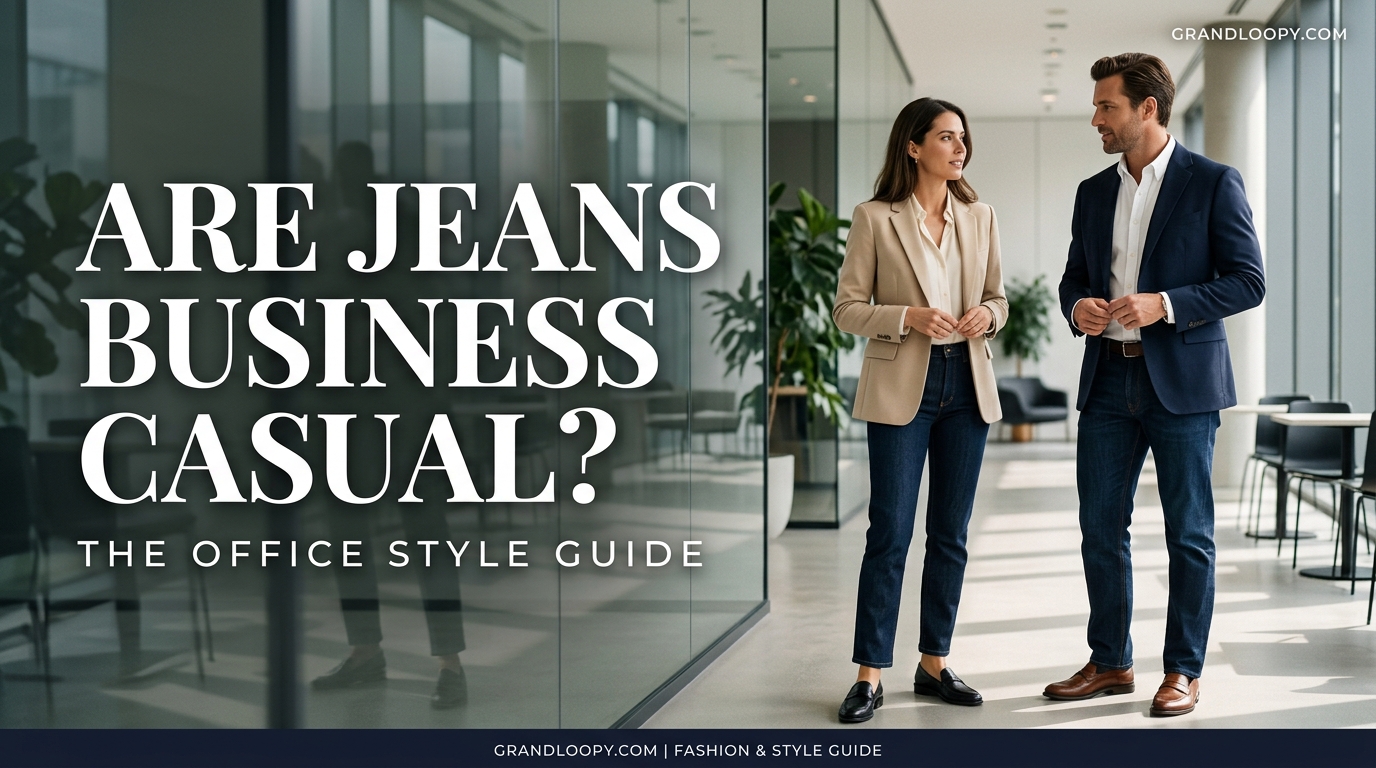
Are jeans business casual? Yes, they can be, but only when the jeans are dark, clean, and well-fitting, and only where the workplace allows denim.
The four factors that decide the answer are fit, wash, styling, and the company dress code. Get all four right, and dark jeans with a blazer look as sharp as dress pants.
Get any one wrong, and the same jeans read as weekend wear. Ripped, faded, or baggy denim belongs at home, not in the office.
The verdict comes first, then the wash and fit rules, the styling formulas for men and women, the shoe guide, and the days to leave jeans at home.
The Short Answer
Jeans can be business casual when the denim looks polished and the overall outfit looks professional. That is the rule in one sentence.
The safest pair is dark indigo or black denim in a straight or slim cut, free of rips and fading, worn with a collared shirt or blazer and leather shoes.
The workplace decides the rest. A tech startup may welcome denim every day, while a law firm may consider even the most polished jeans inappropriate.
When in doubt, check the handbook, look at what colleagues wear, or ask HR before you wear jeans to work.
| Question | Short answer |
|---|---|
| Are jeans business casual? | Yes, when they are dark, clean, and well-fitting, and the workplace allows denim. |
| Which jeans are safest? | Dark indigo or black denim, straight or slim cut, no rips, no fading. |
| What should you wear with them? | A collared shirt or blazer, plus leather shoes such as loafers or oxfords. |
| When should you skip jeans? | Interviews, client meetings, board meetings, and formal industries such as law and banking. |
| Are ripped jeans business casual? | No, ripped, distressed, and heavily faded jeans are never business casual. |
What Does Business Casual Actually Mean?

Business casual sits between formal officewear and everyday casual clothing. It is pulled together, but not formal.
Typical business casual clothing includes collared shirts, blouses, chinos, tailored trousers, cardigans, fine-knit sweaters, blazers, and leather shoes.
Clean, well-fitting denim joins that list only where the workplace permits it. The jeans are the exception, not the rule.
The goal is balance. One relaxed item works well when the rest of the outfit adds structure and polish.
Dark straight-leg jeans plus a crisp shirt plus loafers generally look more business casual than faded jeans plus a graphic tee plus athletic sneakers.
The difference is not simply the jeans themselves. It is the complete outfit, and the complete outfit is what a dress code judges.
Business casual used to mean khakis and a button-down shirt, and that was all. Workplaces have changed a lot since then, and the lines have blurred.
Tech companies and startups often embrace a more relaxed dress code, making jeans a common sight. Traditional industries such as finance and law have moved far more slowly.
Understanding the workplace interpretation of business casual matters more than any single rule about denim. The same outfit can pass in one office and fail in another.
When Are Jeans Business Casual?
Jeans qualify as business casual when several details work together. No single detail is enough on its own.
The wash must look refined. Dark indigo, deep navy, black, and clean charcoal denim are easier to style for work than heavily faded or bleached jeans.
The fit must look intentional. A straight or slim cut holds a clean line from the seat to the shoe, and the hem breaks neatly over the shoe rather than pooling at the ankle.
The condition must be clean. No rips, no holes, no heavy fading, no sandblasting, and no whiskering at the hips. The fabric should look like fabric, not like a styling project.
The styling must add structure. A collared shirt, a blazer, or a fine-knit sweater lifts the denim into business casual territory, while a graphic tee drags it back to casual.
The workplace must allow it. A written policy, a manager, or a colleague can settle the question faster than any style guide can.
One useful test is the trouser test. The more a pair of jeans looks like a dark trouser at conversational distance, the more confidently it belongs in a business casual rotation.
Another useful principle is that the jeans should be the most casual element in the outfit.
If the jeans are tied for most casual with the shirt and the shoes, the outfit reads casual, not business casual.
Jeans rarely fail on their own. They fail when they are the most casual thing in an outfit that was already casual everywhere else.
The Wash: Which Colors Work
Color changes how much of the workwear character of denim comes through. Dark indigo gets closest to the visual restraint of trousers, particularly beneath a navy jacket.
Darker washes are almost always preferable. They project a more sophisticated and professional image, and they pair easily with the structured pieces business casual requires.
Light washes, distressed denim, and overly embellished jeans are firmly in the casual category. No styling trick rescues them for a business casual office.
Dark indigo
Dark indigo is the safest wash for business casual. It reads as a deep, even blue, and it sits closest to a dress trouser at conversational distance.
Pair dark indigo jeans with a white or light blue Oxford shirt and a navy blazer for the most reliable office outfit denim can build.
Look for an even wash with intact hems and discreet pocket stitching. The finish should be simple, with no fading at the thighs or knees.
Black
Black jeans are an especially useful option for business casual. With a gray blazer and a fine knit, they give office dressing a slightly urban cast.
Black denim works best when the color stays deep and even. Faded black jeans read as washed-out, and washed-out denim reads as casual.
Pair black jeans with a white button-down shirt, a charcoal blazer, and black leather shoes for a clean, monochrome office look.
Medium blue
Medium blue jeans can work in an office that has already made its peace with denim. They are the middle ground, and the middle ground needs the most careful styling.
Choose a clean, refined medium wash with minimal fading and no distressing. Pair it with a structured blazer to keep the outfit on the business side of casual.
Skip medium blue jeans on the first day in a new office, and skip them entirely if the dress code is strict. Darker denim is the safer first step.
Light wash
Light wash jeans are not business casual. They read as weekend wear in almost every office, no matter how they are styled.
The pale color draws the eye to the denim itself, and that is the opposite of what business casual asks for. The jeans should blend in, not announce themselves.
Save light wash jeans for casual Friday in a very relaxed office, or for the weekend. They do not belong in a business casual rotation.
White
White jeans belong to the summer end of the conversation. They look assured with a textured jacket and brown loafers, though they announce themselves more readily than indigo.
White denim needs a spotless finish and a tailored cut to work at the office. Any stain, crease, or baggy fit breaks the look at once.
Treat white jeans as a seasonal exception, not a daily option. Dark denim is the workhorse, and white denim is the summer guest.
| Wash | Business casual? | Best paired with |
|---|---|---|
| Dark indigo | Yes, safest | White Oxford shirt, navy blazer, loafers |
| Black | Yes, very safe | White button-down, charcoal blazer, black leather shoes |
| Medium blue | Yes, where denim is accepted | Structured blazer, collared shirt, leather shoes |
| Light wash | No | Weekend wear only |
| White | Summer exception only | Textured jacket, brown loafers |
| Faded or distressed | No | Never for work |
The Fit: Which Cuts Work
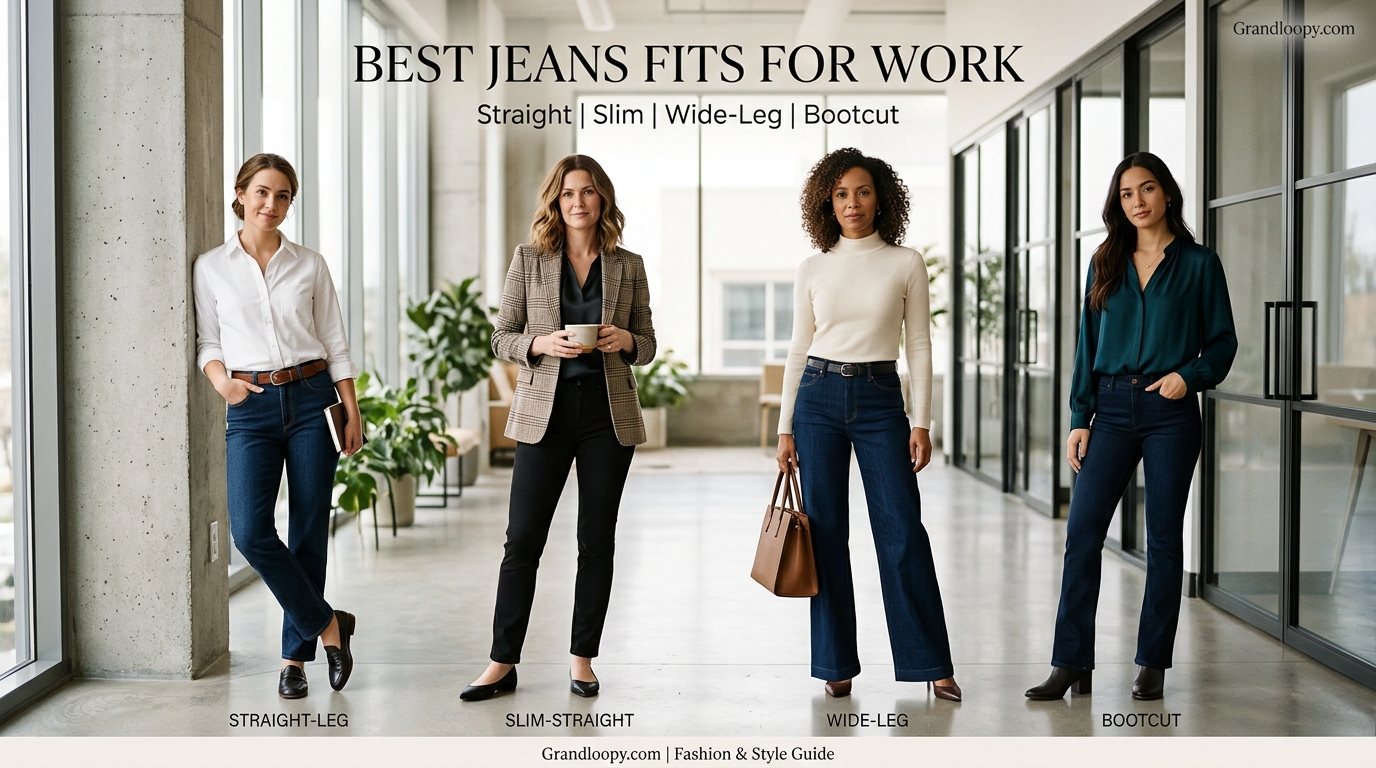
Fit is king in business casual denim. A well-fitting pair of dark jeans can look more professional than a poorly fitting pair of dress pants.
The jeans should skim the body without being too tight or too loose. They should hold a clean line from the seat to the shoe.
Avoid overly baggy or overly tight jeans. Both extremes read as casual, and both break the clean line that business casual requires.
The hem matters as much as the waist. Jeans should break neatly over the shoe rather than pooling at the ankle, and they should never drag on the floor.
Straight-leg
Straight-leg jeans are the safest cut for business casual. They fall in a clean line from the hip to the ankle, and they sit well with tailoring.
Straight legs work for men and women, and they suit most body types. They are the default choice when the dress code is uncertain.
Pair straight-leg jeans with a tucked shirt and loafers for a look that reads as intentional rather than accidental.
Slim and slim-straight
Slim and slim-straight jeans work well for business casual when they are tailored through the seat and thigh without being tight.
The cut should follow the leg without clinging to it. If the fabric pulls at the pockets or the seams, the jeans are too tight for work.
Slim-straight jeans pair well with a blazer and leather shoes, and they are a strong choice for a modern office that accepts denim.
Wide-leg
Wide-leg jeans can work when they are tailored and dark. A structured wide leg in dark indigo reads as deliberate, not sloppy.
The key is the fabric and the length. The jeans should drape cleanly, and the hem should sit just above the shoe rather than pooling.
Pair wide-leg jeans with a fitted blouse or a tucked shirt to balance the volume below. A blazer adds the structure the cut needs.
Bootcut
Bootcut jeans are a classic office choice, and they work well with ankle boots and heels. The slight flare balances the shoe and lengthens the leg.
Choose a dark wash with a clean finish and minimal stitching. The flare should be subtle, not dramatic, and the hem should cover the top of the shoe.
Bootcut jeans suit a traditional office that accepts denim, and they are a strong choice for women who wear heels to work.
Skinny
Skinny jeans read as trendy, and trendy is a risk in a business casual office. On men, skinny jeans often look too casual for work.
On women, a dark skinny jean can work with a long blazer and ankle boots, but the margin for error is small. Any fading or tightness breaks the look.
Choose straight or slim instead when the dress code is uncertain. Skinny jeans are a fashion choice, not a safe work choice.
Baggy and relaxed
Baggy jeans lack the polish that business casual requires. They read as weekend wear, and no blazer rescues them.
Relaxed fits can look sloppy even in dark denim, because the excess fabric breaks the clean line from the seat to the shoe.
Save baggy jeans for the weekend. The office asks for a tailored line, and baggy denim cannot give it.
| Cut | Business casual? | Best for |
|---|---|---|
| Straight-leg | Yes, safest | Men and women, most body types, uncertain dress codes |
| Slim and slim-straight | Yes | Modern offices, blazer pairings, tailored looks |
| Wide-leg | Yes, when tailored and dark | Women, fitted tops, blazer pairings |
| Bootcut | Yes | Ankle boots and heels, traditional offices |
| Skinny | Risky, usually no for men | Women with a long blazer, dark wash only |
| Baggy and relaxed | No | Weekend wear only |
How to Style Jeans for Work
Pairing jeans with the right pieces is crucial for elevating them to business casual status. The jeans themselves are only half the battle.
The rule is simple. When one piece is casual, the other should be structured. Jeans are casual, and a blazer is structured, so that pairing works almost every time.
Dress everything around the jeans up to compensate for the denim. A collared shirt, a blazer, and leather shoes do the heavy lifting.
Three formulas hold up in almost every office that accepts denim. Learn them, and the question of what to wear with jeans to work answers itself.
Formula 1: Jeans plus blazer
Jeans plus a blazer is sharp and office-ready instantly. The blazer adds the structure that denim lacks, and the contrast is the whole point.
Choose a blazer in navy, charcoal, or gray, and pair it with dark indigo or black jeans. A white or light blue shirt underneath keeps the look clean.
Finish with loafers or leather shoes, and add a leather belt that matches the shoes. The outfit reads as intentional from across the room.
Formula 2: Jeans plus button-down shirt
Jeans plus a button-down shirt is clean, classic, and reliable. An Oxford button-down is a natural partner for denim.
Tuck the shirt in and add a belt, because the tucked shirt is what makes the outfit look deliberate rather than thrown together.
Choose classic colors such as white, light blue, or navy. A crisp shirt in a solid color does more for the outfit than any pattern can.
Formula 3: Jeans plus knitwear
Jeans plus knitwear is smart and comfortable for cooler days. A fine-knit sweater layered over a collared shirt is a strong office look.
Choose cashmere or merino wool in a solid color, and keep the knit fine rather than chunky. A chunky knit reads as weekend wear.
Pair the knit with dark jeans and ankle boots or loafers, and add a blazer on top when the day calls for more polish.
Accessories finish the outfit. A leather belt that matches the shoes is essential for men, and a dress watch adds a touch of sophistication.
For women, jewelry should be tasteful and understated. A simple necklace or stud earrings add polish without distracting from the outfit.
Keep the overall look clean. Minimal stitching, subtle hardware, and no large logos keep the denim on the business side of casual.
Business Casual Jeans for Women
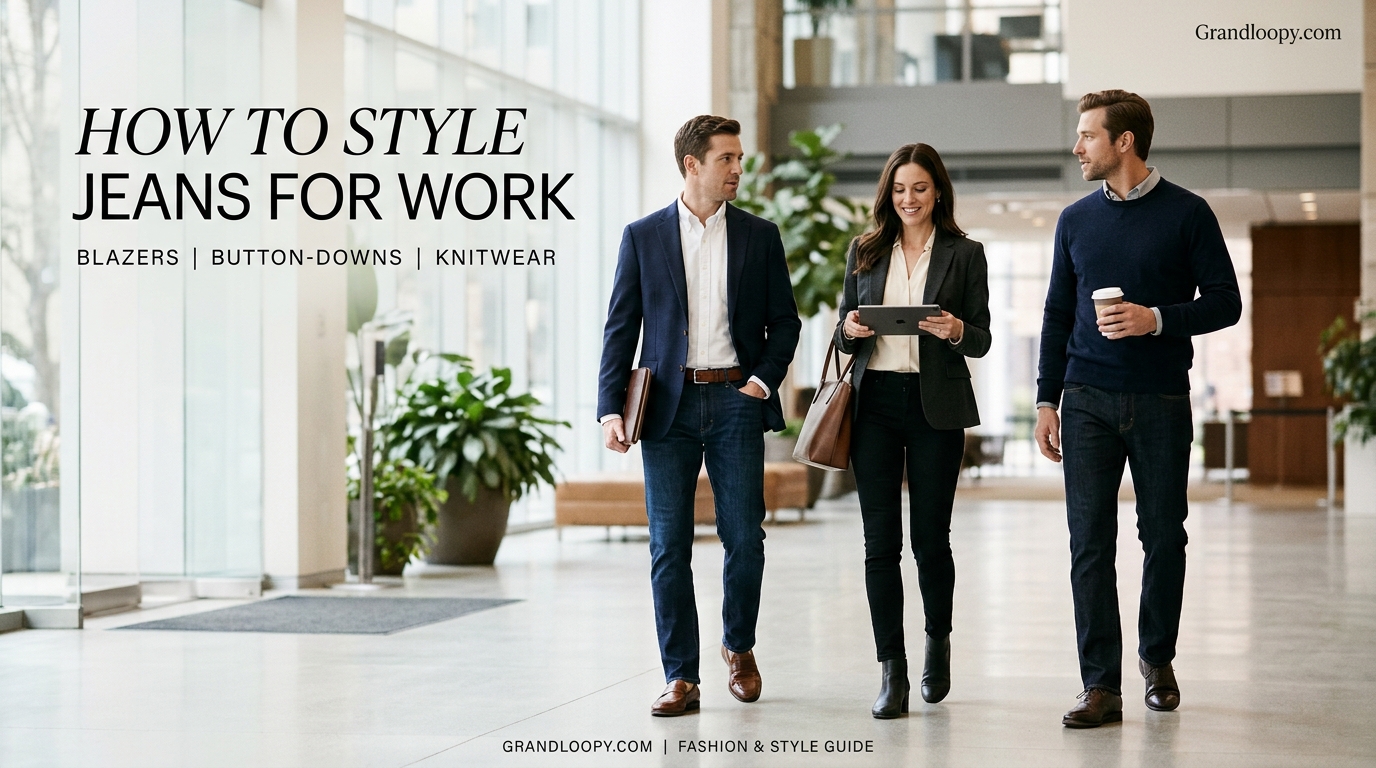
Women have plenty of options for styling jeans for work. The goal is to look like thought went into the outfit, even if it took five minutes to put on.
High-rise and straight-leg cuts are the most flattering in professional settings. They hold a clean line and sit well with a tucked blouse.
Dark wide-leg jeans with a silk blouse and loafers look just as polished as dark straight jeans with an Oxford shirt and boots.
Reliable combinations include jeans plus a blouse plus a blazer, and jeans plus a structured top plus heels or flats. Both give a polished and put-together look.
Blouses in silk, linen, or cotton are excellent choices. A well-fitting blazer or cardigan can instantly elevate the look.
Avoid overly casual tops such as t-shirts, unless they are layered under a blazer, and avoid anything with excessive embellishments or graphics.
Heels, flats, and dressy ankle boots are all suitable options. Pumps, block heels, wedges, loafers, and ballet flats all work with dark jeans.
Distressed jeans were one of the lowest-rated styles for professionalism in a survey of 2,000 UK office workers by Lands’ End, alongside mom jeans and jeggings.
The same survey found that straight-leg and bootcut jeans were considered the smartest options for work. That finding matches the fit rules above.
Finding a personal style helps too, because business casual is a broad dress code and the right jeans depend on the rest of the wardrobe.
Which Fashion Style Am I? LWSpeakFashion Quiz helps readers place their own style before they build a work wardrobe around dark denim.
Business Casual Jeans for Men
Men can absolutely make jeans work in a business casual office, and the rules are the same ones that apply to women: dark wash, clean fit, structured top, leather shoes.
The wash and the clothes around them help determine the answer. Dark-wash denim in a slim or straight fit, free of rips, is the safest starting point.
The appeal is the slight informality jeans bring to office clothes. A shirt looks less corporate, and a sport coat looks less ceremonious, when denim is part of the outfit.
Among the jeans types for men, straight and gently tapered cuts are easy companions for tailoring. They sit well under a blazer and over leather shoes.
The fabric can be pure cotton or have a little stretch. What matters is how it behaves through a day at a desk, not what the label says.
A sport coat gives blue denim enough structure for a smarter working day. An Oxford button-down is a natural partner for denim, and a turtleneck with a checked blazer brings tailoring into the conversation.
Leather dress shoes are the safest bet. Oxfords, loafers, or brogues all work, and clean, minimalist sneakers can work in some very relaxed business casual environments.
Avoid sandals, work boots, and overly casual sneakers. The footwear often decides whether jeans look ready for work, so choose it with care.
Permission to wear jeans on an ordinary Tuesday applies to an ordinary Tuesday. Interviews and client meetings deserve their own check, particularly when someone else’s expectations enter the picture.
What Shoes to Wear
The choice of shoes often decides whether jeans look ready for work. Loafers give denim an easy relationship with tailoring, and leather derbies add a firmer finish.
Shoes are the ground the outfit stands on. The wrong shoes can undo a perfect pair of dark jeans, and the right shoes can lift an average pair.
Shoes for men
Leather loafers are the easiest choice for business casual jeans. They are comfortable, polished, and they sit naturally with a blazer.
Oxfords and derbies add a firmer finish, and they are the right choice for a more formal office that accepts denim.
Clean leather boots work well in cooler months, particularly with straight-leg or bootcut jeans. Work boots do not belong in the office.
Minimalist sneakers can work in a very relaxed business casual environment, but proceed with caution. Athletic sneakers never work.
Shoes for women
Pumps and block heels add polish to dark jeans, and they pair well with a blazer and a blouse for a classic office look.
Loafers and ballet flats are comfortable and polished, and they work with straight-leg, wide-leg, and bootcut jeans alike.
Dressy ankle boots are a strong choice for cooler months, and they pair well with bootcut and straight-leg denim.
Avoid sandals, flip-flops, and athletic sneakers. Open-toed shoes and trainers break the business casual look at once.
| Shoes | Men | Women |
|---|---|---|
| Best | Loafers, oxfords, derbies | Pumps, loafers, ankle boots |
| Good | Clean leather boots | Block heels, ballet flats, wedges |
| Risky | Minimalist clean sneakers | Clean white sneakers in a relaxed office |
| Avoid | Athletic sneakers, sandals, work boots | Flip-flops, sandals, athletic sneakers |
When to Leave Your Jeans at Home
Even in a relaxed office, some days call for something dressier. Knowing those days matters as much as knowing the styling rules.
Job interviews are the clearest no, unless the company tells you the dress code is casual. An interviewer judges the outfit as a signal of judgment, and jeans are a risk.
Client meetings, pitches, and presentations deserve dress pants. The client did not choose the dress code, and their expectations set the bar.
Board meetings and formal company events call for business formal, not business casual. A suit or a tailored outfit is the right choice.
Industries with strict codes, such as law, banking, and government, often ban denim entirely. A written policy settles the question, and ignoring it is never a good idea.
Any day the manager or HR policy asks for business formal is a no-jeans day. The request is the rule, and the rule applies to everyone.
A dinner jacket with jeans is a fashion combination, not a substitute for black tie. Formal events have their own dress code, and denim is not part of it.
When in doubt, dress up. Nobody was ever sent home for wearing dress pants, but people have been sent home for wearing jeans.
Jeans by Industry
Office dress codes have relaxed a lot over the past few decades, but they have not relaxed evenly. The industry sets the baseline, and the company sets the details.
Tech companies and startups often embrace a more relaxed dress code, making jeans a common sight. Clean dark jeans and a blazer are welcome in most of them.
Creative agencies welcome denim too, and they often treat it as part of the culture. A fashion-forward office may expect personal style, not a uniform.
Traditional corporate offices vary. Some allow dark jeans on casual Friday only, while others allow them every day. The handbook is the only reliable guide.
Finance and law usually consider even the most polished jeans inappropriate. A suit and tie remain the standard in only a few areas of business, but those areas still enforce it.
Healthcare and education sit in the middle. Teachers and nurses often wear jeans where the role allows it, but clinical and front-facing roles usually do not.
Government offices tend to be formal, and many still expect dress pants or a suit. Check the policy before wearing denim to a government office.
Remote and hybrid workers face a different question. Video calls show only the top half, and a quarter of remote workers admit they do not follow any dress code at all.
| Industry | Jeans verdict | What to wear instead |
|---|---|---|
| Tech and startups | Yes, most days | Dark jeans, blazer, clean sneakers or loafers |
| Creative agencies | Yes, most days | Dark jeans, structured top, personal style |
| Traditional corporate | Varies, often casual Friday only | Chinos or dress pants on other days |
| Finance and banking | Usually no | Suit or dress pants, collared shirt, tie where required |
| Law | Usually no | Suit or tailored outfit, formal shoes |
| Government | Usually no | Dress pants or suit, formal shoes |
| Healthcare and education | Varies by role | Chinos, dress pants, or role-specific uniform |
| Remote and hybrid | Yes, on camera days too | Dark jeans, collared shirt, neat top half |
Founders set their own dress code, and a startup dress code is often the first culture decision a founder makes. A relaxed code attracts talent, and a strict code signals a different kind of company.
How to Start a Business in 10 Steps (2026 Guide) covers the early decisions that shape a company, and the dress code is one of them.
Jeans vs Chinos vs Dress Pants
Jeans are just one type of business casual pants. Knowing the others helps pick the right pair for each day.
Chinos are the easiest change when the dress code excludes denim. They are lighter than jeans, and they read as more formal in almost every office.
Khakis are the classic business casual trouser, and they pair with the same shirts and blazers that dark jeans do. They are the safe default.
Dress pants are the most formal option in the business casual range, and they are the right choice for interviews, client meetings, and formal industries.
Tailored trousers in wool or a wool blend sit at the top of the range, and they are the closest thing to a suit without wearing one.
Dark jeans sit between chinos and dress pants in dressiness, and they are the most comfortable option in the range. That comfort is part of why they have become so common.
| Pant type | How dressy it looks | Best for |
|---|---|---|
| Dark jeans | Relaxed but polished | Desk days, team meetings, casual offices |
| Chinos | Polished, versatile | Everyday business casual, uncertain dress codes |
| Khakis | Classic business casual | Traditional offices, first days, interviews in relaxed firms |
| Dress pants | Formal business casual | Client meetings, interviews, formal industries |
| Tailored wool trousers | Most formal | Board meetings, formal events, law and finance |
The Dress-Code Ladder
Jeans casual and business casual are not the same thing. The dress-code ladder shows where denim fits in each level.
Casual dress allows any wash or fit, with a tee, a hoodie, sneakers, and ripped denim. It is weekend wear, not office wear.
Smart casual allows clean and fitted jeans, with a knit polo or sweater, dark jeans, and leather sneakers or boots. It is relaxed, but it is still intentional.
Business casual allows dark and polished jeans, with a blazer or button-down, dark straight jeans, and loafers or ankle boots. That is the level where dark jeans belong at work.
Business formal allows no jeans at all. A suit or a tailored outfit is the only option, and denim is out of the question.
Moving down the ladder is easy, and moving up is the hard part. Jeans make it easy to slip from business casual into smart casual, and the styling is what holds the line.
| Dress code | Can you wear jeans? | Typical outfit |
|---|---|---|
| Casual | Yes, any wash or fit | Tee, hoodie, sneakers, ripped denim |
| Smart casual | Yes, clean and fitted | Knit polo or sweater, dark jeans, leather sneakers or boots |
| Business casual | Yes, dark and polished | Blazer or button-down, dark straight jeans, loafers or ankle boots |
| Business formal | No | Suit or tailored outfit, formal shoes |
Streetwear sits outside the ladder entirely, and it is a useful contrast. Streetwear is casual clothing from hip-hop, surf, and skate culture, and it follows its own rules.
What Is Streetwear Fashion? Definition, History, Brands & Style explains the style that dark jeans grew out of, and why it does not belong in a business casual office.
What the Surveys Say
The evidence says offices have relaxed, and jeans are part of that change. The figures below come from named surveys, each labelled with its source, sample, and date.
Captivate Office Pulse surveyed 501 white-collar workers across North America in August 2021, and it found that 53 percent said their work attire had become more relaxed compared with before the pandemic.
The same survey found that 43 percent of workers reported seeing more jeans in the office than before the pandemic, and 35 percent reported seeing senior executives wearing more jeans.
Those figures come from Captivate and were released through Business Wire in October 2021.
The Business Wire release itself returns an access error to automated checks, so it is named in plain text here rather than linked.
Zippia surveyed 2,165 workers across the United States, and its dress-code report was updated on January 17, 2026.
It found that 46 percent of employees believe jeans should always be acceptable at work, while another 51 percent feel they should be permitted occasionally.
Only 1 percent of employees in the Zippia survey advocated for a strictly business formal dress code.
A majority, 52 percent, said they prefer a casual work environment, while 30 percent favor a business casual atmosphere.
Sloppy, Casual, And Too Much Skin: How Workers Dress For The Office is the Zippia report behind those figures, and it is the freshest US survey on this topic.
Gallup Work and Education poll surveyed 1,019 adults in August 2007, and it found that 43 percent of workers said they wear business casual clothing to work most days.
The same Gallup poll found that 28 percent wear casual street clothes, 19 percent wear a uniform, and just 9 percent wear formal business clothing.
Women were more likely than men to wear business casual, at 52 percent against 34 percent, and business casual had risen from 32 percent in 2002 to 43 percent in 2007.
These Gallup figures are from 2007, and they must be read as history, not as current data. They show that business casual was already the most common work attire almost two decades ago.
“Business Casual” Most Common Work Attire is the Gallup report behind those figures, published in October 2007 and updated in February 2026.
Lands’ End surveyed 2,000 office workers in the United Kingdom, and it found that 26 percent think wearing jeans to work is inappropriate.
The same UK survey found that 79 percent of 18 to 24 year-olds think jeans are OK for work, while 75 percent of people over 45 were the most strongly opposed.
The survey also found that 53 percent of UK workers said their offices had relaxed the dress policy since the pandemic, allowing more casual and comfortable outfits.
These figures are from the United Kingdom, and they must never be presented as US data. They show the same age divide that US surveys show, but in a different country.
Are Jeans Appropriate Workwear? | Lands’ End is the Lands’ End survey behind those figures.
The Society for Human Resource Management reports that most organizations permit jeans and denim dresses year-round, according to an attorney quoted in its summer dress-code guide.
The same SHRM guide lists clean and untorn jeans as appropriate summer attire, and it advises employers to define business casual with specific examples rather than relying on good judgment alone.
What Not to Wear This Summer (At Work) is the SHRM guide behind that advice.
A Canadian business school article on the return to office cites the same Captivate survey, and it notes that 43 percent of office and hybrid workers said they were seeing more jeans in the office.
The same article notes that jean-style trousers made of grey or tan cotton rather than denim are gaining traction, which shows how the office look is evolving beyond denim itself.
In the News: ‘Comfort is king’: Workers are returning to the office but formal wear isn’t following suit is the McMaster DeGroote article behind that context.
| Survey | Sample and date | Key finding |
|---|---|---|
| Captivate Office Pulse | 501 white-collar workers, North America, August 2021 | 53% say attire more relaxed post-pandemic; 43% seeing more jeans; 35% seeing executives in jeans |
| Zippia | 2,165 US workers, updated January 17, 2026 | 46% say jeans always acceptable; 51% say occasionally; 1% want strict formal |
| Gallup | 1,019 adults, August 2007 (OLD, dated) | 43% wear business casual most days; women 52% vs men 34% |
| Lands’ End UK | 2,000 UK office workers (UK, never US) | 26% say jeans inappropriate; 79% of 18-24 say jeans OK; 75% of over-45s opposed |
| SHRM | Summer dress-code guide, attorney guidance | Most organizations permit jeans year-round; clean and untorn jeans appropriate |
These surveys measure different things on different dates in different countries, so they must never be merged into one trend line.
The Gallup figures are from 2007 and the Zippia figures are from 2026, and they are 19 years apart.
What the surveys agree on is the direction: offices have relaxed, jeans are more common, and younger workers accept denim more readily than older workers do.
How to Check Your Dress Code in 5 Minutes
The handbook settles most questions, and it takes five minutes to check. Follow these steps before wearing jeans to a new office.
- Read the handbook. Look for the dress-code section, and read the examples of appropriate and inappropriate clothing. A policy that lists jeans as acceptable is the clearest possible answer.
- Look at what colleagues wear. Observational learning is key. If everyone is in chinos and button-downs, jeans are probably a no-go, and if senior staff wear denim, the office accepts it.
- Check your role. Client-facing positions often require a more polished appearance than back-office roles, and the same office can have different rules for different teams.
- Ask HR or your manager. It is better to clarify than to risk a dress-code violation, and a short question saves a day of second-guessing.
- Test with the safest pair. Wear dark indigo straight-leg jeans with a blazer and loafers on a normal desk day, and see how the outfit lands before trying anything bolder.
A dress code should be in writing so it is enforceable, and it should explain the employer objective in creating it.
That guidance comes from the Society for Human Resource Management, and it is the standard most HR teams follow.
The policy should be specific, with examples of business casual and inappropriate attire, and it should explain casual or dress-down days. Vague policies cause the most confusion.
Religious accommodations matter too. If a dress code conflicts with religious practices, the employer must modify it unless doing so would result in undue hardship, under the Civil Rights Act of 1964.
The History: How Jeans Got to the Office
Jeans began as workwear, not as office wear. They were built for miners, cowboys, and factory workers, and they carried that association for a century.
The first move into the office came through casual Friday, a 1960s idea that spread in the 1990s as tech companies grew.
A single casual day a week became the testing ground for denim at work.
The tech boom made jeans normal in startups, where a relaxed dress code signalled a modern culture. A hoodie and jeans became the uniform of a new kind of company.
The pandemic accelerated the change. Remote work made formal officewear irrelevant for two years, and the return to office brought a more relaxed wardrobe with it.
Fast fashion made dark denim cheap and widely available, which put a polished pair of jeans within reach of every office worker.
The verdict on the biggest fast-fashion brands is a separate question from the styling rules, and it matters for anyone buying work jeans.
Is Zara Fast Fashion? The Verdict & Evidence (2026) covers the largest fast-fashion brand, and the same questions apply to the other brands that sell dark denim for work.
Is Uniqlo Fast Fashion? The Honest Answer (2026) covers a brand many office workers buy basics from, including dark jeans and the shirts that pair with them.
Is Cider Fast Fashion? Verdict & Evidence covers a newer online brand that sells trend-led denim, and it shows how fast the fashion cycle now moves.
The history matters because it explains why the answer is conditional. Jeans entered the office through the back door, through casual Friday and tech culture, and they never got a formal invitation.
That is why the dress code still decides. Denim is accepted where the culture accepts it, and it is banned where the culture does not, and no style rule overrides that.
Frequently Asked Questions
Are jeans business casual?
Yes, jeans can be business casual, but only when they are dark, clean, and well-fitting, and only where the workplace allows denim. The four factors are fit, wash, styling, and the company dress code.
Can you wear jeans to work?
Yes, you can wear jeans to work in many offices, provided the jeans are dark and polished and the rest of the outfit is structured. Check the handbook first, and look at what colleagues wear.
Are jeans business casual for women?
Yes, jeans are business casual for women under the same rules as for men. Dark straight-leg or wide-leg jeans with a blouse, a blazer, and loafers or ankle boots make a reliable office outfit.
Are jeans business casual for men?
Yes, jeans are business casual for men where the workplace allows them.
Dark-wash denim in a slim or straight fit, free of rips, worn with a collared shirt or blazer and leather shoes, is the safest starting point.
Are black jeans business casual?
Yes, black jeans are business casual when the color stays deep and even. Pair them with a white button-down shirt, a charcoal blazer, and black leather shoes for a clean office look.
Are dark jeans business casual?
Yes, dark jeans are the safest choice for business casual. Dark indigo and black denim sit closest to a dress trouser, and they pair easily with the structured pieces business casual requires.
Are light wash jeans business casual?
No, light wash jeans are not business casual. They read as weekend wear in almost every office, no matter how they are styled, and the pale color draws the eye to the denim itself.
Are white jeans business casual?
White jeans are a summer exception only, not a daily business casual option. They need a spotless finish and a tailored cut, and they announce themselves more readily than indigo.
Are ripped jeans business casual?
No, ripped jeans are never business casual. Rips, tears, heavy fading, sandblasting, and whiskering all belong on the weekend, and no styling trick rescues them for work.
Are skinny jeans business casual?
Skinny jeans are risky for business casual. They read as trendy, and on men they often look too casual for work. Choose straight or slim cuts instead when the dress code is uncertain.
Are baggy jeans business casual?
No, baggy jeans are not business casual. They lack the polish that business casual requires, and the excess fabric breaks the clean line from the seat to the shoe.
Are wide-leg jeans business casual?
Yes, wide-leg jeans can be business casual when they are tailored and dark. Pair them with a fitted blouse or a tucked shirt and a blazer to balance the volume below.
Are straight-leg jeans business casual?
Yes, straight-leg jeans are the safest cut for business casual. They fall in a clean line from the hip to the ankle, and they sit well with tailoring for men and women alike.
Can you wear jeans to a job interview?
No, do not wear jeans to a job interview unless the company tells you the dress code is casual.
An interviewer judges the outfit as a signal of judgment, and dress pants are the safe choice.
Can you wear jeans to a client meeting?
No, wear dress pants to a client meeting. The client did not choose the dress code, and their expectations set the bar, so a polished trouser is the right call.
Can you wear jeans to a board meeting?
No, board meetings call for business formal, not business casual. A suit or a tailored outfit is the right choice, and denim is out of the question.
Are jeans business casual for teachers?
Yes, jeans are often business casual for teachers, where the school allows them. Dark, clean jeans with a structured top are a common classroom outfit, but check the school policy first.
Are jeans business casual for nurses?
It depends on the role. Nurses in administrative roles may wear dark jeans where the policy allows them, while clinical roles usually require scrubs or a uniform instead.
Can you wear jeans with sneakers to work?
Only clean, minimalist sneakers work with jeans in a very relaxed business casual office. Athletic sneakers never work, and the safer choice is always a leather shoe.
Can you wear jeans with a t-shirt to work?
No, a t-shirt with jeans reads as casual, not business casual. A collared shirt, a blouse, or a blazer is what lifts the denim into business casual territory.
Can you wear jeans with a blazer to work?
Yes, jeans with a blazer is the most reliable business casual outfit denim can build. The blazer adds the structure that denim lacks, and the contrast is the whole point.
What color jeans are most professional?
Dark indigo and black are the most professional jean colors. They sit closest to a dress trouser, and they pair easily with the structured pieces business casual requires.
Do jeans need to be dark to be business casual?
Yes, in practice they do. Dark denim is what makes jeans read as business casual, while light wash, faded, and distressed denim read as weekend wear.
What shoes go with business casual jeans?
Loafers, oxfords, derbies, ankle boots, flats, and pumps all work with business casual jeans. Avoid athletic sneakers, sandals, flip-flops, and work boots.
Are jeans business casual in winter?
Yes, dark jeans work well in winter with a fine-knit sweater, a blazer, and leather boots. The knitwear formula is built for cooler days.
Conclusion
Are jeans business casual? Yes, when the jeans are dark, clean, and well-fitting, when the rest of the outfit is structured, and when the workplace allows denim.
The four factors decide every case: fit, wash, styling, and the company dress code. Get all four right, and dark jeans with a blazer look as sharp as dress pants.
The safest pair is dark indigo or black denim in a straight or slim cut, free of rips and fading, worn with a collared shirt or blazer and leather shoes.
Leave jeans at home for interviews, client meetings, board meetings, and formal industries. Those days call for dress pants, and no styling trick changes that.
Check the handbook, look at colleagues, and ask HR when the answer is unclear. Five minutes of checking beats a day of second-guessing.
Start with the safest pair, wear it on a normal desk day, and build from there. The verdict is yes, with conditions, and the conditions are the whole guide.